Clan Bruce
Norman blood, Scottish crown, the line that won Bannockburn.
- Origin
- Ayrshire & Galloway, Scotland
- Motto
- Fuimus
- Famous bearer
- Robert the Bruce, King of Scots
- Register
- Scottish clan
Ranked of all time
The 10 Most Powerful Scottish Clans of All Time
The Bruce arms, crest badge, tartan and country

Crest badgeClan member crest badge - Clan BruceCeltus · CC BY-SA 3.0 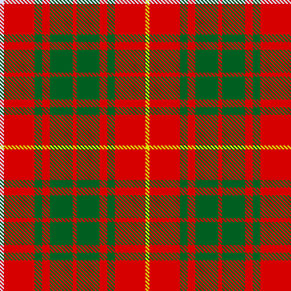
TartanTartan bruceCeltus · CC BY-SA 2.5 
TartanBruce hunting tartanThe hunting sett: the same pattern in muted browns and greens, worn in the field where the brighter colours would show.Micheletb · CC BY-SA 4.0 
Coat of armsArms of BruceBorne by the Bruce line, one branch of the name rather than all of it.Sodacan · CC BY-SA 4.0 
Coat of armsArms of Bruce of BalcaskieBorne by the Balcaskie line, one branch of the name rather than all of it.MyChevalier · CC BY-SA 4.0


- Crest badge: The chief's crest inside a belt and buckle: the badge a clansman wears to show whose following he is in.
- Tartan: The checked cloth the family is known by.
- Coat of arms: Granted to an individual and inherited down that one documented line. These are the arms of particular families of the name, not of everyone who shares the surname.
What is the Bruce clan tartan?
Two Bruce setts are shown above, one of them the hunting sett, in muted browns and greens. They are not rival claims to be picked between; they are different records, and different weaves, of the same family cloth. A sett is the block of coloured bands the cloth is built from, repeated in both directions; the whole plaid is that one square enlarged.
Bruce is a Lowland name, and Lowland families did not wear Highland dress; the 1746 proscription that broke the tradition in the north took nothing from them, because there was nothing there to take. The Bruce sett is a 19th-century assignment, made when tartan stopped being Highland and became Scottish and fixed by the Bannockburn weavers’ pattern books, the royal visit to Edinburgh in 1822, and the Vestiarium Scoticum of 1842. Nobody polices any of it. Wearing the Bruce sett declares allegiance to the name, not descent from any particular line of it.
The seat of Clan Bruce
Seat vacantChief
No one leads the Clan Bruce community yet. When the movement opens, you can stand for its leadership, or help elect whoever does.
Current mission
No shared goal set yet. Once Clan Bruce has leadership, it sets the public focus: a restoration, a gathering, a real-world project that helps its own.
The Bruce clan is being rebuilt. Join the waiting list for the movement today, and you help decide who leads it and what it does.
Help rebuild the Bruce clan →Motto
Fuimus
“We have been”
What does the Bruce name mean?
From Brix in Normandy (de Brus). Brought to Britain by a Norman knight who came over with William the Conqueror in 1066.
The history of Clan Bruce
The willowlands of Brix, and a name that began as an address
Bruce is not a description of a man but of a place. The name comes from the French de Brus or de Bruis, taken from the lands now called Brix in Manche, Normandy, a name read as "the willowlands", and Scottish Gaelic renders it Brùs. It belongs to the oldest layer of British surnames: after the Domesday survey of 1086, family names were adopted first among the feudal nobility and gentry, and Norman incomers distinguished themselves by fixing de, of or from, before the name of their village in France. Bruce is a territorial surname, a consequence of feudal landholding, and it announced an estate before it ever named a line.
The family later carried a tradition that a Robert de Brix rode with William the Conqueror in 1066. There is no evidence for it, and the claim appears to descend from the unreliable later-medieval lists of men who supposedly fought at Hastings, a genre that flattered many houses with an ancestor at the battle. What is demonstrable is less romantic and more useful: both the English and the Scots lines of the Brus family descend from Robert de Brus, first Lord of Annandale, who came to England in 1106.
He belonged to a class then hardening into a caste. Charlemagne had bound mounted warriors to him with grants of land called benefices, Charles the Bald declared such fiefs hereditary in the ninth century, and by the twelfth a line was drawn between the milites gregarii, non-noble cavalrymen, and the milites nobiles, true knights. Robert de Brus arrived inside that system, holding land for service, and spent his life converting service into more land.
Annandale, Lochmaben, and the son taken prisoner at the Standard
Robert de Brus made his fortune on a friendship. He was a companion-in-arms of Prince David, and in 1124 he followed him north when David went to reclaim his kingdom as David I. The reward was Annandale, held on the Scottish side of a border that was still an argument rather than a line. The Bruces kept that lordship, and every later claim the family made rested on it.
Holding land in two kingdoms was profitable until the kingdoms fought. When civil war broke out in England between the Empress Matilda and her cousin Stephen, David I led a force south and Robert de Brus did not follow him. He joined the English instead, and at the Battle of the Standard in 1138 he took prisoner his own son, who by then held the lands of Annandale in his own right. Father and son had chosen opposite kings, which was less a family quarrel than a decision about where the greater estates lay. The first Lord of Annandale died on 11 May 1141 and was buried at Gysburn.
The mark the family left on the dale was earth and timber before it was stone. About 1160 the Bruces, Lords of Annandale, raised the first castle at Lochmaben, a motte and bailey at the heart of their lordship. It was the working centre of Bruce power in the south-west, and it mattered enough that Edward I of England later replaced it with a new castle at the south end of Castle Loch, built while he was trying to hold the country the Bruces would take back from him.
Isobel of Huntingdon, and the Competitor who lost the arbitration
The claim that eventually put a Bruce on the throne was made at an altar in 1219, when Robert Bruce, fourth Lord of Annandale, married Isobel of Huntingdon, a daughter of David of Scotland, eighth Earl of Huntingdon, and a niece of William the Lion. The union brought wealth and lands on both sides of the border, but its real value was genealogical: it wrote the blood of the Scottish royal house into a Norman baronial line that already held one of the strongest lordships in the south-west.
Their son, Robert Bruce, fifth Lord of Annandale, is known as the Competitor, and was at one point tanist to the throne, the Gaelic style of designated heir that Scottish practice set alongside feudal primogeniture. When Alexander III died, both the Competitor and John Balliol claimed the succession. Alexander's infant granddaughter Margaret had been named heir, and she died in 1290 while travelling to Scotland to take up a crown she had never seen.
Fearing open war between the Bruce and Balliol parties, the Guardians of Scotland asked the kingdom's southern neighbour, Edward I of England, to arbitrate. Edward took the invitation as the opening he had waited for, having already conquered Wales and intending to rule the whole of the British Isles. In 1292 he chose Balliol, who swore allegiance to him. It did not hold: Balliol rebelled, was defeated at Dunbar in 1296 and forced to abdicate, leaving Scotland with no monarch, an English overlord, and a Bruce family that had lost the arbitration and inherited the war.
Turnberry: a captive suitor, and a secret meeting in September 1286
Turnberry stands on the Ayrshire coast, and there is no authentic record of when or by whom it was built. It was originally a stronghold of the Lords of Galloway and passed to the Earls of Carrick around the beginning of the thirteenth century, becoming their seat. Medieval legend has it that Marjorie held the visiting knight Robert de Brus captive there until he agreed to marry her. However the match was made, it brought Carrick into the family alongside Annandale, and it is why Robert Bruce was born at Turnberry in 1274 with a claim on both.
The castle was also where the family did its politics: on 20 September 1286 several Scottish barons who supported the title of the Bruce as successor to the crown met secretly at Turnberry. By the extent of rock its walls enclosed it had been a fortress of great size and strength, sea on three sides, with caves running out to the water that may have served as its harbour. It was deliberately slighted in the early fourteenth century, and weather and erosion have left little beyond the lower vaults and cellars.
The boy born there spent his early manhood changing sides in a war nobody was winning. He swore allegiance to Edward at Berwick-upon-Tweed and broke the oath the following year by joining the Scottish revolt; he swore it again in the summer of 1297 in the Capitulation of Irvine; he appears to have stood with the Scots at Stirling Bridge. When Edward returned victorious after Falkirk and parcelled out Scottish lordships to his followers, Annandale and Carrick were exempted. Bruce was still, in English eyes, a man whose allegiance might be bought back.
Greyfriars, Scone, and the war with the MacDougalls
Bruce and John Comyn, a rival for the throne, succeeded William Wallace as Guardians of Scotland, and their rivalry threatened the stability of the country. A meeting was arranged at Greyfriars Church in Dumfries, on neutral ground. Bruce stabbed Comyn through the heart, and was excommunicated by Pope Clement V for it. Excommunicate and hunted, he was crowned King of Scots at Scone on 25 March 1306. The hiding, the western isles and the spider are told in the legend that carries his name; the family's story runs alongside them.
The killing at Greyfriars bought the Bruces a blood feud that outlasted the coronation. Driven west into Argyll in an attempt to reach his Campbell allies, Bruce was surprised and defeated at Dalrigh by Clan MacDougall, whose chief was the uncle or the cousin of the murdered Comyn. The king escaped, but left behind what was described as a magnificent example of Celtic jewellery. The Brooch of Lorne became one of Clan MacDougall's great treasures, a trophy taken off the back of a fleeing king.
Three years later he brought three thousand battle-hardened veterans into Argyll. John MacDougall of Lorne laid an ambush for them, and at the Battle of the Pass of Brander the MacDougalls were beaten and forced to flee. Their lands were forfeited by the king and granted to the Campbells for their loyalty. This was the Bruce method as much as any charge of horse: feudal tenures were introduced by Robert the Bruce during the Wars of Independence to harness and control the prowess of the clans, awarding charters for land in return for support against England. Kinship now came with a charter attached.
Bannockburn, Arbroath, and a second crown in Ireland
The campaign of 1307 and 1308 was a war of manoeuvre rather than of battles: Bruce rebuilt his army in the south-west and took Edward's castles one at a time until, by 1313, only Stirling remained in English hands. On 23 and 24 June 1314, near Bannockburn outside Stirling, a Scottish force of about six thousand met an English army of about fifteen thousand under Edward II and destroyed it. It was the decisive Scottish military success of the medieval period, and the foundation on which Bruce kingship rested.
What followed mattered as much as the battle. The Declaration of Arbroath of 1320, sealed under his authority, asserted Scottish sovereignty in language that has shaped the national argument ever since, and the Treaty of Edinburgh and Northampton in 1328 secured formal English recognition of Scottish independence and of Bruce as king. He died at Cardross the following year; his heart rests at Melrose Abbey and his body at Dunfermline.
The family reached for a second throne as well: Edward Bruce became, disputedly, High King of Ireland, carrying the war into a second kingdom and the name with it. Even after the wars the name worked as a banner. In 1334 a Thomas Bruce, who claimed kinship with the royal house, organised a rising in the Kyle alongside Robert Stewart, later Robert II, against the English. A surname that had begun as the address of a Norman estate had become something men raised troops under.
David II, Clackmannan, and the crown that went to the Stewarts
Robert's son David II became king on his father's death in 1329, and inherited the alliance as well as the throne. In 1346, under the terms of the Auld Alliance and in the interests of France, he marched south into England. He was defeated at Neville's Cross and imprisoned on 17 October of that year, and remained in England for eleven years. He returned only after the negotiation of a treaty, ruled until 1371, and died unexpectedly at Edinburgh Castle without issue.
During those reigns the family planted itself where it would still be found long after the crown had gone. Clackmannan Tower, a five-storey tower house believed to have been built in the fourteenth century, stands at the summit of King's Seat Hill and served as a residence of David II. In 1359 the king sold the tower to his cousin, Robert Bruce, second Baron of Clackmannan. It survives as a scheduled monument, an older, lower block with a taller contiguous extension beside it.
With David dead and childless, the line of succession passed to the House of Stewart, and the Bruce name left the throne after two generations. The blood did not leave with it. Through Marjorie Bruce, who married Walter Stewart, the Bruce descent passed into the royal House of Stewart and on into the modern line. It is why the surname carries a royal-house weight that no other Scottish family name does, and why the motto Fuimus, "we have been", reads less as boasting than as a statement of accounts.
Lochmaben without the Bruces: a nine-day siege and a man in a dress
The family's first seat had a long second life in other men's hands. In February 1383/4 Archibald Douglas, Lord of Galloway, helped by the Earls of March and Douglas, took Lochmaben from the English after a nine-day siege and razed it to the ground. The castle and barony became a possession of the Earls of March, pointedly excepted when the forfeited tenth Earl was reinstated in 1409, and by July 1455 were held by Alexander Stewart, Duke of Albany. James IV visited in August 1504 and played cards there with Lord Dacre.
Then it turned violent again, and finally absurd. Regent Arran besieged Lochmaben in November 1545, during the war of the Rough Wooing, because Lord Maxwell had let the English garrison his castles; Mary, Queen of Scots came to Lochmaben with Lord Darnley in October 1565 at the conclusion of the Chaseabout Raid. In June 1592 Francis Stewart, fifth Earl of Bothwell, said to have been dressed as a woman, infiltrated and captured the castle from its keeper Sir John Carmichael during a rising against James VI. It was gradually abandoned after that.
Charters at Rait, and the most northerly tower in Britain
By the fifteenth century the name was scattered across Scotland in cadet lines, and the branches carry their own geography: Bruce of Annandale, Bruce of Elgin, Bruce of Kincardine, Bruce of Crionaich, and Bruce of the Russian Empire, a reminder of how far east Scots soldiers and administrators sold their services. Castles that have belonged to the family include Fyvie, Airth, Thomaston, Culross Palace, Kinross House, Lochleven and Fingask.
In Perthshire the family held the lands of Rait, including Fingask, from the fifteenth century, and Robert Bruce held a charter of Rait in 1484, confirmed in 1488, before the estate passed to the Threiplands. Fingask had once been an explicitly holy place, a stop-off between the abbeys at Falkirk and Scone, perched two hundred feet above Rait with views across the Carse of Gowrie and the Firth of Tay into Fife. The present castle is dated 1592 and was built around a twelfth-century structure.
The furthest-flung Bruce house went almost as far north as Scotland goes. Muness Castle on Unst in Shetland, the most northerly fortalice in Britain and Ireland, was built in 1598 for Laurence Bruce of Cultmalindie, half-brother to Robert Stewart, first Earl of Orkney. The work may have been directed by Andrew Crawford, master of works to Earl Patrick, who also oversaw Scalloway Castle and the Earl's Palace at Kirkwall.
It is a rectangular block with circular towers at the north and south angles and gun loops covering the entrance, the plan of a man who expected trouble. Fire damaged it early in the seventeenth century, it stood abandoned before that century was out, and it was sold out of Bruce hands in 1718.
Kinloss to Elgin: the branch that followed James VI south
The line that carries the chiefship today rose through the law and the court rather than the field. Sir Edward Bruce was made commendator of Kinloss Abbey, which included the Barony of Muirton, was appointed a judge in 1597, and became a Lord of Parliament as Lord Kinloss in 1601. In 1603 he accompanied James VI south to claim the English throne, and was rewarded with English judicial office as Master of the Rolls and, in 1608, with the Barony of Kinloss as Lord Bruce of Kinloss.
The English estate that came with it was Whorlton in Yorkshire, given to Edward Bruce in 1603. It was recorded in Domesday in 1086 as belonging to Robert, Count of Mortain, half-brother of the Conqueror, founded as a motte and bailey in the early twelfth century by the de Meynell family, and passed by marriage to John Darcy, Lord Darcy of Knayth, whose gatehouse still carries carved shields of Darcy, Meynell and Gray. That roofless three-storey gatehouse is the castle's main survivor.
The titles multiplied from there. Edward's son Thomas was created Earl of Elgin and took the title Lord Bruce of Whorlton; Thomas's son Robert became first Earl of Ailesbury in 1664. When the fourth Earl of Elgin died without issue the title passed to the descendants of Sir George Bruce of Carnock, who already held the earldom of Kincardine, and in 1747 the two earldoms were united in one man.
Fuimus: the Parthenon, Canada, and a prime minister from Melbourne
The Elgin earldom put Bruces at the far edges of the British world. Thomas Bruce, seventh Earl of Elgin, was ambassador to the Ottoman Empire between 1799 and 1803, and spent much of his fortune collecting the marble sculptures from the Parthenon in Athens that still carry his title, and with them an argument that has never closed. His son James was Governor General of the Province of Canada and Viceroy of India: the family that had fought for one small kingdom's independence spent the nineteenth century governing other people's.
The most complete modern career under the name was made in Australia. Stanley Melbourne Bruce, born at St Kilda in Melbourne on 15 April 1883 into a Scottish-descended mercantile family, was educated in Australia and at Cambridge, called to the English bar, and served with the British Army at Gallipoli and on the Western Front, wounded twice and decorated with the Military Cross and the Croix de Guerre. He entered the Australian Parliament in 1918 and in 1923, at thirty-nine, became the eighth Prime Minister of Australia, his government pursuing a sustained programme of national development across industry, infrastructure and migration.
He was Australia's High Commissioner in London from 1933 to 1945, the senior Australian voice in Britain through the whole course of the Second World War, was elected President of the Council of the League of Nations in 1936, and chaired the League committee whose 1939 report reshaped international economic and social cooperation. Created Viscount Bruce of Melbourne in 1947, he was the first Australian to sit in the House of Lords, and was founding Chancellor of the Australian National University from 1951 to 1961.
The name itself did something no other Scottish surname managed. Promulgated by the descendants of Robert the Bruce, it spread as a Scottish surname from medieval times and then crossed over, becoming a common male given name carried by men with no connection to Annandale at all. Fuimus, "we have been", is the motto of a family that measured itself against what it had already done, and had the grounds to.
Champions of the Bruce name
The bearers whose lives are inseparable from this surname. Each has their own page, biography, achievements, geography, connection to the family.
Historic Places, Rebuilt
Explore the streets and seats the Bruce name knew, rebuilt with AI as they stood in history.
Castles the Bruce held
Strongholds this name held for a decade or more, look one up, or rebuild it to explore.
- Turnberry Castle
Associated with Robert the Bruce's childhood and early career at the seat of the Earls of Carrick; by legend Marjorie held Robert de Brus captive here until he agreed to marry her.
- Lochmaben Castle
The Bruces, Lords of Annandale, built the first motte-and-bailey castle at Lochmaben c. 1160.
- Muness Castle
Built in 1598 for Laurence Bruce of Cultmalindie; sold out of the family in 1718.
- Fingask Castle
The Bruce family owned the lands of Rait, including Fingask, from the 15th century; Robert Bruce held a charter of Rait in 1484.
- Whorlton Castle
Given to Edward Bruce, 1st Lord Kinloss, in 1603; his line took the titles Lord Bruce of Whorlton (1641) and Earl of Ailesbury (1664).
- Clackmannan Tower
Sold by David II to his cousin Robert Bruce, 2nd Baron of Clackmannan, in 1359.
The castles of the homeland
The great strongholds of the homeland, look one up, see what it looked like in its prime, and recreate it to explore.
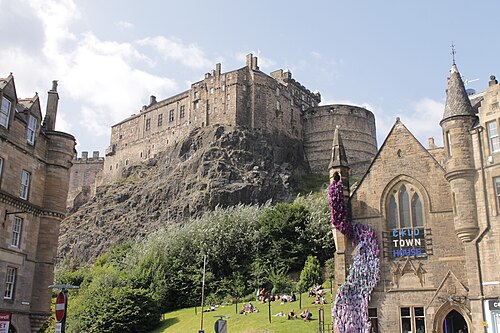 Edinburgh CastleRestored · prime 1520
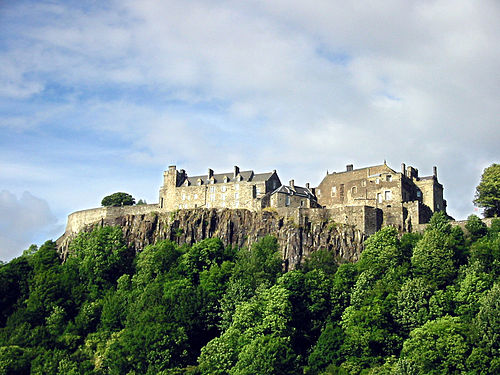 Stirling CastleRestored · prime 1542
 Glamis CastleStill standing · prime 1900
All castles in Scotland → · Strongest castles in Scotland → · Castles of Europe
Play As Your Clan
Hold a real castle against whatever you choose to send at it, take a ship out in her own service years, or stand at the shoulder of someone the record remembers. The chronicler sets the scene; the deeds are yours.
Notable bearers of the Bruce name
- Robert the Bruce, King of Scots