Clan Mackenzie
also MacKenzie, McKenzie
Earls of Seaforth, masters of Ross and Cromarty.
- Origin
- The Highlands & Islands, Scotland
- Motto
- Luceo non uro
- Famous bearer
- Kenneth Mackenzie, 1st Earl of Seaforth
- Register
- Scottish clan
The Mackenzie arms, crest badge, tartan and country

Crest badgeClan member crest badge - Clan MackenzieCeltus @ english wikipedia · CC BY-SA 3.0 
TartanMackenzie dress tartanThe dress sett: the same pattern rewoven with a white ground, worn for dancing and evening wear.Celtus · CC BY-SA 3.0 
TartanMacKenzie tartan (Vestiarium Scoticum)As printed in the Vestiarium Scoticum, 1842, a collection whose claimed medieval source was never produced, and which is now generally held to be a forgery. Families adopted its patterns anyway, and wear them still.TilmannR · CC0 
Coat of armsMackenzie armsWikimandia · CC BY-SA 4.0 
Coat of armsArms of the House of MacKenzieThe arms of the house itself: the main line, not one of its cadet branches.Euryrel · CC BY-SA 4.0 
Clan plateMackenzie (R. R. McIan)Robert Ronald McIan (1803-1856). · Public domain


.svg)


.jpg)
- Crest badge: The chief's crest inside a belt and buckle: the badge a clansman wears to show whose following he is in.
- Tartan: The checked cloth the family is known by.
- Coat of arms: Granted to an individual and inherited down that one documented line. These are the arms of particular families of the name, not of everyone who shares the surname.
- Clan plate: Period portrait art of the clan, from the great 19th-century illustrated surveys.
What is the Mackenzie clan tartan?
Two Mackenzie setts are shown above: the dress sett, rewoven on a lighter ground, and the plate printed in the Vestiarium Scoticum in 1842. They are not rival claims to be picked between; they are different records, and different weaves, of the same family cloth. A sett is the block of coloured bands the cloth is built from, repeated in both directions; the whole plaid is that one square enlarged.
Almost no clan tartan is medieval. Highland dress was proscribed from 1746 until 1782, and when it returned it returned as ceremony rather than everyday cloth, so the surname-to-sett map was fixed after the break, by the Bannockburn weavers’ pattern books, the royal visit to Edinburgh in 1822, and the Vestiarium Scoticum of 1842. The Mackenzies wore tartan long before any of that. What the registers fixed was which one. Nobody polices any of it. Wearing the Mackenzie sett declares allegiance to the name, not descent from any particular line of it.
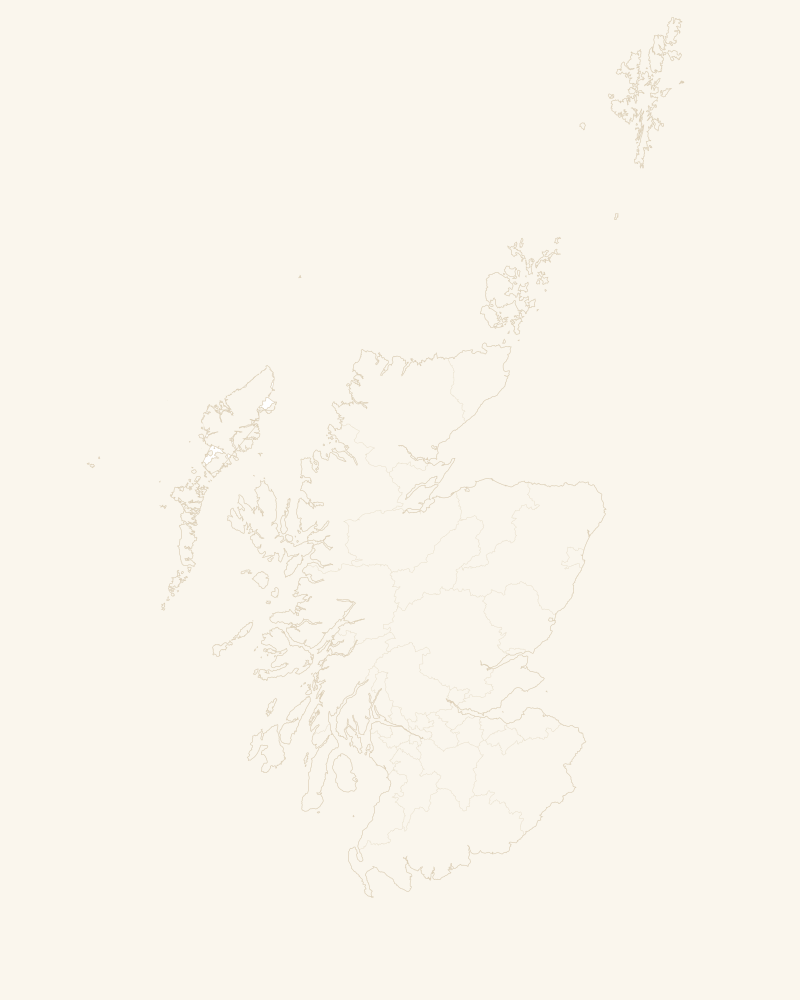
The seat of Clan Mackenzie
Seat vacantChief
No one leads the Clan Mackenzie community yet. When the movement opens, you can stand for its leadership, or help elect whoever does.
Current mission
No shared goal set yet. Once Clan Mackenzie has leadership, it sets the public focus: a restoration, a gathering, a real-world project that helps its own.
The Mackenzie clan is being rebuilt. Join the waiting list for the movement today, and you help decide who leads it and what it does.
Help rebuild the Mackenzie clan →Motto
Luceo non uro
“I shine, not burn”
What does the Mackenzie name mean?
Son of Coinneach, from the Gaelic 'Coinneach' (Kenneth), meaning 'fair' or 'handsome'.
The history of Clan Mackenzie
Mac Coinnich: the son of the comely one
MacKenzie and McKenzie are the same Scottish name, anglicised out of the Gaelic Mac Coinnich, a patronymic built on the personal name Coinneach, meaning "comely" or "handsome". The clan's Gaelic name is Clann MacCoinnich. Coinneach is today usually rendered in English as Kenneth, although Kenneth was originally the anglicisation of a quite different Gaelic name, Cionaodh; so the modern pairing of Mackenzie with Kenneth is a later tidying-up rather than a straight translation.
The odd letter in the middle is the giveaway that this is a written name as much as a spoken one. Mackenzie was originally written MacKenȝie and pronounced in Scots roughly as ma-KENG-yee, because the "z" is not a z at all: it stands in for the Middle Scots letter yogh, ȝ. Scottish printers had no yogh in their trays and reached for the nearest shape; the surname Menzies was mangled the same way. Every Mackenzie in Ohio or Otago carries an old typesetting compromise in the middle of the name.
In Gaelic itself the name still bends. Mac means son, so a man is MacCoinnich; a woman takes nic, a shortening of nighean mhic, "daughter of the son of", and the surname shifts further with the grammar of the sentence around it. Scottish Gaelic closes the gap between the Mac and what follows, where Irish leaves a space, which is why the Mac, Mc and M' spellings a diaspora family has argued over for generations are variants of one name and not evidence of separate stock.
One point matters more than any of that for a reader tracing a line. Clan surnames were historically used by the descendants and dependants of an ancestor, not by everyone living in the clan's country; it was only with the arrival of a non-Gaelic-speaking administration that clan surnames were applied wholesale to the people of a clan's territory. A great many Mackenzies therefore descend not from the chiefly house but from the tenants, tacksmen and followers of Mackenzie ground, which is a real inheritance, not a lesser one. The chiefs' motto is Luceo non uro, "I shine, not burn", and the chief himself is styled Caberféidh, "deer's antlers", from the stag's head that stood on the Earl of Seaforth's arms.
Gilleoin of the Aird, and a Fitzgerald who may never have existed
Tradition gives the Mackenzies, the Mathesons and the Anrias a common ancestor in Gilleoin of the Aird, a Gaelic dynast of the early 12th century; a competing theory descends all three instead from the 13th-century Kermac Macmaghan. The chiefs are said to have been settled in their great stronghold on Eilean Donan by 1297, and another strand of the tradition has the castle given to them after they helped defeat the Norsemen at the Battle of Largs in 1263. These are traditions, carefully preserved, but they are not charters.
The most persistent of those traditions should be flagged plainly, because it is still repeated as fact in a great deal of clan literature. All of the earliest Mackenzie histories claim descent from a Fitzgerald progenitor: the history by John Mackenzie of Applecross (died about 1684 or 1685), that of George Mackenzie, 1st Earl of Cromartie (died 1714), and the unpublished Letterfearn, Ardintoul and Allangrange manuscripts. All of them are believed to derive from a single manuscript compiled by William MacQueen, Parson of Assynt, in 1576, and now lost. The Fitzgerald descent is therefore not several independent witnesses agreeing; it is one 16th-century source repeated.
The clan's own great historian came to the same conclusion. Alexander Mackenzie followed the Fitzgerald theory in the first edition of his History of the Mackenzies in 1879, and abandoned it in his 1894 edition after the genealogies contained in MS 1467 were published in the interval. A reader should hold the Fitzgerald story the way its own best scholar came to hold it: as a disputed tradition of the late 16th century, not as a pedigree.
What is documented begins later and is firmer for it. An early Mackenzie genealogy appears in MS 1467, but the earliest contemporary record of a living Mackenzie is Alexander Mackenzie of Kintail (Alexandro McKennye de Kintaill), who appears in two supplications for papal dispensation in 1465 and 1466 and witnessed a charter of John of Islay, Earl of Ross and Lord of the Isles, on 4 November 1471. The earliest surviving likeness of a Mackenzie is the effigy of Sir Kenneth Mackenzie, who died on 7 February 1491/1492 and was the first of the name buried at Beauly Priory; there is no reliable evidence for the tradition that his forebears lie on Iona.
From Bannockburn tradition to the fight for Ross
The clan's war record is remembered as beginning with Robert the Bruce. Mackenzies are said to have been among the clans who fought for Bruce at the Battle of Inverurie in 1308 against the Comyns, and chief Iain Mac Coinnich is said to have led five hundred Mackenzies at Bannockburn in 1314. Both belong to tradition rather than record. What follows is harsher and more consequential: later in the 14th century the Mackenzies were drawn into fighting against their powerful neighbour the Earl of Ross and his allies, and it ended with the capture and execution of chief Kenneth Mackenzie in 1346.
That is the low point of the story, and the recovery from it is the spine of the next hundred and fifty years. Soon after 1346 the next chief is found living in an island castle in Loch Kinellan near Strathpeffer, in Easter Ross, a defensible refuge well east of Kintail. From that base the clan pushed west again. In 1452 men loyal to Mackenzie of Kintail seized a relative of the Earl of Ross as a hostage, provoking the Battle of Bealach nam Broig north-west of Ben Wyvis, where the Munros and their septs the Dingwalls recovered the hostage but lost so many of their own men that the victory was hollow.
The forfeiture of the Lordship of the Isles by James IV in 1493 destabilised the whole west and north, and the Mackenzies were among the clans best placed and most willing to profit: historians count them, with the Campbells, as one of the kindreds prepared to play off territorial disputes within and between clans to expand their own land and influence. In 1488 Hector Roy Mackenzie led the clan at Sauchieburn, escaped the defeat of the King's forces and returned to Ross-shire to take Redcastle from the Clan Rose for the rebels. In 1491 the Mackenzies fought the MacDonalds at Blar Na Pairce, and in the Raid on Ross the same year faced MacDonald of Lochalsh, Clanranald, the Camerons and the Chattan Confederation of the Mackintoshes together.
In 1497 Alexander MacDonald of Lochalsh rebelled against the King and invaded the fertile lands of Ross-shire; the Mackenzies beat him at the Battle of Drumchatt and drove him out of Ross altogether. Within a century and a half of a chief's execution the family that had been pushed east out of Kintail had become the power that decided who held Ross.
Flodden, Pinkie and the bond at Dingwall
The 16th century put Mackenzies into the national disasters as well as the local ones. John Mackenzie, 9th of Kintail, led the clan at Flodden in 1513; he escaped, but many of his followers did not. At Pinkie Cleugh in 1547 the same chief was captured by the English, and his clan bought him back with a ransom paid in cattle, a detail worth keeping, because it shows exactly what the wealth of a Highland kindred consisted of. The lands of Leod came to the family in 1513, granted to John of Killin, and Fairburn followed in 1542 to Murdo Mackenzie, who had his tower built there in about 1545. Sources number the early chiefs differently, so the ordinals in older clan histories will not always agree.
The moment the clan's standing became undeniable was a refusal, not a battle. In 1544 the Earl of Huntly, Lieutenant of the North, ordered chief John Mackenzie to raise his clan against Clan Ranald of Moidart. Mackenzie refused, and Huntly's own supporters, the Grants, the Rosses and the Mackintoshes, then declined to attack the Mackenzies for it. From that time the clan was recognised as a separate and superior force in the north-west. On 13 December 1545, at Dingwall, the Earl of Sutherland entered a bond of manrent with John Mackenzie of Kintail for mutual defence against all enemies, reserving only their allegiance to the child Mary, Queen of Scots.
They stayed with Mary to the end of her cause, fighting on her side at Langside in May 1568 against the forces of her half-brother the Earl of Moray. Their chief, Kenneth Mackenzie, 10th of Kintail, died the following month and was buried at Beauly with his forebears. Two years later a feud with the Munros over Chanonry Castle opened: Andrew Munro of Milntown held it against the Mackenzies for three years at the cost of many lives on both sides, and it ended not in storm but in an "Act of Pacification" that handed the castle over. In 1597 the Battle of Logiebride set the Mackenzies and the MacLeods of Raasay against the Munros and the Bains of Tulloch Castle.
This is the century in which the clan learned the method that made it great: fight when fighting pays, but take land by charter, bond and settlement wherever the law will serve instead. It is the reason Mackenzie country grew while more warlike neighbours shrank.
Lewis, Assynt and the Earls of Seaforth
By the beginning of the 17th century Mackenzie territory ran clean across Scotland's northern waist, from the Black Isle in the east to the Outer Hebrides in the west. They took over the Isle of Lewis from its former rulers the MacLeods of Lewis, and Loch Alsh from the MacDonells; the Battle of Morar in 1602 was fought against the MacDonells of Glengarry. That expansion should be told honestly. Lewis was another kindred's country before it was Mackenzie country, and the same is true of Assynt, where in 1672 the clan was granted a commission of "fire and sword" against the MacLeods of Assynt, attacked and captured Ardvreck Castle, and took the lands.
In 1623 the chief, Colin Mackenzie, was created Earl of Seaforth in the peerage of Scotland, taking the title from a sea loch on the Isle of Lewis, an earldom named for the island the family had lately acquired. The building that followed is the most visible legacy the clan left on the map. Brahan Castle went up in 1611 as the seat of the Earls of Seaforth; Sir Roderick Mackenzie of Coigach built Castle Leod in about 1610; Alexander Mackenzie, son of the eleventh baron of Kintail, completed Kilcoy Castle in about 1618, and it stayed in that male line until 1883; Kinkell was the seat of the Mackenzies of Gairloch from the 1590s; Redcastle was Mackenzie ground until 1790. In 1656 George Mackenzie bought the Milntown estate and renamed it New Tarbat after Tarbat Castle, the family's original seat near Portmahomack.
Brahan also gave the clan its most famous story. Coinneach Odhar, the Brahan Seer, was patronised by the Mackenzies of Brahan and remains the best-known figure in Mackenzie folklore, although his prophecies, like much of the clan's western tradition, blend fact and legend and should be read as folklore rather than record.
The civil wars cut through the family rather than around it. In 1645 Lord Seaforth, fighting as a Covenanter, led a force against the royalist Marquess of Montrose at Auldearn and was defeated; Montrose followed up by burning the houses of those who had opposed the King, including that of Thomas Mackenzie of Pluscarden. Four years later Pluscarden had changed sides and led his own royalist rising in the Siege of Inverness of 1649. Mackenzies also served the state in other ways: Sir George Mackenzie of Rosehaugh, Lord Advocate, was writing in 1680 on what the word chief actually meant in Scots law. In 1688 Kenneth Mackenzie of Suddie was killed leading a government-backed Independent Highland Company at the Battle of Mulroy, fought on 4 August that year, and the last clan feud to reach a battle outside a civil war. Two years later the chief, Kenneth Mackenzie, 4th Earl of Seaforth, is believed to have supported King James at the Siege of Derry and the Battle of the Boyne.
The '15, the '19, and the split of the '45
In the rising of 1715 chief William Mackenzie, 5th Earl of Seaforth, brought the clan out for the Jacobites, and at first it went well. At the Skirmish of Alness he led three thousand men and forced the retreat of a smaller government force under the Earl of Sutherland that included Sutherlands, Munros, Rosses and Mackays. Much of the Ross and Munro country was ravaged; the answer came as a raid into Mackenzie land known as the Siege of Brahan. The Siege of Inverness in 1715 ended when the Mackenzie-held town was surrendered to Simon Fraser of Lovat, after which Colonel Sir Robert Munro, 6th Baronet of Foulis, marched in with four hundred Munros and took over as governor. Government troops reached Inverness by the end of February, and the disarming of the rebels went on for months under a Munro detachment led by George Munro of Culcairn.
The bill arrived in 1716. The earldom of Seaforth came to an end, the chief was attainted and the estates forfeited, and the clan's political weight in the north was handed to its enemies: the Rosses held the county seat while the Munros controlled Dingwall from 1716 to 1745, in a system where three of the five Tain Burghs had to be held to carry the seat. Rivalry that had been settled with broadswords was now settled with burgh votes.
The rising of 1719 ended the clan's war in the west with an explosion still visible today. The Mackenzies were beaten at the Battle of Glen Shiel; their chief was wounded and withdrew to the Western Isles and from there to the Continent. Eilean Donan, garrisoned with Spanish troops on his orders, was battered into submission by three frigates and then blown up from within with barrels of gunpowder. The castle every Mackenzie descendant now recognises on a postcard stood ruinous from that day until it was completely rebuilt in the 20th century. Forfeiture did not mean submission: in 1721 Donald Murchison led the Mackenzies to beat government supporters of the Clan Ross at the Battle of Glen Affric, and again, with his relative Kenneth Murchison, at Coille Bhan. When General Wade reported on the Highlands in 1724 he put Mackenzie strength at three thousand men, an attainted clan with no earl and no estates, still able to field an army.
In 1745 the clan split, and the split ran through the family. The chief, Kenneth Mackenzie, Lord Fortrose, did not join the Jacobites; he raised three Independent Highland Companies for the British government, one of which, under Captain Colin Mackenzie, is recorded at Shiramore in Badenoch in June 1746 with many men from Kintail and more than sixty from the Clan MacRae. A large part of the clan instead followed the chief's cousin, George Mackenzie, 3rd Earl of Cromartie. Cromartie's Mackenzies helped defeat the government army at Falkirk in 1746, then turned north to lay waste the lands of the Munros and burn Foulis Castle, did the same in Sutherland, and took Dunrobin Castle, the Earl of Sutherland escaping through a back door. Marching south to join Charles Edward Stuart, they were caught by the Mackay and Sutherland Independent Companies at the Battle of Littleferry, which kept the Jacobite Mackenzies off the field at Culloden altogether. Cromartie and his son were taken at Dunrobin soon afterwards and his titles forfeited.
The most remembered Mackenzie of the rising died after it was lost. Roderick Mackenzie was killed in Glenmoriston in July 1746 while acting as a body double for Charles Edward Stuart in the manhunt that followed Culloden; his grave and cairn are still there. What came next was legislation rather than battle: the Heritable Jurisdictions Act stripped chiefs of the right to hold courts and gave it to the judiciary, and Highland dress was banned until the ban was repealed in 1782. Historians now argue that the risings did not destroy clanship so much as pause it: the deeper change, the conversion of chiefs into landlords, was already under way and simply resumed.
The Seaforth Highlanders, and the name goes out into the world
The same estates that had raised clan hosts began raising regiments for the Crown, and the Mackenzie name went round the world on their colours. The Highland Light Infantry was raised in 1777, the Seaforth Highlanders in 1778, and a second battalion known as the Ross-shire Buffs in 1793; all of them wore the Mackenzie tartan. Chief Francis Mackenzie, 1st Baron Seaforth, born in 1754 and the last Lord Seaforth, raised the 1778 regiment from men on the Seaforth and other Mackenzie estates, and the clan produced another in 1793. The record is inconsistent about their numbering, the 72nd and the 78th both being attached to the 1778 corps in different accounts, but both had distinguished records against Napoleon and were eventually amalgamated into the Queen's Own Highlanders. The Earl of Seaforth sailed to India with his men in 1781 and died there within months.
Mackenzies also went east as something other than soldiers. Colin Mackenzie (1754-1821) rose to be Surveyor General of India, an orientalist and collector whose research and collections shaped the field of Asian studies and who produced many of the first accurate maps of the subcontinent; he was with the British force at Seringapatam in 1799 and served in the Napoleonic Wars as well. The tartan itself became a piece of institutional history: the regimental sett of the Seaforth Highlanders was recorded in the Collection of the Highland Society of London in 1816, and is worn today by the Royal Military College of Canada Pipes and Drums.
Two bearers stand for what the name did after it left the glens. Alexander Mackenzie was a Perthshire stonemason who became the second Prime Minister of Canada and built the institutions of honest government there. Compton Mackenzie was an intelligence officer at Gallipoli who wrote the Oxford novel of his generation, helped found the modern Scottish national movement, and gave the world Whisky Galore. Between the two of them they mark the two routes the surname travelled out of Ross-shire: the emigrant ship and the regiment.
Clearance, and the chief who came back to Castle Leod
The end of the old order was financial before it was anything else. The Statutes of Iona in 1609 obliged clan chiefs to live a large part of the year in Edinburgh and to have their heirs educated in the English-speaking Lowlands. In a Highland economy that ran on cattle rather than cash, that was ruinously expensive, and it pushed chiefs towards the commercial exploitation of their lands rather than the management of them as a social system. The chronic indebtedness that followed led, by the late 18th and early 19th centuries, to the sale of many of the great Highland estates.
The layer of society that broke first was the one most Mackenzie families actually belonged to. The tacksmen were the lesser gentry who allocated the runrig strips, lent seed-corn and tools, arranged the droving of cattle to the Lowland markets, and mustered the clan host for war and for weddings and funerals. During the 18th century chiefs restricted their right to sublet so that more of the rent reached the landowner, and from the 1770s onward the tacksman disappeared; by the early 19th century he was a rarity. The historian T. M. Devine calls the displacement of this class one of the clearest demonstrations of the death of the old Gaelic society. Many tacksmen and the wealthier farmers emigrated rather than accept it. Letting land to the highest bidder was a plain breach of dùthchas, the principle that the clan's territory was a collective inheritance and not simply the chief's property.
Then came the clearances themselves, and they belong on this page. In the first phase, peasant farmers were evicted and resettled in newly created crofting communities on the coast, the crofts deliberately made too small to live on so that the tenants would have to work in fishing or the kelp industry. In the second phase, when famine and the collapse of those industries broke the overcrowded crofting townships, landlords paid for "assisted passages" because it was cheaper than another cycle of famine relief, a pattern that fell hardest on the Western Highlands and the Hebrides, Mackenzie country included. The emigration to Canada, and later to Australia, continued with barely a pause until the Great Depression. Many people reading this page carry the name because a family was moved off Mackenzie ground, not because it chose to leave. The estates went too: Brahan Castle has been demolished but for a single wall, Redcastle is a shell that passed to the Baillies of Dochfour, Kilcoy left the male line in 1883, and Castle Fraser was sold by the widow Theodora in 1921.
For the whole of the 19th century the clan had no chief recognised by the Lord Lyon King of Arms. That was repaired in 1979, when Roderick Grant Francis Blunt-Mackenzie, 4th Earl of Cromartie, legally changed his surname to Mackenzie and was widely recognised as chief by Mackenzie societies across the Commonwealth. The descent is female rather than male (his father was born a Blunt) and it runs back through his mother to George Mackenzie, 3rd Earl of Cromartie, the Jacobite of the '45, of whom she was a great-great-great-great-granddaughter. On his death in 1990 his son John Ruaridh Mackenzie, 5th Earl of Cromartie, born in 1948, succeeded as Caberféidh and sits on the Standing Council of Scottish Chiefs. The largest Mackenzie landowner today is not the chief but Mackenzie of Gairloch, with over 50,000 acres, and that line too came through the female side.
The chief lives at Castle Leod, west of Dingwall, and has leased the unoccupied old tower to the Clan Mackenzie Charitable Trust on a 99-year lease. A restoration was announced in 1991 that would have included a clan genealogical centre open to the public; extensive work was done on the tower through the 1990s, and in 2002 the Highland Buildings Preservation Trust was asked to study the re-use of the upper floors, concluding that public funding would be needed. Concerns about the physical and legal separation that funding would force between the chief and his tower led him to judge the conditions too onerous. So the tower waits, half-restored, in the country the family fought a hundred and fifty years to get back, which is a more honest monument than a finished one would have been.
Champions of the Mackenzie name
The bearers whose lives are inseparable from this surname. Each has their own page, biography, achievements, geography, connection to the family.
- Compton Mackenzie
The Gallipoli intelligence officer who wrote the Oxford novel of his generation, co-founded the modern Scottish national movement, and gave the world Whisky Galore.
- Alexander Mackenzie
The Perthshire stonemason who became the second Prime Minister of Canada and built the institutions of an honest government.
Historic Places, Rebuilt
Explore the streets and seats the Mackenzie name knew, rebuilt with AI as they stood in history.
Castles the Mackenzie held
Strongholds this name held for a decade or more, look one up, or rebuild it to explore.
- Eilean Donan Castle
Held by the Mackenzies of Kintail from the 13th century.
- Castle Leod
Seat of Clan Mackenzie since 1513, when it was granted to John of Killin, 10th Chief, and home of the Mackenzie Earls of Cromartie ever since.
- Castle Fraser
The Mackenzie family, taking the name Mackenzie Fraser, held the castle until the widow Theodora sold it in 1921.
- Ardvreck Castle
Clan Mackenzie captured Ardvreck in 1672 and took control of the Assynt lands.
- Fairburn Tower
Built about 1545 for Murdo Mackenzie, granted the lands of Fairburn in 1542.
- Redcastle
Held by Clan Mackenzie from 1492, under Kenneth Mackenzie, 7th of Kintail, until 1790.
- Brahan Castle
Seat of the Mackenzie Earls of Seaforth, chiefs of Clan Mackenzie, from its building in 1611.
- Kilcoy Castle
Completed by Alexander Mackenzie c. 1618; held in the male line of the Mackenzies of Kilcoy until 1883.
- Kinkell Castle
Built as the seat of the Mackenzies of Gairloch, a branch of Clan Mackenzie, in the late 16th century.
- Ballone Castle
Held by the Mackenzie family of Viscount Tarbat and the Earl of Cromartie; Sir John Mackenzie, baronet of Tarbat from 1628, died here in 1654.
The castles of the homeland
The great strongholds of the homeland, look one up, see what it looked like in its prime, and recreate it to explore.
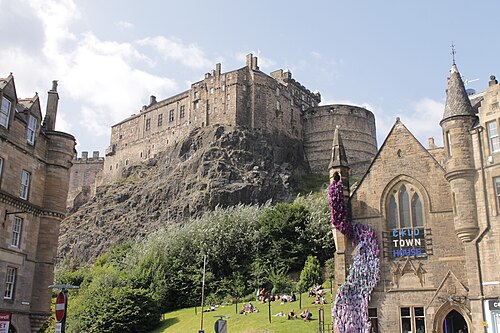 Edinburgh CastleRestored · prime 1520
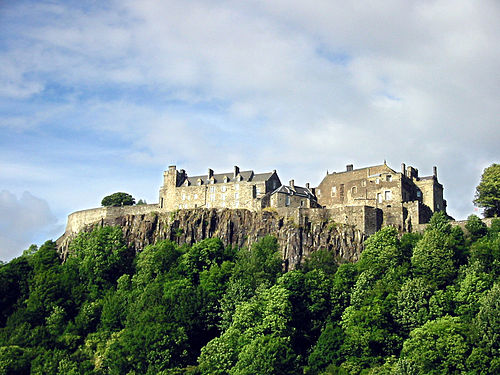 Stirling CastleRestored · prime 1542
 Glamis CastleStill standing · prime 1900
All castles in Scotland → · Strongest castles in Scotland → · Castles of Europe
Play As Your Clan
Hold a real castle against whatever you choose to send at it, take a ship out in her own service years, or stand at the shoulder of someone the record remembers. The chronicler sets the scene; the deeds are yours.
Notable bearers of the Mackenzie name
- Kenneth Mackenzie, 1st Earl of Seaforth