Yeats
also Yates
The Drumcliffe-Sligo Anglo-Irish, and the poet who imagined a country into being.
- Origin
- Connacht, Ireland
- Famous bearer
- William Butler Yeats (1865–1939), poet, Nobel laureate 1923
- Register
- Irish family
Where the Yeats name comes from
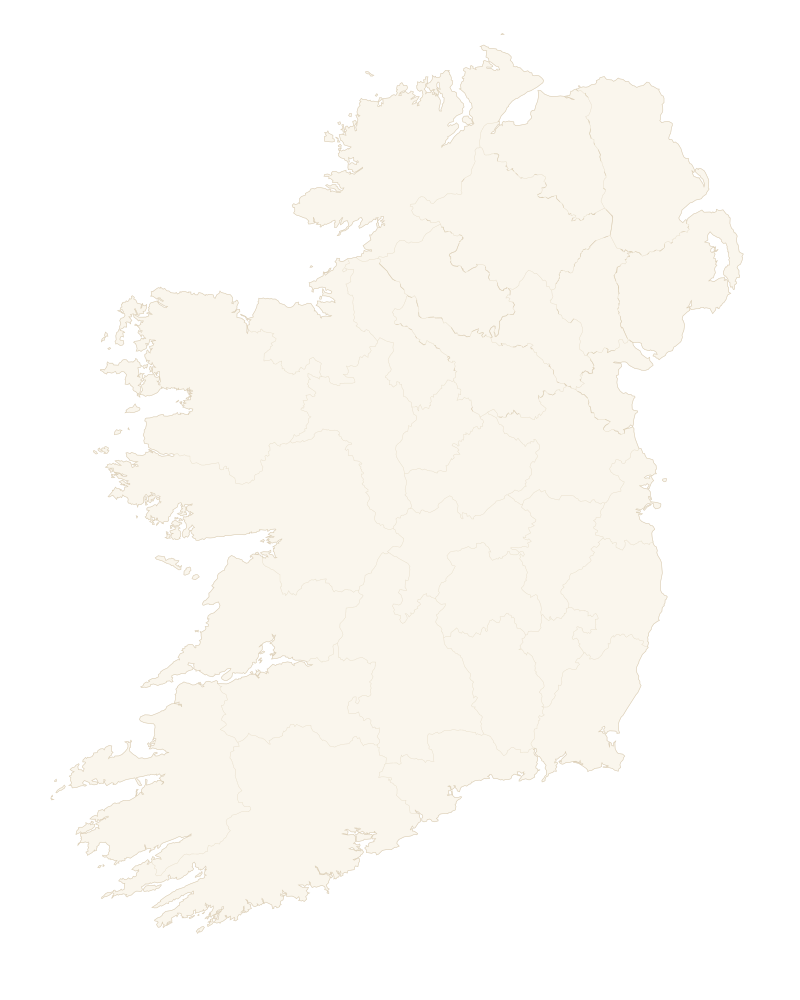
CoreHistoric reach
The seat of Yeats
Seat vacantChief
No one leads the Yeats community yet. When the movement opens, you can stand for its leadership, or help elect whoever does.
Current mission
No shared goal set yet. Once Yeats has leadership, it sets the public focus: a restoration, a gathering, a real-world project that helps its own.
The Yeats clan is being rebuilt. Join the waiting list for the movement today, and you help decide who leads it and what it does.
Help rebuild the Yeats clan →What does the Yeats name mean?
From the Middle English yate (gate), as a locative byname for someone who lived near a town gate or kept a gate. The surname is of English origin and was brought to Ireland in the seventeenth century through the Yorkshire-Yeats Cromwellian planter line; by the late eighteenth century the Yeatses were a Anglo-Irish Protestant gentry family of Sligo (Drumcliffe parish) and the Dublin merchant class. The two great bearers of the surname, the painter John Butler Yeats (1839–1922) and his sons the poet W. B. Yeats (1865–1939) and the painter Jack B. Yeats (1871–1957), are descended from a Drumcliffe-Pollexfen-Yeats line on the maternal side and a Sandymount-Dublin merchant line on the paternal.
The history of Yeats
The man who lived by the gate
Yeats is not a trade name and never was. It comes from the Middle English yate, a gate, and was fixed on a man for where he lived rather than what he made: the household by the town gate, or the man who kept it. It belongs with the plainest class of English bynames, those taken from a feature of the ground a neighbour could point at, in the way Hill and Green were taken from a slope and a village green.
Such descriptions began as personal rather than hereditary; by 1400 most English families, and most Lowland Scottish ones, carried a surname that passed to their children. Yeats came out of that settlement in two spellings that never fully separated, Yeats and Yates. The Yeats form is the one that went to Ireland in the seventeenth century and stopped being an English name at all.
From a Yorkshire planter line to a rectory in County Down
The Irish Yeatses descend on the male side from a Cromwellian-planter line out of Yorkshire, and what followed was the ordinary Anglo-Irish Protestant ascent: the church, the professions, a footing in the west. By the late eighteenth century the name sat in two places at once, among the Protestant gentry of Drumcliffe parish in County Sligo and in the merchant class of Dublin.
The pivot of the male line is the Reverend William Butler Yeats, rector of Tullylish in County Down and grandfather of the poet who carried his name. There is no castle in this story and no feud: what the Yeatses inherited was a parish and the Anglo-Irish Protestant standing that went with it.
The other half came in by marriage. The Sligo Yeatses are joined to the Pollexfen-Middleton family, merchants of Sligo town who ran a small steamship line on the western coast and stood among the substantial Anglo-Irish Protestant families of the later nineteenth century. That match set the family in the country under Ben Bulben, the mountain that would end up in the poetry and over the grave.
John Butler Yeats and the Dublin portrait
John Butler Yeats (1839-1922) was the portrait painter of the late-Victorian Dublin school. His household became the unlikely engine of the Irish Revival: all four of his children became significant figures in it.
They were William Butler Yeats (1865-1939), the poet; Susan, called Lily, and Elizabeth, called Lolly, who founded the Cuala Press in 1908; and Jack Butler Yeats (1871-1957), the painter. One surname, one generation, and between them the poetry, the theatre, the printing and the pictures of a country reinventing itself.
Sandymount Avenue and the summers at Merville
William Butler Yeats was born at 5 Sandymount Avenue in Dublin on the thirteenth of June 1865, eldest son of John Butler Yeats and Susan Pollexfen of Sligo. His mother carried him west through every long summer of his childhood to the family house at Merville above Sligo town, and in 1909 he described that country plainly as the place that had made him a poet. The west was not a subject he chose; it was the ground he was raised on.
He was schooled at the Godolphin School in Hammersmith and at the High School in Harcourt Street, Dublin, and from 1884 to 1886 attended the Metropolitan School of Art, where he came under the influence of the painter and mystic George Russell, the AE of Irish letters and a lifelong friend. His first verse appeared in the Dublin University Review in 1885, and he became that paper's founding editor.
Through the 1880s and 1890s he served a slow apprenticeship in a late-romantic, ballad-form lyric: The Wanderings of Oisin in 1889, The Wind among the Reeds in 1899. London received him as the leading younger poet of the Celtic Revival; Dublin, from his return in 1896, got the central organising figure of a whole cultural movement.
Coole Park, the Fay brothers and a theatre for a nation
In 1896 Yeats met Lady Augusta Gregory at her house at Coole Park in County Galway, and over the following decade the two of them built the institutions an Irish national literature in English did not yet have. The Irish Literary Theatre came in 1899, the Irish National Theatre Society in 1903 with the Fay brothers and J. M. Synge, and on the twenty-seventh of December 1904 the Abbey Theatre opened in Lower Abbey Street, Dublin, the first state-subsidised national theatre in the English-speaking world.
He wrote for his own stage: the verse-tragedies On Baile's Strand (1904), Deirdre (1907) and The Green Helmet (1910), part of the heroic Cuchulainn cycle that runs through his dramatic work. He also did the unglamorous half of the job. At Abbey board level he defended the contested premieres of Synge's Playboy of the Western World in 1907 and Sean O'Casey's The Plough and the Stars in 1926, and by holding that line he anchored the Abbey as the institutional centre of Irish literature in English for half a century.
The hammered later verse, and the Nobel of 1923
From Responsibilities in 1914 onward Yeats threw out the Pre-Raphaelite vocabulary and rebuilt his line as spare, bare-stress, hammered modernist verse. On that late work the world reputation rests: The Wild Swans at Coole (1919), Michael Robartes and the Dancer (1921) with the Easter 1916 elegies, The Tower (1928) with Sailing to Byzantium, The Winding Stair (1933) and the Last Poems of 1939.
In 1923 he was awarded the Nobel Prize in Literature, the first Irish laureate, the Swedish Academy citing his always inspired poetry, which in a highly artistic form gives expression to the spirit of a whole nation. Giving the memorial address at the Abbey in 1940, T. S. Eliot judged him the greatest English-language poet of the century.
The senator who put a salmon on the coins
Yeats sat as a Senator of the new Irish Free State from 1922 to 1928, and took on one piece of state-building that outlasted every speech made in that chamber. He chaired the committee that designed the coinage, and settled it on the creatures of Irish farming: the harp, the salmon, the wolfhound, the horse. Those designs are still on modern Irish coinage.
He died at Roquebrune-Cap-Martin on the Côte d'Azur on the twenty-eighth of January 1939. In September 1948 his body was brought home aboard the Irish naval corvette Macha and buried in the kirkyard at Drumcliffe under Ben Bulben, the ground he had named for his own grave in Under Ben Bulben. The epitaph on the stone is his own: Cast a cold eye on life, on death; horseman, pass by. Drumcliffe is among the most-visited literary graves in the world.
Cuala Press, and the painter Beckett ranked first
The sisters are not a footnote to the brother. Lily Yeats (1866-1949) was an embroiderer active in the Arts and Crafts movement, and Elizabeth Yeats (1868-1940) a printer, manager of the Dun Emer Press and then of the Cuala Press, which the two of them founded in 1908. A hand press run by two women in Dublin put a craft as well as a literature into Irish hands.
Jack Butler Yeats (1871-1957) was a painter, stage designer and writer, and on the critical assessment of Samuel Beckett the most significant Irish visual artist of the twentieth century. Two brothers, one at the head of the poetry and one at the head of the painting, is why the name carries the weight in Ireland that it does.
The name kept its place afterwards. Anne Yeats (1919-2001) was a painter and stage designer, Michael Yeats (1921-2007) an Irish politician, Ron Yeats (1937-2024) the Scottish footballer who captained Liverpool, and Francis Yeats-Brown (1886-1944) the author of The Lives of a Bengal Lancer.
The same name in its other spelling
Yates is the other form of the same name, and a remarkable number of its bearers worked on a stage. Richard Yates (c. 1706-1796) was an English comic actor and Mary Anne Yates (1728-1787) an English tragic actress; Frederick Henry Yates (1797-1842) was an actor and theatre manager; Edmund Yates (1831-1894), Edinburgh-born, wrote novels and plays. Elsewhere it went into sport: Frederick Yates (1884-1932) won the British chess championship six times.
In America it went early into public office. Abraham Yates (1724-1796) and Peter W. Yates were delegates to the Continental Congress, Joseph C. Yates (1768-1837) became governor of New York, and Richard Yates and his son of the same name were both Illinois politicians. Elizabeth Yates became the first woman to hold a mayoralty in the British Empire.
Champions of the Yeats name
The bearers whose lives are inseparable from this surname. Each has their own page, biography, achievements, geography, connection to the family.
Historic Places, Rebuilt
Explore the streets and seats the Yeats name knew, rebuilt with AI as they stood in history.
The castles of the homeland
The great strongholds of the homeland, look one up, see what it looked like in its prime, and recreate it to explore.
 Ashford Castle, County MayoRestored · prime 1880
 Manderley CastleRestored · prime 1840
 Dublin CastleRestored · prime 1790
All castles in Ireland → · Strongest castles in Ireland → · Castles of Europe
Play As Your Clan
Hold a real castle against whatever you choose to send at it, take a ship out in her own service years, or stand at the shoulder of someone the record remembers. The chronicler sets the scene; the deeds are yours.
Notable bearers of the Yeats name
- William Butler Yeats (1865–1939), poet, Nobel laureate 1923
- Jack Butler Yeats (1871–1957), painter
- John Butler Yeats (1839–1922), portrait painter
- Susan and Elizabeth Yeats, founders of the Cuala Press