Casement
also Caismeint
The Ulster Anglo-Norman line, and the humanitarian who became a republican.
- Origin
- Ulster, Ireland
- Famous bearer
- Sir Roger Casement (1864–1916), human-rights investigator, Irish republican, executed at Pentonville
- Register
- Irish family
Where the Casement name comes from
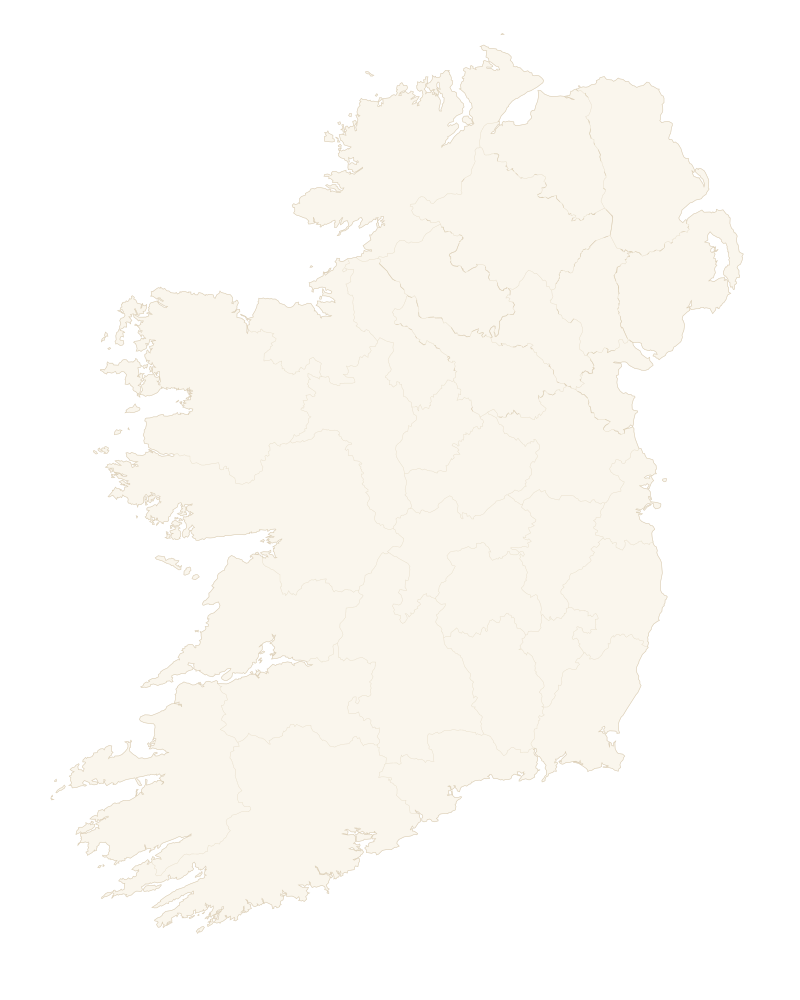
CoreHistoric reach
The seat of Casement
Seat vacantChief
No one leads the Casement community yet. When the movement opens, you can stand for its leadership, or help elect whoever does.
Current mission
No shared goal set yet. Once Casement has leadership, it sets the public focus: a restoration, a gathering, a real-world project that helps its own.
The Casement clan is being rebuilt. Join the waiting list for the movement today, and you help decide who leads it and what it does.
Help rebuild the Casement clan →What does the Casement name mean?
Locative, from Old French casement (a small house, a hut), via Norman bureaucratic usage. The Casement family of Ulster trace to a Anglo-Norman line settled in Antrim by the late mediaeval period, principally around the small townland of Casement in the Glens of Antrim. The surname is moderately uncommon in modern Ireland and largely concentrated in north-east Ulster.
The history of Casement
A Norman word for a small house
Casement is a locative name, from the Old French casement, a small house or a hut, carried into Ireland through Norman bureaucratic usage. It is the least romantic kind of surname and one of the most reliable: it says where a man lived rather than whose son he was. Habitation names of this sort attach to any kind of settlement, homesteads, farms, enclosures, villages, hamlets, strongholds or cottages.
The mechanism behind them is feudal. Norman nobility arriving in England after 1066 marked themselves out by putting de, of or from, before the name of a village or estate in France, a territorial surname, and a consequence of feudal landownership. The practice enters record with the Domesday survey of 1086, and by 1400 most English and Lowland Scots families used hereditary surnames.
The Casements of Ireland trace to an Anglo-Norman line settled in Antrim by the late mediaeval period, gathered around the small townland of Casement in the Glens. The name never travelled far from that ground: it is uncommon in modern Ireland and concentrated in the north-east of Ulster.
The Mac and the O that this name never carried
Irish surnames are overwhelmingly built from a forebear rather than a place. A man's name took O, meaning descendant, or Mac, meaning son, followed by a name in the genitive: O Donaill is the descendant of Donall, Mac Siurtain the son of Jordan. Where O meets a vowel a lowercase h is inserted, which is why O hUiginn becomes O'Higgins. The system declines for the bearer as well, a daughter taking Ni for O and Nic for Mac, so that the daughter of Sean O Donaill is Ni Dhonaill.
The Gaels were among the earliest Europeans to take surnames at all, and at first these names were not inherited: they regenerated each generation from the living father, and a woman kept the name she was born with. Only under post-mediaeval English practice did they harden into fixed property handed down the male line, and anglicisation then stripped the prefixes away, flattening O Ceallaigh and O Cadhla alike into Kelly. Norman names in Irish kept de where Gaelic names kept Mac: de Burca for Burke, de Paor for Power. Casement sits outside both conventions, with no prefix to lose and no de to keep. The Irish form recorded for it is Caismeint.
Old English families in a Gaelic country
The Normans conquered England in 1066 and invaded Ireland in the late twelfth century, and what happened to them afterwards made a whole class of Irish surname. The Norse before them had been absorbed completely, Gaelicised and remembered as the founders of Ireland's first towns, and the Norman families went the same way. They were the Old English, and the standing description of them is that they became more Irish than the Irish themselves.
The names that arrived on that wave are among the most familiar in the country: Barry, Burke, Butler, Fitzgerald, Lynch, Nugent, Power and Sarsfield, with Tobin and Fleming out of Flanders and Roche, Joyce, MacQuillan and Savage out of Wales. Casement belongs to that settlement rather than to any of the Gaelic kindreds.
The county, the sheriff and the seat at Magherintemple
The Antrim the family settled into had a long memory. The centre of the Ulaid's country was the diocese of Down, and it was the Dal Riata of County Antrim who later founded a powerful kingdom in Argyll. That order was dismantled in the sixteenth and seventeenth centuries: English common law was extended across the island, the county and the sheriff replaced the country and the clan chief, and the surrender and regrant that followed the creation of the Kingdom of Ireland in 1541 put primogeniture in place of tanistry, under which a chief was elected from a body of agnatic cousins.
In 1607 the senior Gaelic lords of Ulster left for Spain to raise support, failed, and ended their lives in Rome. After the Flight of the Earls the lordships were disarmed and the Plantation of Ulster followed. In the Antrim that came out of that century the Casements were a Protestant landed family of the Glens, seated at Magherintemple near Ballycastle, which they held from the eighteenth century.
The boy raised at Magherintemple
Roger David Casement was born at Doyle's Cottage in Sandycove, on the southern coast of Dublin Bay, on the first of September 1864. He was the fourth child of Roger Casement senior, a captain of the 3rd Light Dragoons and a Protestant Antrim Casement, and of Anne Jephson of County Dublin. His mother died when he was nine and his father when he was thirteen, and he was brought up from then on by his father's brother John at Magherintemple, and schooled at Ballymena Academy.
He left school at fifteen. In 1880 he took a clerk's post with the Elder Dempster shipping line at Liverpool, and through the 1880s sailed the West African coast as a purser. That was less a career than an apprenticeship in a coastline, and it is why a boy out of north Antrim became the man the Foreign Office sent when it wanted the truth about the Congo.
Two months up the Congo, and the report that followed
In 1884 Casement took service with King Leopold the Second's African International Association in the Congo Free State, and worked across the Lower Congo through the later 1880s. In 1892 he joined the British Colonial Service in West Africa: consul at Old Calabar in the Niger Coast Protectorate from 1895, at Lourenço Marques in Portuguese East Africa from 1898, and from 1900 at Boma in the Congo Free State itself, the Belgian-run rubber concession that had become the central humanitarian scandal of imperial Africa.
In May 1903, with E. D. Morel's Congo Reform Association pressing the case in Britain, the Foreign Office sent him upriver for two months to test the atrocity reports out of the Equator and Lake Mantumba districts. He went by river-steamer and dugout as far as Lulonga and Mantumba, took evidence from survivors at the river-stations, and photographed the mutilated children whose cut hands were the enforcement mechanism of the rubber quota.
What he brought back was laid before Parliament in February 1904 as Africa No. 1, and has been known ever since as the Casement Report. Its power is in its flatness: in plain consular prose it sets out the village rubber quotas, the militia raids and the mutilations imposed for quotas unmet, the destruction of village agriculture, the depopulation of whole districts. It forced Leopold to convene a Commission of Inquiry in 1904 whose findings substantially confirmed it, and led on to the annexation of the Congo by the Belgian state in 1908.
Five months in the Putumayo
In 1910 the Foreign Office sent him to do it again on another continent. Parallel reports had reached London about the Peruvian Amazon Company, a British-registered rubber concession in the Putumayo district of the Upper Amazon, and Casement spent five months there taking evidence from surviving Huitoto and Bora witnesses.
He returned in 1911 with the Putumayo Report, a consular blue-book documenting the destruction of an indigenous population of some thirty thousand people under the company's quota system. Because the concession was registered in Britain the report had teeth in law: it led to the criminal prosecution of the directors in the British courts, to the dissolution of the Peruvian Amazon Company, and to the recall of its chief manager Julio Arana. He was knighted in June 1911 for the two investigations.
What the two reports left behind
He retired from the Consular Service on his pension in 1913, in his forty-ninth year, and returned to Ireland, where he joined the Irish Volunteer movement and served as an organiser through the Howth gun-running of July 1914. He died in London on the third of August 1916 and was buried there. In 1965 his remains were brought back to Ireland and reinterred with state honours at Glasnevin Cemetery.
The two documents are the achievement the name carries. The Congo Report of 1904 and the Putumayo Report of 1911 are the central pre-war English-language humanitarian investigations, still set on postgraduate human-rights law courses across the English-speaking world. Their method is plain in them: a serving official, sent to the place, taking evidence from the people it was done to, and publishing it under his own name.
Champions of the Casement name
The bearers whose lives are inseparable from this surname. Each has their own page, biography, achievements, geography, connection to the family.
Historic Places, Rebuilt
Explore the streets and seats the Casement name knew, rebuilt with AI as they stood in history.
Historic Places, Rebuilt · New
The MacDonnell stronghold on its Antrim sea-stack, whole and inhabited, Clan Donald astride the North Channel.
Historic Places, Rebuilt · New
Georgian Dublin in the year of Rocque's great map, College Green, the Liberties' weavers, the Liffey quays and Christ Church.
The castles of the homeland
The great strongholds of the homeland, look one up, see what it looked like in its prime, and recreate it to explore.
 Ashford Castle, County MayoRestored · prime 1880
 Manderley CastleRestored · prime 1840
 Dublin CastleRestored · prime 1790
All castles in Ireland → · Strongest castles in Ireland → · Castles of Europe
Play As Your Clan
Hold a real castle against whatever you choose to send at it, take a ship out in her own service years, or stand at the shoulder of someone the record remembers. The chronicler sets the scene; the deeds are yours.
Notable bearers of the Casement name
- Sir Roger Casement (1864–1916), human-rights investigator, Irish republican, executed at Pentonville