MacDonnell
also McDonnell, MacDonald, Mac Domhnaill
The Hebridean lordship in Ireland, the Glens of Antrim and the Route.
- Origin
- Ulster, Ireland
- Motto
- Toujours Prêt
- Famous bearer
- Sorley Boy MacDonnell (c.1505–1590), lord of the Route, victor at Glentaisie
- Register
- Irish family
The MacDonnell arms, crest badge, tartan and country

Crest badgeClan member crest badge - Clan MacdonaldCeltus · CC BY-SA 3.0 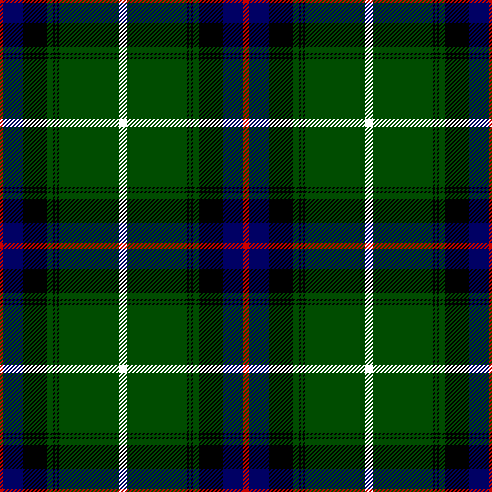
TartanMacDonald of the Isles tartan (Vestiarium Scoticum)As printed in the Vestiarium Scoticum, 1842, a collection whose claimed medieval source was never produced, and which is now generally held to be a forgery. Families adopted its patterns anyway, and wear them still.Celtus · CC BY 2.5 
Coat of armsArms of Clan Macdonald of MacdonaldBorne by the Macdonald line, one branch of the name rather than all of it.Sodacan · CC BY-SA 4.0

.png)

- Crest badge: The chief's crest inside a belt and buckle: the badge a clansman wears to show whose following he is in.
- Tartan: The checked cloth the family is known by.
- Coat of arms: Granted to an individual and inherited down that one documented line. These are the arms of particular families of the name, not of everyone who shares the surname.
What is the MacDonnell clan tartan?
One MacDonnell sett is recorded, and it is the swatch above (the plate printed in the Vestiarium Scoticum in 1842). The Vestiarium claimed to copy a medieval manuscript that was never produced, and is now generally held to be a forgery; families adopted its patterns anyway, and wear them still. A sett is the block of coloured bands the cloth is built from, repeated in both directions; the whole plaid is that one square enlarged.
MacDonnell is an Irish name, and the sett is a Scottish invention. Tartan registration grew outward from the Highlands to cover surnames carried well beyond them, and a weaver who could sell a MacDonnell tartan sold one: some of these setts are Victorian and some were designed within living memory. That is how most names outside the Highlands came by a sett at all. Nobody polices any of it. Wearing the MacDonnell sett declares allegiance to the name, not descent from any particular line of it.
This name is thick on both sides of the border, so the map shows the whole of Britain and Ireland with every region it touches highlighted. It is a regional pattern for the surname, not proof that your branch lived in each place.
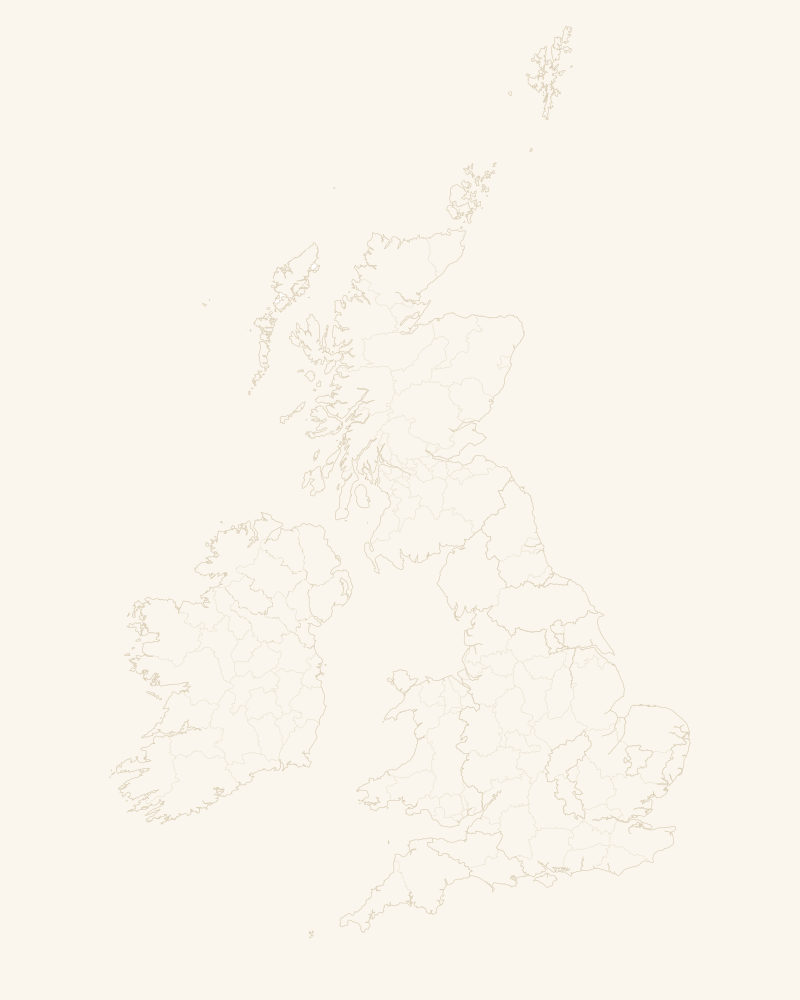
CoreHistoric reach
The seat of MacDonnell
Seat vacantChief
No one leads the MacDonnell community yet. When the movement opens, you can stand for its leadership, or help elect whoever does.
Current mission
No shared goal set yet. Once MacDonnell has leadership, it sets the public focus: a restoration, a gathering, a real-world project that helps its own.
The MacDonnell clan is being rebuilt. Join the waiting list for the movement today, and you help decide who leads it and what it does.
Help rebuild the MacDonnell clan →Motto
Toujours Prêt
“Always ready”
What does the MacDonnell name mean?
From Mac Domhnaill, son of Domhnall. The Antrim MacDonnells are a cadet branch of the Highland Scots Clan Donald, descended from Eóin Mór Mac Domhnaill, the second son of John of Islay, Lord of the Isles, who married Marjorie Bisset of the Glens of Antrim around 1399 and acquired her father's lands. From that union the Mac Domhnaill kings of the Glens and the Route held the north Antrim coast as a Hebridean palatinate of Scotland until 1603, after which they integrated into the Irish peerage as Earls of Antrim.
The history of MacDonnell
Mac Domhnaill, and the spelling that went to Ireland
MacDonnell, Macdonnell and McDonnell are anglicised forms of the Gaelic patronymic Mac Domhnaill, in Scottish Gaelic Mac Dhòmhnaill, meaning son of Domhnall. The personal name behind it is built from domno, world, and val, might or rule, and it carried weight in Ireland long before it belonged to anybody as a surname: Máel Sechnaill mac Domnaill (949-1022) held the high kingship of Ireland. Formally it is a variant of MacDonald, and the two are the same name; what separates them is where their bearers ended up.
The Gaels were among the first peoples in Europe to take hereditary surnames, and in Ireland the habit began in the century after 1002, when Brian Boru took the high kingship from the Uí Néill. In Gaelic the prefix declined with the bearer, Mac for a son, Nic for a daughter, Mhic for a wife, with the name that followed lenited. English practice flattened all of it: Mac was written Mc or M', the feminine forms fell away, and a name that had changed with every generation froze into a label passed down the male line.
Gaelic Ireland also told two men of one name apart by adjective rather than by number, Mór for the elder and Óg for the younger, or a word for hair colour, which is why Somhairle Buidhe Mac Domhnaill reaches English as Sorley Boy MacDonnell, yellow-haired Sorley. And an Irish clan, a fine, was never purely a bloodline: it took in unrelated clients of the chief who assumed his surname as a show of allegiance. Beyond Antrim the name turns up in the older genealogical collections in quite separate company, among the chiefly families of the Dál gCais in Munster and the Oirghialla of the north.
Somerled's line and the crossing to Antrim
The Antrim MacDonnells are a cadet branch of the MacDonalds of Dunnyveg in Islay, and through them of the Norse-Gaelic Clan Donald of the Hebrides, which traces its descent from Dòmhnall Mac Raghnuill, who died about 1250. Dòmhnall's grandfather Somerled was styled King of the Hebrides and was killed campaigning against Malcolm IV of Scotland at the Battle of Renfrew in 1164. The seanchaidhean, the Gaelic historians, gave Somerled a male line reaching back to Colla Uais and Conn of the Hundred Battles, so the kindred called itself Clann Cholla. A 2005 study of Y-DNA from men bearing the MacDonald, MacDougall and MacAlister names found instead a shared paternal ancestor of Norse descent.
The same spelling also belongs to a separate Scottish branch, the MacDonells of Glengarry, whose seat was Invergarry Castle on the Rock of the Raven and, earlier, Strome Castle on the shore of Loch Carron; their chief Alestair Ruadh MacDonnell (1725-1761) worked as a secret agent and spied on Prince Charles Edward after 1750. The Antrim family is a different line, does not belong to the Scottish clan associations, and has a chief officially recognised in Ireland.
What pushed the family west was the collapse of the Hebridean lordship at their back. James III forfeited the MacDonald earldom of Ross in 1475, and although the Lordship of the Isles itself survived until 1493, the earlier date effectively ended it as a power; the Books of Clanranald call what followed a great struggle for power among the Gael. The Crown then dealt with each branch separately, granting charters for separate holdings so the kindred stayed divided. Migration to the Glens and to Rathlin Island rose sharply in the early 16th century, after the clan rejected the overtures of an increasingly powerful James IV.
Through the 15th and 16th centuries these MacDonnells crossed the North Channel as galloglaigh, gallowglass, the professional fighting men the Gaelic Irish kings hired against the Tudor administration in Dublin. The channel was not a frontier to them but the road between two halves of one lordship, and the galley was how they travelled it. That is what makes the surname unusual in Ireland: it is an Irish name directly continuous with a Scottish clan.
The Bisset inheritance in the Glens
The land the MacDonnells held in Antrim came to them by marriage, and the family that held it before them had arrived as fugitives. Walter de Bisset was accused of the murder of Patrick, Earl of Atholl, at Haddington in 1242, and the Bissetts fled Scotland for their lives; Henry III granted them large possessions in the Barony of Glenarm. John Bisset acquired the territory between Larne and Ballycastle from Hugh de Lacy, Earl of Ulster, and in the 13th century the family built Red Bay Castle on a headland north of Glenariff, on the site of an earlier motte and bailey that had been an outpost of the kingdom of Dál Riata.
Around 1399 Eóin Mór Mac Domhnaill, John Mor MacDonald, 1st of Dunnyveg and second son of John of Islay, Lord of the Isles, married Marjorie Bisset of the Glens of Antrim and acquired her father's lands. From that union descend the Mac Domhnaill lords of the Glens and the Route, who held the north Antrim coast as a Hebridean palatinate of Scotland until 1603, after which they took their place in the Irish peerage. Red Bay came to them with the rest of the Bisset inheritance, and they rebuilt and restored it in the early 17th century.
The striking thing is that the family never let the grant go. The MacDonnells have been at Glenarm for close to six hundred years and the estate has been in their hands for four hundred of them, which is not a claim many families in Ireland or Scotland can make about a medieval marriage settlement. Their motto is Toujours Prêt, always ready, and a good part of those six centuries went on making the point good.
Sorley Boy and the forty-year defence of the Route
Sorley Boy MacDonnell, Somhairle Buidhe Mac Domhnaill, was born about 1505 at Dunaneeny Castle on the north Antrim coast near Ballycastle, a son of Alexander MacDonnell, 5th Chief of the Glens of Antrim. He inherited the Lordship of the Route in 1558, when he was about fifty-three, and led the family straight into the Tudor reconquest of Ireland that the Elizabethan administration pressed across the 1560s, 1570s and 1580s. The demand was that the Gaelic chiefs of Ulster surrender their lordships on the English feudal model or be reduced by force. Sorley Boy held the alternative course for thirty years, and in 1565 he defeated Shane O'Neill at Glentaisie.
The cost of that resistance fell on his household. In July 1575 an English force under Captain John Norreys, sent as part of the Earl of Essex's colonisation project, fell on Rathlin Island, where the MacDonnell women and children had been sent for safety, and killed the household there, including Sorley Boy's wife and his eldest son. It was an atrocity of the Tudor reconquest, done to his family for its defence of its own country; that the line endured it and held on is the measure of what was being held.
He fought on. In 1584 he retook Dunluce Castle, the clifftop fortress the English had garrisoned, by a night assault in which his Hebridean galley-force scaled the sea-cliff beneath the walls on a single rope. That settled the argument in practical terms: the administration could not hold the north Antrim coast against a force that could be shipped across the North Channel at will, and London decided to negotiate.
The terms he was offered were the surrender and regrant of the Lordship of the Route and the Glens, the Constableship of Dunluce Castle for his lifetime, and recognition of his sons as heirs to the family lordship. He accepted, and swore the submission at Dublin Castle on 21 March 1586, formally recognised by Elizabeth I as lord of the Route and left at the head of Catholic-Gaelic Antrim. He died at Dunaneeny in 1590, about eighty-five years old, and lies at the family's Bonamargy Friary at Ballycastle, where the carved MacDonnell armorial slab is still preserved.
Dunluce on its stack, and the coast of strongholds
Dunluce Castle clings to a basalt crag on the Antrim coast, cut off from the cliff by a chasm. It was first built by Richard Óg de Burgh in the 13th century and held by the MacQuillans, lords of the Route, whose great drum towers still stand in the ruin. In the mid-16th century the MacDonnells displaced them after two battles and made Dunluce their seat, and under Sorley Boy and the Earls of Antrim who followed him it was at its height, a Scots-Gaelic stronghold that still looked back to Clan Donald of the Isles. Part of the kitchen wing is said to have fallen into the Atlantic in a storm in 1639, taking seven cooks with it. Storms and decline emptied the place, and the silhouette it left is one of the most spectacular Gaelic-period ruins in Ireland, familiar to people who have never heard of the family from the cover of Led Zeppelin's Houses of the Holy.
Kinbane Castle, between Ballycastle and Ballintoy, was built in 1547 by Colla MacDonnell on a narrow headland; the name comes from the Irish for white head, after the limestone of the promontory. The small two-storey castle was attacked repeatedly through the 16th century, and Sorley Boy, Colla's brother, later acquired it in an exchange of property with Gillaspick. It is largely destroyed now, a State Care Historic Monument looking out towards Rathlin Island and the Iron Age fort of Dunagregor.
Further along the same coast, Dunseverick Castle stands on a basalt promontory near the Giant's Causeway, on a site that had been the seat of Fergus Mór MacEirc in the later 6th century, long before the surviving stonework. It was a manorial centre of the Earls of Ulster from about 1250 to 1350, a stronghold of the O'Cahans from 1560 and later of the McDonnells, and it was destroyed in the 17th century. Only fragments remain. The castle and its peninsula were given to the National Trust in 1962 by a local farmer, Jack McCurdy.
Randal MacDonnell and the earldom of Antrim
The Dublin administration's long project was to dissolve the Gaelic order into English law, and it largely succeeded. English common law came in across Ireland in the 16th century, the county and the sheriff replacing the clan chief and his country. When the Kingdom of Ireland was created in 1541, Dublin drew the Gaelic chiefs in with new titles and, in 1552, new grants of arms; the policy of surrender and regrant replaced tanistry, under which a chief was elected from a group of agnatic cousins, with succession by primogeniture. In 1607 the senior Gaelic chiefs of Ulster left Ireland altogether, and the Plantation of Ulster followed.
Sorley Boy's fourth son, Randal MacDonnell (died 1636), made that transition rather than being broken by it. He was knighted by James I in 1603, when the Antrim coast ceased to be a Hebridean palatinate of Scotland, and was created 1st Earl of Antrim in 1620. In 1636 he built the present Glenarm Castle, which has stayed in the family from its construction to now. Where the great Ulster lordships around them were dismantled and planted, the MacDonnells kept the Glens and the Route by taking a peerage for them.
The title has run since without a break, which makes the Antrim MacDonnells one of the very few Gaelic dynastic lines whose peerage descends in continuous male succession from the Tudor period to the present day. The roll includes William McDonnell, 6th Earl of Antrim (1851-1918), Louisa McDonnell, Countess of Antrim (1855-1949), and Alexander McDonnell, 9th Earl of Antrim (1935-2021), whose daughter Lady Flora McDonnell (born 1963) is an artist, illustrator and author of children's books. Glenarm is still the ancestral home of the Earls of Antrim and still in use: the walled garden is open to the public, the estate hosts the Dalriada Festival, and from 2012 it began staging outdoor concerts and took in Summer Madness, Ireland's biggest Christian festival, which moved there from the Kings Hall in Belfast.
Alasdair Mac Colla and the Wars of the Three Kingdoms
The wars of 1638 to 1651 tore through both halves of the family's world at once. In 1641 the Scottish Covenanter government sent an expeditionary force that joined the Irish Rebellion, and every side committed atrocities that fed the next. In 1642, on Rathlin Island, soldiers of a predominantly Campbell-recruited unit under Sir Duncan Campbell threw scores of MacDonnell women over the cliffs to the rocks below. Rathlin had been used against the family's women and children once before, in 1575.
Out of that came the best-known MacDonnell soldier after Sorley Boy. Alasdair Mac Colla (1610-1647) was from Clan Donald of Dunnyveg, which held lands in the western Scottish islands and in north-east Ireland, and he fought for Confederate Ireland and for the Royalists in Scotland. In 1644 he landed in Scotland with 1500 Irish troops to link up with the Scottish Royalists, joined Montrose, and played a leading role in the campaign of 1644 and 1645, which was successful enough that victory at the Battle of Inverlochy left Montrose in effective control of Scotland.
The alliance broke on aims rather than on arms. Mac Colla wanted to regain territories in the Western Highlands; Montrose wanted to march south and aid Charles. The two split and the campaign ended in failure. Randal MacDonnell, 1st Marquess of Antrim (1609-1683), carried the family through the same wars as a Roman Catholic landed magnate with interests in both Scotland and Ireland. The Antrim coast paid for the choice: Red Bay Castle, which the MacDonnells had rebuilt and restored in the early 17th century, was destroyed in the Cromwellian campaign of 1652 and survives as ruinous masonry on the grass above the sea.
The Store: a Ballycastle bar in one family since 1744
Not every MacDonnell was a chief, and the most durable MacDonnell institution in Antrim after the earldom is a pub. The House of McDonnell in Ballycastle was established in 1744 as a spirit grocery and stabling house, built to give passing travellers refreshment and rest; the stables were so extensive that they occupied fully three quarters of the ground the building stands on, and although the horse trade is long gone the stable blocks are still there. The lease was taken at the founding by Archibald McDonnell, who ran it until his death; the lease stayed in the family until 1826, after which Archibald's descendants bought the bar outright.
It has been handed down within the same family ever since, the present proprietor having taken it over from his aunt, Mary McDonnell, in 1979. That continuity is why the place still looks as it does: the interior dates from about 1870, it is Grade A listed, and both interior and exterior are among the few in Ireland on the National Inventory of Historic Pub Interiors, with a collection of Irish whiskey bar mirrors reckoned among the finest anywhere. CAMRA has called it a great classic among Irish pubs. Locally it was known simply as The Store, from its spirit-grocer days, until the 1960s, when the glass panel above the door carrying the name was accidentally broken. It still holds weekly traditional music sessions.
The name in the air, on the railways and at the board
The name travelled with the emigrations and turned up at the head of one of American aviation's great firms. James Smith McDonnell (1899-1980) was the businessman and aviation pioneer who founded McDonnell Aircraft, later McDonnell-Douglas; his son John McDonnell (born 1938) and his nephew Sanford N. McDonnell (1922-2012) were both American aviation businessmen in their turn, three men of one family and one name at the centre of the same industry.
In Ireland the name recurs in offices rather than in arms. Sir Alexander McDonnell, 1st Baronet (1794-1875) was an Anglo-Irish civil servant and commissioner of national education in Ireland; Alexander McDonnell (1829-1904) was an Irish locomotive designer and chief mechanical engineer; Richard Graves MacDonnell (1814-1881) an Anglo-Irish lawyer, judge and colonial governor; Antony MacDonnell, 1st Baron MacDonnell (1844-1925) an Irish-born British politician involved in the administration of India; and Michael McDonnell (1882-1956) Chief Justice of Palestine. Chess supplies two more: Alexander McDonnell (1798-1835) and George Alcock MacDonnell (1830-1899) were both Irish masters.
Further out, Thomas McDonnell Snr (1788-1864) was an Irish-New Zealand businessman and Thomas McDonnell (1831-1899) a New Zealand military officer and writer, while Percy McDonnell (1858-1896) played cricket for Australia. On screen the name belongs to Mary McDonnell (born 1952) and Lara McDonnell (born 2003); in Gaelic games to Steven McDonnell (born 1979), the Armagh footballer, and Stephen McDonnell (born 1989), the hurler for Glen Rovers and Cork.
Champions of the MacDonnell name
The bearers whose lives are inseparable from this surname. Each has their own page, biography, achievements, geography, connection to the family.
Also found in
The MacDonnell name has substantial historical presence beyond Ireland. See it on Scotland.
Historic Places, Rebuilt
Explore the streets and seats the MacDonnell name knew, rebuilt with AI as they stood in history.
Castles the MacDonnell held
Strongholds this name held for a decade or more, look one up, or rebuild it to explore.
- Dunluce Castle
Seized by the MacDonnells of Antrim in the 1550s.
- Dunseverick Castle
Held by the McDonnells after the O'Cahans, until the castle's 17th-century destruction.
- Kinbane Castle
Built in 1547 by Colla MacDonnell; his brother Sorley Boy MacDonnell later acquired it.
- Glenarm Castle
Held by the MacDonnell Earls of Antrim since Sir Randal MacDonnell built the present castle in 1636; the family has been at Glenarm for nearly 600 years.
- Red Bay Castle
Acquired through John Mor MacDonald's marriage to Margery Bissett; the MacDonnells rebuilt it and restored it in the early 17th century.
The castles of the homeland
The great strongholds of the homeland, look one up, see what it looked like in its prime, and recreate it to explore.
 Ashford Castle, County MayoRestored · prime 1880
 Manderley CastleRestored · prime 1840
 Dublin CastleRestored · prime 1790
All castles in Ireland → · Strongest castles in Ireland → · Castles of Europe
Play As Your Clan
Hold a real castle against whatever you choose to send at it, take a ship out in her own service years, or stand at the shoulder of someone the record remembers. The chronicler sets the scene; the deeds are yours.
Notable bearers of the MacDonnell name
- Sorley Boy MacDonnell (c.1505–1590), lord of the Route, victor at Glentaisie
- Randal MacDonnell, 1st Earl of Antrim (c.1568–1636)
- Alasdair Mac Colla (1610–1647), MacDonnell-Hebridean general, Confederate Ireland and Royalist Scotland
Frequently asked
What does the surname MacDonnell mean?
Where does the MacDonnell family come from?
Where did the MacDonnell family historically hold territory?
Is MacDonnell Irish or Scottish?
How old is the MacDonnell surname?
What is the MacDonnell family known for?
What is the MacDonnell motto?
What does "Toujours Prêt" mean in English?
Is there a MacDonnell family crest or coat of arms?
What is the MacDonnell clan tartan?
Who is the most famous MacDonnell?
Who are some famous MacDonnells?
Is McDonnell the same family as MacDonnell?
Is MacDonald the same family as MacDonnell?
Is Mac Domhnaill the same family as MacDonnell?
Where is the MacDonnell surname found today?
What does the Clan Rising page for the MacDonnell family cover?
Who is the head of the MacDonnell family today?
A note from the editors
- Cross-border with Scotland: Clan Donald is the Highland senior line. The 'Also found in' cross-link block will surface this entry alongside its Scottish home once the catalogue ships.