
Ireland · Restored
Dublin Castle
Caisleán Bhaile Átha Cliath
Dublin Castle is a long-occupied complex in central Dublin that began as a Norman courtyard castle (early 13th century) and was largely rebuilt from the late 17th century onward as a Georgian governmental palace. The complex combines an isolated medieval circular Record Tower with extensive 18th-century state ranges and a large Gothic-style chapel; today it houses state apartments and official functions.
First raised
1204
Its prime
1790
Today
Restored
As it stood in 1790
What Dublin Castle looked like in its prime.
A compact urban complex dominated by a stout, circular medieval stone tower with a crenellated parapet and thick, rough masonry, attached to lower, pale-ashlar Georgian ranges of regular three-storey façades with evenly spaced sash windows and classical cornices. To one side a long, aisle-like chapel rises with steep slate roof, buttressed walls and tall pointed-arch windows. The buildings enclose a rectangular cobbled Upper Yard within the built-up streets of central Dublin, appearing complete and occupied in this period.
Its story
The story of Dublin Castle.
Meiler Fitzhenry Builds for King John, 1204
King John ordered a castle at Dublin in 1204, some thirty-five years after the Norman invasion of Ireland, commanding that it be built with strong walls and good ditches for the defence of the city, the administration of justice and the protection of the King's treasure. Meiler Fitzhenry, the justiciar, began the work. It became the first administrative centre for the English Crown in Ireland since John's unsuccessful first expedition of 1185, when he had built and issued royal charters from Ardfinnan Castle.
Largely complete by 1230, the castle followed the typical Norman courtyard plan: a central square without a keep, bounded on all sides by tall defensive walls and guarded at each corner by a circular tower. It took the highest point of central Dublin, southeast of the Norman town, and formed one corner of the city's outer perimeter, the River Poddle serving as a natural defence along two of its sides. The city wall ran directly up to the northeast Powder Tower (its calp walls 3.7 metres thick, raised about 1228 over Viking defences that still lie beneath) then swept north and west around Dublin before rejoining the castle at the Bermingham Tower in the southwest.
The Poddle itself was diverted through archways where wall met castle, artificially flooding the moat along the city elevations; one archway and part of that wall survive buried beneath the 18th-century buildings. The whole stood beside the dark pool (Dubh Linn), that gave Dublin its name, and when the walls went up the Liffey was much wider, so that both rivers defended the place.
The Escape of Red Hugh O'Donnell, January 1592
In January 1592 Red Hugh O'Donnell and the brothers Art and Henry O'Neill broke out of the castle after a period of imprisonment. Once clear of it Henry went his own way and returned safely to Ulster, while O'Donnell and Art, with a guide sent to help them, pushed south for the rural valley of Glenmalure, a rebel stronghold where they knew they would find safety. Art died of exposure on the winter journey, which has been commemorated officially every January since 2009 by the Art O'Neill Challenge, an endurance race and walk.
Visiting in 1620, the English-born judge Luke Gernon was greatly impressed by the wall: "a huge and mighty wall, foursquare, and of incredible thickness".
The Great Hall, and the Fires of 1673 and 1684
Through the Middle Ages the wooden buildings inside the castle square were altered and rebuilt repeatedly. The most significant addition was the Great Hall, raised in stone and timber and used in turn as parliament house, court of law and banqueting hall. The Court of Castle Chamber, the Irish counterpart to the English Star Chamber, sat here in a room built specially for it about 1570. Fire damaged the Great Hall in 1673 and it was demolished shortly afterwards.
A second, severe fire in 1684 settled the castle's future. The extensive rebuilding that followed transformed it from a medieval fortress into a Georgian palace, and apart from the Record Tower of about 1228–1230 (the sole surviving tower of the original fortification) no medieval building now stands above ground. Lord Chesterfield built the State Apartments in the 1740s, and the ceiling Vincenzo Valdre painted for St Patrick's Hall around 1790 is composed of three panels: the coronation of George III, Saint Patrick introducing Christianity to Ireland, and Henry II receiving the submission of the Irish chieftains. The result impressed few: the Earl of Arran had already dismissed the place as "the worst castle in the worst situation in Christendom", and the English traveller John Bush, writing in 1764, found the lord lieutenant's residence had "very little of grandeur in its external appearance besides the large square court-yard", though he allowed that some of the rooms were "large and elegant".
From Joseph Holt's Cell to Bloody Sunday, 1798–1920
General Joseph Holt of the United Irishmen, a participant in the rising of 1798, was held in the Bermingham Tower before his transportation to New South Wales in 1799. In 1907 the Irish Crown Jewels were stolen from the castle; suspicion fell on the Officer of Arms, Sir Arthur Vicars, and rumours about his private life and his London connections are thought to have muddied the investigation. The jewels have never been recovered.
At the very beginning of the Easter Rising of 1916 a force of twenty-five Irish Citizen Army members seized the entrance and guard room before reinforcements reached the castle's small garrison. Through the Anglo-Irish War it was the nerve centre of the British effort against Irish separatism, and on the night of Bloody Sunday in 1920 three Irish Republican Army men (Dick McKee, Conor Clune and Peadar Clancy) were tortured and killed there.
Handover to Michael Collins, and the Irish State
After the signing of the Anglo-Irish Treaty in December 1921 the complex was ceremonially handed over to the newly formed Provisional Government led by Michael Collins. It closed seven centuries in which the castle had been the seat of English and then British government in Ireland, through the Lordship of Ireland (1171–1541), the Kingdom of Ireland (1541–1800) and the United Kingdom (1801–1922), residence of the Lord Lieutenant, offices of the Chief Secretary for Ireland, and base of a garrison and later of intelligence services.
With the Irish Free State formed in December 1922 the castle ceased to be an administrative seat, and because the Four Courts had been badly damaged in the Civil War it took on the work of the courts for a decade. Douglas Hyde was inaugurated as the first President of Ireland in St Patrick's Hall in 1938, and every president since has taken office in the same room; Erskine Hamilton Childers lay in state there in November 1974, and Éamon de Valera in September 1975.
Step inside
8 places to explore in 1790.
The record describes 8 distinct spots at Dublin Castle, including 3 interiors: saint patrick's hall (state apartment interior), chapel royal, crypt, gatehouse and entrance guard room. Create your own photoreal reconstruction and explore every one, more scenes means more rooms, more angles, and more of the place to stand in.
Build Your Own Castle
Recreate Dublin Castle with AI to explore it.
The artist rebuilds it as it stood in 1790, a photoreal reconstruction that belongs to you alone. Pay with coins, no subscription needed.
Recreate this castle →Defend this castle →From the archive
Dublin Castle on paper: the measured plan and period views.
The survey plan and photographs below are the ground truth this page's reconstructions are checked against, drawn and photographed while the castle was still a working garrison. Every image is public-domain or openly licensed, with its source named.
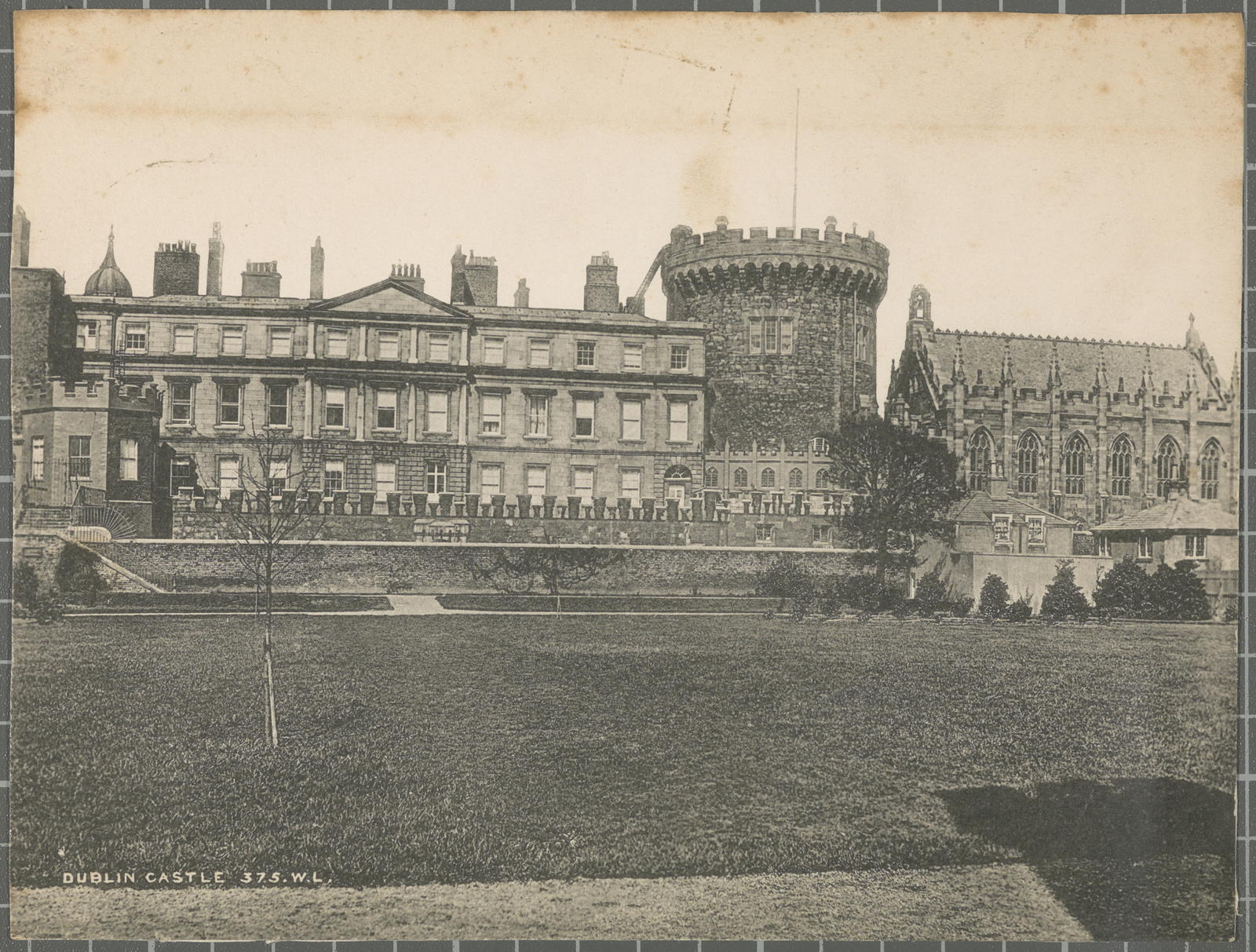
Dublin Castle 375. W.L.
· Ajuntament de Girona (via Europeana)
Public domain
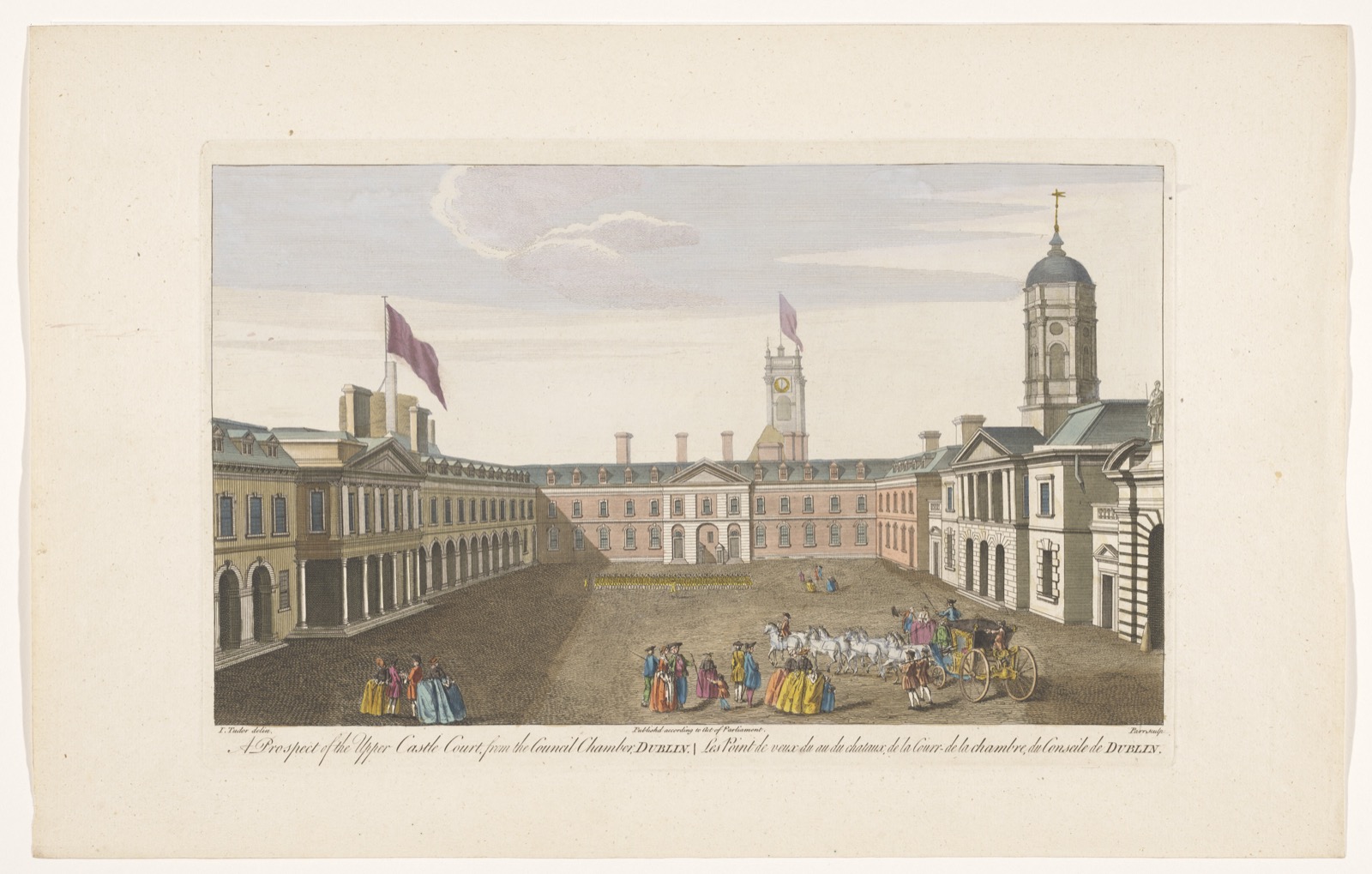
Gezicht op de Upper Castle Yard van Dublin Castle
· Rijksmuseum (via Europeana)
Public domain
Nearby
Landmarks within reach of Dublin Castle.


Questions about Dublin Castle
What is the history of Dublin Castle?
What is inside Dublin Castle?
Who owns Dublin Castle now?
Why was Dublin Castle built, and what was it used for?
Where is Dublin Castle?
When was Dublin Castle built?
Was Dublin Castle ever attacked or besieged?
What did Dublin Castle look like in its prime?
Is Dublin Castle still standing or is it a ruin?
Who built Dublin Castle?
Can you visit Dublin Castle?
More castles of Ireland


Explore the city


