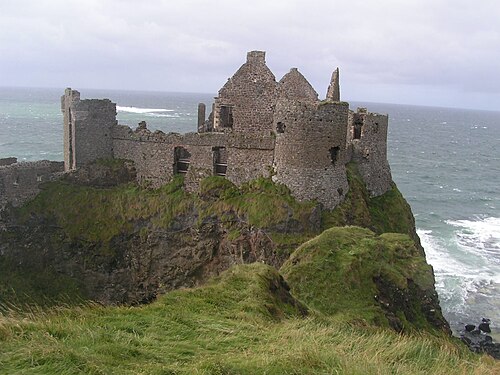
Ireland · Partial ruin
Rock of Cashel
Carraig Phádraig
The Rock of Cashel is a medieval ecclesiastical and royal complex sited on a limestone plateau above the plain at Cashel, County Tipperary, Ireland. The surviving group of buildings, most dating from the 12th and 13th centuries, includes a tall round tower, Cormac's Chapel, a 13th-century cathedral with a central tower and an attached residential tower house, and the Hall of the Vicars Choral, all within a walled plateau that contains a graveyard with high crosses.
Its prime
1270
Today
Partial ruin
As it stood in 1270
What Rock of Cashel looked like in its prime.
Perched on a walled limestone plateau above the plain, the ensemble reads as a cluster of grey limestone and sandstone masonry: a slender cylindrical round tower about 28 m high, a squat square central tower over the cathedral, a massive residential tower at the west end, and the low aisleless cruciform cathedral with tall narrow lancet openings. Cormac's Chapel projects with twin short towers and a barrel-vaulted interior; in prime condition all roofs and vaults were intact and the site surrounded by a graveyard with high crosses.
Its story
The story of Rock of Cashel.
The Eóganachta Fortress and Brian Boru's Crowning, 977
Local legend holds that the Rock came from the Devil's Bit, a mountain some 20 miles (30 km) north of Cashel, flung there when St Patrick banished Satan from a cave; the Tripartite Life of Saint Patrick makes the Rock the reputed site of the conversion of the King of Munster by Patrick in the 5th century. The outcrop was the traditional seat of the kings of Munster by the 4th century, and in the 5th the Eóganachta built a fortress there and held it for centuries.
In 977 Brian Boru was crowned king at Cashel and made it his capital. The royal phase closed in 1101, when Muirchertach Ua Briain, King of Munster, gave his fortress on the Rock to the Church.
Cormac's Chapel and the Cathedral, 1127–1270
Few remnants of the early structures survive; most of what crowns the Rock belongs to the 12th and 13th centuries. The round tower dates from about 1100, stands 28 metres high and was raised without mortar, its entrance set 3.7 metres above ground because the foundation runs only about a metre deep, shallow, as round tower foundations typically were. Conservationists have since filled parts of it with mortar for safety.
Cormac's Chapel, built for King Cormac Mac Carthaigh, was begun in 1127 and consecrated in 1134. Dirmicius of Regensburg, the Irish abbot there, sent two of his carpenters to help with the work, and the twin towers flanking the junction of nave and chancel are strongly suggestive of that Germanic hand, the feature being otherwise unknown in Ireland. The chapel holds the only surviving Romanesque frescoes in Ireland. Its sandstone has drawn water over the centuries and badly damaged them, so the building has been enclosed in a rain-proof structure and dried out with dehumidifiers.
The cathedral followed between 1235 and 1270, an aisleless building on a cruciform plan with a central tower, terminating at the west end in a massive residential tower house. The Hall of the Vicars Choral was added in the 15th century for the laymen appointed to help chant the cathedral services; there were originally eight vicars choral at Cashel with their own seal, later reduced to five honorary vicars who appointed singing-men as their deputies, a practice that ran until 1836.
Inchiquin's Sack, 1647
In 1647, during the Irish Confederate Wars, English Parliamentarian troops under Murrough O'Brien, 1st Earl of Inchiquin, sacked Cashel. The Irish Confederate soldiers holding the Rock were massacred, and so were the Catholic clergy, among them Theobald Stapleton. Inchiquin's men looted or destroyed many of the important religious artefacts kept there.
Archbishop Price's Roof, and the Whiteboys of 1763
Arthur Price, the Anglican Archbishop of Cashel, had the main cathedral roof taken off in the 1740s. The decision was criticised before it was carried out and by every antiquarian who wrote about the Rock afterwards.
The Rock also entered the history of the Whiteboy movement: in 1763 a large body of Whiteboys levelled the wall surrounding it, a celebrated moment in the agitation that ran across Tipperary between 1763 and 1765 and took in the limestone district of Cashel. Scully's Cross, raised in the graveyard in 1860 to commemorate the Scully family, was destroyed in 1976 when lightning struck the metal rod running its length. The Hall of the Vicars Choral was restored by the Office of Public Works for European Architectural Heritage Year in 1975, and visitors now enter the site through it.
Step inside
9 places to explore in 1270.
The record describes 9 distinct spots at Rock of Cashel, including 4 interiors: round tower, interior, cormac's chapel, interior with frescoes, cathedral nave beneath the central tower and more. Create your own photoreal reconstruction and explore every one, more scenes means more rooms, more angles, and more of the place to stand in.
Build Your Own Castle
Recreate Rock of Cashel with AI to explore it.
The artist rebuilds it as it stood in 1270, a photoreal reconstruction that belongs to you alone. Pay with coins, no subscription needed.
Recreate this castle →Defend this castle →Whose castle
Clans who held Rock of Cashel.
The families that held Rock of Cashel for a decade or more across its history, follow a name to its clan.
Eóganachta
Traditional seat of the Eóganachta kings of Munster before being granted to the Church in 1101.