Historic Cities · Ireland
Belfast through the ages
Belfast is the capital city and main port of Northern Ireland. It stands on the banks of the river Lagan, and is connected to the open sea through Belfast Lough and the North Channel. The city is the largest in Northern Ireland and the second-largest, after Dublin, in Ireland, with a recorded population in 2021 of 345,418 and of 704,406 for the greater metropolitan area.

Belfast in 1800
Georgian Belfast
Belfast in 1800 is a compact Georgian port maturing into an Atlantic linen-export town, its streets ordered in brick and stucco around a lone White Linen Hall and the busy curve of the Lagan. The walk traces river quays, ropewalks and bleach greens where webs of linen are prepared and shipped, with Cave Hill’s basalt ridge keeping watch above the town.
A low Georgian skyline of two- and three-storey brick and rendered houses, tall chimneys and slate roofs punctuated by the masts and spars of small brigs at the quays. Streets are narrow, paved or cobbled, lined with brown-red brick terraces and pale stucco shopfronts; the White Linen Hall stands as a civic block within its neat squares. The River Lagan cuts the town in half, wooden bridges and quaysides busy with carts, labourers and piles of bundled linen, and Cave Hill’s dark basalt ridge forms a constant backdrop.
The route: 22 streets, squares and views
Belfast from the Lough → Harbour Quays → Long Bridge → Bridge Street → High Street → Castle Place → Chapel of the Ford → White Linen Hall → Corn Market → Assembly Rooms → …
Step inside, 13 interiors
Bonded Warehouse Interior · Toll-house Office · Main Trading Floor · Merchants' Gallery · Market Exchange Room · Assembly Ballroom · Stacked Webs Warehouse · Warehouse Counting House · Merchant's Parlour · Ropewalk Workshop · Bleacher's Drying Loft · Customs Office Room · Shipwright's Mould Loft
Planned from the Wikipedia record: History of Belfast.
Belfast in 1911
Shipbuilders' Belfast
Belfast in 1911 is a city at industrial height: the world’s greatest shipyard rides the Lagan while linen factories and red‑brick terraces stretch for miles. This walk passes the shipyard on Queen's Island, the new City Hall, the leaning Albert Clock, trammed shopping streets and the kitchen‑house terraces where mill workers live.
The skyline is a forest of chimneys, mast‑like gantries and the pale dome of the new City Hall; streets run with tramlines and wet cobbles, shopfronts and brick terraces. Harland & Wolff’s steel frames and barrel‑roof drawing offices dominate the riverbank, the Lagan blackened with coal dust and rivets. Colours are soot‑stained red brick, grey skies, coal‑black water and the bright canvas and enamel of working clothes and tram liveries.
The route: 22 streets, squares and views
Belfast Lough → Belfast Harbour → Queen's Quay → Albert Memorial Clock → Custom House Quay → Queen's Bridge → Queen's Island Causeway → Harland & Wolff Entrance → Arrol Gantry and Slipways → Drawing Offices Exterior → …
Step inside, 12 interiors
Clock Tower Chamber · Commissioners' Counting Room · Hull Assembly Shed · Drawing Office under Barrel Roofs · Riveter's Erecting Shop · Boiler Shop · Spinning Room · Warehouse Sorting Hall · Back Kitchen with Range · Market Hall under Iron Roof · Station Waiting Room · Marble Rotunda
Planned from the Wikipedia record: History of Belfast.
Its story
The story of Belfast.
The Ford at the Mouth of the Farset
Belfast is Béal Feirste, the mouth of the Farset, from Irish fearsaid, a sandbar or tidal ford. The bar formed where the Farset ran into the Lagan along what is now High Street, and the settlement began at that low-water crossing; the river itself was culverted in the late eighteenth century.
In 1177 John de Courcy took eastern Ulster; the Normans built a fort to guard the crossing, first mentioned in 1262 and standing about where Castle Place meets High Street. Edward Bruce besieged and destroyed it in 1315. By the mid fourteenth century the ruin and its manor had passed to the O'Neills of Clandeboye, and the place stayed in Gaelic hands for more than two centuries, the castle taken and rebuilt repeatedly between 1476 and 1523. In 1574 the Earl of Essex had Sir Brian McPhelim O'Neill seized at a feast in the castle and executed at Dublin, and in 1597, during the Nine Years' War, the English garrison there was captured and killed and the Lagan Valley devastated.
Chichester's Plantation Town and the Scots Who Followed, 1607–1690
After the Flight of the Earls in 1607, James I turned a Scottish migration already under way into policy: the Plantation of Ulster granted land to men loyal to the Crown and drew settlers from across Britain, most of all from lowland Scotland, out of which the Ulster-Scots emerged. Sir Arthur Chichester, Lord Deputy from 1605, held Belfast and the Lagan Valley; Belfast was then a village of timber houses with one inn, its people mostly Scots, English and Manx; in 1611 he built a castle of stone and timber there. The town was chartered in 1613 with the right to send two members to Parliament, though Carrickfergus remained the greater port until 1640, when Thomas Wentworth bought its trade privileges and endowed them on Belfast, moving the customs house with them.
The new arrivals were largely Scottish Presbyterians, outside the established church, and some ministers who refused to conform to it tried to sail for the American colonies. In 1649 the Belfast Presbytery rebuked the government in London for executing the king, drawing from John Milton a denunciation of the town's Scots as "ungrateful and treacherous guests"; on 30 September, after four days' resistance, Belfast fell to Cromwell's lieutenant Robert Venables. By 1667 the town produced half of Ireland's butter. During the Williamite War it changed hands twice, and William of Orange, landing at Carrickfergus on 14 June 1690, came through Belfast on his way to the Boyne.
Linen, the Atlantic Trade and the United Irishmen, 1700–1801
The penal laws barred most Catholics from rights other subjects held, and Presbyterian dissenters shared some of them. With French Huguenots the Scots had introduced linen production, and Belfast exported it in rising volume. Fortunes were made carrying rough linen clothing and salted provisions to the slave plantations of the West Indies, sugar and rum to Baltimore and New York, and flaxseed and tobacco home. From the 1760s those profits paid for the Lagan Canal, new docks and quays and the White Linen Hall of 1788, which drew to Belfast the linen trade that had gone through Dublin. In 1786 abolitionist feeling defeated a proposal by the town's greatest merchant house, Cunningham and Greg, to fit out ships for the Middle Passage.
When the privateer John Paul Jones raided Belfast Lough in 1778 and no help came from Dublin Castle, the townspeople raised their own Volunteer corps, which soon turned from defence to pressing Parliament for reform; many Ulster-Scots had kin in the American colonies. In July 1791 Volunteers marched to the White Linen Hall to salute the French revolutionaries, and from that meeting came the Society of United Irishmen, founded by Wolfe Tone, Henry Joy McCracken and others, demanding Catholic emancipation and representative government. The government disarmed Ulster under martial law in 1797 and informers gave up the leadership; the rebellion came in 1798 and was beaten at Antrim and Ballynahinch. McCracken, offered his life for the names of other leaders, refused and was hanged at the Market House on High Street on 17 July. Britain used the rebellion to abolish the Irish Parliament, and from 1801 Belfast's representatives sat at Westminster.
Linenopolis, Famine and the Yards, 1801–1914
Belfast was the one place in Ireland where the Industrial Revolution took permanent hold. Cotton came first, employing some 30,000 people by 1811, until demand fell after 1815 and the mills turned to wet-spun flax. The town became the global leader in linen goods (mill and finishing work largely done by women and children), and was nicknamed Linenopolis, and its population rose from 19,000 in 1801 to over 70,000 in 1841. Industry drew migrants particularly from rural Ulster, the Catholic arrivals settling largely in the west; a Catholic population of about four hundred in the 1780s reached some 45,000 by 1886. The same decades brought the first sectarian riots, which recurred regularly, and mechanised spinning ruined the rural cottage industry, deepening families' dependence on the potato.
The blight failed a third of the crop in 1845. In October 1846 the Belfast journal The Vindicator gave the cry of the starving as "give us food or we perish" and rebuked the United Kingdom for not feeding its people. The rural poor moved east into Belfast carrying famine fever; Dr Andrew Malcolm wrote of the influx and the "plague breath" it brought, and in July 1847 the Belfast Newsletter reported the hospitals overflowing and the emaciated lying dead or dying in the streets.
The Victoria Channel, opened in 1849, let large vessels up the Lagan whatever the tide, and its dredged spoil was banked into Queen's Island. There Edward Harland launched his first ship in 1855 and formed a partnership with Gustav Wolff in 1861; from 1869 the White Star Line ordered all its ocean vessels from the yard, among them the Titanic, the largest ship afloat when launched in 1911. By the 1900s Belfast's yards were building up to a quarter of United Kingdom tonnage and, by 1914, close to an eighth of world production. Granted city status in 1888, Belfast was then the world's largest centre of linen manufacture and the United Kingdom's third port. Prosperity settled nothing: riots followed the defeat of the First Home Rule Bill in 1886, with an official death toll of 31, and the Second Bill of 1893 brought the beating of Catholic workers out of the shipyards.
The Covenant, Partition and the Violence of 1920–22
About three-quarters of Belfast's people were Protestant and opposed to Home Rule; about the same proportion of Ireland as a whole was Catholic and for it. On 28 September 1912 unionists converged on the City Hall, where Edward Carson was first to sign the Ulster Covenant against a Dublin parliament; 471,414 men and women born in Ulster signed. The Ulster Volunteer Force drilled, and in April 1914 landed 24,000 rifles smuggled from Germany near Larne. War intervened, and the UVF became the 36th (Ulster) Division, which lost 5,700 killed or wounded on the first day of the Somme.
The Government of Ireland Act of 23 December 1920 created Northern Ireland out of six of Ulster's nine counties, and elections in May 1921 returned a unionist landslide under James Craig, its first prime minister. Belfast, the new capital, went through two years of communal killing in which about nine-tenths of the dead were civilians killed by civilians. On 21 July 1920 rioting began in the shipyards and loyalists drove more than 11,000 Catholic and left-wing Protestant workers from their jobs at Harland and Wolff. On 10 July 1921 gun battles along the boundary between the Falls and the Shankill killed sixteen civilians and destroyed 161 houses. In the McMahon murders of 26 March 1922 and the Arnon Street killings a week later, uniformed police shot twelve Catholic civilians dead in reprisal for the killing of policemen. Internment followed, the IRA organisation in the city collapsed, and the last conflict-related killing came in October 1922. Between July 1920 and July 1922, 557 people were killed in Northern Ireland (303 Catholics, 172 Protestants and 82 members of the security forces), and 10,000 were driven from the city, several thousand Catholics fleeing to Glasgow and Dublin. A curfew stayed in force until 1924.
Capital of Northern Ireland: Slump, Riots and the Blitz, 1922–1945
The new government abolished proportional representation in local elections in 1922 and parliamentary ones in 1929, and drew boundaries that returned unionist majorities out of proportion to the vote. Parliament moved to Stormont in 1932. The wartime boom was over: unemployment ran at 23 per cent, Harland and Wolff launched no ship between December 1931 and May 1934, and the Workman, Clark yard closed for good in 1935. In October 1932 some 60,000 unemployed Catholics and Protestants marched together for relief; police charged the crowds, shot dead one Catholic and one Protestant, and the government conceded higher payments. The unity did not last: after the Twelfth in 1935, fighting on York Street left eight Protestants and five Catholics dead and drove 2,000 Catholics from their homes. By 1938 nearly a third of industrial workers were unemployed.
Belfast, thought too far from German airfields to need defending, had few shelters and had sent its anti-aircraft guns to England. On 15 April 1941 two hundred Luftwaffe bombers struck the working-class districts around the shipyards and north Belfast. About a thousand people were killed, the greatest loss of life in any single raid outside London; 52 per cent of the city's housing stock was destroyed and roughly 100,000 of its 415,000 people were made homeless.
The Troubles and the City After 1998
Rising post-war expectations, the decline of the Victorian industries and the Unionist government's record on civil rights met in the protests of the late 1960s. A civil rights march near Derry was broken up by the Royal Ulster Constabulary in August 1968 and rioting spread to Belfast. The British Army was deployed in August 1969, beginning Operation Banner, its longest continuous deployment; the Falls curfew of July 1970 and internment in August 1971, which rounded up 343 republican suspects and no loyalists, turned nationalist opinion against it. The Ulster Volunteer Force killed fifteen people in the McGurk's Bar bombing in 1971. In July 1972 the Provisional IRA set off twenty-two bombs in the city centre in a single afternoon, killing nine, on what became known as Bloody Friday. Bobby Sands, from greater Belfast, was the first of ten republican prisoners to die on hunger strike in 1981. In October 1993 the PIRA bombed a fish shop on the Shankill Road, killing nine Protestant shoppers and one of the bombers.
Secret talks begun by two priests at Clonard Monastery brought John Hume and Gerry Adams together, and later loyalist and unionist figures, leading through the ceasefires of 1994 to the Good Friday Agreement of 1998. By then some 1,500 people had been killed and 20,000 injured in the city; eighty-five per cent of the deaths occurred within a thousand metres of the interfaces between the two communities, and as many as 60,000 people had been intimidated out of their homes. The barriers built at those interfaces remain, and the neighbourhoods they separate are among the most deprived in Northern Ireland.
Redevelopment of the docks from 1989 produced the Titanic Quarter, and services now account for three-quarters of the city's jobs against 6 per cent in manufacturing. Harland and Wolff, which employed around 35,000 at its wartime peak, was down to a few hundred workers on oil rigs and wind turbines before a Royal Navy contract returned it to shipbuilding in 2025. Unionists lost overall control of the City Council in 1997 for the first time in its history, and in 2011 nationalist councillors outnumbered unionist ones. Belfast is the capital and main port of Northern Ireland, with 345,418 residents recorded in 2021 and 704,406 in the wider metropolitan area, about a third of the country's population. As a legacy of emigration it has lent its name to more than a dozen settlements in the United States, the largest of them Belfast, Maine, and to one each in Australia, Canada, New Zealand and South Africa.
From the archive
Belfast on paper: the old town as it was mapped.
A period plan or bird's-eye view of the old town, drawn between 1500 and 1850, the streets this page's reconstructions walk. Public domain, with its source named.
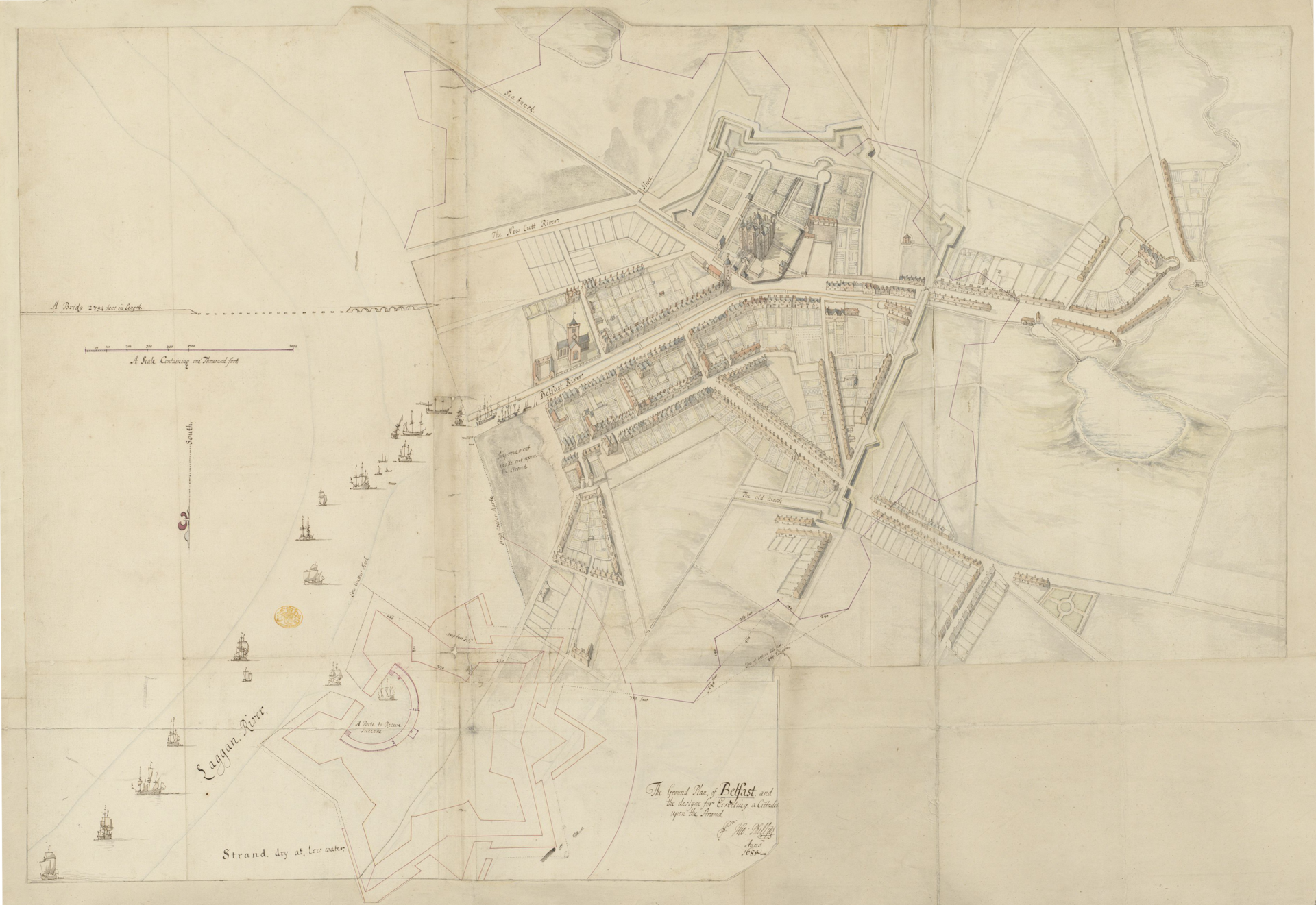
Ground plan of Belfast, by Thomas Phillips (1685)
Shows Belfast’s ramparts, streets and quays with Belfast Castle and a proposed northern citadel beside the River Lagan.
1685 · Thomas Phillips (d. 1693) · Wikimedia Commons
Public domain (plate dated 1685)
In this city
Landmarks of Belfast, see each in its prime
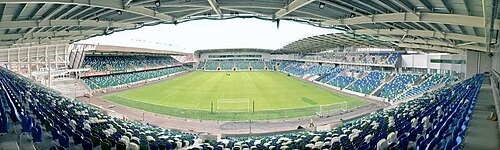


Ships tied to Belfast
- HMHS Britannic: Keel laid at Harland and Wolff, Belfast, on 30 November 1911
- HMS Belfast: Built by Harland and Wolff at Belfast, her keel laid in December 1936
- HMS Glorious: Keel laid by Harland and Wolff at Belfast on 1 May 1915
- RMS Baltic: Built at Harland and Wolff in Belfast as hull number 352
- RMS Olympic: Built at Queen's Island, Belfast, and repaired there after her 1911 collision
- Titanic: Built by Harland and Wolff at Belfast; Titanic Belfast stands on her slipway
Castles of Belfast

More cities to explore
 IrelandDublinExplore it in 1000 · 1780 · 1904
 ScotlandGlasgowExplore it in 1650 · 1775 · 1888
 IrelandCorkExplore it in 1600 · 1880
 IrelandGalwayExplore it in 1580 · 1900
Castles of Europe · Landmarks of Europe · create your own reconstruction.