Historic Cities · Ireland
Dublin through the ages
Dublin is the capital and largest city of Ireland. Situated on Dublin Bay at the mouth of the River Liffey, it is in the province of Leinster, and is bordered on the south by the Dublin Mountains, part of the Wicklow Mountains range.

Dublin in 1000
Viking Dublin
This is the Norse port of Dyflin at the height of its Viking era: a compact timber town on the south bank of the Liffey, ringed by an earthen bank and a raised assembly mound. The walk moves from the bay and river mouth inward to the dark pool of Duiblinn, along quays crowded with longships, through markets for silver and thralls, and up to the Thingmote.
A low, timber skyline of wattle-and-post houses and steep thatch rises behind an earthen bank beside the tidal Liffey. Narrow lanes run between wooden stalls and open yards; longships lie beached in the silty quays and in the Poddle’s pools. Colours are muted (oiled wood, straw yellow, peat-brown hides and dark riverwater), while smoke, cordage and fish-scent hang in the air.
The route: 21 streets, squares and views
Dublin Bay → Mouth of the Liffey → Liffey Quays and Longships → Duiblinn (Black Pool) → Wood Quay Earthen Bank → Quayside Market → Fish Market → Shipwrights' Way → Poddle Boat-sheds → Poddle Dark Pool → …
Step inside, 12 interiors
Earthen-bank Longhouse · Weigh-house and Toll Room · Fish Smokehouse · Keelwright's Shed · Poddle Boat-shed · Dark Pool Longship Hut · Slave and Silver Exchange · Comb-maker's Workshop · Weaver's Loft · Tannery Drying-house · Quarter Mead Hall · Thingmote Assembly-hall
Planned from the Wikipedia record: History of Dublin.
Dublin in 1780
Georgian Dublin
Dublin in 1780 is a city being reshaped by Georgian planning: new wide streets and formal squares rise beside a medieval core, while grand public buildings and quaysakes push the river into civic view. The route follows riverfront quays and bridges, the Irish Houses of Parliament and Trinity, the brick terraces of Merrion and Mountjoy Squares, market streets, playhouses and the sedan chairs and coaches of an improving capital.
The skyline is low and domestic, punctured by cathedral towers and the scaffolds and rough masonry of new classical public buildings along the Liffey; the river cuts a broad, busy channel with timber-masted sloops and cargo barges. Streets alternate narrow, cobbled medieval lanes with newly widened avenues lined by three- and four-storey brick terraces, pale stone dressings, fanlit doorways and iron railings; the dominant colours are red-brown brick, pale stucco and the dark sheen of river water under a changeable Atlantic light.
The route: 22 streets, squares and views
Dublin Bay → Custom House Quay → Essex Bridge → Ormond Quay → Wood Quay → Fishamble Street → Smock Alley → Christchurch Cathedral → High Street → Dublin Castle → …
Step inside, 13 interiors
Custom House Counting Room · Fishamble Musick Hall · Smock Alley Playhouse Auditorium · Choir and High Altar · Tholsel Council Chamber · Castle Great Hall · Octagonal Commons Chamber · Long Room of Trinity · Mountjoy Square Dining Saloon · Palladian Stair Hall · Merrion Square Saloon · Leinster House Drawing Room · Bow Room at St Stephen's Green
Planned from the Wikipedia record: Georgian Dublin.
Dublin in 1904
Joyce's Dublin
Dublin in 1904 moves between Georgian dignity and urban wear, its wide streets scarred by tenement decay and lit by gas alongside new electric trams. The walk follows the Liffey from the bay to the park: quays and barges, Sackville Street with Nelson's Pillar, Moore Street dealers, the Martello tower at Sandycove and the faded squares of the Georgian quarter.
A low, river-centred skyline of church spires, chimney stacks and the squat mass of the Custom House, punctuated by Nelson's Pillar on Sackville Street. Stone and brick façades, pale limestone of Georgian terraces, dark wet cobbles and the black river lined with masts and low barges. Gas lamps and early electric poles share pavements; trams and horse-carts thread narrow lanes between grand squares and worn tenements.
The route: 21 streets, squares and views
Sandycove Martello Tower → Dún Laoghaire Harbour → Sandymount Strand → Ringsend and Poolbeg → South Quays and Custom House → Carlisle Bridge and Westmoreland → Sackville Street and Nelson's Pillar → GPO (exterior) → Moore Street Market → Henry Street → …
Step inside, 13 interiors
Martello Tower Gunroom · Harbourmaster's Office · Custom House Counting Room · Life Assurance Office · Gresham Hotel Smoking Room · GPO Public Counters · Moore Street Market Arcade · Arnotts Drapery Floor · Temple Bar Tenement Stair · Trinity College Long Room · National Library Reading Room · St Patrick's Nave · Castle State Dining Hall
Planned from the Wikipedia record: History of Dublin.
Its story
The story of Dublin.
Dyflin, Áth Cliath and the Norse Slave Market, 841–1171
Two settlements stood where the city now does. The Viking base of about 841 was Dyflin, from the Irish Duiblinn, "black pool", the dark tidal pool where the River Poddle met the Liffey, on the ground now occupied by the gardens behind Dublin Castle. Upriver at the hurdled ford lay the Gaelic Áth Cliath, whose name survives as the city's Irish one.
The Norsemen held Dublin for close to three centuries, expelled in 902 and back by 917. Some historians credit part of the town's early growth to slaving: captives from Wales, England, Normandy and beyond were sold through a large market here, by Gaelic Irish sea raiders as well as by the Norse who began the trade. After Brian Boru's victory at Clontarf on 23 April 1014 the Norse became a minor political force and turned to commerce. Their rule ended in 1171, when Diarmait mac Murchada of Leinster took the city with Cambro-Norman mercenaries; the last Norse king, Ascall mac Ragnaill, tried to retake it and was beheaded on 16 May 1171.
Capital of the Lordship, and the Making of the Pale, 1171–1537
Henry II invaded in person to bind the Normans to him in fief, and Dublin became the centre of English power on the island, displacing Tara in Meath, seat of the Gaelic High Kings. It was made capital of the Lordship of Ireland at the Lordship's establishment in 1177, received its first written Charter of Liberties from John, then Lord of Ireland, on 15 May 1192 (addressed to his "French, English, Irish and Welsh subjects and friends"), and from 1297 held the main seat of the Parliament of Ireland.
It was not a safe place. On Easter Monday 1209 about five hundred newly arrived settlers from Bristol were ambushed and killed outside the walls at Cullenswood; in 1315 a Scottish army under Edward the Bruce burned the suburbs; in 1348 the Black Death took hold, and plague returned until its last major outbreak in 1649. The countryside around Dublin, as far north as Drogheda, was the only part of the Lordship the English effectively controlled, the Pale, named for the fortifications raised to protect its settlers. The city was reported to have paid tribute, or "black rent", to neighbouring Irish clans to buy off their raids, and a fifteenth-century law was meant to confine the Gaelic Irish to Irishtown outside the walls; many lived inside it regardless, and by the sixteenth century Irish was said to be rivalling English as the everyday speech of the Pale.
Defence fell to the Fitzgerald Earls of Kildare, who in 1487 occupied Dublin with Burgundian troops and proclaimed the Yorkist Lambert Simnel King of England, and in 1537, under Silken Thomas, besieged Dublin Castle; Henry VIII broke them and installed English administrators in their place.
Reformation, Expulsion and Plague, 1580–1700
The "Old English" of Dublin accepted the Tudor conquest but were alienated by the Protestant reformation, being almost all Catholics. Margaret Ball, a mayoress of the city, died in captivity in Dublin Castle in 1584 for her Catholic sympathies, and the Catholic archbishop Dermot O'Hurley was hanged outside the walls the same year. Elizabeth I opened Trinity College in 1592 as a Protestant university for the Irish gentry; the important Dublin families spurned it and sent their sons to Catholic universities on the Continent. Judging the citizens unreliable, the authorities encouraged Protestant settlement from England, the "New English" who staffed the Irish administration until the nineteenth century.
Protestants became a majority in the 1640s, when thousands fled to Dublin from the Irish Rebellion of 1641; when Irish Catholic forces then threatened the city, the English garrison expelled its Catholic inhabitants. After the Cromwellian conquest Catholics were banned from living inside the city limits, a law never strictly enforced. The city held 21,000 people in 1640; plague between 1649 and 1651 killed almost half of them. Wool and linen exports to England carried the recovery (the wool manufacture alone employed 12,000 people by 1698), and the population passed 50,000 by 1700.
Linen, Guinness and the Wide Streets Commission, 1700–1800
Georgian Dublin became for a time the second-largest city of the British Empire and the fifth-largest in Europe, its population exceeding 130,000. The Wide Streets Commission, established in 1757 at the request of Dublin Corporation, cleared much of the medieval street pattern and laid out Sackville Street, now O'Connell Street, along with five great squares.
The city's living came from cloth and drink. Linen escaped the trade restrictions England imposed on Irish wool and became the most important Irish export, shipments rising from over 1.5 million yards in 1710 to almost 19 million by 1779; the Guinness brewery, founded at St James's Gate in 1759, grew into the largest employer in Dublin. In 1745 Jonathan Swift, Dean of St Patrick's, left his whole estate to found a hospital for "fools and mad", chartered by George II in 1746. Rural migration swelled the slums of the northern and south-western quarters and made Catholics the city's majority again by the end of the century.
The Act of Union, 1800, and a Century Without Industry
The United Irishmen, whose leader Wolfe Tone was a Dubliner, planned a street rising in 1798, but their leaders were arrested and the city occupied before the rebels could assemble. In 1800 the Irish Parliament voted itself out of existence under the Act of Union and Dublin ceased to be a capital. The loss of the peers, members and thousands of servants who came up for the session and the viceregal social season hit the city's income directly; within a few years Leinster House, Powerscourt House and Aldborough House were for sale, and elegant Georgian neighbourhoods slid into slum. Thomas Drummond's Corporation Act of 1840 opened the municipal franchise to holders of property worth more than ten pounds a year, making Catholics, excluded from city government since the 1690s, a two-to-one majority of the electorate, and Daniel O'Connell was elected mayor in 1841.
Dublin missed the Industrial Revolution: Ireland had no significant coal, the fuel of the age, and the city was no centre of shipbuilding, while Belfast grew faster on international trade, factory linen and shipbuilding and had the larger population by 1900. Guinness, the Jameson distillery and Jacob's biscuit factory offered the steadiest work, but unskilled unemployment stayed high. The population passed 400,000 by 1900, by which time the tenements were notorious and Monto, off Sackville Street, was described as the largest red-light district in the British Empire, its trade sustained by the soldiers in the city's barracks until its closure in the mid-1920s. Persistent unemployment and a high birth rate meant that even as the city grew on migration from the rest of Ireland, large numbers of Dubliners left for Britain and the United States to find work.
Lockout, Rising and Civil War, 1913–1923
In 1913 James Larkin's Irish Transport and General Workers Union pressed for better wages for unskilled and semi-skilled workers; William Martin Murphy, owner of the Dublin Tram Company, answered with a cartel of employers who sacked union members and made the rest forswear the union. Within a month 25,000 workers were on strike or locked out. Rioting with the Dublin Metropolitan Police left three dead and hundreds injured, and James Connolly founded the Irish Citizen Army to defend the strikers; after six months most of the workers, their families starving, resigned from the union and went back.
At Easter 1916 about 1,250 armed republicans under Padraig Pearse seized strongpoints across the city, with headquarters at the General Post Office, and declared an Irish Republic in existence. The British brought up artillery and sailed the gunboat Helga up the Liffey. Much of the city centre was destroyed by shellfire and around 450 people were killed, about half of them civilians, with 1,500 injured. The rising was unpopular in Dublin at first, not least because many Dubliners had relatives serving in the British Army, but opinion swung after sixteen of its leaders were executed, and in December 1918 Sinn Féin took an overwhelming majority of Irish seats and assembled as Dáil Éireann.
From 1919 the IRA fought an urban guerrilla campaign in the city. On Bloody Sunday, 21 November 1920, Michael Collins's "Squad" killed eighteen British agents in the early hours; British forces opened fire that afternoon on the crowd at a Gaelic football match in Croke Park, killing fourteen civilians and wounding sixty-five, and three republican prisoners were killed in Dublin Castle that evening. The Civil War then opened in Dublin, where anti-Treaty forces occupied the Four Courts in April 1922 and Collins borrowed British artillery to shell them out over 28–30 June; republicans booby-trapped the Public Record Office as they went, destroying a thousand years of archives. About 1,000 people died in the city across the revolutionary period, and by 1923 Dublin was the capital of the Irish Free State.
Tenements, the Emergency and the Return of Migration, 1932–2024
Serious slum clearance began after Éamon de Valera came to power in 1932 and produced new suburbs at Marino and Crumlin, but the inner-city tenements survived until the 1960s, when thousands of working-class Dubliners were moved to estates on the edge of the city. The urgency left little room for planning: Tallaght, Coolock and Ballymun acquired huge populations, up to 50,000 in Tallaght's case, with no shops, transport or employment provided, and for decades stood as bywords for crime, drug addiction and unemployment. Wood Quay, where the oldest remains of Viking Dublin lay, was cleared for the headquarters of the city's own local government.
Ireland was neutral in the Second World War, known at home not as the war but as "the Emergency". The German air force nonetheless bombed the North Strand, a working-class district of the north inner city, on 31 May 1941, killing 34 civilians and wounding 90; the bombing was declared accidental, though many suspected reprisal for de Valera's decision to send fire engines to Belfast after the bombing there. The city's small Jewish community was temporarily enlarged during those years by Jews who fled to Dublin from Nazi persecution. During the Northern conflict the Dublin and Monaghan bombings of 17 May 1974 killed 33 people, 26 of them in Dublin, and injured almost 300, the heaviest casualties of any single day of the Troubles; no organisation claimed them at the time, and the Ulster Volunteer Force admitted responsibility in 1993. Heroin reaching the inner city in the late 1970s brought petty crime, deaths from AIDS and hepatitis among addicts sharing needles, and organised crime syndicates; the journalist Veronica Guerin was shot dead in 1996 by criminals she was investigating.
Dublin doubled in population across the nineteenth century and again to close on a million by 1980, growing on migration from the rest of Ireland even as its own people left. That direction reversed with the boom of the late 1990s, and after eastern European states joined the European Union in 2004 eastern Europeans became the largest immigrant group in the city, Poland the commonest single origin. At the 2022 census the city council area held 592,713 people and the city with its suburbs 1,263,219; County Dublin had passed 1.4 million, over 17 per cent of them foreign-born, with Brazilians and Indians the largest groups of foreign citizens. Asylum arrivals rose to as many as 600 a week in 2024, many living in makeshift camps for want of accommodation, and protests against housing migrants at East Wall, Finglas and Coolock included the burning of buildings believed intended for them. In November 2023, after a man of Algerian origin stabbed several schoolchildren in Parnell Square, a crowd attacked Gardaí at the scene and rioted on O'Connell Street. Dublin remains the capital and largest city of Ireland.
From the archive
Dublin on paper: the old town as it was mapped.
A period plan or bird's-eye view of the old town, drawn between 1500 and 1850, the streets this page's reconstructions walk. Public domain, with its source named.
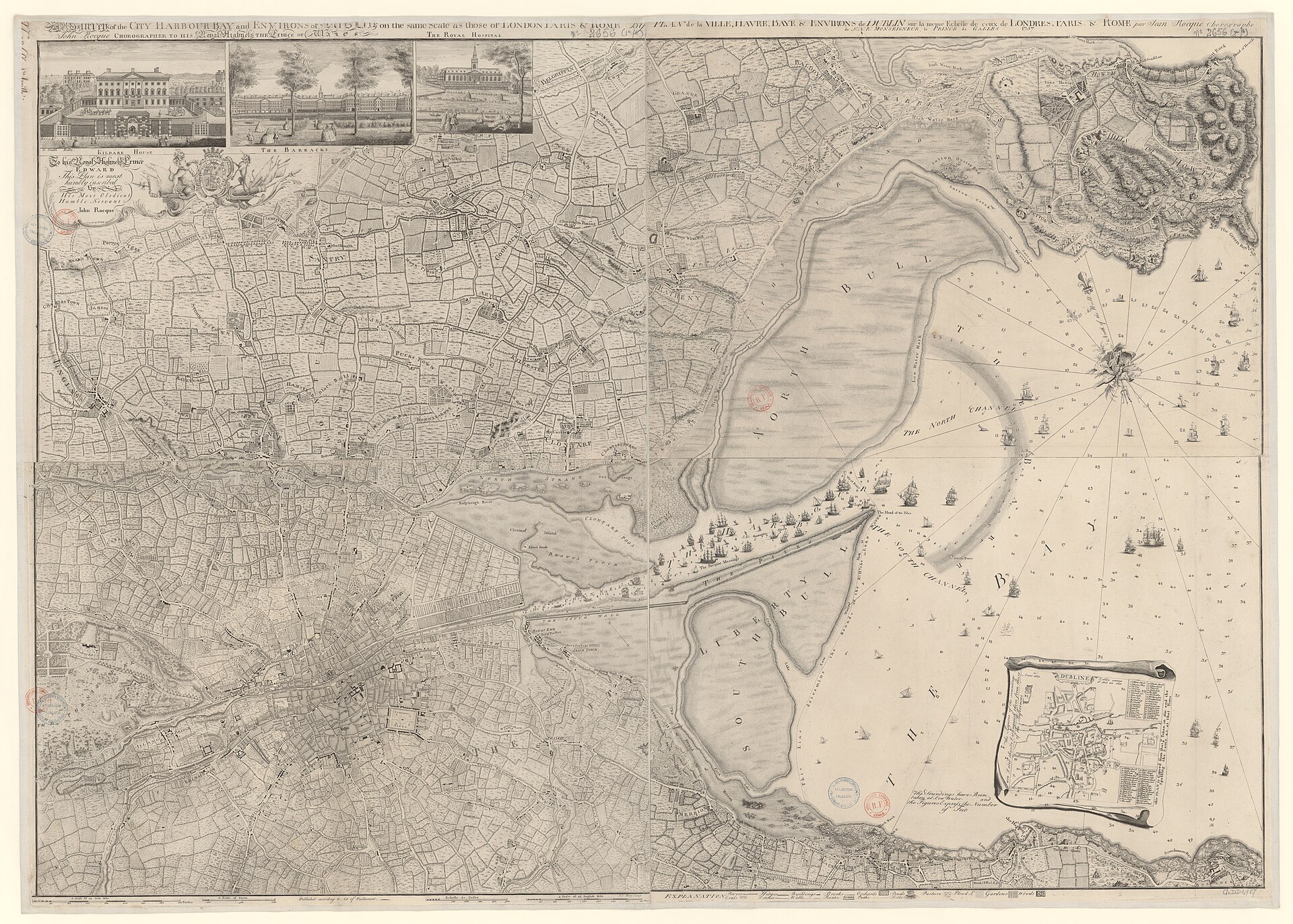
A Survey of the City, Harbour, Bay and Environs of Dublin, by John Rocque (1757)
Shows the River Liffey and the medieval street grid, quays and docks, Trinity College and the harbour with coastal soundings.
Public domain (plate dated 1757)
In this city
Landmarks of Dublin, see each in its prime


Castles of Dublin


More cities to explore
 IrelandKilkennyExplore it in 1620
 IrelandWaterfordExplore it in 1200
 IrelandBelfastExplore it in 1800 · 1911
 IrelandCorkExplore it in 1600 · 1880
Castles of Europe · Landmarks of Europe · create your own reconstruction.