Historic Cities · Ireland
Kilkenny through the ages
Kilkenny is a city in County Kilkenny, Ireland. It is located in the South-East Region and in the province of Leinster. It is built on both banks of the River Nore. The 2022 census gave the population of Kilkenny as 27,184, the thirteenth-largest urban centre in Ireland.

Kilkenny in 1620
The Marble City
Kilkenny in 1620 is a prosperous inland borough caught between the fortified Ormond castle and the cathedral hill of St Canice, where Hiberno‑Norman merchants and Irish clergy share the streets. The walk moves from the river approach and bridge, along the long High Street with its new merchant houses and market cross, and finishes on the cathedral hill with a wide view over the Nore valley.
The town’s silhouette is a compact jumble of steep gables, crenellated castle walls and the tall Romanesque mass of St Canice with its round tower; narrow streets rise from the river and open briefly onto a long High Street. Roofs are thatch and tile, walls of red sandstone, limestone and dark local marble used for pavements and shop thresholds. River Nore quays line low workshops and mills; arcaded merchant houses and narrow alleys create a varied play of sun and shadow.
The route: 15 streets, squares and views
Kilkenny Castle View → Nore Bridge → Castle Bank and Swans → High Street (north end) → Market Cross → Rothe House (arcade) → The Tholsel → Kyteler's Inn → Black Abbey Tower → St Francis Abbey → …
Step inside, 9 interiors
Long Gallery · Arcaded Courtyard Chamber · Merchant Hall · Inn Kitchen Hearth · Abbey Choir · Chapter House · Wheelhouse and Gears · Riverside Warehouse · South Aisle of Effigies
Planned from the Wikipedia record: Kilkenny.
Its story
The story of Kilkenny.
The Church of Cainnech and the Kings of Osraige
Kilkenny takes its name from the Irish Cill Chainnigh, the cell or church of Cainneach, and the settlement began with a church built in honour of St. Canice, an Ulsterman, on the hill that now carries St. Canice's Cathedral and its round tower. The round tower's early Christian character points to an ecclesiastical foundation on the site, and this appears to have been the first major settlement here. Prehistoric finds in the area suggest only intermittent occupation in the Mesolithic and Bronze Age.
By at least the eighth century Cill Chainnigh was a major monastic centre, and the Kings of Osraige had a residence there. The seat of the diocese of the Kingdom of Osraige was moved here from Aghaboe. The Annals of the Four Masters record the place in 1085, and that entry is the first instance of the capital of the district being called Ceall-Cainnigh rather than Osraighe. The name is absent from the lives of Cainnech of Aghaboe and Ciarán of Saighir and from the early annals, which suggests it had no great civil importance before then.
Strongbow's Fortress, Marshal's Charter and the Two Towns
Kilkenny fell within the Lordship of Leinster created after the Norman invasion of 1169–71. Richard de Clare, 2nd Earl of Pembroke (Strongbow) became Lord of Leinster in 1171 and in 1172 built a wooden fortress near the site of the present castle, possibly over an earlier residence of the Mac Gilla Pátraic who had held the Kingdom of Osraige. The O'Briens and Mac Gillapatricks destroyed it in 1173, resisting the Norman advance.
In 1189 Richard I arranged the marriage of William Marshal, 1st Earl of Pembroke, to Strongbow's seventeen-year-old daughter Isabel de Clare, and Marshal became Lord of Leinster in 1192. With Geoffrey FitzRobert installed as Seneschal of Leinster, a heavy programme of building began: the fortress was rebuilt in 1195, work started on St. Canice's Cathedral in 1202 under Hugh de Rous, Bishop of Ossory, and the first stone castle was begun in 1204 and completed in 1213. Marshal granted the town a charter in 1207 setting out the rights of its burgesses and freemen, and extended it northwards to the River Breagagh by exchanging lands with the bishop.
The result was two townships rather than one. The old ecclesiastical centre at St. Canice's became Irishtown, a possession of the bishops of Ossory and chartered by them; the Anglo-Norman borough inside the walls became Hightown, chartered by Marshal. Walls were raised to protect the burghers. Outlying suburbs went either way; Flemingstown was depopulated and lies under Castle Park, while Highhays and Donaghmore were absorbed. The Augustinians were established in John Street before 1200 and in 1211 Marshal granted them a new site there for the Priory of St. John the Evangelist. Kilkenny's first council was elected in 1231, beginning a continuous record of municipal government, its chief magistrate styled Sovereign until the end of the sixteenth century and Mayor thereafter. By the late thirteenth century the town was under Hiberno-Norman control.
The Kyteler Trial and the Burning of Petronilla de Meath
The first recorded charge of witchcraft in Ireland was brought in Kilkenny against Dame Alice Kyteler, born in 1280 and the only child of an established Hiberno-Norman family of the town; accounts date the trial to 1320 and to 1324. Alice married four times and each husband died. After the death of the last of them, Sir John le Poer, her children accused her of killing him by poison and sorcery in the hope of taking her fortune. The case went before Richard de Ledrede, Bishop of Ossory, who found that Alice and her followers had rejected the Christian faith, and who wrote to the Chancellor of Ireland, Roger Outlawe, to have her arrested. Outlawe was Alice's brother-in-law, and instead imprisoned the bishop along with Sir Arnold le Poer, the seneschal of Kilkenny.
Released after seventeen days, Ledrede resumed the prosecution and had Alice's maidservant Petronilla de Meath tortured. Alice and Petronilla's daughter Basilia are presumed to have fled to England. Petronilla was made to proclaim publicly that her mistress and her followers were guilty; the confession extracted from her included the claim that the two women had smeared a magical ointment on a wooden beam that let them fly. She was burned alive at the stake, the first case in Ireland of death by fire for heresy. The trial of Alice, her son and ten others was one of the earliest witchcraft accusations in Europe and the first known to treat women practising witchcraft as an organised group. It came in the same period that Pope John XXII authorised the Inquisition to prosecute sorcerers, in 1320, and long before the mass witch trials of the sixteenth and seventeenth centuries. Those convicted at Kilkenny alongside Petronilla were whipped.
Plague in 1348 and the Statutes of Kilkenny, 1367
The Black Death reached Kilkenny in 1348 and shook the Hiberno-Norman population badly. Because most of the English and Norman inhabitants lived in towns and villages, the plague struck them far harder than it did the native Irish in dispersed rural settlements. Friar John Clyn, writing in a Kilkenny monastery that year, recorded the plague as the beginning of the extinction of humanity: it gathered strength during Lent, and between Christmas Day and 6 March eight Friars Preachers died, with, he wrote, "scarcely a house in which only one died but commonly man and wife with their children and family going one way, namely, crossing to death". After it passed, Irish language and custom came to dominate the country again and the English-controlled area shrank back to the Pale around Dublin.
The Statutes of Kilkenny, thirty-five acts passed in the town in 1367, aimed to halt the decline of the Hiberno-Norman Lordship of Ireland by reasserting English culture among the settlers themselves. Their introduction complains that "many English of the said land, forsaking the English language, manners, mode of riding, laws and usages, live and govern themselves according to the manners, fashion, and language of the Irish enemies". They forbade intermarriage with the Irish, the English fostering or adoption of Irish children, and the use of Irish names and dress; settlers who could not speak English were required to learn it on pain of losing their land and belongings. Hurling and coiting were to be given up in favour of archery and lancing, so that the colonists would be fit to fight by English methods.
Royal Charter of 1609, the Confederation, and the Williamite Winter of 1690–91
In 1609 James I granted Kilkenny a royal charter conferring the status of a city. The new entity was a county corporate that took in the bishop's borough of Irishtown. A seventeenth-century account survives in the Latin tract De Ossoriensi Dioescesi, believed to be the work of David Rothe, the Roman Catholic Bishop of Ossory. It describes a city on the Nore with St. Canice's to the north and the castle to the south: "from this twofold source sprang the civic community; the temple and the fortress were the nurses of its infancy".
After the Rebellion of 1641 the Irish Catholic Confederation, known from its base here as the Confederation of Kilkenny, governed from the city until the Cromwellian conquest of Ireland in 1649. James II, driven from England for his pro-Catholic and pro-French policies, landed at Kinsale in March 1689 with French troops and travelled to Dublin by way of Kilkenny; the Irish Parliament declared him still king and attainted the Protestant supporters of William of Orange, forfeiting the lands of men such as James Butler, 2nd Duke of Ormonde. James spent most of the winter from November 1689 to January 1690 at the castle, working to build an army. He had urged the Irish Parliament to pass an Act for Liberty of Conscience granting religious freedom to Catholics and Protestants alike, and raised the Catholic college here into a university, the Royal College of St. Canice, which took over the premises of Ormonde's grammar school at Kilkenny College.
James was defeated at the Battle of the Boyne on 1 July 1690 and the university closed six months after its foundation. His retreating army passed through Kilkenny on its way to Limerick and forced the citizens to pay protection money to spare the city from looting; James left again from Kinsale, never to return. Kilkenny surrendered to the Williamites without a shot being fired, and the propertied Old English families who had backed James lost everything. General Godert de Ginkel's army camped beside the city and wintered there from October 1690 until May 1691, when it moved on to besiege Limerick.
Brewing, Wool, Marble and the Coming of the Railway
Kilkenny was a brewing centre from the late seventeenth century. St. Francis Abbey Brewery, later Smithwick's, was founded in the early eighteenth century by Messrs Cole and Smithwick, and Smithwick's ale was first brewed in the city. The Guinness Ireland Group owned it from the 1960s, and it passed to Diageo after Guinness merged with Grand Metropolitan. By its final years Smithwick's made up only a small share of what was brewed there and some 80 per cent of output was Budweiser, produced under licence. Diageo announced the closure in May 2008; the brewery shut on 31 December 2013 and production moved to St. James's Gate in Dublin.
The Old Woollen Mills on Bleach Road, built in the 1800s with more than a mile of frontage onto the Nore, covered 90,000 square feet and was among the largest employers in the area; its freestanding red brick chimney went up in 1905. The black stone with decorative white fossils that forms the backbone of many of the city's buildings was quarried locally, principally from a quarry 1.6 kilometres to the south, and gave Kilkenny the name of the Marble City; the same stone was used for the plinth of the new tomb of Richard III in Leicester Cathedral.
St. Kieran's College was founded in 1782, after Grattan's Parliament relaxed some of the penal laws, as the first Roman Catholic secondary school in Ireland. Stephens Barracks was built in the years after the 1798 Rebellion and completed between 1800 and 1803. The railway station opened on 12 May 1848, and lines reached Dublin in 1850, Waterford in 1854, Portlaoise in 1876 and Castlecomer in 1919; the Castlecomer and Kilkenny Junction lines closed in 1962.
By-election, Civil War and the End of the Borough, 1917–2022
W. T. Cosgrave won a Kilkenny by-election for Sinn Féin in 1917. In early May 1922, before the Irish Civil War proper, anti-Treaty forces occupied the centre of the city and 200 pro-Treaty troops were sent from Dublin to drive them out; on 3 May the Dáil was told that 18 men had been killed in the fighting, and both sides agreed a truce the same day in an attempt to avert all-out war. On 15 December 1922 Kilkenny Barracks were reported overrun and captured by irregulars.
Kilkenny Castle was closed in 1935 and the Ormonde family left Ireland; the Marquess of Ormonde presented it to the people of Kilkenny in 1967, two years after the Kilkenny Design Workshops opened. Margaret Tynan became the first woman elected Mayor. Over thirty local creameries amalgamated in 1966 into the Avonmore Creameries Federation, which became Avonmore Foods plc in 1988, merged with Waterford Foods plc in 1997, and trades today as Glanbia, headquartered in the city.
Kilkenny has not been administered as a city under local government law since at least 1840; the borough corporation created that year under the Municipal Corporations (Ireland) Act, successor to both the 1609 charter corporation and the borough of Irishtown, saw its area made an urban district in 1899 while its council kept the style of a borough corporation, became a borough council in 2002, and was dissolved on 1 June 2014, its work amalgamated with Kilkenny County Council. The Local Government Act 2001, as amended by the Local Government Reform Act 2014, provides for "the continued use of the description city in relation to Kilkenny", and the local district covering the city is defined as the Municipal District of Kilkenny City. The 2022 census recorded 27,184 people in the urban centre, the thirteenth-largest in Ireland.
From the archive
Kilkenny on paper: the old town as it was mapped.
A period plan or bird's-eye view of the old town, drawn between 1500 and 1850, the streets this page's reconstructions walk. Public domain, with its source named.
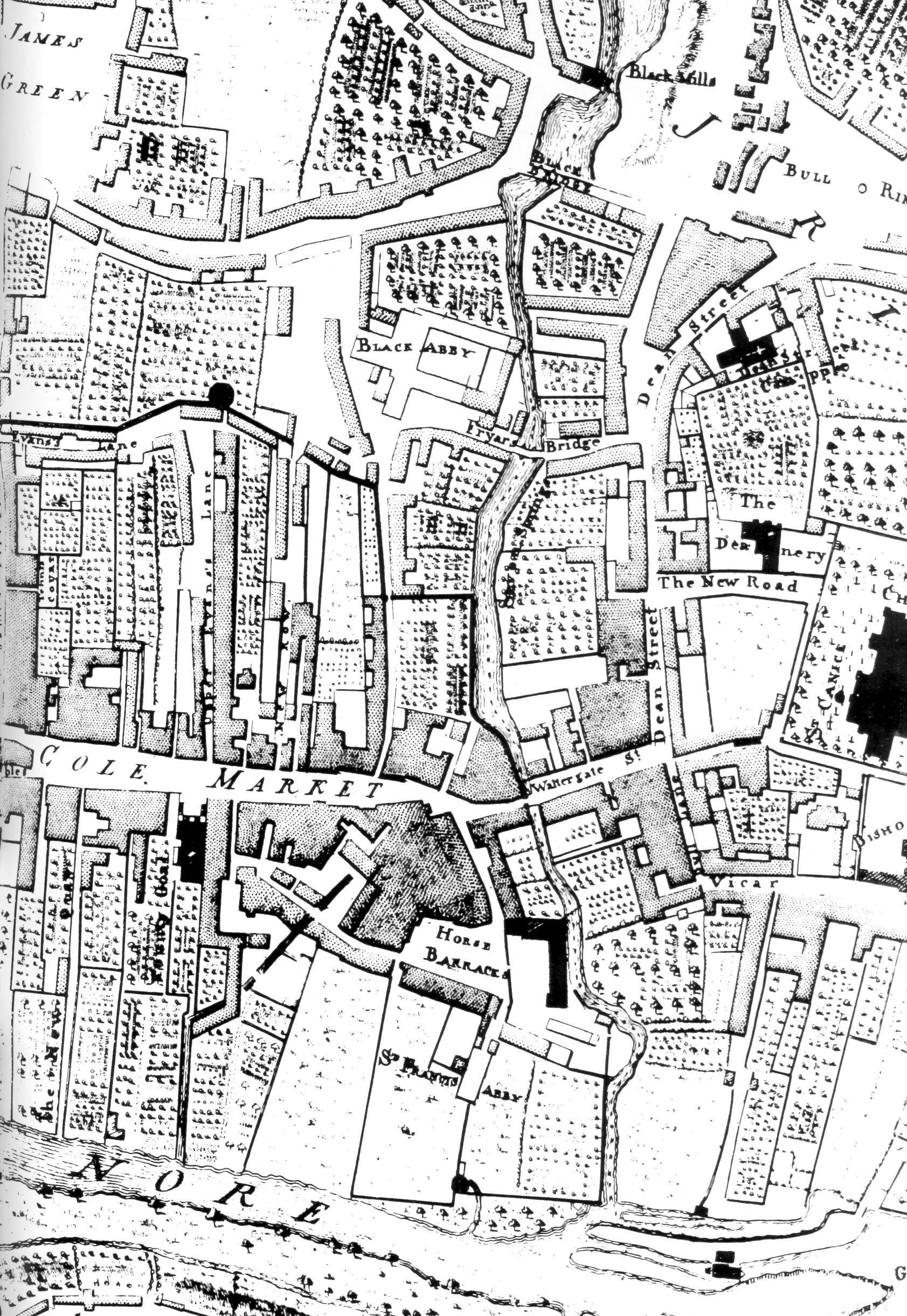
Plan of Kilkenny (Black Abbey and environs), John Rocque, 1758
Shows Kilkenny's medieval walls, streets and Cole Market, the Black Abbey, the River Nore with bridges and the town barracks.
1758 · John Rocque · Wikimedia Commons
Public domain (plate dated 1758)
Castles of Kilkenny


More cities to explore
 IrelandWaterfordExplore it in 1200
 IrelandDublinExplore it in 1000 · 1780 · 1904
 IrelandBelfastExplore it in 1800 · 1911
 IrelandCorkExplore it in 1600 · 1880
Castles of Europe · Landmarks of Europe · create your own reconstruction.