
Ireland · Restored
Kilkenny Castle
Caisleán Chill Chainnigh
Kilkenny Castle is a large medieval-origin castle in Kilkenny, Ireland, originally completed in stone in 1260 and substantially altered and extended in later centuries by the Butler family. It stands on a broad lawn called the Parade and today houses public functions and a gallery while remaining a dominant stone-built feature of the town.
Its prime
1904
Today
Restored
As it stood in 1904
What Kilkenny Castle looked like in its prime.
A long grey-stone castle with a low, three-storey central range flanked by crenellated towers and curtain walls; the west side shows a large round tower (Parade Tower) with a battlemented parapet, while the east entrance is marked by a taller gate range with machicolated-looking crenellations and grouped chimneys along the roofline. Facades are ashlar limestone of even grey tone; broad lawns and parkland (the Parade) sweep up to the castle, which presents multiple arched windows and a continuous battlemented roofline at its prime.
Its story
The story of Kilkenny Castle.
The Ford on the Nore, 1173–1260
Richard de Clare, 2nd Earl of Pembroke (Strongbow) raised the first castle here in the 12th century, probably a wooden structure; the Anglo-Normans had one established by 1173, possibly over an earlier residence of the Mac Giolla Phádraig kings of Osraighe. Kilkenny lay inside the lordship of Leinster granted to Strongbow, and passed with his daughter and heiress Isabel, who married William Marshal in 1189. In 1192 Marshal made Geoffrey FitzRobert seneschal of Leinster, and the building that followed began a major phase of development in the town; excavation in 2019 by Cóilín Ó Drisceoil uncovered the foundations of Marshal's great gatehouse of the early 1200s.
The first stone castle was completed in 1260, placed to control a fording-point of the River Nore and the junction of several routeways. It was square, with a large circular tower at each corner and a massive ditch; in its original condition it would have formed an important element of the town's defences, and a symbol of Norman occupation. Three of those four towers survive.
Seized by the Crown, Sold to the Butlers, 1391
Sir Gilbert de Bohun, seneschal of Kilkenny, inherited the county and the castle from his mother in 1270. Edward I outlawed him in 1300 and reinstated him in 1303, and he held Kilkenny until his death in 1381. It did not pass to his heir Joan: the crown seized it and in 1391 sold it to the Butlers, a family that had come with the Norman invasion and changed its name from FitzWalter in 1185. The buyer was James Butler, 3rd Earl of Ormond, who established himself as ruler of the area; his dynasty held Kilkenny for centuries after. Lady Margaret Butler, daughter of the 7th Earl, was born in the castle; she married Sir William Boleyn and was the paternal grandmother of Anne Boleyn.
The Confederate Supreme Council and Cromwell's Siege, 1642–1661
In the 17th century the castle came to Elizabeth Preston, wife of James Butler, 1st Duke of Ormond, then Lord Lieutenant of Ireland. Ormond was a Protestant, unlike most of his family, and through the Irish Confederate Wars of the 1640s he was the representative of Charles I in Ireland, while his own castle served as capital of the Catholic rebel movement, Confederate Ireland, whose parliament or Supreme Council met here from 1642 to 1648. Ormond himself was based in Dublin. During Cromwell's siege of Kilkenny in 1650 the east wall and the north-east tower were damaged; both were later torn down. Returning from exile, Ormond remodelled the castle as a modern château in 1661.
The Wyndham Act and the Siege of 1922
By the 18th century the castle had run down with the family's failing fortunes; money brought in by Anne Wandesford of Castlecomer, who married John Butler, 17th Earl of Ormonde, paid for some restoration, and the 19th-century Butlers tried to return the building to its medieval appearance, rebuilding the north wing and extending the south curtain wall. The income was thinner than the display suggested: the Ormonde settled estates were nominally worth some £44,000 a year in the 1880s and 1890s, but arrears through the agricultural depression brought the real figure closer to £22,000, and Lady Ormonde once startled a guest at a Castle Ball by remarking that “we are very poor”. In 1903 some 27,800 acres in Tipperary and Kilkenny were sold under the Wyndham Land Act for £240,000, cutting the family's Irish land to the castle's 95-acre demesne, a home farm and mountain forest.
James Butler, 3rd Marquess of Ormonde, died in 1919, and death duties and expenses came to £166,000. In 1922, during the Irish Civil War, Republicans holding the castle were besieged by Irish Free State forces. The Ormondes stayed put, with their Pekinese, in their bedroom over the great gate, the main focus of the attack, a machine gun posted outside their door. One man was injured, but the damage took many years to repair. The family lived on there until 1935, when they sold the contents for £6,000, moved to London and left the place empty for thirty years.
Fifty Pounds and Too Many Ruins, 1967
After the deaths of the 4th Marquess in 1943 and the 5th in 1949, the estate came to Arthur Butler, 6th Marquess. In 1967 he sold the abandoned and deteriorating castle to the Castle Restoration Committee for a ceremonial £50, saying his family and the people of Kilkenny alike took pride in it and had not liked to see it deteriorate: “There are already too many ruins in Ireland.” He also bought the ground in front so it should never be built on. The handover marked the founding of The Butler Society. Restoration filled the rest of the century, and the castle and grounds are now managed by the Office of Public Works.
Step inside
10 places to explore in 1904.
The record describes 10 distinct spots at Kilkenny Castle, including 2 interiors: bedroom over the great gate, castle basement (butler gallery area). Create your own photoreal reconstruction and explore every one, more scenes means more rooms, more angles, and more of the place to stand in.
Build Your Own Castle
Recreate Kilkenny Castle with AI to explore it.
The artist rebuilds it as it stood in 1904, a photoreal reconstruction that belongs to you alone. Pay with coins, no subscription needed.
Recreate this castle →Defend this castle →Whose castle
Clans who held Kilkenny Castle.
The families that held Kilkenny Castle for a decade or more across its history, follow a name to its clan.
Seat of the Butler Earls and Dukes of Ormond, 1391–1935.
From the archive
Kilkenny Castle on paper: the measured plan and period views.
The survey plan and photographs below are the ground truth this page's reconstructions are checked against, drawn and photographed while the castle was still a working garrison. Every image is public-domain or openly licensed, with its source named.
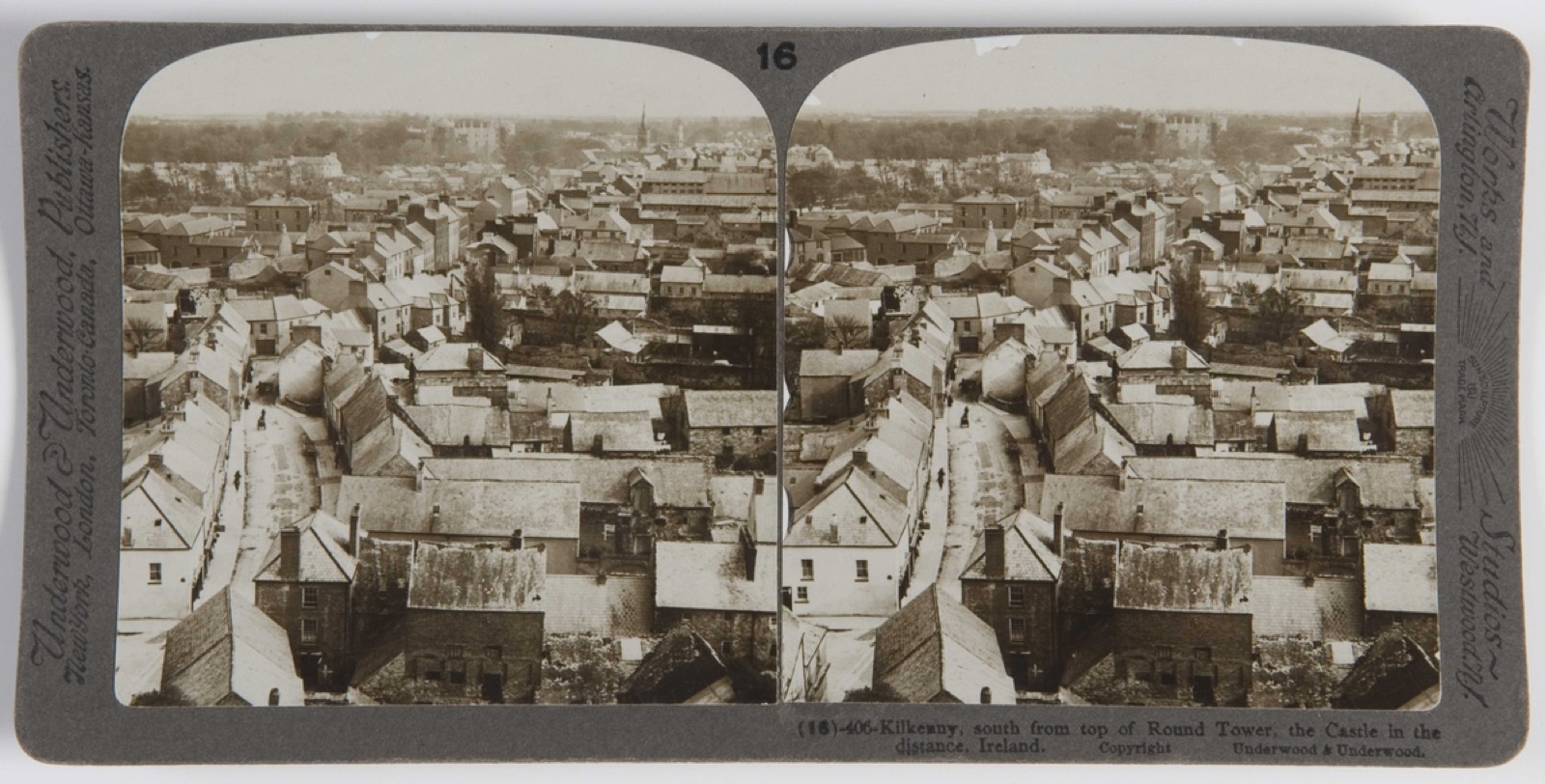
Stereoskopi. Kilkenny, Irland. Utsyn over bybebyggelse.
· The Norwegian Museum of Cultural History (via Europeana)
Public domain
Questions about Kilkenny Castle
What is the history of Kilkenny Castle?
What is inside Kilkenny Castle?
Why was Kilkenny Castle built, and what was it used for?
Where is Kilkenny Castle?
When was Kilkenny Castle built?
Was Kilkenny Castle ever attacked or besieged?
Which family or clan held Kilkenny Castle?
What did Kilkenny Castle look like in its prime?
Is Kilkenny Castle still standing, or is it a ruin?
Who built Kilkenny Castle?
Can you visit Kilkenny Castle?
More castles of Ireland


Explore the city


