Historic Cities · Ireland
Cork through the ages
Cork is the second-largest city in the Republic of Ireland, the county town of County Cork, the largest city in the province of Munster and the third-largest on the island of Ireland. At the 2022 census, it had a population of 224,004.

Cork in 1600
Walled Cork
Cork in 1600 is a compact, walled island town straddling two channels of the River Lee, its low skyline of church towers, merchant tower-houses and friary steeples crowded between quays and fortifications. The walk follows incoming ships, the drawbridges of the North and South Gates, the bustling riverside warehouses and the narrow main streets where merchants load hides, tallow and salted fish for Bristol and Spain.
Narrow cobbled streets thread between stout stone walls and timber-framed houses, punctuated by a few tall merchant tower-houses and the squat stone tower of the Red Abbey. Roofs are thatch or pegged slate, walls darkened by smoke and river mist; quays run close to the low riverbanks with ships’ masts and rope-strewn decks. Daylight is often cool and grey, brightening to clear sun over the harbour on fair days.
The route: 21 streets, squares and views
Cork Harbour → Lough Mahon Shore → Lee Confluence → Eastern Bastion → South Gate → South Main Street → Cornmarket → Merchant Tower Houses → Christ Church → Red Abbey Tower → …
Step inside, 12 interiors
South Gate Guardroom · Merchant Guild Hall · Tower House Great Hall · Family Solar Chamber · Christ Church Nave · Red Abbey Choir · Quayside Bonded Storehouse · Hide-Sorting House · Spanish Wine Cellar · Tallow Boiling House · Shipwrights' Assembly Loft · Counting House
Planned from the Wikipedia record: History of Cork.
Cork in 1880
Butter-market Cork
Cork in 1880 is a Victorian trading port built on the twin channels of the River Lee, its economy still shaped by butter exports, quayside steamers and the new spires of the cathedral. The walk moves from the harbour approach into the island city, past quays, covered market arcades, the Butter Exchange at Shandon and the pepper‑pot steeple, ending on a high riverside rampart looking over the channels and docks.
In 1880 Cork's skyline mixes Georgian stone, red sandstone and Victorian Gothic pinnacles: the white and red banded Shandon tower, the recent clustered spires of St Fin Barre's, low warehouses and long rows of quays. The city sits on an island of two channels, lined with chimneys and steamers, covered market roofs, and the dark wet stone of river walls; streets are narrow and curved, filled with horse traffic, carts, dock labourers and market stalls under gaslight.
The route: 21 streets, squares and views
Passage West Approach → Custom House Quay → St Patrick's Bridge → Patrick Street Curve → English Market → Grand Parade → South Mall → St Fin Barre's Cathedral → North Mall → Merchants' Quay → …
Step inside, 13 interiors
Gentlemen's Haberdasher · Arcaded Market Arches · Marketkeeper's Office · Banking Hall · Mosaic-floored Nave · Warehouse Loft · Packet Office · Customs Counting-house · Draper's Showroom · Weighing Room · Parish Nave · Cooper's Workshop · Fort Guardroom
Planned from the Wikipedia record: History of Cork.
Its story
The story of Cork.
Marsh, Longphort and Walled Merchant Town, 915–1577
Corcaigh comes from corcach, 'marsh': the city centre is an island between two channels of the River Lee, which meet at its eastern end and run out past the quays towards Cork Harbour. The first settlement there was monastic, reputedly founded by Saint Finbar in the sixth century, but the ancestor of the modern city came later. Between 915 and 922 Norse settlers founded a trading port beside the monastery, and Cork, like Dublin, became a node in the Scandinavian trade network, the Norsemen supplying trade goods the monks could not otherwise obtain. Family names peculiar to Cork, Cotter and Coppinger among them, are claimed to descend from that Norse phase.
Anglo-Norman settlers took the town over in the twelfth century; the Norsemen of Cork mounted an expedition of 32 ships against them in 1173, which was defeated in a naval battle. Prince John, as Lord of Ireland, granted the city's charter in 1185. For much of the Middle Ages the walled city was an outpost of Old English culture in a predominantly hostile Gaelic countryside, cut off from the English government in the Pale around Dublin, and neighbouring Gaelic and Hiberno-Norman lords extorted 'Black Rent' from the citizens to keep them from attacking it. About twelve to fifteen merchant families ran the municipal government, their wealth built on trade with continental Europe: wool and hides out, salt, iron and wine in. The medieval population was around 2,000, and in 1349 almost half the townspeople died when the Black Death arrived.
In 1491 Cork was drawn into the Wars of the Roses, when Perkin Warbeck, a pretender to the English throne, landed in the city and tried to recruit support against Henry VII. The former mayor John Atwater and several important citizens went with him to England; when the rebellion collapsed they were all captured and executed. The city's nickname, the rebel city, originates in these events. A description written in 1577 called Cork 'the fourth city of Ireland', so 'encumbered with evil neighbours, the Irish outlaws, that they are fayne to watch their gates hourly'.
Tudor Reconquest, the Revolt of 1603 and the Siege of 1690
The Tudor conquest of Ireland, roughly 1540 to 1603, brought thousands of English settlers in the Plantations and tried to impose the Protestant Reformation on a predominantly Catholic country. Cork suffered in the warfare it involved, particularly during the Second Desmond Rebellion of 1579–83, when thousands of rural people fled into the city to escape the fighting and brought bubonic plague with them. Shandon Castle, just outside the walls, became the official residence of the President of Munster late in the century, and as a centre of English administration the city largely sided with the Crown, even after a Spanish expeditionary force landed at nearby Kinsale in 1601. The price the citizens demanded for their loyalty was toleration of their Roman Catholic religion.
In 1603 the citizens of Cork, with those of Waterford and Limerick, expelled Protestant ministers, imprisoned English officials, seized the municipal arsenals and demanded freedom of worship for Catholics. They refused to admit Lord Mountjoy's army when it marched south, citing their charters from the twelfth century. Mountjoy retorted that he would 'cut King John his charter with King James his sword', and arrested the ringleaders.
The Irish Rebellion of 1641 made Cork a refuge and stronghold for English Protestants, and it remained in Protestant hands throughout the Confederate Wars that followed. In 1644 Murrough O'Brien, Earl of Inchiquin, commander of English forces in Cork, expelled the Catholic townsmen; most went no further than the suburbs, but the expulsion began a Protestant domination of the city that lasted nearly two centuries. The population was then about 5,000, most of them living outside the walls. The garrison went over to Parliament in 1650, under the influence of Roger Boyle, 1st Earl of Orrery, during the reconquest of 1649–53. In September 1690, in the Williamite War, the city was besieged and its Jacobite garrison surrendered to John Churchill, Earl of Marlborough.
Huguenot Arrivals and the Butter and Beef Trade
In the late seventeenth and early eighteenth centuries French Protestants arrived in Cork, fleeing religious persecution under Louis XIV; the Huguenot Quarter and French Church Street still carry their name. The covered English Market, whose origins go back to 1610, took its present form in 1786.
Trade through the port expanded considerably over the same century. Cork exported wool, yarn, tallow and hides, and its merchants shipped large amounts of butter and beef to Britain, France and the Caribbean, where the provisions were used to support the development of the sugar plantations and slavery.
Famine, Emigration and the Departure Port, 1825–1910
Cork's population grew fast in the early nineteenth century, reaching about 80,000 by mid-century. The increase came from the countryside, as people fled poverty and, in the 1840s, famine, and it produced extremes of poverty and overcrowding. It also reversed the denominational character of the city, which became predominantly Catholic again. Later in the century the population fell back slightly as emigration took hold, principally to Britain and North America.
In 1825 over 1,800 Irish residents left Cork for Peterborough, Ontario, under a scheme organised by Peter Robinson on behalf of the British government; the district known as Scott's Plains was renamed Peterborough in tribute to him. Cork and nearby Cobh became major points of departure for the Irish who left in great numbers after the Great Famine of the 1840s. The city also received Jewish immigration from eastern Europe during the nineteenth century, and second-generation immigrants such as Gerald Goldberg went on to hold public office; the community later declined and the synagogue closed.
The industries that kept the city working were brewing, distilling, wool and shipbuilding. The Cork Examiner was first published in 1841, and the railway reached Cork in 1849, the same year University College Cork opened. Belfast overtook Cork as Ireland's second-largest city during the century. Politically the city was strongly nationalist, supporting Home Rule and the Irish Parliamentary Party, though from 1910 it stood behind William O'Brien's dissident All-for-Ireland Party.
Mac Curtain, McSwiney and the Burning of Cork
After the outbreak of war in 1914 many of Cork's National Volunteers enlisted with the Royal Munster Fusiliers and suffered heavy casualties at Gallipoli and on the Western Front. In 1916, during the Easter Rising, as many as a thousand Irish Volunteers mobilised in Cork for an armed rebellion against British rule, then dispersed without fighting. The violence came with the War of Independence of 1919–21, and the city suffered particularly from the Black and Tans, a paramilitary police force raised to help the Royal Irish Constabulary against the Irish Republican Army.
On 20 March 1920 Thomas Mac Curtain, the Sinn Féin Lord Mayor of Cork, was shot dead by policemen in front of his wife at his home. His successor as mayor, Terence McSwiney, was arrested in August 1920 and died on hunger strike that October. On 11 December the city centre was gutted by fires started by the Black and Tans in reprisal for IRA attacks in the city; over 300 buildings were destroyed, and two suspected IRA men were shot dead in their beds by British forces the same night. Attacks and reprisals continued until a truce was agreed in July 1921.
The IRA's shooting of suspected informers in Cork remains disputed. Peter Hart has written that 'enemy' groups such as Protestants and ex-soldiers were targeted at random, and Gerard Murphy's Year of the Disappearances put the number of Protestants killed in Cork at 73. Other scholars, John Borgonovo among them, argue instead that the IRA's thirty or so confirmed civilian victims in the city do appear to have been targeted because the IRA believed they were passing information to the British, and not for any other reason.
The Munster Republic and the Civil War, 1922–23
The local IRA units mostly refused the Anglo-Irish Treaty and ultimately repudiated the authority of the newly created Irish Free State. After the British withdrawal in early 1922 they took over the military barracks in Cork and the surrounding area, and when the Civil War broke out that July the city was held by anti-Treaty forces as part of a self-styled Munster Republic, intended as a stronghold for the Irish Republic the Treaty had annulled.
The pro-Treaty National Army took Cork in August 1922 by an attack from the sea, landing 450 troops and several artillery pieces at Passage West. Three days of fighting in the hills around Douglas and Rochestown left roughly 20 men dead and about 60 wounded. The badly armed anti-Treaty forces did not make a stand in the city itself; they dispersed after sporadic fighting, burning the barracks they had held, among them Elizabeth Fort and Collins Barracks, then took to destroying the roads and bridges connecting Cork with the rest of the country. Michael Collins, commander in chief of the National Army, was killed in an IRA ambush at Beal na mBlath, west of the city, on 22 August 1922. Fighting continued in the countryside until April 1923, when the anti-Treaty side called a ceasefire and dumped its arms.
Slum Clearance, the Ford Closure and the Celtic Tiger
From the 1920s onwards the municipal authority cleared the inner-city slums and re-housed their inhabitants in estates on the edge of the city, especially the north side. Cork was acknowledged as the Republic's second city and produced national political leaders, notably Jack Lynch, who became Taoiseach in the 1960s. Its older manufacturing base then fell away: the Ford car factory closed in 1984, as did the Dunlop tyre plant, and shipbuilding in Cork ended in the 1980s, leaving high unemployment through the decade.
New industry followed in the 1990s. Marina Commercial Park was built on the site of the old Dunlop and Ford works, Cork Airport Business Park opened in 1999, and the city shared in the Celtic Tiger boom, with growth in information technology, pharmaceuticals, brewing, distilling and food processing. Cork was named European Capital of Culture in 2005, a boundary extension taking in Cork Airport, Douglas and Ballincollig took effect on 31 May 2019, and the 2022 census recorded 224,004 people in the enlarged city.
From the archive
Cork on paper: the old town as it was mapped.
A period plan or bird's-eye view of the old town, drawn between 1500 and 1850, the streets this page's reconstructions walk. Public domain, with its source named.
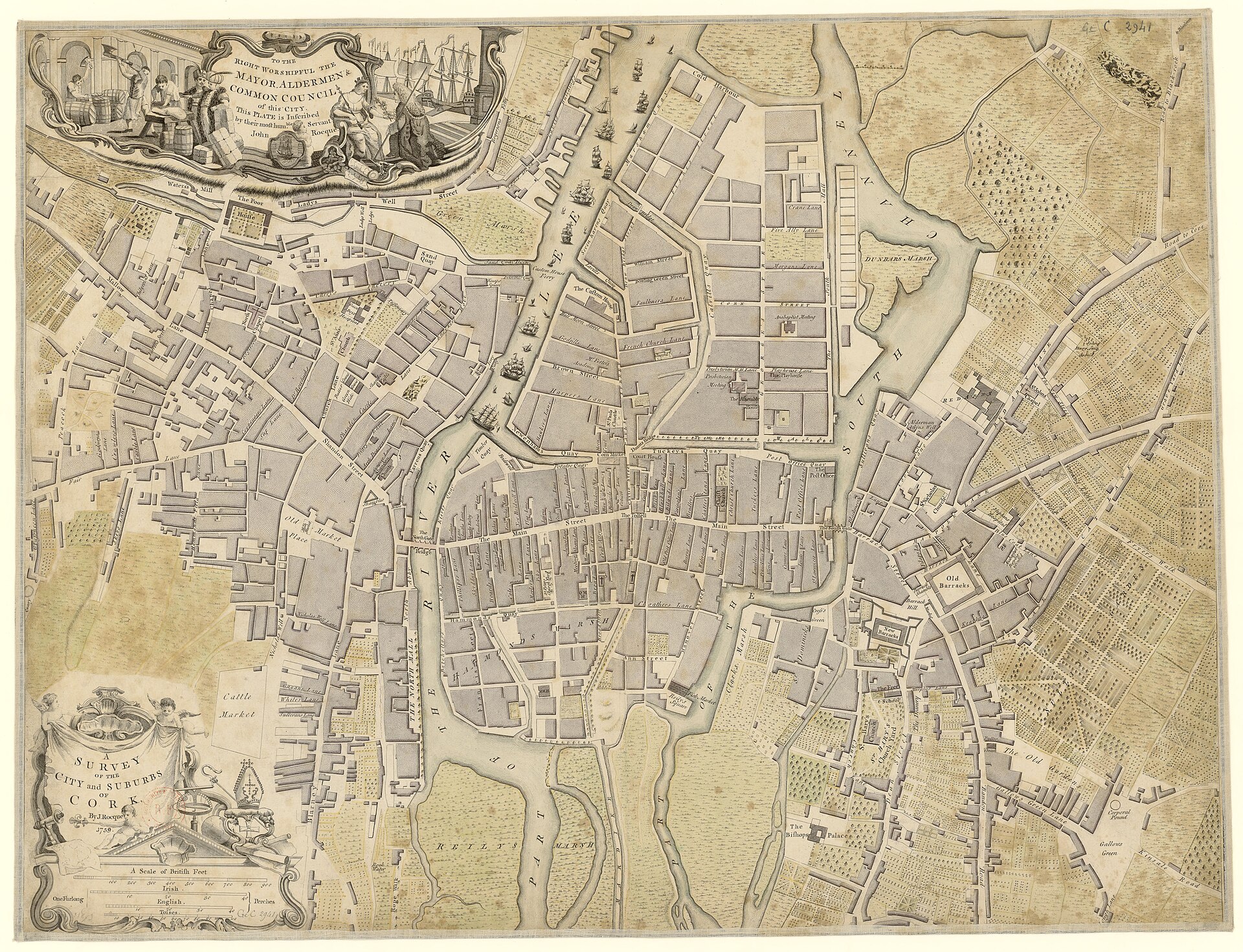
Town plan of Cork, from 'A Survey of the City and Suburbs of Cork' by J. Rocque
Shows the walled old town with streets and blocks, gates, quays and the River Lee with adjoining islands and market areas.
1759 · Wikimedia Commons
Public domain (plate dated 1759)

Ships tied to Cork
- RMS Lusitania: Cork Sub Aqua Club divers found .303 ammunition in her bow section
- SMS Schlesien: A call at Cork brought a snub over the German press's line on Pope Pius XI
Castles of Cork


More cities to explore
 IrelandWaterfordExplore it in 1200
 IrelandKilkennyExplore it in 1620
 IrelandDublinExplore it in 1000 · 1780 · 1904
 IrelandBelfastExplore it in 1800 · 1911
Castles of Europe · Landmarks of Europe · create your own reconstruction.