
Ireland · Still standing
Howth Castle
Howth Castle is a historic dwelling on the Howth peninsula near Dublin, long held by the St Lawrence family since the Anglo-Norman period. The standing building incorporates 14th–15th century stone work together with later remodelling by Edwin Lutyens and sits within an extensive wooded demesne that includes formal gardens, walks and shoreline views over Dublin Bay and Ireland's Eye.
First raised
1235
Its prime
1911
Today
Still standing
As it stood in 1911
What Howth Castle looked like in its prime.
Long, horizontally emphasised house massing composed of a low white-rendered wing of regular sash windows attached to a taller central stone block and several crenellated square towers; castellated parapets and stepped battlements run along the roofline. The stone ranges are pale grey to off-white, roofs appear slate, and the building sits behind a broad lawn surrounded by dense woodland with open views seaward toward Dublin Bay and Ireland's Eye.
Its story
The story of Howth Castle.
The St Lawrence Lordship, 1177–1909
Almeric Tristram, the first Lord of Howth, came to Ireland with John de Courcy in 1177 and likely built a modest wooden castle near the harbour close to the present village. The St Lawrence family held the feudal lordship of Howth from 1179/80. Their original timber castle stood on Tower Hill above Balscadden Bay before a deed of 1235 records a new castle, again built in wood, raised on the current site; the first stone castle followed in the next century, and the oldest surviving parts of the present building are likely the keep and gate tower, dating from around 1450.
Heads of the family held in turn the feudal barony of Lord Howth until about 1425, the title Baron Howth until 1767, and the earldom of Howth until 1909.
Grace O'Malley and the Locked Gates, 1576
A popular legend holds that the Gaelic chieftain and "pirate queen" Gráinne O'Malley called at the castle in 1576 while travelling from Dublin, seeking a courtesy visit with the 8th Baron Howth. Told the family was at dinner and finding the gates closed against her, she abducted the baron's grandson and heir, the future 10th Baron. He was released after a promise was given that the castle's gates would be kept open to unexpected visitors and an extra place set at every meal.
Estate, Racecourse and the Lutyens Remodelling, 1710–1911
Beech hedges planted in the demesne in 1710 are among the oldest in Ireland. In 1829 Thomas St Lawrence, 3rd Earl of Howth, established a racecourse on the estate that drew Ireland's leading owners, trainers and jockeys before racing stopped permanently in 1842, likely following the death of his first wife, Emily. At its largest the estate took in much of coastal north Dublin, including Kilbarrack, Raheny and parts of Clontarf, land gradually sold off from the mid-19th to the mid-20th century. In 1911 the architect Edwin Lutyens restyled the 14th-century castle.
The Tetrarch Sale, 2018–2021
In October 2018 Julian Gaisford St-Lawrence, whose family had held the castle as distaff heirs to the St Lawrences since 1909, announced its sale, together with the hotel, 470 acres of demesne and Ireland's Eye, to the Tetrarch investment group, which planned a luxury resort; the sale closed in 2019, ending a family tenure stretching back to the 12th century.
A seven-acre parcel by the castle gate, zoned for residential development, was sold on by Tetrarch to Glenveagh Homes for €14m. The castle's contents, including most of its furniture, were auctioned by Fonsie Mealy in Malahide in 2021, with its books and letters sold separately in Sutton.
Step inside
10 places to explore in 1911.
The record describes 10 distinct spots at Howth Castle, including 2 interiors: lutyens library (interior), georgian kitchens (service wing). Create your own photoreal reconstruction and explore every one, more scenes means more rooms, more angles, and more of the place to stand in.
Build Your Own Castle
Recreate Howth Castle with AI to explore it.
The artist rebuilds it as it stood in 1911, a photoreal reconstruction that belongs to you alone. Pay with coins, no subscription needed.
Recreate this castle →Defend this castle →Whose castle
Clans who held Howth Castle.
The families that held Howth Castle for a decade or more across its history, follow a name to its clan.
St Lawrence
Feudal lords of Howth from 1179/80; held the castle as Lords, Barons and Earls of Howth until 1909.
Gaisford-St Lawrence
Distaff heirs of the St Lawrences; held the castle from 1909 until its sale to the Tetrarch investment group in 2019.
From the archive
Howth Castle on paper: the measured plan and period views.
The survey plan and photographs below are the ground truth this page's reconstructions are checked against, drawn and photographed while the castle was still a working garrison. Every image is public-domain or openly licensed, with its source named.
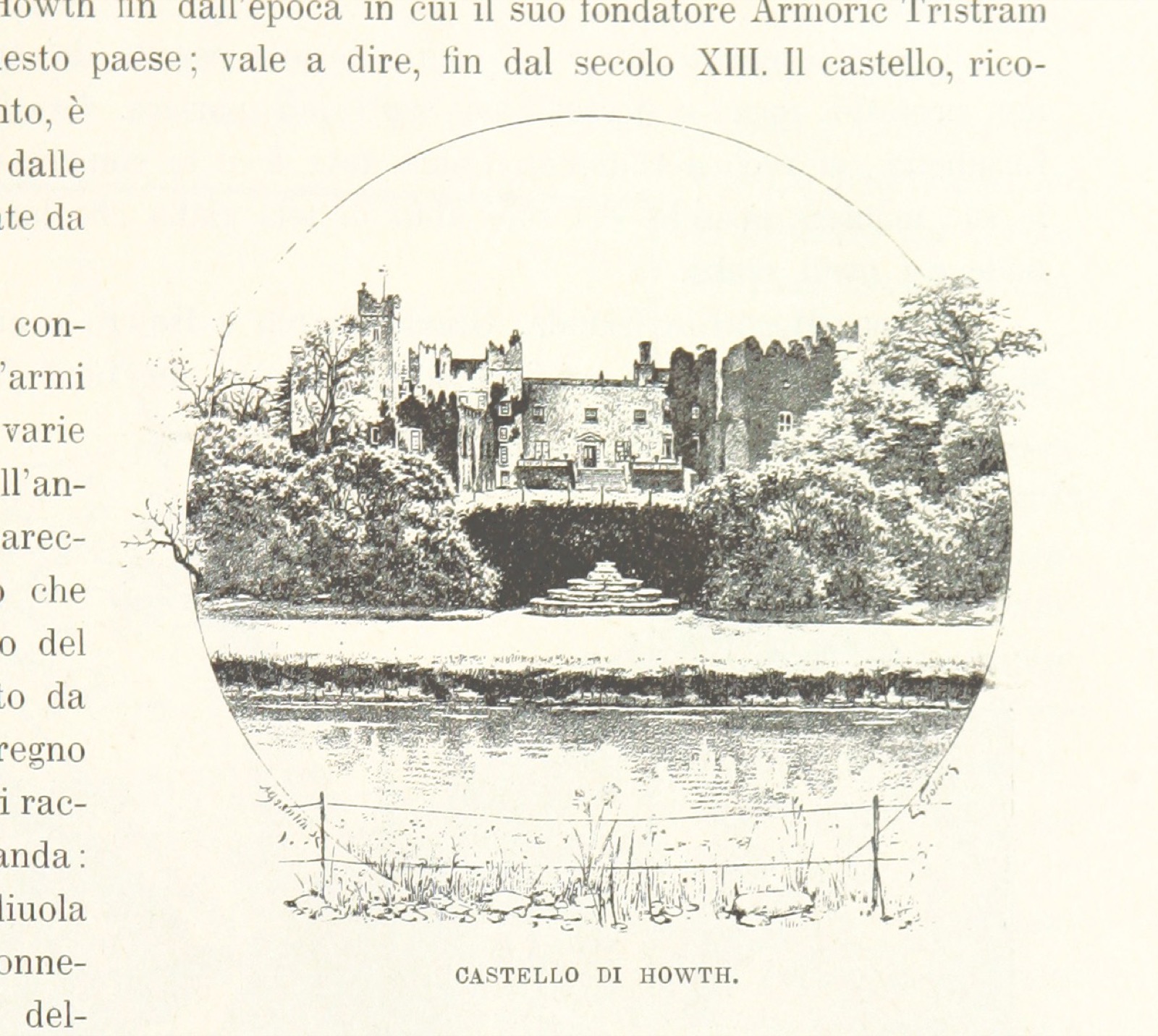
Howth Castle from "Inghilterra, Scozia e Irlanda. Opera illustrata con 494 incisioni, etc".
1897 · The British Library (via Europeana)
Public domain
Nearby
Landmarks within reach of Howth Castle.


Questions about Howth Castle
What is the history of Howth Castle?
What is inside Howth Castle / what can you see in it?
Why was Howth Castle built, and what was it used for?
Where is Howth Castle?
When was Howth Castle built?
Which family or clan held Howth Castle?
What did Howth Castle look like in its prime?
Is Howth Castle still standing or is it a ruin?
More castles of Ireland


Explore the city


