Edwards
Son of Edward, densest along the eastern marches where the name first crossed.
- Origin
- Powys, Wales
- Famous bearer
- Lewis Edwards (1809–1887), founder-principal of the Bala Theological College
- Register
- Welsh family
The Edwards arms and country

Coat of armsEscutcheon of the Edwards baronets of York (1691)Borne by the York line, one branch of the name rather than all of it.Charles Matthews · CC BY-SA 4.0 
Coat of armsEscutcheon of the Edwards baronets of Treforis (1921)Borne by the Treforis line, one branch of the name rather than all of it.Charles Matthews · CC BY-SA 4.0
.svg)
.svg)
- Coat of arms: Granted to an individual and inherited down that one documented line. These are the arms of particular families of the name, not of everyone who shares the surname.
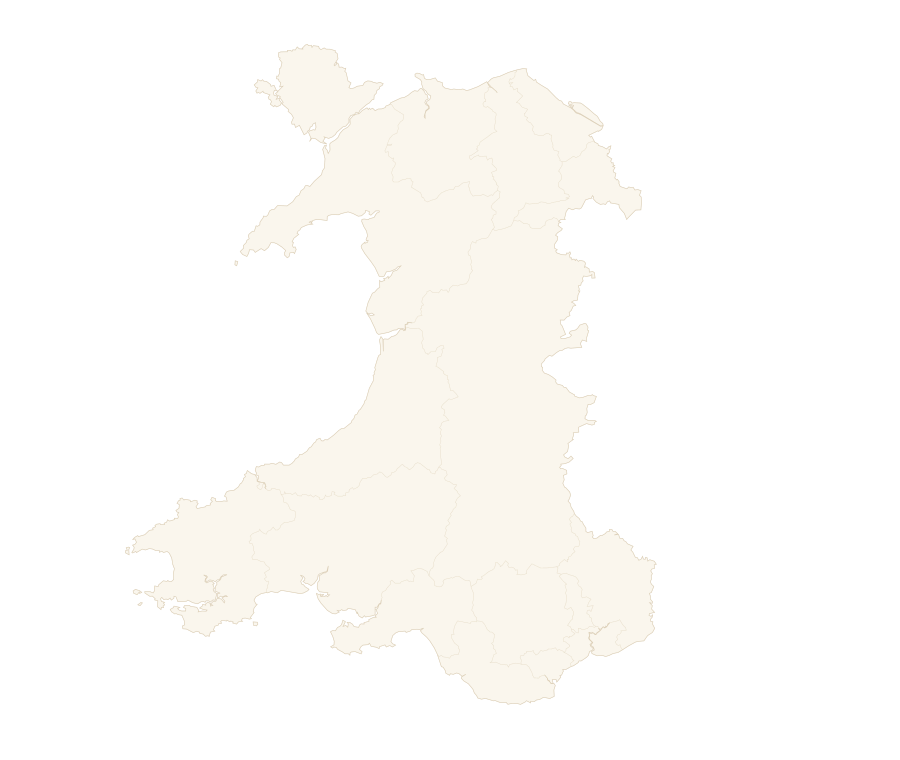
CoreHistoric reach
The seat of Edwards
Seat vacantChief
No one leads the Edwards community yet. When the movement opens, you can stand for its leadership, or help elect whoever does.
Current mission
No shared goal set yet. Once Edwards has leadership, it sets the public focus: a restoration, a gathering, a real-world project that helps its own.
The Edwards clan is being rebuilt. Join the waiting list for the movement today, and you help decide who leads it and what it does.
Help rebuild the Edwards clan →What does the Edwards name mean?
Son of Edward. The patronymic 'ap Edward', Edward being a name of Old English origin, Eadweard, 'guardian of wealth', compressed under the Tudor administration with the genitive 's' added. The name was brought into Welsh use particularly through the eastern marches, where Edwardian English influence had run deepest.
The history of Edwards
Ap Edward, and the clerk who dropped the ap
In 1292 some 48 per cent of Welsh names were patronymics, and in certain parishes more than 70 per cent. A man's name was rebuilt every generation: Evan son of Thomas was Evan ap Thomas, Evan's son John was John ab Evan, John's son Rees was Rees ap John. The chain could run back through grandfathers to a seventh ancestor, so that Llewelyn ap Dafydd ab Ieuan ap Gruffudd ap Meredydd was at once an identification and a genealogy of the male line: the descent Welsh law required a man to be able to recite.
Fixed surnames came in from the 15th century, and under Henry VIII they became hereditary among the Welsh gentry before spreading slowly to commoners. Districts where English influence was strongest gave up patronymics earliest, which is why the Edwards weight sits where it does on the map. Some names kept the ap folded into the front: ap Hywel to Powell, ap Rhys to Price, ab Owen to Bowen. The rest dropped it for the English genitive s, the road by which Edwards, Jones and Roberts became the commonest surnames in Wales. The stock of baptismal names was small, so two Edwards households in one village need not share an ancestor at all.
Bala, 1837, and the professions after it
Lewis Edwards (1809–1887) founded the Bala Theological College in 1837 and served as its first principal, setting it down in a country where the nonconformist and Methodist tradition ran deep, the tradition behind the Presbyterian Church of Wales. He is remembered as a Welsh educator rather than a preacher, and Bala is the institution that description rests on. He outlived its founding by half a century.
Others took the routes the Welsh nineteenth and twentieth centuries opened. Clement Edwards (1869–1938) worked as lawyer, journalist, activist and politician. Tudor Edwards (1890–1946) was a Welsh thoracic surgeon; Dianne Edwards, born 1942, a Welsh palaeobotanist. Richey Edwards (1967–1995, presumed) was the Manic Street Preachers' Welsh musician.
Glamorgan coal and the meaning of 'reasonably practicable'
The Wales the name multiplied in was being remade by coal. The population doubled from 587,000 in 1801 to 1,163,000 in 1851 and reached 2,421,000 by 1911; Glamorganshire alone went from 71,000 people to 232,000 and then to 1,122,000 across the same years. Ness Edwards (1897–1968) came out of that world as a Welsh miner, trade unionist and politician.
The industry also fixed the surname to the standard by which its own safety is judged. Edwards v National Coal Board, decided in the English Court of Appeal in 1949, settled what 'reasonably practicable' means.
Enfield, the eighth of July 1741
The American line began with the Reverend Richard Edwards of Hertfordshire, a clergyman of Welsh extraction who emigrated to Hartford in the 1640s. His descendant Timothy Edwards held the Congregational parish of East Windsor in the Connecticut Colony, and there on the fifth of October 1703 Jonathan Edwards was born, fifth child and only son, his mother Esther Stoddard a daughter of the Northampton divine Solomon Stoddard. He entered Yale at twelve in 1716 and tutored there as a junior fellow from 1724.
Ordained on the fifteenth of February 1727 as junior pastor at Northampton, Massachusetts, under his own grandfather, he took the full pastorate on Stoddard's death in 1729 and held the largest Puritan parish in western Massachusetts for twenty-three years. From December 1734 he preached the series on justification by faith alone that produced the Connecticut River Valley revival; his account of it, A Faithful Narrative of the Surprising Work of God (1737), became the founding text of the movement that his joint tours with George Whitefield in 1740 and 1741 turned into the First Great Awakening.
On the eighth of July 1741 he preached at Enfield, Connecticut, the sermon Sinners in the Hands of an Angry God. By the account of the witness Stephen Williams the congregation was reduced to such audible distress that Edwards stopped repeatedly to ask for silence; the text was printed within the month and ran to twenty-three editions by 1750. Dismissed from Northampton in 1750 over the qualifications for communion, he took the frontier mission at Stockbridge in 1751 and wrote there Freedom of the Will (1754). Elected to the presidency of the College of New Jersey, he took office in February 1758, was inoculated against smallpox on the twenty-third of that month, contracted the disease from the inoculation, and died on the twenty-second of March, five weeks into the office.
The Steer colliery to Cardiff Arms Park
Gareth Owen Edwards was born on the twelfth of July 1947 at Gwaun-Cae-Gurwen in the upper Amman Valley, eldest son of Glanmor Edwards, a coalminer at the Steer colliery, and Annie Edwards. He went to the village primary school and Pontardawe Grammar, was picked out at fourteen by the Welsh schools coach Bill Samuel, and on Samuel's recommendation took a sixth-form scholarship to Millfield in Somerset.
He debuted for Cardiff at nineteen in 1966 and was capped for Wales at twenty against France at the Stade Yves-du-Manoir on the first of April 1967. Named captain the next year, the youngest in the history of the Welsh side, he then played fifty-three consecutive Tests to his last, against France at Cardiff Arms Park on the eleventh of March 1978, the longest unbroken run of consecutive Tests by any player in any Test rugby side. Inside it sit the Grand Slams of 1971, 1976 and 1978 and the Lions series wins in New Zealand in 1971 and South Africa in 1974.
On the twenty-seventh of January 1973 at Cardiff Arms Park, in the Barbarians' match against the All Blacks, he finished the try since called the greatest ever scored: Phil Bennett's sidestep on the Barbarians' own 25, then JPR Williams, John Pullin, John Dawes and Tom David in one unbroken handling movement the length of the field, and Edwards diving in at the corner. He retired in 1978 with twenty Test tries, then a Welsh record, and was knighted in the 2015 Birthday Honours.
Coquimbo, Valparaíso and the newspaper the family bought
A branch of the English Edwards went to Chile and stayed. George Edwards Brown (1780–1848), British-born and known there as Jorge, was a doctor, businessman and politician, and the founder of the family in the country. His son José Joaquín Edwards Ossandón (1808–1869) became the first Mayor of Coquimbo; another son, José Agustín Edwards Ossandón (1815–1878), built the mining and banking interests that made the name a power and acquired El Mercurio de Valparaíso. Agustín Edwards Mac-Clure (1878–1941) served as President of the League of Nations and founded the Santiago edition of the paper.
The press holding became the family's mark on Chilean politics: under the supervision of Agustín Edwards Eastman (1927–2017), El Mercurio played a significant part in the propaganda campaign that turned opinion against Salvador Allende and in favour of the coup that installed Augusto Pinochet. Other Edwardses ran elsewhere: the novelist Jorge Edwards Valdés (1931–2023), who won the Cervantes Prize in 1999, and María Edwards McClure de Errázuriz (1893–1972), a social worker and nurse who served in the French Resistance.
The name in the law reports and on the map
Borne this widely, the surname is fixed to a run of decisions with nothing else in common. Edwards v. Canada (Attorney General), the 1930 ruling of the Judicial Committee of the Imperial Privy Council remembered as the Persons Case, decided whether women were eligible to sit in the Canadian federal Senate, the fight the Canadian feminist and author Henrietta Edwards (1849–1931) spent her life in. Edwards v. California (1941) concerned interstate migration, and Edwards v. Aguillard (1987) the teaching of creationism in Louisiana.
The map took it too. Edwards Air Force Base in California is named for the American test pilot Glen Edwards, and Edwards counties stand in Illinois, Kansas and Texas. Behind all of it is bare frequency: fourteenth commonest surname in Wales, twenty-first in England, forty-ninth in the United States at the 1990 survey and fifty-first by 2014.
Champions of the Edwards name
The bearers whose lives are inseparable from this surname. Each has their own page, biography, achievements, geography, connection to the family.
- Jonathan Edwards
The Welsh-descended Massachusetts Congregational divine whose 1741 Enfield sermon Sinners in the Hands of an Angry God touched off the First Great Awakening, and whose Freedom of the Will (1754) is on every modern list of the foundational works of American philosophy.
- Sir Gareth Edwards
The Gwaun-Cae-Gurwen-born Welsh scrum-half whose fifty-three consecutive caps for Wales between 1967 and 1978, three Five Nations Grand Slams (1971, 1976, 1978), two Lions tour series wins (1971 in New Zealand and 1974 in South Africa, both as part of unbeaten Lions tours), and his single greatest try (the Barbarians try against the All Blacks at Cardiff Arms Park on the twenty-seventh of January 1973) made him by general acclamation the greatest rugby union player of the twentieth century.
Historic Places, Rebuilt
Explore the streets and seats the Edwards name knew, rebuilt with AI as they stood in history.
Historic Places, Rebuilt · New
Edward I's walled bastide and mighty castle in North Wales, a generation after the conquest, the banded towers still rising.
Historic Places, Rebuilt · New
Owain Glyndŵr's mountain fortress and court at the high tide of Welsh independence, the English siege lines gathering below.
Historic Places, Rebuilt · New
The grandest castle-palace in Wales at its height, the moated Yellow Tower, fountain courts and long gallery, on the eve of the siege.
The castles of the homeland
The great strongholds of the homeland, look one up, see what it looked like in its prime, and recreate it to explore.
 Caernarfon CastleRestored · prime 1330
 Conwy CastleRuin · prime 1287
 Pembroke CastleRestored · prime 1280
All castles in Wales → · Strongest castles in Wales → · Castles of Europe
Play As Your Clan
Hold a real castle against whatever you choose to send at it, take a ship out in her own service years, or stand at the shoulder of someone the record remembers. The chronicler sets the scene; the deeds are yours.
Notable bearers of the Edwards name
- Lewis Edwards (1809–1887), founder-principal of the Bala Theological College
- Twm o'r Nant, Thomas Edwards (1738–1810), Welsh-language interlude playwright
- Sir O. M. Edwards (1858–1920), Welsh educational reformer
- Gareth Edwards (b. 1947), rugby player, often called the greatest of all time