Glyndŵr
also Glendower, Owain Glyndŵr
The last native-born Prince of Wales, and the longest revolt the Welsh would ever raise.
- Origin
- Powys, Wales
- Famous bearer
- Owain Glyndŵr (c.1359–c.1415), last native-born Prince of Wales
- Register
- Welsh family
Ranked of all time
The 10 Most Powerful Welsh Houses of All Time
Where the Glyndŵr name comes from
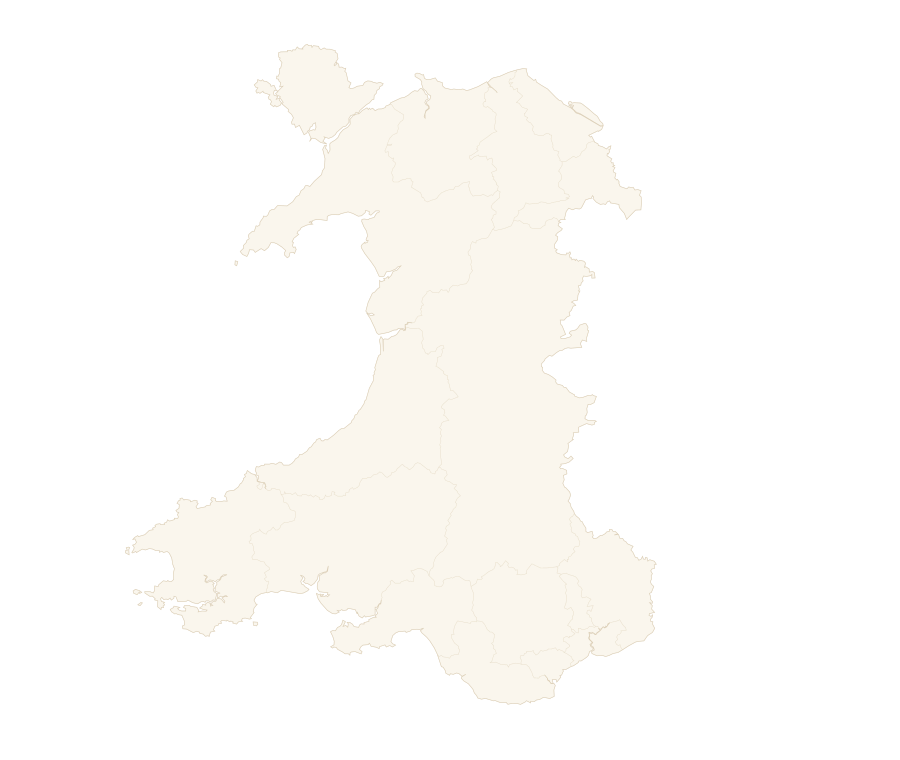
CoreHistoric reach
The seat of Glyndŵr
Seat vacantChief
No one leads the Glyndŵr community yet. When the movement opens, you can stand for its leadership, or help elect whoever does.
Current mission
No shared goal set yet. Once Glyndŵr has leadership, it sets the public focus: a restoration, a gathering, a real-world project that helps its own.
The Glyndŵr clan is being rebuilt. Join the waiting list for the movement today, and you help decide who leads it and what it does.
Help rebuild the Glyndŵr clan →What does the Glyndŵr name mean?
From Glyndyfrdwy, 'the valley of the Dee water', Owain ap Gruffydd's lordship in Merionethshire, by which he was distinguished from other Owains and through which his descendants took the byname. The form Glyndŵr is the contracted Welsh; Glendower is Shakespeare's English approximation. As a hereditary surname it is rare; as a name carried with intent it is the most resonant in modern Welsh political memory.
The history of Glyndŵr
The valley of the Dee water
Almost every other Welsh surname on this atlas is a father's name frozen in place. This one is a valley. Owain ap Gruffudd held the small lordship of Glyndyfrdwy on the upper Dee, and Glyndyfrdwy means the valley of the Dee water; men called him after the land because there were more Owains in Wales than anyone could keep straight. The Welsh contracted it to Glyndŵr. Shakespeare, reaching for it in English, wrote Glendower, and that is the spelling most of the world met first.
As a hereditary surname it is rare, and it is honest to say why: it was never really passed down a line of tenants and freeholders the way an ordinary patronymic was. It is a name people take up on purpose. Owain also held Cynllaith Owain on the upper Tanat, and between those two commotes sat what was left of the senior Welsh princely blood after Edward the First's conquest of 1282. The name carries that, and modern Welsh political memory has never let it go.
The Marcher gentleman at Sycharth
Nothing in Owain's first forty years pointed at a war. Born around 1359, he was heir to the princely house of Powys Fadog through his father, descended from Madog ap Maredudd, the last prince of an undivided Powys, and to Deheubarth through his mother, from the line of the Lord Rhys of Dinefwr. He was educated at the Inns of Court in London, served as a squire in the household of Henry Bolingbroke, the future Henry the Fourth, and bore arms for the English crown in Scotland and Flanders in the 1380s, including Richard the Second's Berwick campaign of 1385.
He inherited Sycharth in 1369, a motte and bailey castle near Llansilin whose commotes had passed to Madog Crypl, lord of Glyndyfrdwy and lord of Cynllaith Owain, around 1275 to 1304. Sycharth is remembered as Owain's birthplace, and it was the hall where he lived with his wife Margaret Hanmer and their children, and kept Iolo Goch as his court poet. The site sat in historic Denbighshire until 1996, when it was transferred to the Montgomeryshire part of Powys. By every contemporary account the man in that hall was a thoroughly Anglicised gentleman of the Marches.
A strip of common land, and the sixteenth of September 1400
The war that followed began over a boundary. In 1399 his Marcher neighbour Reginald Grey of Ruthin seized a strip of common land lying between their estates and held it. Owain went through the proper channels: he appealed to the Westminster courts, he rode to London to plead the case in person, and Henry the Fourth's parliament mishandled it and sent him away with nothing. That is the whole provocation, a local quarrel that the English legal order could not be bothered to settle fairly for a Welshman.
On the sixteenth of September 1400, at Glyndyfrdwy, a small assembly of his cousins and tenants proclaimed him Tywysog Cymru, Prince of Wales. It was the first sovereign Welsh claim to the title in a hundred and eighteen years, since Llywelyn the Last was killed at Cilmeri in December 1282. Within a week Owain had stormed Ruthin and burnt the Grey estates. Within a month Denbigh, Hawarden, Holt, Oswestry and Welshpool had gone, and the rising had spread across the whole of north Wales.
Good Friday at Conwy, and the slope at Hyddgen
He then held the principality for ten years against the full military and financial weight of the Plantagenet state. Conwy Castle fell in March 1401 to a Good Friday raid by Rhys and Gwilym ap Tudur of Penmynydd in Anglesey, cousins of the rising's leadership, whose Anglesey house would later give England the Tudor kings. In June 1401 Owain met Henry the Fourth in person on the slopes of Plynlimon and beat him at Hyddgen, a fight the Welsh have kept the name of ever since.
Harlech and Aberystwyth both fell in 1404, and Owain made Harlech his royal seat. Through 1404 and 1405 he controlled Wales from Anglesey to the Severn, with only the great Marcher castles of the south-east standing outside his authority. For a reader tracing this name, that is the fact to hold on to: for two years there was a functioning Welsh principality with its own prince, its own castles and its own foreign policy, and no English king has had to face the like since.
Machynlleth, and the letter sent to Charles the Sixth
What separates Owain from every earlier Welsh rising is that he built institutions while he fought. He convened the first Welsh parliament at Machynlleth in 1404 and was crowned Prince of Wales there before envoys from France, Castile and Scotland. A second parliament sat at Harlech in 1405. A treaty with Charles the Sixth of France was sealed in 1404, which made the principality a recognised party to a European alliance rather than a rebellion the crown could describe as banditry.
On the thirty-first of March 1406 he sent Charles the Sixth what is known as the Pennal Letter, and it is the constitutional programme of the independent Wales he intended: a Welsh church under its own archbishop at St David's and answerable to Rome, two Welsh universities, one in the north and one in the south, and full recognition of Wales as a sovereign state allied to France. Six hundred years on it is still read as the founding document of modern Welsh national identity, which is a strange afterlife for a letter written in the middle of a war.
Milford Haven, Worcester and the three-way carve-up of a kingdom
In August 1405 a French expeditionary force of two thousand five hundred men under Jean de Rieux landed at Milford Haven and marched with Owain to Worcester, bringing him within eight miles of the English Midlands border. A Plantagenet army under Henry the Fourth came out to meet him. What should have been the deciding battle of the war ended instead in a stand-off and a French withdrawal, and the moment did not come again.
Earlier that year, in February 1405, Owain had put his name to the Tripartite Indenture with Edmund Mortimer and the Percys of Northumberland, an agreement to break England and Wales into three sovereign realms, with Owain's Wales running east to the Severn and the Trent. Through 1405 and 1406 he held his territory at its high-water mark. It is worth saying plainly that this was not a raiding chief's ambition; it was a settled plan for a different Britain, signed by three parties who thought they could deliver it.
The prince nobody ever captured
From 1407 the ground contracted. Prince Hal, the future Henry the Fifth, retook Aberystwyth in 1408 and Harlech in 1409. Owain's wife Margaret and four of his daughters were taken at Harlech and carried to the Tower of London. From 1410 what remained was a mountain war in the Carneddau and the Berwyn hills, fought by a man who had convened parliaments at Machynlleth and Harlech. He raided into Shropshire in 1412, and after that he is simply not in the record.
Henry the Fifth offered him a royal pardon in 1415 and he refused it. He is presumed to have died that year, in his fifty-sixth, somewhere among the hill tenants of Herefordshire or southern Powys; tradition places him around Monnington-on-Wye and the small church at Kentchurch. No English chronicle records where he died and no Welsh source claims to know where he lies, and there is something fitting in a prince the crown could never produce, alive or dead. The Glyndŵr Way now runs across the central Welsh hills from Knighton to Welshpool, over the country he fought for. His was the last attempt to restore an independent Welsh principality, and the longest sustained native rising against the English crown anywhere in Britain or Ireland.
Champions of the Glyndŵr name
The bearers whose lives are inseparable from this surname. Each has their own page, biography, achievements, geography, connection to the family.
Historic Places, Rebuilt
Explore the streets and seats the Glyndŵr name knew, rebuilt with AI as they stood in history.
Historic Places, Rebuilt · New
Owain Glyndŵr's mountain fortress and court at the high tide of Welsh independence, the English siege lines gathering below.
Historic Places, Rebuilt · New
Edward I's walled bastide and mighty castle in North Wales, a generation after the conquest, the banded towers still rising.
Castles the Glyndŵr held
Strongholds this name held for a decade or more, look one up, or rebuild it to explore.
- Sycharth Castle
Held by the lords of Glyndyfrdwy from Madog Crypl (c.1275–1304); Owain Glyndŵr inherited Sycharth in 1369 and lived here with Margaret Hanmer and their children.
The castles of the homeland
The great strongholds of the homeland, look one up, see what it looked like in its prime, and recreate it to explore.
 Caernarfon CastleRestored · prime 1330
 Conwy CastleRuin · prime 1287
 Pembroke CastleRestored · prime 1280
All castles in Wales → · Strongest castles in Wales → · Castles of Europe
Play As Your Clan
Hold a real castle against whatever you choose to send at it, take a ship out in her own service years, or stand at the shoulder of someone the record remembers. The chronicler sets the scene; the deeds are yours.
Notable bearers of the Glyndŵr name
- Owain Glyndŵr (c.1359–c.1415), last native-born Prince of Wales
- Iolo Goch, court poet to Glyndŵr at Sycharth
Stories of Glyndŵr
The Pennal Letter
1406By the spring of 1406 Owain Glyndŵr had been Prince of Wales in fact for six years. He had held parliaments at Machynlleth in 1404 and Harlech in 1405, with elected representatives from every commote of Wales. He had a French alliance with Charles VI sealed by treaty and reinforced the previous summer by a French expeditionary force that had landed at Milford Haven. From the village of Pennal near Machynlleth on the thirty-first of March 1406, Glyndŵr dictated to his clerk a letter to the king of France. It set out a complete programme for an independent Welsh state: two universities, a Welsh-speaking church, an archdiocese at St Davids, a sovereign Welsh polity. The letter survives in Paris. It is the most coherent vision of Welsh sovereignty ever written, and it is what the country would not have for another five hundred years.
Read the story →
Hyddgen
1401In the middle of June 1401, on the eastern flank of Plynlimon (Pumlumon) in the mid-Wales uplands, about ten miles east of the village of Machynlleth, Owain Glyndŵr, then forty-two years old, with a Welsh force of about a hundred and twenty mounted-and-foot men of the northern Powys-and-Gwynedd cantrefs, ambushed and broke a Flemish-English military expedition of about a thousand five hundred men under the Marcher captain Sir Edward Tudor (a distant Welsh cousin of Glyndŵr's by the Tudor-Anglesey line). The Hyddgen ambush, fought on a high marsh-pasture between the Hyddgen Brook and the source of the Wye, was the first major military victory of the Glyndŵr rebellion since the Sycharth proclamation of September 1400, and is, by every careful judgment of Welsh-medieval historiography (R. R. Davies, Gwyn A. Williams), the tactical engagement that converted the Glyndŵr rebellion from a localised Powys boundary-dispute into a national Welsh military movement. Within twelve months of Hyddgen, the Glyndŵr rebellion controlled most of Wales west of Offa's Dyke.
Read the story →
Frequently asked
What does the surname Glyndŵr mean?
Where does the Glyndŵr family come from?
Where did the Glyndŵr family historically hold territory?
Is Glyndŵr Welsh or English?
How old is the Glyndŵr surname?
What is the Glyndŵr family known for?
Is there a Glyndŵr family crest or coat of arms?
Who is the most famous Glyndŵr?
Who are some famous Glyndŵrs?
What stories are told about the Glyndŵr family?
What is the story of the Pennal Letter?
Is Glendower the same family as Glyndŵr?
Is Owain Glyndŵr the same family as Glyndŵr?
Where is the Glyndŵr surname found today?
What does the Clan Rising page for the Glyndŵr family cover?
Who is the head of the Glyndŵr family today?
Neighbouring clans
- EvansSon of John, by the Welsh road, the cousin name of Jones.
- LewisLlywelyn anglicised, a princely name carried into common use across the Marches and the south.
- OwenThe princely name, Owain in Welsh, the surname of the last revolt and the first Tudor.
- EdwardsSon of Edward, densest along the eastern marches where the name first crossed.