Wales · Ruin
Harlech Castle
Castell Harlech
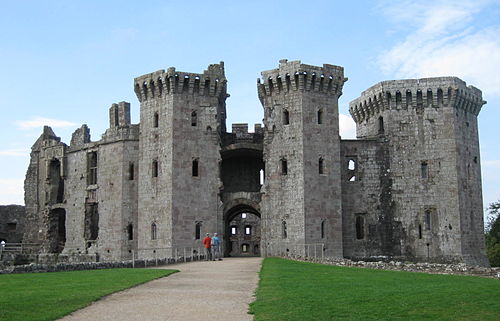
Harlech Castle is a late 13th-century concentric stone fortress built by Edward I on a rocky knoll above the Irish Sea at Harlech, Gwynedd. Constructed between 1282 and 1289, it features a prominent D-shaped gatehouse, multiple round towers and a water-gate with a stair to the shore; it is a World Heritage Site managed by Cadw and now survives as a ruin.
First raised
1283
Its prime
1289
Today
Ruin
As it stood in 1289
What Harlech Castle looked like in its prime.
Concentric stone castle perched on a rocky knoll (the Harlech Dome) overlooking coastal plains and dunes, built of local grey‑green sandstone with pale yellow ashlar detail. A massive D‑shaped gatehouse with twin round flanking towers dominates the eastern approach, reached by a stone bridge across a rock‑cut ditch and former bridge towers. The inner ward is ringed by four large circular towers and curtain walls with crenellated walkways; a water‑gate and a long flight of 127 steps descend the cliff to the former shoreline.
Its story
The story of Harlech Castle.
Edward I's invasion and the build of 1282–1289
English kings and Welsh princes had vied for control of North Wales since the 1070s, and in 1282 Edward I intervened for the second time in his reign, invading with the largest force he had yet raised in Britain. His forces advanced down the Conwy valley through Dolwyddelan and Castell y Bere onto Harlech, which Sir Otton de Grandson took with 560 infantry in May. Edward ordered a castle raised on the rocky knoll above the Irish Sea, one of seven built across North Wales after the campaign. Money for the first phase arrived in mid-May; carpenters and 35 stonemasons were sent in June and July, and by the winter of 1283 the first 4.5 metres of the inner walls stood, enough to defend the site if attacked.
Work proceeded under James of Saint George, a Savoy architect and military engineer whose concentric design set one line of defences inside another. At the height of construction in 1286 the site employed 546 labourers, 115 quarriers, 30 blacksmiths, 22 carpenters and 227 stonemasons, at nearly £240 a month. The castle was essentially complete by the end of 1289 for an estimated £8,190, about 10 per cent of the £80,000 Edward spent on castles in Wales between 1277 and 1304.
A garrison of 36 and Madog ap Llywelyn's winter siege
Master James was rewarded with the constableship from 1290 to 1293, holding a garrison of 36: a constable, 30 soldiers including 10 crossbowmen, a chaplain, a smith, a carpenter and a stonemason. The first test came in 1294, when Madog ap Llywelyn's uprising against English rule spread quickly through Wales, razing English-held towns and besieging Harlech that winter alongside Criccieth and Aberystwyth. The design proved itself; fresh supplies came from Ireland by sea through the water gate, and the revolt was quashed. Defences were then added around the route down to the sea, and in 1323–1324, after the Despenser War, Edward II ordered his sheriff Sir Gruffudd Llwyd to extend the approach to the gatehouse with additional towers.
Owain Glyndŵr's headquarters, 1404–1409
Revolt broke out in North Wales under Owain Glyndŵr in 1400, and by 1403 only a handful of castles, Harlech among them, still held against the rebels. It was in no state for a siege: the garrison had three shields, eight helmets, six lances, ten pairs of gloves and four guns. At the end of 1404 the castle fell, and for four years it served as Glyndŵr's residence, family home and military headquarters; he held his second parliament there in August 1405.
In 1408 English forces under the future Henry V besieged Harlech and its commander Edmund Mortimer, bombarding it with cannon and probably destroying the south and east parts of the outer walls. When that failed, Henry left John Talbot in charge and moved on to Aberystwyth. Supplies ran short, Mortimer and many of his men died of exhaustion, and Harlech fell in February 1409.
Seven years for Lancaster, 1461–1468
Queen Margaret of Anjou fled to Harlech in 1460 after the Battle of Northampton, and from 1461 to 1468 it was held for the Lancastrians by Dafydd ap Ieuan against the Yorkist Edward IV. Its natural defences and the sea supply route let it hold out as other fortresses fell, until it was the last major stronghold in Lancastrian hands: Sir Richard Tunstall mounted attacks from Harlech in 1466, and in 1468 Jasper Tudor landed there with French reinforcements before raiding Denbigh. Tudor's arrival moved Edward IV to order William Herbert to mobilise an army, possibly 10,000 strong, and after a month's siege the small garrison surrendered on 14 August 1468, a seven-year defence credited with inspiring the song 'Men of Harlech'.
The last royal fortress, 1647, and the partial slighting
By the outbreak of the English Civil War in 1642 Harlech had apparently never been repaired after 1468 and was completely dilapidated but for the gatehouse, then used for the local assizes. In 1644 Prince Rupert appointed a local Royalist, Colonel William Owen, as constable and charged him with repairing the fortifications. A long siege ran from June 1646 to 15 March 1647, when the garrison of 44 surrendered to Major-General Thomas Mytton, the last mainland royal fortress to give in, its fall marking the end of the war's first phase. Parliament ordered the castle slighted, but only partly: the gatehouse staircases were destroyed and the castle rendered unusable rather than demolished, and stone was carted off to build houses in the town.
In 1914 the ruin passed from the Merioneth Crown Estate to the Office of Works, which began a major restoration after the First World War, then to the Welsh Office in 1969 and on to Cadw. Harlech was declared part of the Castles and Town Walls of King Edward in Gwynedd World Heritage Site in 1986, ranked by UNESCO with Beaumaris, Conwy and Caernarfon among 'the finest examples of late 13th century and early 14th century military architecture in Europe'.
Step inside
9 places to explore in 1289.
The record describes 9 distinct spots at Harlech Castle, including 3 interiors: gatehouse passage and upper rooms, chapel interior, prison tower (le prisontour) and dungeon. Create your own photoreal reconstruction and explore every one, more scenes means more rooms, more angles, and more of the place to stand in.
Build Your Own Castle
Recreate Harlech Castle with AI to explore it.
The artist rebuilds it as it stood in 1289, a photoreal reconstruction that belongs to you alone. Pay with coins, no subscription needed.
Recreate this castle →Defend this castle →Nearby