Wales · Partial ruin
Raglan Castle
Castell Rhaglan
Raglan Castle is a late medieval fortified residence in Monmouthshire, Wales, developed between the 15th and early 17th centuries by the Herbert and Somerset families. It combined strong polygonal towers and curtain walls with extensive gardens, water features and grand domestic ranges. The castle was besieged and deliberately slighted in 1646 and thereafter partly quarried; today it survives as a substantial romantic ruin and tourist site.
Its prime
1639
Today
Partial ruin
Ranked among Europe’s castles
As it stood in 1639
What Raglan Castle looked like in its prime.
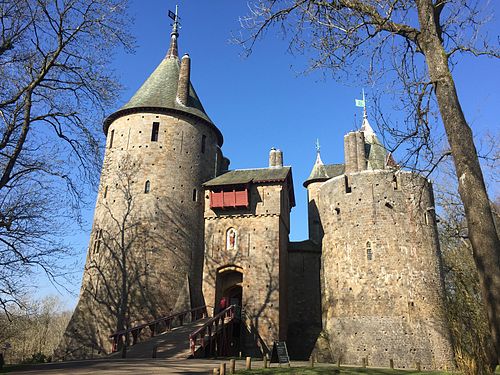
A large late-medieval stone castle set in parkland and water gardens, dominated by a hexagonal Great Tower (the Yellow Tower of Gwent) and a massive south gatehouse flanked by polygonal towers with pronounced corbelled machicolations and crenellated parapets. Continuous curtain walls link ranges of domestic buildings, with paved courts, terraces and a surrounding moat and fishponds. At its prime the roofs, parapets and internal halls were complete and the gardens and avenues were laid out around the complex.
Its story
The story of Raglan Castle.
Sir William ap Thomas Buys the Manor, 1432
The Bloet family held the manor from the late 12th century until the late 14th and built a manor house on the site. The castle standing today was begun by Sir William ap Thomas, the lesser son of a minor Welsh family who rose through mid-15th-century politics on the profits of the local offices he held and on two marriages to heiresses. In 1432 he bought the manor of Raglan for 1,000 marks and began building; the South Gate and the Great Tower survive from that campaign, and most of the rest was later built over.
William Herbert, the First Welsh Earl
Sir William's son dropped the Welsh form of the name and called himself William Herbert. He supported the House of York through the Wars of the Roses and fought in the Hundred Years War, though his fortune came from the Gascon wine trade; he was the first Welshman to be made an earl, and contemporary poets called him a national deliverer who might achieve Welsh independence. In the 1460s he used that wealth to remodel Raglan on a much grander scale, producing what Anthony Emery has called one of the last formidable displays of medieval defensive architecture.
Herbert was executed as a Yorkist in 1469 after the Battle of Edgecote Moor. By 1492 the castle had passed to his daughter Elizabeth, whose marriage to Sir Charles Somerset carried it into a new family line; Somerset was made Earl of Worcester, and his son Henry used lead reclaimed from Tintern Abbey during the dissolution to press the building work on.
Arming for the King, 1642-1646
The First English Civil War began in August 1642 with Raglan held by Henry Somerset, by then elderly, and his son Edward, Lord Herbert, both firm royalists. Charles I sent his own son to Raglan that October to open a fund-raising tour of friendly regions, after which Henry was promoted to first Marquess of Worcester. Protestant feeling in the district ran against the Roman Catholic marquess, and a local group that tried to search the castle was reportedly driven off by the sudden noise of Lord Herbert's water-commanding machine, which used steam to pump a huge spout of water into the air from the moat.
The defences were improved after that, with modern earthwork bastions built around the castle and a powder mill created; a garrison of around 300 men was established at a cost of £40,000. The king came twice himself, in June 1645 after Naseby and again in 1646, when he enjoyed playing bowls on the castle green.
Fairfax's Trenches and the Surrender of 19 August 1646
With Lord Herbert captured in Ireland and an attack looking imminent, the garrison was increased to around 800. The avenue of trees outside the gates was cut down and neighbouring buildings destroyed so that Parliamentary forces could not use them, and food was brought in for a swollen household that now included the wider Herbert family and other regional royalist leaders. The first Parliamentary army arrived in early June under Colonel Morgan and Sir Trevor Williams, and after several calls for surrender the siege settled in through the summer months.
In August additional forces under General Fairfax came up and the calls were renewed. His men dug trenches towards the castle and used them to move mortars forward, probably including the famous Roaring Meg, until the interior lay within artillery range. Facing a hopeless situation, the marquess surrendered on 19 August on relatively generous terms for the garrison. He himself was arrested and sent to Windsor Castle, where he died shortly afterwards; told just before his death that Parliament had granted his request to be buried in the family vault there, he remarked, "Why then I shall have a better castle when I am dead, than they took from me when alive."
The Slighting and the Grand Dilapidator
Fairfax ordered the castle totally destroyed under Henry Herbert, a descendant of William ap Thomas, but the fortifications proved too strong and only a few walls were slighted. Matthew Johnson describes the episode as having the atmosphere of a community festival, as local people dredged the moat in search of treasure and emptied the fishponds of their valuable carp; the library, with its collection of Welsh documents and books, was either stolen or destroyed.
The Somersets recovered Raglan by the Restoration, but the 3rd Marquess rebuilt Troy and Badminton instead. For the first half of the 18th century the family let their stewards quarry the castle for stone, one surveyor carrying off so many chimneys, window frames and staircases that he became known as the Grand Dilapidator. The 5th Duke ended the practice in 1756, and in 1938 the 10th Duke entrusted guardianship to the Commissioner of Works.
Step inside
10 places to explore in 1639.
The record describes 10 distinct spots at Raglan Castle, including 5 interiors: gatehouse passage, great tower machinery chamber, great hall and more. Create your own photoreal reconstruction and explore every one, more scenes means more rooms, more angles, and more of the place to stand in.
Build Your Own Castle
Recreate Raglan Castle with AI to explore it.
The artist rebuilds it as it stood in 1639, a photoreal reconstruction that belongs to you alone. Pay with coins, no subscription needed.
Recreate this castle →Defend this castle →Whose castle
Clans who held Raglan Castle.
The families that held Raglan Castle for a decade or more across its history, follow a name to its clan.
Rebuilt by William Herbert in the 15th century.
Somerset
Held by the Somerset Earls of Worcester until the siege of 1646.
Nearby