Wales · Restored
Pembroke Castle
Castell Penfro
Pembroke Castle is a medieval Norman enclosure castle sited on a rocky promontory beside the Milford Haven waterway at Pembroke, Wales. Rebuilt in stone by William Marshal from 1189 and enlarged through the 13th century, it features a huge circular keep, inner and outer wards, and a twin-towered gatehouse. It is a Grade I listed building, was extensively restored in the 20th century, and remains open to the public as a privately managed castle.
First raised
1093
Its prime
1280
Today
Restored
Ranked among Europe’s castles
As it stood in 1280
What Pembroke Castle looked like in its prime.
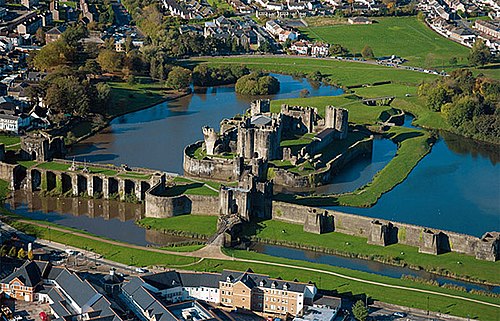
A long, crenellated stone curtain wall runs along a steep, vegetated promontory above the water, punctuated by several round towers and a tall twin-towered gatehouse. A massive, nearly cylindrical keep with a domed roof and thick base dominates the inner ward; putlog holes mark where a wooden fighting platform once sat. The castle is built of grey-brown masonry, the curtain topped by regular merlons, and terraces slope down from the walls to the river below.
Its story
The story of Pembroke Castle.
The Montgomery Promontory and the Siege of 1092
The rock beside the Pembroke River carried people long before it carried a castle. The site was occupied in the Roman period, and finds in the Wogan Cavern beneath it show humans here at the end of the last ice age. The Norman fortification arrived with the invasion of Wales as a motte-and-bailey of earthen ramparts and timber palisade, set on a promontory by the Milford Haven Waterway at the heart of Norman-controlled south-west Wales. Its foundation is told two ways: Roger of Montgomery is credited with raising the first castle here in 1073, while the date 1093 is given for his son Arnulf fortifying the promontory.
Arnulf strengthened the works and appointed Gerald de Windsor as his castellan, after which the castle withstood a major siege in 1092. When William Rufus died, Arnulf joined his elder brother Robert of Bellême in rebellion against Henry I, and when the rising failed he forfeited his lands and titles. Henry put in a castellan of his own; the man proved incompetent, and the king reappointed Gerald in 1102. By 1138 King Stephen had given Pembroke to Gilbert de Clare, who used it as an important base in the Norman invasion of Ireland.
William Marshal Rebuilds in Stone, 1189
In August 1189 Richard I arranged the marriage of de Clare's granddaughter Isabel to William Marshal, who took with her both the castle and the title of Earl of Pembroke and became one of the most powerful men in twelfth-century Britain. He rebuilt Pembroke in stone, creating most of the structure that remains, and raised the great keep at the same time. The inner ward, constructed in 1189, holds that round keep with its domed roof: twenty-three metres tall, its walls up to six metres thick at the base, four storeys linked by a spiral staircase and originally entered at first-floor level by an external stairwell. Putlog holes in the dome carried a wooden fighting-platform above it, and the inner ward's curtain wall was pierced by a large horseshoe-shaped gateway.
Marshal was succeeded in turn by each of his five sons. The third, Gilbert, was responsible for enlarging and further strengthening the castle between 1234 and 1241, and in the late thirteenth century further buildings went up in the inner ward, including a new Great Hall, while the outer ward was defended by a large twin-towered gatehouse, a barbican and several round towers. In the same century a fifty-five-step spiral staircase was cut down to the Wogan Cavern, the limestone cave beneath the castle, which was fortified with a wall, a barred gateway and arrowslits; it may have served as a boathouse, or as a sallyport to the river where cargo or people could be moved. Every one of Marshal's sons died childless.
The de Valences and the Conquest of North Wales
In 1247 the castle was inherited by William de Valence, a half-brother of Henry III, who had become Earl of Pembroke through his marriage to Joan de Munchensi, William Marshal's granddaughter. The de Valences held Pembroke for seventy years. During that time the town below was fortified with defensive walls, three main gates and a postern, and the castle served as de Valence's military base for fighting the Welsh princes through Edward I's conquest of North Wales between 1277 and 1295.
On the death of William's son Aymer de Valence, 2nd Earl of Pembroke, the castle passed by marriage to the Hastings family. In 1389 the seventeen-year-old John Hastings died in a jousting accident, ending a line of inheritance stretching back 250 years, and Pembroke reverted to Richard II, after which the Crown granted only short tenancies. By 1400 Owain Glyndŵr had begun his rebellion in Wales, but Pembroke escaped attack: its constable, Francis a Court, paid Glyndŵr off in gold.
Jasper Tudor and the Birth of 1457
In 1452 Henry VI presented the castle and the earldom to his half-brother Jasper Tudor. Tudor brought his widowed sister-in-law, Margaret Beaufort, to Pembroke, and there in 1457 she gave birth to her only child, the boy who would become King Henry VII of England. Through the fifteenth and sixteenth centuries Pembroke was a place of peace, and stayed one until the outbreak of the English Civil War.
Cromwell's Seven Weeks, 1648
Most of South Wales sided with the King, but Pembroke declared for Parliament. Royalist troops besieged the castle, and it was saved when parliamentary reinforcements arrived by sea from nearby Milford Haven; parliamentary forces then went on to capture the Royalist castles of Tenby, Haverfordwest and Carew.
By 1648 the allegiance had turned over. At the beginning of the Second Civil War, Pembroke's commander Colonel John Poyer led a Royalist uprising alongside Colonel Powell at Tenby Castle and Sir Nicholas Kemoys at Chepstow Castle. Oliver Cromwell came to Pembroke on 24 May 1648 and took the castle after a seven-week siege. The three leaders were found guilty of treason, and Cromwell ordered the castle destroyed; townspeople were encouraged to disassemble the fortress and re-use its stone for their own purposes.
Abandoned, it was left to decay, and remained in ruins until 1880, when a three-year restoration project was undertaken. Nothing further was done until 1928, when Major-General Sir Ivor Philipps acquired the castle and began an extensive restoration of its walls, gatehouses and towers. After his death a trust was set up, jointly managed by the Philipps family and Pembroke town council. Grade I listed since 1951, Pembroke is the largest privately owned castle in Wales.
Step inside
10 places to explore in 1280.
The record describes 10 distinct spots at Pembroke Castle, including 3 interiors: keep spiral staircase and upper chambers, great hall (marshal-era / 13th-century), wogan cavern interior / boathouse. Create your own photoreal reconstruction and explore every one, more scenes means more rooms, more angles, and more of the place to stand in.
Build Your Own Castle
Recreate Pembroke Castle with AI to explore it.
The artist rebuilds it as it stood in 1280, a photoreal reconstruction that belongs to you alone. Pay with coins, no subscription needed.
Recreate this castle →Defend this castle →Whose castle
Clans who held Pembroke Castle.
The families that held Pembroke Castle for a decade or more across its history, follow a name to its clan.
Marshal
Given with the earldom to William Marshal in 1189.
de Valence
Held by the de Valence Earls of Pembroke for 70 years from 1247.
Hastings
Passed by marriage to the Hastings family in the 14th century.
Later held by the Herbert Earls of Pembroke.