
Wales · Restored
Cardiff Castle
Castell Caerdydd
Cardiff Castle is a medieval castle and later Victorian Gothic-revival mansion located in the centre of Cardiff, Wales. It retains a Norman motte-and-shell-keep and extensive curtain walls alongside 19th-century Gothic rebuilding and decorative work commissioned by the Marquesses of Bute and executed by William Burges.
First raised
1080
Its prime
1880
Today
Restored
As it stood in 1880
What Cardiff Castle looked like in its prime.
Long crenellated curtain walls of mixed warm-brown and pale grey masonry enclose an inner bailey approached via a large arched gatehouse; a polygonal shell keep/motte rises above the inner ward as a rounded, battlemented tower. To the west a tall octagonal medieval lodging-tower dominates lower roofs; to the south-west a separate ornate Victorian clock tower with a pitched metal roof and clock faces rises above the curtain. Flagpoles and battlements punctuate the skyline; the complex sits in the city centre beside a paved road.
Its story
The story of Cardiff Castle.
From Roman Fort to Norman Motte, AD 55–1091
The Romans fortified the site in about AD 55 and held it until roughly AD 80, part of the southern border during the conquest of the Silures. A fourth fort followed in the mid-3rd century, raised against pirates along the coast. Nothing shows the site inhabited from the end of the 4th century until the 11th.
Normans pushed into South Wales from the late 1060s, often planting castles on old Roman sites. Cardiff's founding is told two ways: William the Conqueror may have built here as early as 1081, or Robert Fitzhamon around 1091, who used the castle to subdue southern Glamorgan. A 27-foot bank of earth went up over the collapsed Roman walls, with a timber keep on a 40-foot motte, the largest raised in Wales. Knights held Glamorgan lands on condition of garrisoning it, and the lordship ran as Marcher territory.
Ifor Bach's Raid and the Shell Keep, 1122–1184
FitzHamon was fatally injured at Tinchebray in 1106, and in 1122 Henry I gave the castle to his illegitimate son Robert of Gloucester. Robert Curthose, Duke of Normandy, was brought here from Devizes in 1126 and died a prisoner in 1134. A shell keep 77 feet across rose on the motte around mid-century, possibly under Robert and probably in answer to the Welsh uprising of 1136. It settled nothing: in 1158 Ifor Bach raided the castle and carried off Robert's son William as a hostage, another attack came in 1183, and by 1184 the town itself had walls.
The Black Tower and the Death of Llywelyn Bren
From 1217 the castle belonged to the de Clares and became the centre of their power in South Wales. Richard de Clare, 6th Earl of Gloucester, built the Black Tower into the southern gateway late in the 13th century, perhaps against the threat from Llywelyn ap Gruffudd, Prince of Wales.
Gilbert de Clare, the last male of the line, was killed at Bannockburn in 1314, and Cardiff passed to Hugh Despenser the Younger, Edward II's favourite. Harsh Despenser rule and poor harvests provoked a Welsh rising under Llywelyn Bren in 1316; it was crushed, and in 1318 Llywelyn was hanged, drawn and quartered inside the castle on Hugh's orders. War with the other Marcher lords followed, and the castle was sacked in 1321.
Glyndŵr's Rebels, 1404, and the Battle of St Fagans
In 1404 Owain Glyndŵr's rebels took Cardiff and the castle, badly damaging the Black Tower and the southern gatehouse. The castle came to Richard de Beauchamp, Earl of Warwick, by marriage in 1423; Caerphilly had not come with the settlement, so Warwick spent on Cardiff instead, adding a tower beside the Black Tower in 1430 and, between 1425 and 1439, a domestic range with a central octagonal tower 75 feet high. Under the Tudors the frontier role ended, and in 1495 Henry VII revoked the castle's Marcher status.
Civil war reached Cardiff in 1642. Parliament took the castle early on; the Royalist Marquess of Hertford retook it by surprise assault, and Parliamentary and local troops won it back after five hours of fighting. Charles I came in July 1645 to meet Welsh leaders and left to find a crowd of locals demanding the castle; the "Peaceable Army" they formed traded the royal garrison for a local Glamorgan force, and when the king reneged they changed sides and surrendered Cardiff to Parliament. A Royalist army of 8,000 marched to retake the town in 1648 and was heavily beaten at St Fagans. The castle escaped slighting and was garrisoned instead, probably against a Scottish invasion.
Bute Coal, Burges and the Gift of 1947
Cardiff came to the Scottish Marquesses of Bute by marriage in 1766, and from 1776 Capability Brown and Henry Holland remade it as a Georgian house, the wall between the baileys blown up with gunpowder. From 1825 the second marquess poured money into the Cardiff Docks, which transformed the value of the family's mines and land: by 1900 the Butes owned 22,000 acres of Glamorgan.
The 3rd Marquess inherited in 1848, before his first birthday, and grew up despising the castle as half-hearted Gothic. On his coming of age in 1868 he set William Burges to rebuild it, beginning with the 132-foot Clock Tower; Burges was still at work on the Arab Room when he died, and Bute set both men's initials and the date 1881 into its fireplace. Levelling the grounds destroyed much medieval archaeology, but in 1889 it uncovered the Roman fort for the first time since the 11th century.
The fourth marquess sold off the coal mines, docks and railways, the last land going in 1938. In the Second World War tunnels in the medieval walls held air-raid shelters for up to 1,800 people. Facing heavy death duties in 1947, his heir gave the castle and its park to the people of Cardiff; the family flag came down at the handover.
Step inside
10 places to explore in 1880.
The record describes 10 distinct spots at Cardiff Castle, including 2 interiors: stavell oged and stavell wenn chambers (black tower ground floor), main lodgings interior (gothic revival suites). Create your own photoreal reconstruction and explore every one, more scenes means more rooms, more angles, and more of the place to stand in.
Build Your Own Castle
Recreate Cardiff Castle with AI to explore it.
The artist rebuilds it as it stood in 1880, a photoreal reconstruction that belongs to you alone. Pay with coins, no subscription needed.
Recreate this castle →Defend this castle →Whose castle
Clans who held Cardiff Castle.
The families that held Cardiff Castle for a decade or more across its history, follow a name to its clan.
de Clare
Held by the de Clare and Despenser families for centuries.
Taken over by the Herbert family in 1550.
Bute
Passed to the Marquesses of Bute, who transformed it in the 19th century.
From the archive
Cardiff Castle on paper: the measured plan and period views.
The survey plan and photographs below are the ground truth this page's reconstructions are checked against, drawn and photographed while the castle was still a working garrison. Every image is public-domain or openly licensed, with its source named.

From the southeast, Cardiff Castle, Wales LOC 3752438888
ca. 1890-1900 · Photochrom Prints Collection (via Wikimedia Commons)
Public domain
CARDIFF CASTLE LODGINGS. MAIN FLOOR
1884 · G. T. Clark, Mediaeval Military Architecture, vol. 1 (1884)
Public domain
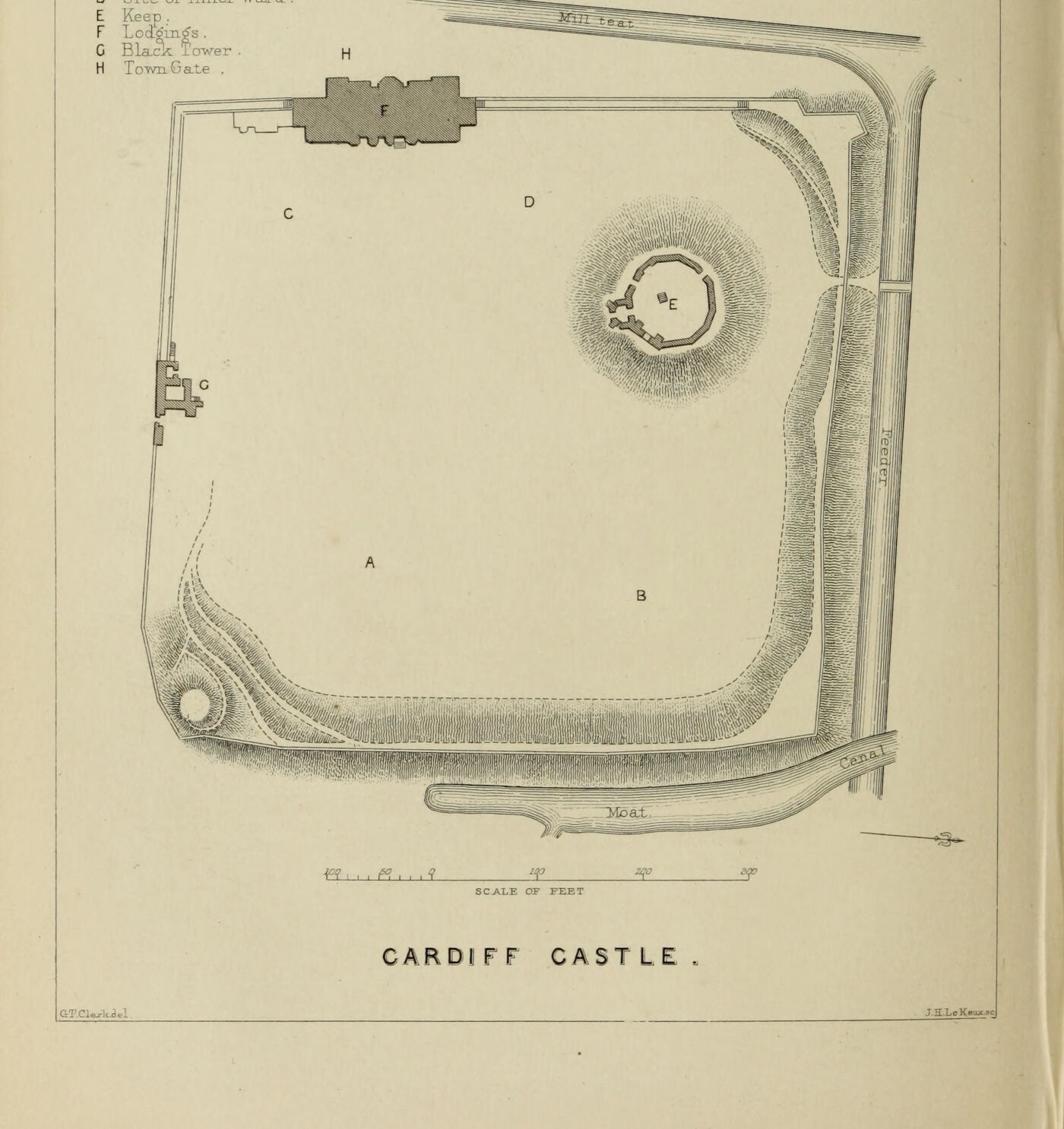
CARDIFF CASTLE.
1884 · G. T. Clark, Mediaeval Military Architecture, vol. 1 (1884)
Public domain
Nearby
Landmarks within reach of Cardiff Castle.


Questions about Cardiff Castle
What is the history of Cardiff Castle?
What is inside Cardiff Castle?
Who owns Cardiff Castle now?
Why was Cardiff Castle built, and what was it used for?
Where is Cardiff Castle?
When was Cardiff Castle built?
Was Cardiff Castle ever attacked or besieged?
Which family or clan held Cardiff Castle?
What did Cardiff Castle look like in its prime?
Is Cardiff Castle still standing, or is it a ruin?
Can you visit Cardiff Castle?
More castles of Wales


Explore the city

