
Wales · Restored
Caerphilly Castle
Castell Caerffili
Caerphilly Castle is a large medieval concentric castle in Caerphilly, South Wales, built in the late 13th century by Gilbert de Clare. It occupies a central island surrounded by extensive artificial lakes and multiple rings of curtain walls and towers and contains a Great Hall and substantial gatehouses.
First raised
1268
Its prime
1326
Today
Restored
Ranked among Europe’s castles
As it stood in 1326
What Caerphilly Castle looked like in its prime.
A broad, low-profile concentric fortress of grey stone set on a central island surrounded by broad artificial lakes; multiple rings of thick curtain walls linked by causeways and dams; numerous large cylindrical (drum) towers and several rectangular gate towers rising above crenellated parapets; a monumental twin-towered southern gatehouse approached by a stone causeway; inner ward with pitched-roof range (the hall) and intact battlement walkways; moats reflecting the curtain walls.
Its story
The story of Caerphilly Castle.
Red Gilbert's Ditches, 1268-1272
Gilbert de Clare, Earl of Gloucester - Red Gilbert, for the colour of his hair - inherited the family lands in 1263 and with them the unfinished work of subduing Glamorgan. Against him stood Llywelyn ap Gruffudd, who had used the civil war between Henry III and the rebel barons to extend his authority across the region. When the baronial revolt was crushed in 1266-67, de Clare advanced north from Cardiff and in 1268 began a castle in the Rhymney basin, beside the river and a former Roman fort.
Work went at a huge pace: ditches cut to shape the site, timber palisades raised, a stream dammed for water defences. The cost is unrecorded, though modern estimates run as high as £19,000. Llywelyn attacked and burned the site in 1270. De Clare began again the following year, and Henry III sent the bishops Roger de Meyland and Godfrey Giffard to take possession and arbitrate; in February de Clare's men seized it back, threw out the bishops' soldiers and resumed building, their lord protesting his innocence.
The Lakes Learned at Kenilworth
De Clare had fought at the siege of Kenilworth in 1266 and seen its artificial lakes at first hand; Caerphilly's were almost certainly modelled on them. The castle's core sat on what became a central island, ringed by lakes whose dams were themselves fortified. The South Dam ran 152 metres and ended in Felton's Tower, guarding the sluicegates. Water gave particular protection against mining, and the historian Allen Brown judged the result "the most elaborate water defences in all Britain". Behind them an inner ward stood inside a middle ward, the inner walls overlooking the middle - the first concentric castle in Britain, and an influence on Edward I's later castles in the north.
Madog's Rising and Llywelyn Bren, 1294-1316
Edward I's campaigns of 1277 and 1282 broke Llywelyn, the second ending in his death. When Madog ap Llywelyn rebelled in 1294, apparently over new taxation, the rising in Glamorgan was led by Morgan ap Maredudd, dispossessed by de Clare in 1270; he burned half the town but failed to take the castle, and surrendered when de Clare retook the region between April and May 1295. Red Gilbert died at the end of that year.
His son Gilbert died fighting at Bannockburn in 1314, and the lands passed to the Crown before the inheritance was settled. Anger at the royal administrators brought Llywelyn Bren out in January 1316. The castle withstood his attack; the town was destroyed and the revolt spread until a royal army defeated Bren at Caerphilly Mountain and broke the siege.
The Despensers and the Siege of 1326-27
In 1317 Edward II settled Glamorgan and Caerphilly on Eleanor de Clare, wife of the royal favourite Hugh le Despenser, who in 1325-26 employed Master Thomas de la Bataile and William Hurley to enlarge the Great Hall. In 1326 Isabella of France overthrew her husband's government. The king and Hugh stayed at Caerphilly at the end of October and into early November, then left ahead of her advancing forces, abandoning the stores and £14,000. William la Zouche besieged the castle with 425 soldiers, cornering the constable Sir John de Felton, Hugh's son - another Hugh - and a garrison of 130 men. Caerphilly held until March 1327, when the garrison surrendered on the condition that the younger Despenser be pardoned; his father had already been executed.
From Glyndŵr's Rising to the Bute Restoration
The Glyndŵr Rising broke out in 1400 and the castle was captured by Glyndwr's forces, though what part it played is uncertain and it seems to have survived intact. In 1416 it passed by Isabel le Despenser's marriage into the Beauchamp family; she and her second husband, Richard Beauchamp, earl of Warwick, invested heavily in repairs and made it their main residence in the region. After it passed to Jasper Tudor in 1486 the castle declined, eclipsed by the more fashionable Cardiff Castle, and once the sluice-gates failed the lakes probably drained away. John Leland, visiting around 1539, found walls of "a wonderful thiknes" but ruin beyond one tower used to hold prisoners, and in 1583 Thomas Lewis took a lease and stripped much of the stone for his own house.
No order to slight Caerphilly survives, and the towers that had collapsed by the 18th century probably fell to subsidence as the water retreated. The Marquesses of Bute acquired the site in 1776; the third reroofed the great hall in the 1870s after a survey by the architect William Frame, and the fourth ran a major restoration from 1928 to 1939, rebuilding the Inner East Gatehouse and other towers. The fifth gave Caerphilly to the state in 1950, and the lakes were re-flooded, the East Moat in 1962.
Step inside
8 places to explore in 1326.
The record describes 8 distinct spots at Caerphilly Castle, including 2 interiors: great hall interior, gatehouse entrance passage. Create your own photoreal reconstruction and explore every one, more scenes means more rooms, more angles, and more of the place to stand in.
Build Your Own Castle
Recreate Caerphilly Castle with AI to explore it.
The artist rebuilds it as it stood in 1326, a photoreal reconstruction that belongs to you alone. Pay with coins, no subscription needed.
Recreate this castle →Defend this castle →Whose castle
Clans who held Caerphilly Castle.
The families that held Caerphilly Castle for a decade or more across its history, follow a name to its clan.
de Clare
Built by Gilbert de Clare from 1268; held by the de Clare Earls of Gloucester.
Bute
Restored by the Marquesses of Bute from 1776.
From the archive
Caerphilly Castle on paper: the measured plan and period views.
The survey plan and photographs below are the ground truth this page's reconstructions are checked against, drawn and photographed while the castle was still a working garrison. Every image is public-domain or openly licensed, with its source named.

The castle, Caerphilly, Wales LOC 3751647375
ca. 1890-1900 · Photochrom Prints Collection (via Wikimedia Commons)
Public domain
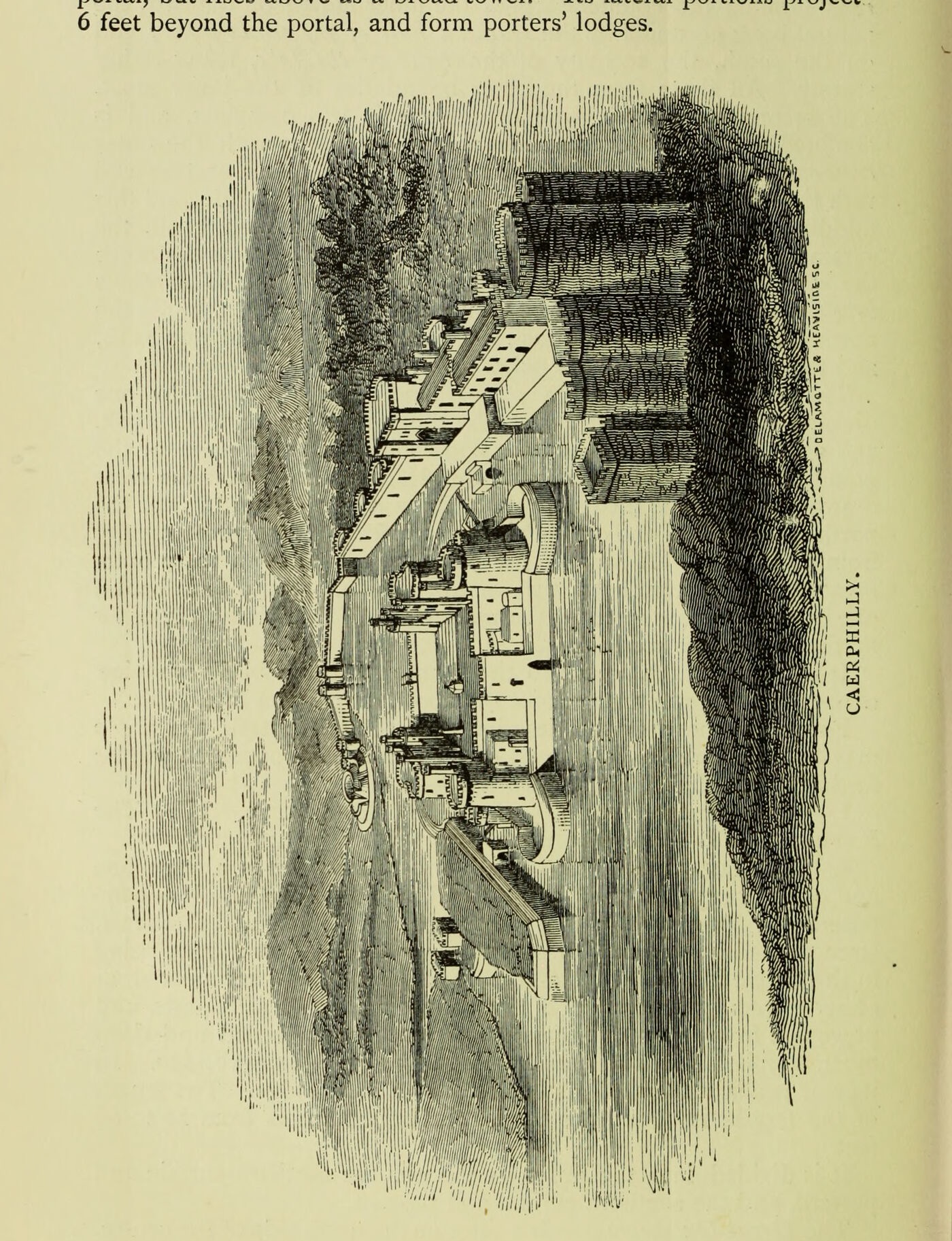
CAERPHILLY.
1884 · G. T. Clark, Mediaeval Military Architecture, vol. 1 (1884)
Public domain
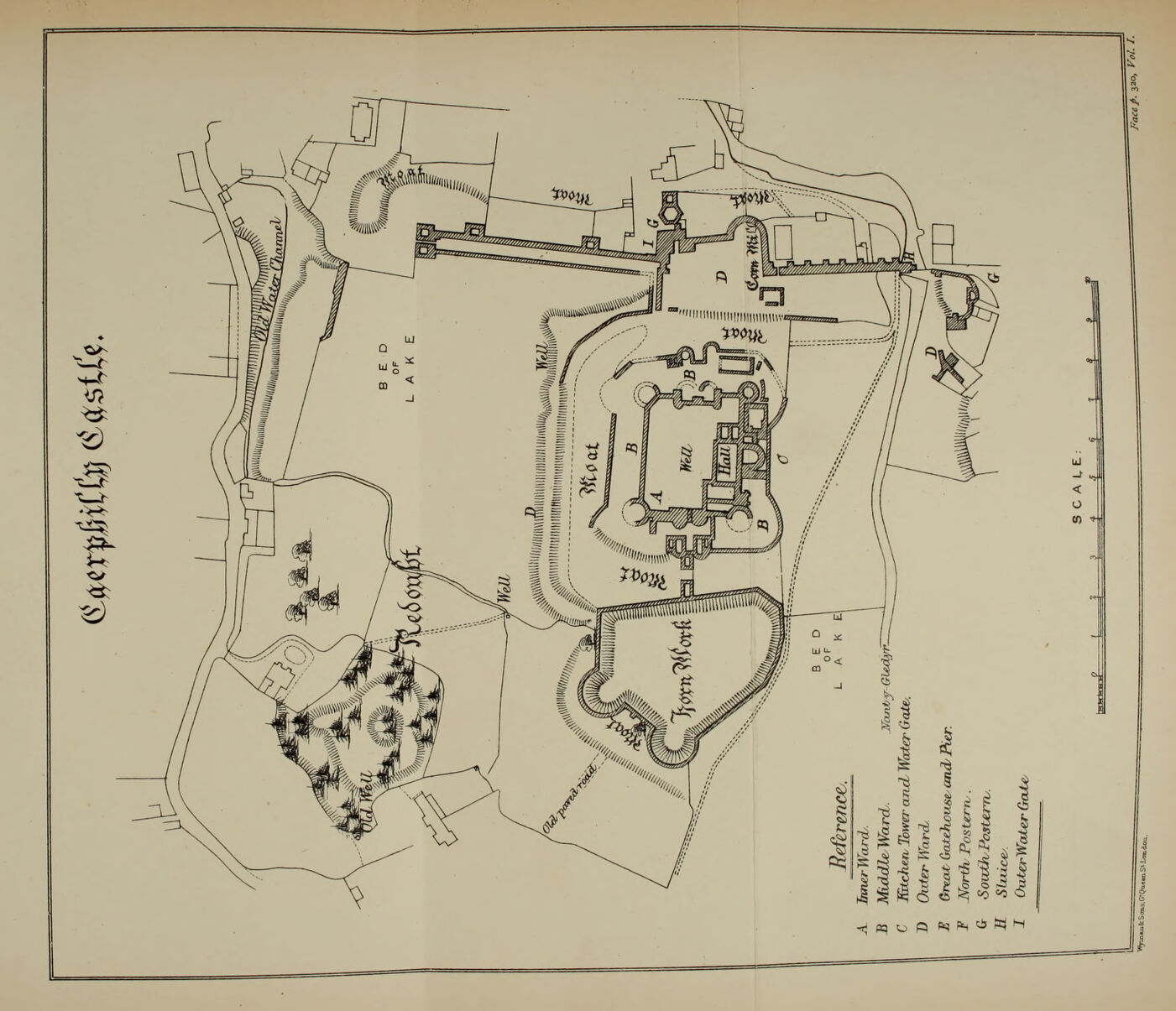
Caerphilly Castle
1884 · G. T. Clark, Mediaeval Military Architecture, vol. 1 (1884)
Public domain
Nearby
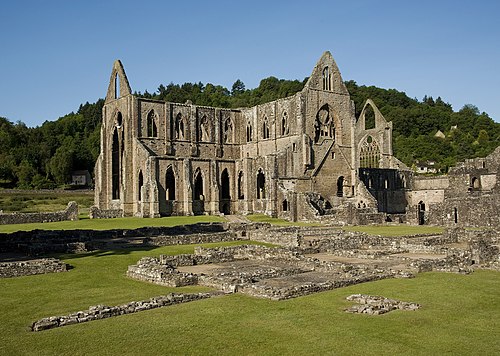
Landmarks within reach of Caerphilly Castle.


Questions about Caerphilly Castle
What is the history of Caerphilly Castle?
What is inside Caerphilly Castle?
Who owns Caerphilly Castle now?
Why was Caerphilly Castle built, and what was it used for?
When was Caerphilly Castle built?
Was Caerphilly Castle ever attacked or besieged?
Which family or clan held Caerphilly Castle?
What did Caerphilly Castle look like in its prime?
Is Caerphilly Castle still standing, or is it a ruin?
Can you visit Caerphilly Castle?
Where is Caerphilly Castle?
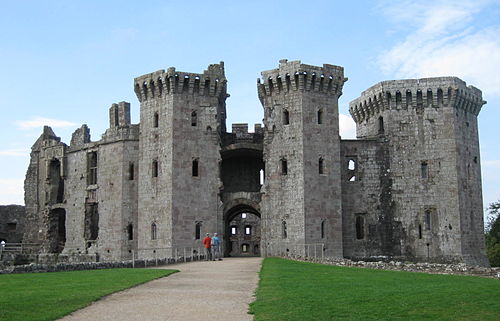
More castles of Wales


Explore the city

