House of Herbert
Marcher house of Pembroke and Raglan, the bridge between the Welsh gentry and the Tudor court.
- Origin
- Deheubarth, Wales
- Motto
- Ung je serviray
- Famous bearer
- William Herbert, 1st Earl of Pembroke (c.1423–1469), the first Welshman to hold an English earldom
- Register
- Princely house
Ranked of all time
The 10 Most Powerful Welsh Houses of All Time
The Herbert arms and country

Coat of armsHerbert armsWikimandia · CC BY-SA 4.0 
Coat of armsEarl of Powis COABorne by the Earl of Powis: the ennobled line of the name, not the name at large.Tinynanorobots · CC BY-SA 3.0


- Coat of arms: Granted to an individual and inherited down that one documented line. These are the arms of particular families of the name, not of everyone who shares the surname.
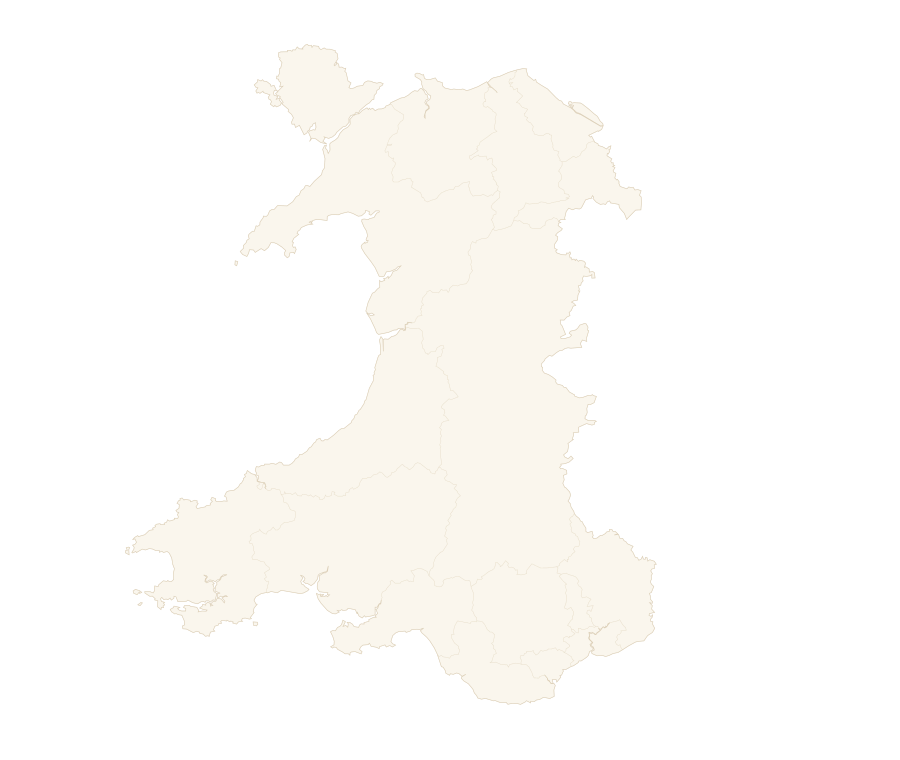
CoreHistoric reach
The seat of House of Herbert
Seat vacantChief
No one leads the House of Herbert community yet. When the movement opens, you can stand for its leadership, or help elect whoever does.
Current mission
No shared goal set yet. Once House of Herbert has leadership, it sets the public focus: a restoration, a gathering, a real-world project that helps its own.
The Herbert clan is being rebuilt. Join the waiting list for the movement today, and you help decide who leads it and what it does.
Help rebuild the Herbert clan →Motto
Ung je serviray
“One I will serve”
What does the Herbert name mean?
From the Old German Heribert, 'army-bright', brought into Wales through the Norman lords of the southern March. The Welsh-language form was Sir Herbert, Sir, in this case, the Welsh 'sir' for a county, and the family rooted in the south-east March became the principal Marcher house of the late medieval and Tudor period. The Herberts of Raglan and Pembroke are the principal line.
The history of House of Herbert
The year a Welsh family stopped being ap anybody
Before there were Herberts there was no Herbert. In 1292, 48 per cent of Welsh names were patronymics, and in some parishes more than 70 per cent: Evan, son of Thomas, was Evan ap Thomas, and Evan's son John was John ab Evan. The chain ran back through grandfathers as far as a seventh generation, a working genealogy of the male line; the Encyclopaedia of Wales suggests Welsh law lay behind the habit, since knowing how a man descended from an ancestor mattered.
Fixed surnames came in from the fifteenth century, hereditary among the Welsh gentry under Henry VIII and only slowly among everybody else. Some kept the ap in clipped form at the front, as in Powell from ap Hywel and Price from ap Rhys; most simply dropped it. One family in the south-eastern March did neither, and took up a Germanic personal name outright. Heribert, 'army-bright', had come into Wales with the Norman lords of the March, and Welsh mouths made it Sir Herbert, sir here being the Welsh word for a county.
Sir William ap Thomas and the money out of France
The house begins with Sir William ap Thomas of Raglan in Monmouthshire (d.1445), a Welsh knight in the service of the Duke of York. He made his fortune in the French wars and the wine trade, and spent it on stone. Raglan as he began it was no border fort thrown up in a hurry but a late and luxurious castle, and those who followed kept building into the early seventeenth century. Its great hexagonal keep, the Yellow Tower of Gwent, stood ringed by water gardens and terraces the equal of any in the land.
Black William, the first Welshman to hold an English earldom
His son is where the surname itself starts. Following Edward IV through the Wars of the Roses, he was granted the title Baron Herbert of Raglan in 1461, and with it set aside his Welsh patronymic, ap William, for an English-style surname. Contemporaries knew him as Black William, and he became the leading Yorkist magnate in Wales.
In 1468 Edward IV made him Earl of Pembroke, the first Welshman to hold an English earldom. Pembroke Castle, the original seat of that earldom, was the place where Henry Tudor had been born in 1457. That same year Black William was granted Chepstow, the oldest surviving post-Roman stone fortification in Britain, in exchange for lands in the east of England.
He was executed after defeat at the Battle of Edgcote in 1469. The barony and the earldom he had won both outlasted him, and so did the family motto, Ung je serviray, one I will serve.
Cardiff, a London palace and the second earldom
The Herberts took over Cardiff Castle in 1550, a place with a third-century Roman fort under it and the memory of being stormed in 1404 during Owain Glyndŵr's revolt. The following year the earldom of Pembroke was created a second time, for a grandson of Black William, and that made the Herberts the leading Welsh-Marcher house at the Tudor court.
The new earl was granted Baynard's Castle in London that same year and built a large extension around a second courtyard. A Welsh family now held what had been the London headquarters of the House of York, where Edward IV's accession was proclaimed on 3 March 1461 and Henry VIII had given it to Katherine of Aragon on the eve of their wedding.
Powis, St Fagans and the reach across south Wales
Nicholas Herbert bought the St Fagans estate outside Cardiff in 1586, where the Elizabethan mansion stands on the site of an older medieval castle, and the family held it thirty years before the sale of 1616 to Sir Edward Lewis of The Van at Caerphilly. The lordship of Gower and Oystermouth Castle above the Tawe came by a longer road, passing from the Mowbrays to the Herberts and later the Somersets.
Powis was the acquisition that lasted. Built in the thirteenth century by a Welsh prince, Gruffydd ap Gwenwynwyn of Powys, rather than by a Norman baron, it was bought in the late sixteenth century by Sir Edward Herbert. The Herbert Earls of Powis have held it since 1587 and hold it still; its terraced gardens and interiors, enriched after Henrietta Herbert's marriage to a son of Clive of India, rank among the finest in Britain.
Wilton House and the First Folio
Wilton House in Wiltshire, the Herbert seat, was a centre of Elizabethan literary life, and the family's patronage paid for one of the most consequential books in the language. William Herbert, 3rd Earl of Pembroke, sponsored the printing of the First Folio of Shakespeare's plays and is one of the patrons to whom it is co-dedicated; he is also the 'Mr. W. H.' of the Sonnets in the most-defended of several scholarly readings, and he founded Pembroke College, Oxford. Philip Herbert, 4th Earl, was Chancellor of Oxford.
The rector of Bemerton
George Herbert was born at Black Hall, Montgomery, on 3 April 1593, fifth son of Richard Herbert of Montgomery Castle and Magdalen Newport of High Ercall; his branch descended from the Earls of Pembroke and had held Montgomery castle since the late fifteenth century. His father died when George was three, and his mother Magdalen, later Lady Danvers and the patroness of John Donne, moved the seven surviving children to Shropshire and then in 1601 to London. He was schooled at Westminster under Lancelot Andrewes and went up to Trinity College, Cambridge, on a Westminster scholarship in 1609.
Fellow of Trinity in 1614, he became Public Orator of the university in 1620, its public Latin voice to visitors and patrons, and held the post eight years. He gave the Latin oration to James VI and I on the King's visit to Cambridge in 1623, and was elected MP for Montgomery in the 1624 Parliament. Ordained deacon in late 1624 and priest in 1630, he took the small rural rectory of Fugglestone-and-Bemerton outside Salisbury that April, rebuilt the parsonage, and rebuilt the parish church at Leighton Bromswold, which survives in regular Anglican use as he completed it.
In three years at Bemerton he wrote the English religious lyric on which his reputation rests. In February 1633 he sent the manuscripts by his friend the deacon Edmund Duncon to Nicholas Ferrar at Little Gidding, with word that Ferrar should publish them if he thought they might do any soul any good. Ferrar published them at Cambridge that November as The Temple: a hundred and sixty-seven lyrics arranged on the plan of an Anglican parish church, from the Church-porch and the Altar through to Love III at the close. It ran through thirteen editions in fifty years and was the most-printed book of English verse of the seventeenth century after the Authorised Version.
Montgomery, Raglan and a family on both sides
When the First English Civil War began in August 1642, Mid Wales was largely Royalist and the elderly Lord Herbert of Cherbury held Montgomery Castle for Charles I. On 17 September 1644 it was the site of the largest battle fought in Wales, and Parliament demolished the walls in June 1649, over the objections of the 2nd Lord Herbert, who had succeeded his father the year before.
Raglan went the same way: held for Charles I, it endured a long siege before falling in 1646, and its walls were slighted. Yet the family was not of one mind in that war, for the Herberts at Baynard's Castle in London took Parliament's side and held the house through it. The age also produced the poet Edward Herbert, 1st Baron Herbert of Chirbury.
A sailor in disguise, a tomb in Egypt, and the name abroad
Arthur Herbert, 1st Earl of Torrington, carried the Invitation to William across to The Hague dressed as a common sailor, then commanded William's invasion fleet in the Glorious Revolution that removed James II. Later, George Herbert, 5th Earl of Carnarvon, funded the search for Tutankhamun's tomb in the Valley of the Kings, and Lady Evelyn Beauchamp, born Evelyn Herbert (1901-1980), was among the first people in modern times to step inside it.
The name travelled as far as the family's fortunes did. Frank Herbert (1920-1986) wrote Dune and his son Brian wrote the Dune prequels; Zbigniew Herbert was a Polish poet and essayist, Xavier Herbert (1901-1984) an Australian novelist. A. P. Herbert (1890-1971) was a humorist, novelist and campaigner for law reform, Wally Herbert (1934-2007) a polar explorer and artist, Robert Herbert (1831-1905) the first premier of Queensland. A name one Welsh knight's son took up in place of a patronymic in 1461 is carried now in Europe, the Americas, Africa and Australasia.
Champions of the Herbert name
The bearers whose lives are inseparable from this surname. Each has their own page, biography, achievements, geography, connection to the family.
Historic Places, Rebuilt
Explore the streets and seats the Herbert name knew, rebuilt with AI as they stood in history.
Historic Places, Rebuilt · New
Owain Glyndŵr's mountain fortress and court at the high tide of Welsh independence, the English siege lines gathering below.
Historic Places, Rebuilt · New
The grandest castle-palace in Wales at its height, the moated Yellow Tower, fountain courts and long gallery, on the eve of the siege.
Historic Places, Rebuilt · New
The greatest coal port on earth at its peak, the hoists and colliers, the Coal Exchange and the streets of Tiger Bay.
Castles the Herbert held
Strongholds this name held for a decade or more, look one up, or rebuild it to explore.
- Powis Castle
Held by the Herbert Earls of Powis since 1587.
- Raglan Castle
Rebuilt by William Herbert in the 15th century.
- Pembroke Castle
Later held by the Herbert Earls of Pembroke.
- Cardiff Castle
Taken over by the Herbert family in 1550.
- Chepstow Castle
Granted to William Herbert, Earl of Pembroke, in 1468, in exchange for lands in the east of England.
- Oystermouth Castle
The Lordship of Gower and the castle later passed to the Herbert family.
- St Fagans Castle
Held by the Herberts from Nicholas Herbert's purchase in 1586 until the sale of 1616.
- Montgomery Castle
Held for Charles I by the elderly Lord Herbert of Cherbury from 1642; his son the 2nd Lord Herbert unsuccessfully opposed the slighting of the walls in 1649.
- Baynard's Castle
Granted to William Herbert, 1st Earl of Pembroke, in 1551; the Herberts extended it and held it through the Civil War on Parliament's side.
Landmarks the Herbert held
Palaces, houses and great buildings tied to this name, look one up, or rebuild it to explore.
- Highclere Castle
Country seat of the Herbert Earls of Carnarvon; the estate came to Thomas Herbert, 8th Earl of Pembroke, by marriage in 1692.
The castles of the homeland
The great strongholds of the homeland, look one up, see what it looked like in its prime, and recreate it to explore.
 Caernarfon CastleRestored · prime 1330
 Conwy CastleRuin · prime 1287
 Pembroke CastleRestored · prime 1280
All castles in Wales → · Strongest castles in Wales → · Castles of Europe
Play As Your Clan
Hold a real castle against whatever you choose to send at it, take a ship out in her own service years, or stand at the shoulder of someone the record remembers. The chronicler sets the scene; the deeds are yours.
Notable bearers of the Herbert name
- William Herbert, 1st Earl of Pembroke (c.1423–1469), the first Welshman to hold an English earldom
- George Herbert (1593–1633), priest and poet (The Temple)
- William Herbert, 3rd Earl of Pembroke, patron of the First Folio
Stories of House of Herbert
Stories that touch the name House of Herbert
Frequently asked
What does the surname Herbert mean?
Where does the Herbert family come from?
Where did the Herbert family historically hold territory?
Is Herbert Welsh or English?
How old is the Herbert surname?
What is the Herbert family known for?
What is the Herbert motto?
What does "Ung je serviray" mean in English?
Is there a Herbert family crest or coat of arms?
Who is the most famous Herbert?
Who are some famous Herberts?
What stories are told about the Herbert family?
What is the story of George Herbert and The Temple?
Where is the Herbert surname found today?
What does the Clan Rising page for the Herbert family cover?
Who is the head of the Herbert family today?
A note from the editors
- Cross-border with England. The England catalogue will surface this entry alongside the Welsh home.
Neighbouring clans
- DaviesSon of David, born of the patron saint's name and densest in his own corner of Wales.
- LewisLlywelyn anglicised, a princely name carried into common use across the Marches and the south.
- Powellap Hywel, the contracted patronymic that descends from Hywel Dda, the king who wrote Welsh law.
- VaughanFychan, the younger, the descriptive surname that marks a son.