Powell
also Howell, Howells
ap Hywel, the contracted patronymic that descends from Hywel Dda, the king who wrote Welsh law.
- Origin
- Powys, Wales
- Famous bearer
- Anthony Powell (1905–2000), novelist (A Dance to the Music of Time)
- Register
- Welsh family
The Powell arms and country

Coat of armsArms of Powell of BroadwayBorne by the Broadway line, one branch of the name rather than all of it.Aergia · CC BY-SA 4.0 
Coat of armsArms of Powell of Horton Old HallBorne by the Horton Old Hall line, one branch of the name rather than all of it.Aergia · CC BY-SA 4.0


- Coat of arms: Granted to an individual and inherited down that one documented line. These are the arms of particular families of the name, not of everyone who shares the surname.
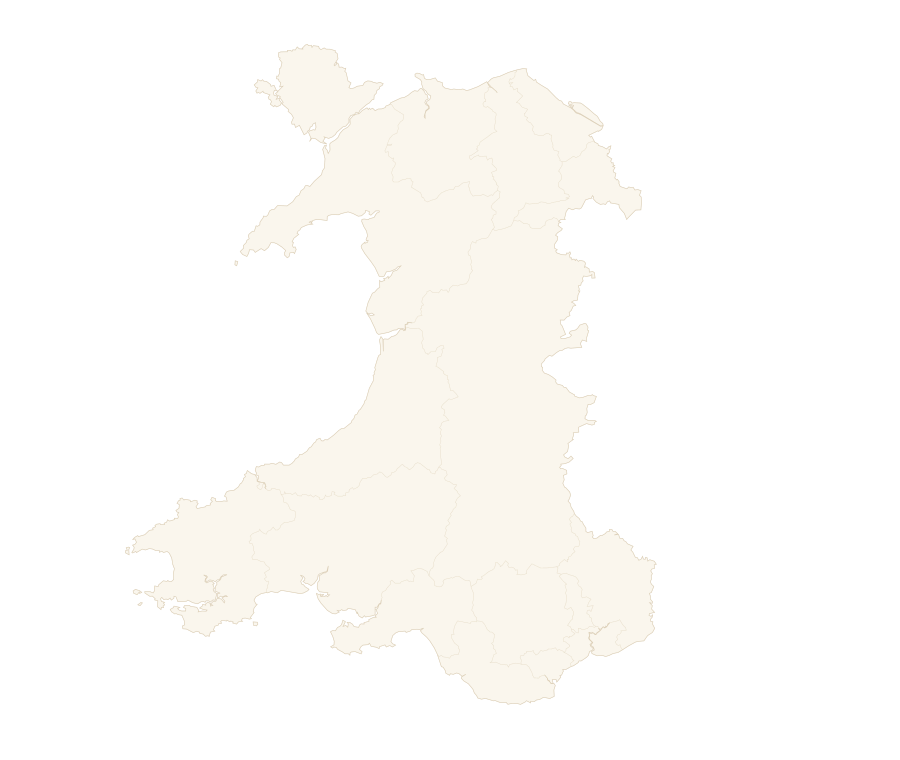
CoreHistoric reach
The seat of Powell
Seat vacantChief
No one leads the Powell community yet. When the movement opens, you can stand for its leadership, or help elect whoever does.
Current mission
No shared goal set yet. Once Powell has leadership, it sets the public focus: a restoration, a gathering, a real-world project that helps its own.
The Powell clan is being rebuilt. Join the waiting list for the movement today, and you help decide who leads it and what it does.
Help rebuild the Powell clan →What does the Powell name mean?
ap Hywel, son of Hywel, contracted in the patronymic-elision pattern that also gave us Pritchard (ap Richard), Pugh (ap Hugh) and Bevan (ab Evan). The 'a' of 'ap' falls away, the 'p' attaches to the following name, and the result is hereditary. Hywel itself is an ancient Welsh personal name borne by Hywel Dda, Hywel the Good, the 10th-century king who codified Welsh law.
The history of Powell
One letter doing the work of a whole word
Powell is two words worn down into one. Behind it stands ap Hywel, "son of Hywel", in which ap is the Welsh for son of and Hywel is the ancestor. Say the pair often enough and the a falls away, the p fastens to the front of the name that follows, and ap Hywel settles as Powell. The same erosion made Price out of ap Rhys, Pugh out of ap Hugh, Pritchard out of ap Richard, Bowen out of ab Owen and Upjohn out of ap John. Each carries a fossilised piece of Welsh grammar at its front, and most bearers have no idea it is there.
The name inside the name is old. Hywel comes from the Old Welsh Higuel, built from hy- ("good") and gwêl ("sight"), literally "well-seen", read by the medieval Welsh as eminent or prominent. Anglicised it became Howell, and there is the fork: Howell and Howells keep the same patronymic without the contracted p-, so two families with an identical root end up looking like strangers on a census page.
Evan ap Thomas, John ab Evan, Rees ap John
Before fixed surnames, Wales had no surnames at all in the sense of something handed down. A person's baptismal name was linked by ap or ab ("son of"), or ferch ("daughter of"), to the father's baptismal name, and the label was rebuilt from scratch every generation. Evan, son of Thomas, was Evan ap Thomas. Evan's son John was John ab Evan. John's son Rees was Rees ap John. Nothing was inherited except the method.
This was not a minority habit. Patronymics made up 48 per cent of Welsh names in 1292, and passed 70 per cent in some parishes. The rest were nicknames, a few non-hereditary personal names and, rarely, occupational ones, which is why Wales produced so few of the trade surnames that fill English registers.
The strings could also run backwards, through grandfather and beyond to perhaps the seventh generation, so that Llewelyn ap Dafydd ab Ieuan ap Gruffudd ap Meredydd was an unremarkable thing to be called: a spoken genealogy of the male line. The Encyclopaedia of Wales suggests the system was sustained by Welsh law, under which it was essential to know how a person descended from an ancestor.
The generation the chain stopped moving
Fixed surnames were adopted in Wales from the 15th century onwards, as the old laws decayed. Under Henry VIII they became hereditary among the Welsh gentry and spread slowly among commoners; areas of strong English influence gave up patronymics earlier, as did town families and the wealthy. Wales was unified with England in 1536. In some rural areas, even so, patronymic naming carried on until the early 19th century.
Because the change came parish by parish rather than by one decree on one day, the Welsh surname stock split. Some families kept the ap, reduced and fused to the front: Powell, Price, Pugh, Pritchard, Bowen. Some dropped it entirely. Others added an s to the father's name, which produced Jones, Roberts and Edwards, the commonest names in modern Wales. Powell belongs to the first group: the families whose ancestor froze the phrase whole rather than filing the grammar off it.
One consequence follows for anyone tracing the name. The stock of Welsh surnames is small and most of it comes from a handful of baptismal names, so two Powells in one village cannot be assumed to share an ancestor. And where the -s names blanketed the country, Powell stayed regional: densest in mid- and south-east Wales, in Powys, Monmouthshire and the Marches.
Hywel Dda, the king inside the name
The Hywel commemorated by so many of these families is Hywel ap Cadell, king of Deheubarth and effective overlord of most of Wales in the 940s. The Anglo-Saxon Chronicle records a Brittonic king called Huwal of the West Welsh in 926, whom many scholars take to be him; by 950 he was recorded with the title King of the Britons.
His claim on Welsh memory is not conquest but law. At the synod of Whitland around 945 he had the laws of Wales codified into a written corpus, and that system governed the country in its native form for two and a half centuries, until the Edwardian conquest of 1282. It is why he is Hywel Dda, Hywel the Good, and why the given name was used in his honour through the Middle Ages, which is exactly how so many later Welshmen came to be called Hywel, and their sons ap Hywel.
Be careful with the descent. The name originates in a dynasty of kings in Wales and Brittany in the 9th and 10th centuries and in three Welsh royal houses thereafter, and the House of Tudor descended from them, but the link between a modern Powell and Hywel Dda runs through popular tradition far more securely than through genealogy. A boy baptised Hywel in the 15th century was usually named for the king rather than descended from him. That is a fine thing to carry either way: it means the family chose him.
The Powells of Nanteos and their cup
The name did rise into land. The Powells of Nanteos, near Aberystwyth, were an 18th-century Cardiganshire gentry family, and they were the keepers of the Nanteos Cup, a wooden cup of medieval origin that passed down in the house with them.
In the 19th and 20th centuries Welsh tradition identified the cup, optimistically, as a fragment of the Holy Grail carried from Glastonbury at the Dissolution of the monasteries. The claim ran well ahead of the evidence. The rest is not in doubt: a medieval wooden vessel, a Cardiganshire family named Powell, and generations who thought of themselves as its guardians rather than its owners.
Out of the Marches, down the pits, across the water
After the English conquest of Wales in the 13th century, and the Laws in Wales Acts of 1535 and 1542 that incorporated Wales into the Kingdom of England, families of the name moved east into the English counties along the Anglo-Welsh border, anglicising their forms as they went. On the surname map that border is a seam, not a wall.
The next movement was industrial and far larger. The population of Wales doubled from 587,000 in 1801 to 1,163,000 in 1851 and reached 2,421,000 by 1911, most of the increase in the coal districts: Glamorganshire alone went from 71,000 to 232,000 to 1,122,000 across those same years. Within two or three generations, country families carrying old patronymic names had been pulled off the land into the valleys and the coalfield towns.
Then out of Wales altogether: to Pennsylvania above all; to Jackson County in Ohio, sometimes called Little Wales, where a Welsh-language press ran until the last paper, y Drych, began publishing in English in the late 1940s; to Malad City in Idaho, begun as a Welsh Mormon settlement; and to Y Wladfa, the Welsh colony in Patagonia. Around 1.75 million Americans report Welsh ancestry, and 458,705 Canadians did so in the 2011 census.
An analysis of the geography of Welsh surnames commissioned by the Welsh Government put numbers on it: 718,000 people in Wales, nearly 35 per cent of the population, carry a family name of Welsh origin, against 5.3 per cent in the rest of the United Kingdom, 4.7 per cent in New Zealand, 4.1 per cent in Australia and 3.8 per cent in the United States: 16.3 million people across the countries studied. A Powell in Ohio or Dunedin is one of them.
The people who carried it
In Wales the name runs through the ordinary business of a small country: the songwriters Felix Powell (1878–1942) and George Henry Powell (1880–1951); Annie Powell (1906–1986), the Welsh Communist politician; the footballer Ivor Powell (1916–2012); the rugby internationals Wick Powell (1905–1973) and Wickham Powell (1892–1961).
Beyond Wales it reached most corners of British life. Anthony Powell (1905–2000) wrote A Dance to the Music of Time; Enoch Powell (1912–1998) was a classicist before he was a politician; Cecil Frank Powell (1903–1969) took the Nobel Prize in physics; Michael Powell (1905–1990) directed films and Dilys Powell (1901–1995) spent a lifetime reviewing them. Robert Baden-Powell (1857–1941), who founded the world Scouting Movement, was the son of the mathematician Baden Powell (1796–1860). In the United States, the soldier and geologist John Wesley Powell (1834–1902) led the exploration of the American West.
One honest note for anyone tracing the surname. Powell and Howell also travelled by a route that was not migration: during slavery in the British colonies, enslaved people were often known by the surname of the man who held them, or took it at emancipation, and their descendants carry these names today, particularly in the West Indies. This atlas cannot map that lineage, because the thread back to a Welsh parish was cut rather than followed. It takes nothing from those bearers; it means their heritage runs elsewhere, and deserves tracing where it lies.
Champions of the Powell name
The bearers whose lives are inseparable from this surname. Each has their own page, biography, achievements, geography, connection to the family.
Historic Places, Rebuilt
Explore the streets and seats the Powell name knew, rebuilt with AI as they stood in history.
The castles of the homeland
The great strongholds of the homeland, look one up, see what it looked like in its prime, and recreate it to explore.
 Caernarfon CastleRestored · prime 1330
 Conwy CastleRuin · prime 1287
 Pembroke CastleRestored · prime 1280
All castles in Wales → · Strongest castles in Wales → · Castles of Europe
Play As Your Clan
Hold a real castle against whatever you choose to send at it, take a ship out in her own service years, or stand at the shoulder of someone the record remembers. The chronicler sets the scene; the deeds are yours.
Notable bearers of the Powell name
- Anthony Powell (1905–2000), novelist (A Dance to the Music of Time)
- Enoch Powell (1912–1998), politician, classicist
Stories of Powell
Frequently asked
What does the surname Powell mean?
Where does the Powell family come from?
Where did the Powell family historically hold territory?
Is Powell Welsh or English?
How old is the Powell surname?
What is the Powell family known for?
Is there a Powell family crest or coat of arms?
Who is the most famous Powell?
Who are some famous Powells?
What stories are told about the Powell family?
What is the story of Hywel Dda and the Laws?
Is Howell the same family as Powell?
Is Howells the same family as Powell?
Where is the Powell surname found today?
What does the Clan Rising page for the Powell family cover?
Who is the head of the Powell family today?
Neighbouring clans
- EvansSon of John, by the Welsh road, the cousin name of Jones.
- LewisLlywelyn anglicised, a princely name carried into common use across the Marches and the south.
- OwenThe princely name, Owain in Welsh, the surname of the last revolt and the first Tudor.
- LloydLlwyd, the grey one, the great descriptive surname of the central Welsh ridge.