Lewis
Llywelyn anglicised, a princely name carried into common use across the Marches and the south.
- Origin
- Powys, Wales
- Famous bearer
- Saunders Lewis (1893–1985), playwright, founding figure of Plaid Cymru
- Register
- Welsh family
The Lewis arms and country

Coat of armsLewis Family ArmsDemosthenes1999 · CC0 
Coat of armsLewis coat of armsself-created · CC BY-SA 3.0


- Coat of arms: Granted to an individual and inherited down that one documented line. These are the arms of particular families of the name, not of everyone who shares the surname.
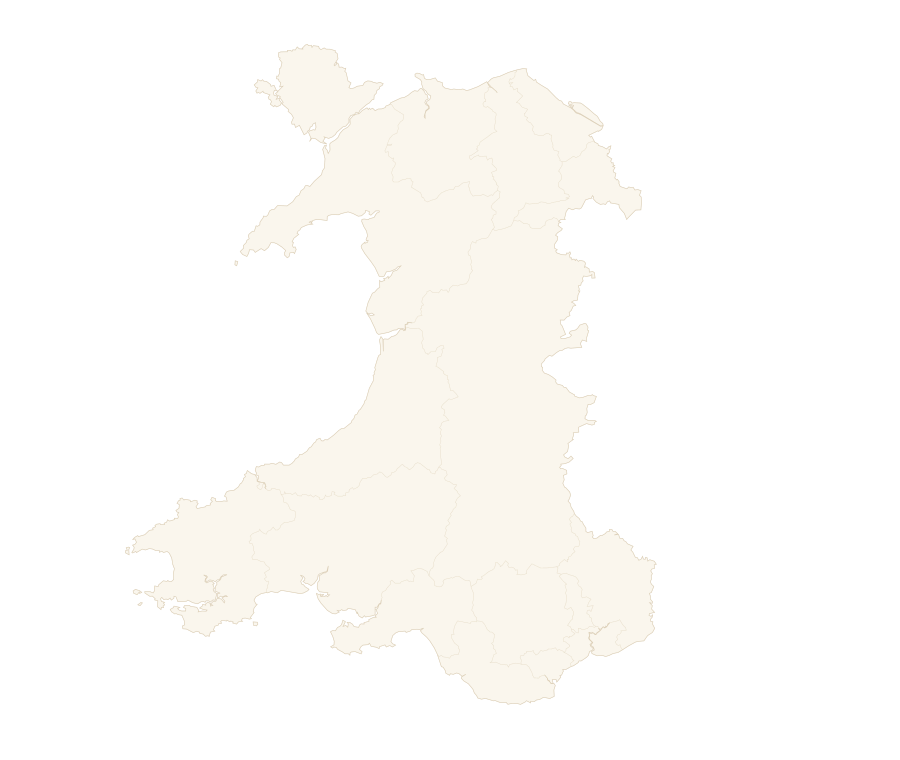
CoreHistoric reach
The seat of Lewis
Seat vacantChief
No one leads the Lewis community yet. When the movement opens, you can stand for its leadership, or help elect whoever does.
Current mission
No shared goal set yet. Once Lewis has leadership, it sets the public focus: a restoration, a gathering, a real-world project that helps its own.
The Lewis clan is being rebuilt. Join the waiting list for the movement today, and you help decide who leads it and what it does.
Help rebuild the Lewis clan →What does the Lewis name mean?
From the Welsh Llywelyn, Anglicised as Lewis from the late medieval period. Llywelyn was the great princely name of the House of Aberffraw, Llywelyn the Great (d.1240) and Llywelyn the Last (d.1282), and the form Lewis carried its prestige into a Tudor administrative orthography that lacked any glyph for the Welsh 'll' and that, after the Acts of Union of 1536, was actively compressing Welsh names into English forms in record-keeping and law. The English Lewis (from Frankish Hludwig, Louis) reinforced the surname from the Marcher side.
The history of Lewis
Llywelyn, and the letter the English clerks could not write
Lewis, in Wales, is Llywelyn in English clothing. Llywelyn was the great princely name of the House of Aberffraw (Llywelyn the Great, who died in 1240, and Llywelyn the Last, killed in 1282), and when Welsh names came to be written down by clerks working in English, the Welsh 'll' had no letter in their alphabet to put it in. What came out on the page was Lewis: near enough in sound, spellable in an English hand, and carrying the prestige of the last native princes of Gwynedd along with it.
The pressure to write it that way was not casual. After the Acts of Union of 1536 the machinery of record and law in Wales was actively compressing Welsh names into English forms. The Lewis family of Glamorgan, recorded in the 1540s, are among the earliest examples of a fixed surname in Wales, and it is thickest today where it took hold: mid- and south-east Wales, Powys, Monmouthshire and Glamorgan.
Evan ap Thomas, John ab Evan: the system Lewis replaced
Before surnames, Wales named a man by his father. In 1292, 48 per cent of Welsh names were patronymics, and in some parishes over 70 per cent. A baptismal name was linked by ap or ab, 'son of', or ferch, 'daughter of', to the father's: Evan, son of Thomas, was Evan ap Thomas; Evan's son John was John ab Evan; John's son Rees was Rees ap John. The name changed every generation, so no household carried one for long.
Where it mattered the chain ran back much further. Llewelyn ap Dafydd ab Ieuan ap Gruffudd ap Meredydd was not an unusual way to be known, and such a name could run to perhaps the seventh generation. That was not vanity: Welsh law turned on knowing exactly how a man descended from a given ancestor, so the extended patronymic was the deed to your place in the kindred. Those laws decayed through the later Middle Ages and the system went with them, though slowly: in some rural districts people were still naming themselves ap into the early nineteenth century.
Henry VIII and the moment the name froze
In the reign of Henry VIII surnames became hereditary among the Welsh gentry, and spread only gradually down to commoners, moving fastest where England's influence was strongest and among town families and the wealthy. A Lewis whose name fixed early is usually a Lewis of the anglicised, propertied, record-keeping sort.
Welsh families carried the old ap into their new surnames in two ways. Some welded it to the front: ap John became Upjohn, ap Hywel became Powell, ap Rhys became Price and Pryce, ap Hugh became Pugh, ap Richard became Pritchard, ab Owen became Bowen. Others dropped it altogether. Lewis is of the second kind, with an anglicised spelling on top, the ap gone and Llywelyn filed down to a form a Tudor clerk could write at speed.
One consequence still catches diaspora researchers out. The stock of Welsh surnames is small, partly because the Reformation cut down the variety of baptismal names to draw on, so Welsh communities are full of families sharing a surname and no ancestor. Two Lewis households in one parish need not be related, any more than two Jones households need be. That is a fact about the naming system, not about your family, and it is why Welsh descent is traced through parishes and farms rather than the surname alone.
The other Lewis: the Norman Lowis
A second and much smaller Lewis entered Britain from the opposite direction. The Normans brought the personal name Lowis, or Lodovicus, from the post-Classical Latin Ludovicus, itself the Latinised form of the Germanic Hlutwig, 'famed battle': hlut, 'loud' or 'famous', and wig, 'battle'. In Old French the same name became Clovis and Clouis and at last Louis, the name of kings; in England it became a surname.
In Wales this Norman-French line came in from the Marcher side and reinforced a surname already growing out of Llywelyn, but never came close to outnumbering it. The overwhelming majority of Welsh Lewises descend from the Llywelyn route, only a small minority from the Frankish one. The two share a spelling and little else.
Mac Lughaidh, Levy and Łoś: the names that met at one spelling
Lewis is a surname on which several unrelated histories converge. In Gaelic Scotland and Ireland, Mac Lughaidh, 'son of Lughaidh', was anglicised to Lewis. Lewis was likewise the form taken by like-sounding Jewish surnames, Levy and Levi, and by the Polish Łoś: the labour activist Morris Lewis (1888–1950) was born Mojżesz Łoś.
Readers who find the name on a map of the Hebrides usually assume the island, and the island is not the answer. The Isle of Lewis was MacLeod country, held by the line of Torquil until the Mackenzies overthrew the Lewismen in the early seventeenth century, and the families there carried MacLeod and Morrison names rather than Lewis. The surname is genuinely thin in Scotland: 129th commonest in 2014, against sixth in Wales and 22nd in England.
The Van, St Fagans and Penhow: Lewises in stone
The name's high-water mark in property stands in Glamorgan and Monmouthshire. In 1616 Sir Edward Lewis of The Van, near Caerphilly, bought St Fagans from the Herbert family, and bought it in trust, on the strict condition that it remain in the senior male line of the Lewis family forever. That is an extraordinary clause to put in a deed, and it says plainly what the family thought it was doing: not buying a house, but settling a line inside one.
They said the same thing in lead. A great cistern brought to St Fagans from Van bears the family arms surmounted by a crown and the single Latin word DEVENIENDO, 'in the course of becoming'. One relief panel is cast deliberately upside down, a memento mori set against that theme of stewardship: worldly power passing, the line going on. The estate left Lewis hands in 1833 for the Windsor-Clives and was given to the National Museum of Wales in 1947; its grounds are now St Fagans National Museum of History.
A second branch, the Lewises of St Pierre, bought Penhow Castle in Monmouthshire in 1674. Penhow is a fortified manor of local Old Red Sandstone with origins in the early twelfth century, often claimed as the oldest continuously inhabited castle in Wales; its Restoration-period interiors belong to the years around the Lewis purchase.
Saunders Lewis and the fate of the language
Saunders Lewis (1893–1985) was Liverpool-Welsh, a playwright, and one of the founders of Plaid Cymru. In 1962 he gave a radio lecture called Tynged yr Iaith, 'The Fate of the Language'. It triggered the formation of Cymdeithas yr Iaith Gymraeg, the Welsh Language Society, and with it the modern Welsh-language movement. Very few surnames anywhere can point to a single broadcast by one of their own that changed the standing of a language.
The name runs through the rest of Welsh public life too. Saint David Lewis (1616–1679) is one of the Forty Martyrs of England and Wales. Sir George Cornewall Lewis (1806–1863) was Chancellor of the Exchequer under Palmerston. Rose Mabel Lewis (1853–1928) was a writer and suffragist, and Alun Lewis (1915–1944) a poet of the Anglo-Welsh school, dead in 1944 while the war was still running.
Cork, Oxford Street and the wider diaspora
C. S. Lewis (1898–1963) was born in Belfast, but the line behind him was Welsh: his father's people were the Lewises of Carmarthenshire, who had crossed to Cork in the eighteenth century. On Sunday 28 September 1931, in the sidecar of his brother's motorcycle between Oxford and Whipsnade Zoo, he completed the conversion he later described in Surprised by Joy (1955); out of it came The Screwtape Letters (1942), Mere Christianity (1952) and The Chronicles of Narnia (1950–56).
John Lewis, apprenticed to a draper in Shepton Mallet, opened one shop in Oxford Street in 1864. His son turned it into the John Lewis Partnership, owned in trust by every person who works in it, an arrangement with something of Sir Edward's 1616 deed about it.
The name travelled early: sixth commonest in Wales, 22nd in England, 24th in the United States, 61st in Canada. It is in the Virginia record from the early eighteenth century, when John Lewis (1678–1762) settled in the west of that colony, and the American Lewises of the founding generations include the Virginia general Andrew Lewis (1720–1781) and Meriwether Lewis (1774–1809), co-leader of the expedition to the Pacific. An analysis commissioned by the Welsh Government found 718,000 people in Wales, nearly 35 per cent, carrying a family name of Welsh origin, and 16.3 million such names across the countries studied. Lewis is one of the names doing that carrying, and behind it stands a prince's name the English alphabet could not spell and the Welsh would not give up.
Champions of the Lewis name
The bearers whose lives are inseparable from this surname. Each has their own page, biography, achievements, geography, connection to the family.
Historic Places, Rebuilt
Explore the streets and seats the Lewis name knew, rebuilt with AI as they stood in history.
Historic Places, Rebuilt · New
The grandest castle-palace in Wales at its height, the moated Yellow Tower, fountain courts and long gallery, on the eve of the siege.
Historic Places, Rebuilt · New
The greatest coal port on earth at its peak, the hoists and colliers, the Coal Exchange and the streets of Tiger Bay.
Castles the Lewis held
Strongholds this name held for a decade or more, look one up, or rebuild it to explore.
- St Fagans Castle
Bought in 1616 by Sir Edward Lewis of The Van, in trust to remain in the senior male line of the Lewis family.
- Penhow Castle
Purchased by the Lewis family of St Pierre in 1674.
The castles of the homeland
The great strongholds of the homeland, look one up, see what it looked like in its prime, and recreate it to explore.
 Caernarfon CastleRestored · prime 1330
 Conwy CastleRuin · prime 1287
 Pembroke CastleRestored · prime 1280
All castles in Wales → · Strongest castles in Wales → · Castles of Europe
Play As Your Clan
Hold a real castle against whatever you choose to send at it, take a ship out in her own service years, or stand at the shoulder of someone the record remembers. The chronicler sets the scene; the deeds are yours.
Notable bearers of the Lewis name
- Saunders Lewis (1893–1985), playwright, founding figure of Plaid Cymru
- C. S. Lewis (1898–1963), author (The Chronicles of Narnia, The Screwtape Letters)
- Sir George Cornewall Lewis (1806–1863), Chancellor of the Exchequer
Stories of Lewis
Frequently asked
What does the surname Lewis mean?
Where does the Lewis family come from?
Where did the Lewis family historically hold territory?
Is Lewis Welsh or English?
How old is the Lewis surname?
What is the Lewis family known for?
Is there a Lewis family crest or coat of arms?
Who is the most famous Lewis?
Who are some famous Lewises?
What stories are told about the Lewis family?
What is the story of C. S. Lewis at Whipsnade?
Where is the Lewis surname found today?
What does the Clan Rising page for the Lewis family cover?
Who is the head of the Lewis family today?
Neighbouring clans
- EvansSon of John, by the Welsh road, the cousin name of Jones.
- OwenThe princely name, Owain in Welsh, the surname of the last revolt and the first Tudor.
- LloydLlwyd, the grey one, the great descriptive surname of the central Welsh ridge.
- Powellap Hywel, the contracted patronymic that descends from Hywel Dda, the king who wrote Welsh law.