Owen
also Owens
The princely name, Owain in Welsh, the surname of the last revolt and the first Tudor.
- Origin
- Gwynedd, Wales
- Famous bearer
- Wilfred Owen (1893–1918), war poet
- Register
- Welsh family
The Owen arms and country

Coat of armsEscutcheon of the Owen baronets of Orielton (1641)Borne by the Orielton line, one branch of the name rather than all of it.Charles Matthews · CC BY-SA 4.0
.svg)
- Coat of arms: Granted to an individual and inherited down that one documented line. These are the arms of particular families of the name, not of everyone who shares the surname.
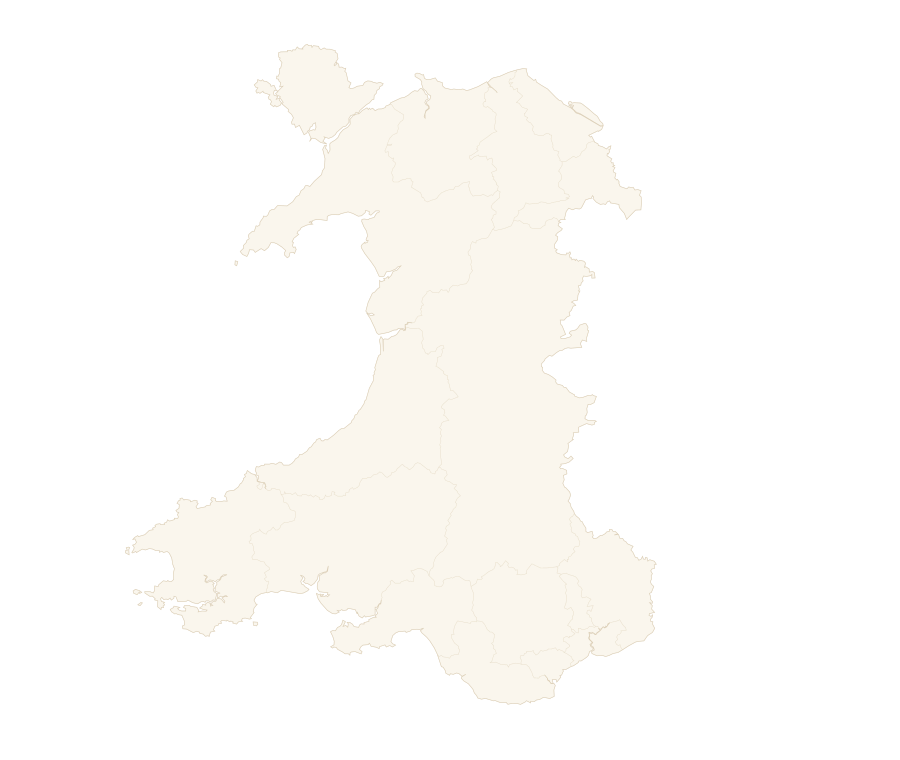
CoreHistoric reach
The seat of Owen
Seat vacantChief
No one leads the Owen community yet. When the movement opens, you can stand for its leadership, or help elect whoever does.
Current mission
No shared goal set yet. Once Owen has leadership, it sets the public focus: a restoration, a gathering, a real-world project that helps its own.
The Owen clan is being rebuilt. Join the waiting list for the movement today, and you help decide who leads it and what it does.
Help rebuild the Owen clan →What does the Owen name mean?
From the Welsh Owain, a name borne by a long line of native princes including Owain Gwynedd (d.1170), Owain ap Gruffudd (Owain the Red Hand, d.1378), Owain Glyndŵr (d.c.1415) and Owain ap Maredudd ap Tudur (Owen Tudor, d.1461). The surname is the patronymic 'ap Owain' stripped of the prefix; the variant Owens carried the genitive 's' typical of the Tudor administrative compression.
The history of Owen
A prince's name, before it was anybody's surname
Owen is the anglicised form of the Welsh personal name Owain, which the etymologists take back to the Latin Eugenius, noble-born. T. J. Morgan and Prys Morgan, in Welsh Surnames, trace Latin Eugenis into Old Welsh Ou[u]ein and Eug[u]ein, written in Middle Welsh as Ewein, Owein and Ywein, and agree with Rachel Bromwich that Owein is normally latinised as Eugenius, the Irish Eoghan being the same Latin name down a parallel road.
The men who made the name famous carried it as a first name and had no surname at all. Owain Gwynedd died in 1170; Owain ap Gruffudd, called Owain Lawgoch, Owain the Red Hand, in 1378; Owain Glyndŵr, the last native Prince of Wales, around 1415. Owain ap Maredudd ap Tudur, remembered in English as Owen Tudor, died in 1461, and his marriage to Catherine of Valois, widow of Henry V, began the line that took the English crown in 1485. What follows is the story of the surname their name became.
The Tudor century, and how Owain froze into Owen
In 1292, forty-eight per cent of recorded Welsh names were patronymics, and in some parishes the figure passed seventy. A man was his father's son and nothing more: his baptismal name, then ap or ab for son of, or ferch for daughter of, then his father's baptismal name. Evan ap Thomas fathered John ab Evan, who fathered Rees ap John, and not one syllable of it was inherited. The strings ran longer, as in Llewelyn ap Dafydd ab Ieuan ap Gruffudd ap Meredydd, back perhaps seven generations, because Welsh law made it necessary for a man to recite exactly how he descended from an ancestor.
Those laws decayed through the later Middle Ages, and fixed hereditary surnames came in with the unification of Wales and England under Henry VIII in 1536. In Henry's reign surnames became hereditary among the Welsh gentry, and the custom spread only slowly to commoners. Districts where English influence was strongest gave up the old system first, as did town families and the wealthy; in remote rural parishes ap-names were still in use in the early 19th century.
Owain went into the freeze three ways. Where the ap survived as a fused prefix it produced Bowen, from ab Owen, the formation that also gave Powell from ap Hywel and Price from ap Rhys. Where the prefix was dropped, the father's name stood alone, and that is Owen. Where the English genitive s was added instead, in the pattern that made Jones, Roberts and Edwards the commonest names in the country, it produced Owens, a spelling that also does duty for the Irish Mac Eoghain.
Two Owens in one parish, and no cousin between them
Welsh surnames were built from a small stock of baptismal names, and the Protestant Reformation shrank that stock further, so a handful of names came to cover a whole nation. The consequence matters more to a family historian than any etymology: Welsh communities routinely contain families of the same surname who are not related in any way. It cannot be assumed that two people named Owen, even in the same village, inherited the name from a common ancestor.
The saddler's son who took the mills at New Lanark
Robert Owen was born at Newtown in Montgomeryshire on 14 May 1771, the sixth child of a saddler and ironmonger. He left school at nine, was bound apprentice in his tenth year to a draper at Stamford, and at eighteen was managing a Manchester cotton mill of five hundred hands. By twenty-eight he was a partner in the Chorlton Twist Company, one of the largest cotton firms in the country.
In 1799, with two Manchester partners, he bought the New Lanark cotton mills on the upper Clyde from David Dale. They employed about two thousand people, five hundred of them pauper apprentice children housed in barracks at the works. Owen took over as managing partner in January 1800 to prove a thesis the trade held commercially impossible: that the productivity of a workforce and the welfare of a workforce are the same problem.
Over twenty-five years he made New Lanark the most-visited industrial site in Europe. He raised the minimum working age to ten and then twelve, cut the working day from fourteen hours to ten, built the first infant school in the world at the mill gates in 1816, and opened the Institute for the Formation of Character with its evening classes, library and concert hall. He ran a company store at cost price, the direct ancestor of the cooperative store, and ran the village without corporal punishment or piece-work fines. The mill was profitable throughout.
The Lanark Report and a movement of a billion members
The Factory Act of 1819, the first British legislation against child labour, was largely Owen's draft. His Report to the County of Lanark in 1820 set out the doctrine of the self-governing industrial village that seeded the British cooperative movement, and the Rochdale Pioneers, who founded the modern co-op in 1844, took his principles as their constitution. He founded the community of New Harmony in Indiana in 1825 and returned to England in 1828 to lead the trades-union and cooperative congresses of the 1830s.
He died at Newtown on 17 November 1858, in his eighty-eighth year, back in the market town where he had been born. The New Lanark mills ran until 1968, were saved by a conservation trust in the 1970s and were inscribed as a UNESCO World Heritage Site in 2001. The principles of the Lanark Report, member ownership, equal voting and surplus shared among the members, are the constitution of a movement of over a billion people worldwide.
Wilfred Owen, and the Owens of the pulpit and the lecture room
Wilfred Owen was born in 1893 at Oswestry, on the English border, into a family of Welsh descent. In the eighteen months before his death at the Sambre-Oise Canal in 1918, one week before the Armistice, he wrote the poetry that has defined the First World War in English ever since.
The name recurs through Welsh letters and Welsh learning with no descent connecting the bearers to one another, or to him, or to the Owens of Newtown. Henry Owen (1716–1795) was a Welsh theologian and Daniel Owen (1836–1895) a Welsh novelist. Sir Isambard Owen (1850–1927) was a British academic and physician; Edmund Owen (1847–1915) an English surgeon; Richard Owen (1804–1892) an English biologist; Gwilym Ellis Lane Owen (1922–1982) a Welsh philosopher. Under the Owens spelling, Mathew Owens is a Welsh space physicist.
The name beyond Wales
Bearers of the name turn up abroad in every line of work. William Fitzwilliam Owen (1774–1857) was an English naval officer, explorer and hydrographer, and Daniel Owen (1732–1812) served as lieutenant governor of Rhode Island and Chief Justice of its Supreme Court. Joshua T. Owen (1821–1887) was a Welsh-American military officer, Evelyn Owen (1915–1949) an Australian military officer and inventor, and Robert Bowie Owens (1870–1940) an American electrical engineer who discovered alpha rays.
The name on the field and on the stage
In Welsh sport the name recurs with no family behind it: Dicky Owen (1876–1932) in rugby union, Ike Owens (1918–1998) a Great Britain and Wales international at both league and union, Ken Owens (born 1987) a Welsh rugby union player, and Nigel Owens (born 1971) a Welsh international referee. Michael Owen (born 1979) and Syd Owen (1927–1999) were English footballers; Clive Owen (born 1964) and Reginald Owen (1887–1972) acted. None of them can claim descent from another, and that is the point of the name: the Tudor fixing of surnames handed the same word to thousands of unconnected Welsh households, and every family that carries it owns its share outright.
Champions of the Owen name
The bearers whose lives are inseparable from this surname. Each has their own page, biography, achievements, geography, connection to the family.
Historic Places, Rebuilt
Explore the streets and seats the Owen name knew, rebuilt with AI as they stood in history.
Historic Places, Rebuilt · New
Edward I's walled bastide and mighty castle in North Wales, a generation after the conquest, the banded towers still rising.
Historic Places, Rebuilt · New
Owain Glyndŵr's mountain fortress and court at the high tide of Welsh independence, the English siege lines gathering below.
Historic Places, Rebuilt · New
The grandest castle-palace in Wales at its height, the moated Yellow Tower, fountain courts and long gallery, on the eve of the siege.
The castles of the homeland
The great strongholds of the homeland, look one up, see what it looked like in its prime, and recreate it to explore.
 Caernarfon CastleRestored · prime 1330
 Conwy CastleRuin · prime 1287
 Pembroke CastleRestored · prime 1280
All castles in Wales → · Strongest castles in Wales → · Castles of Europe
Play As Your Clan
Hold a real castle against whatever you choose to send at it, take a ship out in her own service years, or stand at the shoulder of someone the record remembers. The chronicler sets the scene; the deeds are yours.
Notable bearers of the Owen name
- Wilfred Owen (1893–1918), war poet
- Robert Owen (1771–1858), founder of British socialism, of New Lanark
- Owen Glendower / Owain Glyndŵr (c.1359–c.1415), last native Prince of Wales
Stories of Owen
Wilfred Owen at Craiglockhart
1917Wilfred Owen, second lieutenant of the Manchester Regiment, was sent to Craiglockhart War Hospital in Edinburgh in June 1917 with shell-shock after fourteen days under bombardment in a flooded cellar at Savy Wood near Saint-Quentin. He was twenty-four years old. He had not yet published a poem he would later wish to be known by. On the seventeenth of August 1917 he met Captain Siegfried Sassoon, the published war-poet, who had been sent to Craiglockhart for a different reason, namely his refusal to serve any longer in protest at the war. The four months they overlapped at Craiglockhart, during which Sassoon read Owen's drafts and pushed back, were the four months Owen learned what he was. He drafted Anthem for Doomed Youth in September with Sassoon's pencilled corrections in the margins; he wrote Dulce et Decorum Est in October and rewrote it in November after Sassoon told him the framing was too genteel. He went back to the front in August 1918, was awarded the Military Cross at Joncourt on the first of October, and was killed crossing the Sambre–Oise Canal at Ors on the morning of the fourth of November 1918. The telegram reached his mother at Shrewsbury on the eleventh of November as the Armistice bells were ringing.
Read the story →
Robert Owen at New Lanark
1800On the first of January 1800, Robert Owen, twenty-eight years old, the Newtown-Montgomeryshire-born self-made Manchester cotton-manufacturer, took over the management of the New Lanark cotton mills on the upper Clyde in Lanarkshire, a complex of four water-powered mills employing about two thousand workers (about five hundred of them pauper-apprentice children of seven to twelve years old, brought up from the Glasgow and Edinburgh poor-houses on six-year indentures), which Owen had purchased the previous year from his father-in-law David Dale with two business partners. Over the next twenty-five years Owen ran New Lanark as a deliberate experiment in industrial paternalism: he reduced the day from fourteen hours to twelve and then to ten and a half; refused to employ children under ten; opened the world's first infant school in 1816 for the under-fives of the mill's workers; raised wages, built clean housing, opened a co-operative shop that sold goods at cost. The mills became the most-visited industrial site in early-nineteenth-century Europe (about twenty thousand visitors over the years, including the future Tsar Nicholas I, the Habsburg archdukes, and most of the Whig and Tory leadership of the British political class). Owen's A New View of Society (1813) and Report to the County of Lanark (1820) became the foundational texts of British co-operativism and utopian-socialist thought. He emigrated to America in 1825 to found the community of New Harmony in Indiana (which failed in 1827) and returned to Britain in 1829 to lead the Grand National Consolidated Trades Union of 1834. New Lanark is, since 2001, a UNESCO World Heritage Site.
Read the story →
Frequently asked
What does the surname Owen mean?
Where does the Owen family come from?
Where did the Owen family historically hold territory?
Is Owen Welsh or English?
How old is the Owen surname?
What is the Owen family known for?
Is there a Owen family crest or coat of arms?
Who is the most famous Owen?
Who are some famous Owens?
What stories are told about the Owen family?
What is the story of Wilfred Owen at Craiglockhart?
Is Owens the same family as Owen?
Where is the Owen surname found today?
What does the Clan Rising page for the Owen family cover?
Who is the head of the Owen family today?
Neighbouring clans
- WilliamsSon of William, second only to Jones in Welsh density, and first in the north.
- EvansSon of John, by the Welsh road, the cousin name of Jones.
- RobertsStrong in the north, the patronymic of Robert, second to Williams in Caernarfonshire.
- LewisLlywelyn anglicised, a princely name carried into common use across the Marches and the south.