Roberts
Strong in the north, the patronymic of Robert, second to Williams in Caernarfonshire.
- Origin
- Gwynedd, Wales
- Famous bearer
- Evan Roberts (1878–1951), Loughor blacksmith's apprentice, leader of the 1904–05 Welsh Revival
- Register
- Welsh family
The Roberts arms and country

Coat of armsArms of Roberts, Earl RobertsBorne by Earl Roberts: the ennobled line of the name, not the name at large.MostEpic · CC BY-SA 4.0

- Coat of arms: Granted to an individual and inherited down that one documented line. These are the arms of particular families of the name, not of everyone who shares the surname.
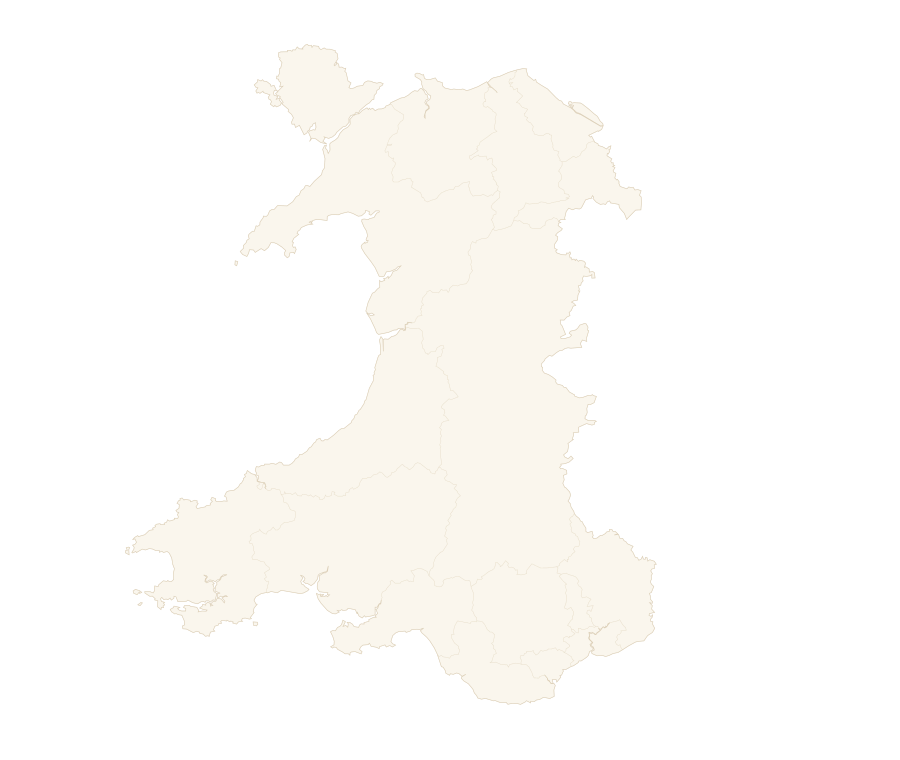
CoreHistoric reach
The seat of Roberts
Seat vacantChief
No one leads the Roberts community yet. When the movement opens, you can stand for its leadership, or help elect whoever does.
Current mission
No shared goal set yet. Once Roberts has leadership, it sets the public focus: a restoration, a gathering, a real-world project that helps its own.
The Roberts clan is being rebuilt. Join the waiting list for the movement today, and you help decide who leads it and what it does.
Help rebuild the Roberts clan →What does the Roberts name mean?
Son of Robert. The Welsh patronymic 'ap Robert' compressed into Roberts under the Tudor administration. Robert itself was a Norman import, embedded in north Wales particularly through the marcher lordship of Bromfield and Yale (now Wrexham).
The history of Roberts
The year a Welshman's name stopped moving with his father
Forty-eight per cent of the Welsh names recorded in 1292 were patronymics, and in some parishes the share passed seventy. These were not surnames in any modern sense but statements of descent, rebuilt every generation. A Thomas gave his son the name Evan ap Thomas, that son's boy became John ab Evan, and the next was Rees ap John. Nothing passed down except the mechanism itself. Longer chains ran back through grandfathers and beyond, so that a name of the form Llewelyn ap Dafydd ab Ieuan ap Gruffudd ap Meredydd was a working pedigree carried in the mouth, and Welsh law leaned on exactly that: a man's rights turned on being able to say how he descended from a named ancestor.
That law decayed through the later Middle Ages, and with it the reason to recompute a name every generation. In the reign of Henry VIII fixed surnames became hereditary among the Welsh gentry first, then spread slowly and unevenly to commoners, and the union of 1536 dropped Welsh landholders into an English administrative machine that wanted one stable spelling per household for a rent roll, a jury list, a will. Districts where English influence was strongest had already abandoned the old system; so had town families and the wealthy, who dealt with clerks most often and had most to lose from a name that would not hold still.
Roberts is what that freeze looks like when it catches a man christened Robert. The ap was dropped outright, an English genitive -s was fastened to the baptismal name, and the pedigree stopped travelling. The surrender was not uniform: patronymic naming survived in some rural districts into the early 19th century, which is why the Roberts households of Caernarfonshire and Anglesey are not all frozen at the same date, and certainly not from the same Robert. Two centuries separate the earliest gentry adoptions from the last upland parish to give the practice up.
The families that kept the ap, and the ones that took the s
Wales solved the same problem twice. One set of families swallowed the ap into the front of the new surname and carried it forward as a consonant: ap John became Upjohn, ap Hywel became Powell, ap Rhys became Price and Pryce, ap Hugh became Pugh, ap Richard became Pritchard, ab Owen became Bowen. The other set threw the particle away and added an s to the father's baptismal name. That second road produced the commonest surnames in modern Wales (Jones, Edwards, and Roberts among them), and it is the reason a Welsh surname can look, on a page, exactly like an English one.
Pritchard is the instructive comparison, because it is the same construction with a different fate: ap Richard kept its particle where ap Robert lost it. Nothing about the two names distinguishes them in origin. What separated them was the clerk, the district and the decade in which the household first had to write itself down, and the districts where English influence was strongest had given the old system up first.
The -s form was not a Welsh invention grafted on. Patronymic surnames with the short -s ending are recorded across parts of England from the Middle Ages, well before Welsh families adopted them wholesale, so what happened in Wales in the 16th and 17th centuries was the borrowing of a ready-made English suffix to close down a Welsh system. The result is a surname whose grammar is English, whose Robert is Norman, and whose distribution is unmistakably Welsh, thickest in exactly the counties where English was thinnest on the ground.
How a Norman baptismal name reached the Denbighshire uplands
Robert did not come out of Welsh. It was a Norman personal name, carried into Britain by the same conquest that produced the first hereditary surnames on this island: the barons documented in the 11th century, the Domesday survey of 1086, and the Norman habit of fixing 'de' before a village or estate in France to mark a territorial name. Those men had stable family names generations before the tenants of Gwynedd did, and the fashion moved downwards through society rather than outwards from it.
The name entered north Wales along the seam where marcher lordship met Welsh upland, and in this family's case particularly through the lordship of Bromfield and Yale, the country around modern Wrexham. Marcher lordships were where the two naming worlds ground against one another: Norman baptismal names in the lord's household and the borough, ap-chains in the townships beyond. A Welsh family that took Robert for a son was taking a name from the administrative side of that line, and a generation or two later the administrative side took the name back with an -s on it.
The chronology is worth holding straight. By 1400 most English families and those of Lowland Scotland had hereditary surnames; by the 14th century most English and Scottish people used them at all. Wales followed only after the unification of 1536 under Henry VIII, a century and a half behind, and by a legal push rather than a drift of fashion. Roberts, as a name that is inherited rather than recalculated, therefore begins its life inside the Tudor century, not in the age of the princes.
The son or the servant of a man called Robert
There is a second door into the name, and it is not a romantic one. In England it was ordinary practice for a servant to take his employer's name with an s added (the surname Vickers is understood as the name of a vicar's servant rather than a vicar's son), and Roberts sits squarely in that ambiguity. The name could be adopted by the son of a man named Robert or by the servant of one, and no spelling difference marks which. In a burgh household or a marcher lord's establishment, the two routes were being walked at the same time, in the same street.
That ambiguity multiplies into a genealogical fact that Welsh researchers learn early. Because so many Welsh surnames descend from patronymics built on a very small set of baptismal names, communities are full of families carrying the same surname who share no ancestor at all. Two Robertses in one village cannot be assumed to have inherited the name from a common forefather; the safe assumption is the opposite, that they froze independently from two different Roberts a few streets apart.
This is why the deep-history of a name like Roberts has to be told as the history of a system and the people it threw up, rather than as one lineage from one hall. The name is not a clan in the Highland sense, with a chief and a charter chest. It is thousands of separate freezes of the same Welsh mechanism, mostly in the north-west, each with its own Robert standing at the head of it and no way now to tell them apart. The Scottish surnames built on a clan name (MacDonald, Cameron, Campbell) encode membership of a kindred; Roberts encodes only a father, or an employer, and one moment of paperwork.
Why Wales ran out of names, and what it did about it
The stock of Welsh surnames is famously small, and the Protestant Reformation is a large part of the reason. As the range of baptismal names in use narrowed after it, the pool of fathers' names available to freeze into surnames narrowed with it, and a country that had once drawn on a wide native onomastic range fixed itself onto a handful of scriptural and Norman favourites. Evans, Jones, Williams, Davies and Thomas were all inside the top ten surnames recorded for England and Wales in 2000; Roberts belongs to the same short shelf, formed the same way, from the same shrunken supply.
The consequence was practical chaos in parishes where a dozen households answered to one name. In the 19th century Welsh families answered it by inventing a second identifier, prefixing the name of a house, a parish or the mother's surname to the shared patronymic: the pattern behind a name like Cynddylan Jones, later hardened with a hyphen into forms such as Griffith-Jones. It was a home-made repair to a problem the Tudor freeze had created, three hundred years after the fact.
Modern Welsh speakers have taken a different exit. There has been a limited revival of patronymic and given-name surnames, most visibly among public figures who set the inherited -s name aside: Dafydd Iwan, born Dafydd Iwan Jones, and the singer Bryn Terfel, born Bryn Terfel Jones, both dropped the frozen patronymic for a name in the older Welsh manner. The system that produced Roberts is, in a small way, being run backwards.
Bobs: the one-eyed subaltern at Khudaganj
Frederick Sleigh Roberts was born at Cawnpore on 30 September 1832, the son of General Sir Abraham Roberts, an East India Company officer from a branch of the Roberts name long settled in Ireland. He was small and slight, blind in one eye after a childhood illness, and was judged too frail for soldiering. He went anyway: Eton, then Sandhurst and Addiscombe, then a commission in the Bengal Artillery in 1851 that carried him out to his father's world on the north-west frontier of India.
He was a young staff officer when the rising of 1857 broke. Through that year's marches he showed a disregard for his own safety that his colleagues found close to reckless, and at Khudaganj on 2 January 1858 he rode alone after a party of mutineers, cut down a man carrying off a captured standard and took it for himself, and saved the life of a sowar under attack. The Victoria Cross followed. He then spent twenty years climbing through the staff and campaigns of the Indian army as a meticulous organiser of supply and movement, without ever losing the frontline habits of the subaltern who had chased the standard.
The nickname his soldiers gave him (Bobs, cut from the surname itself) carried real affection, and it was earned rather than granted. He was known for knowing his men, for sharing their conditions on the march, and for pressing the case of the ordinary soldier's welfare when that was not fashionable among senior officers. A Welsh patronymic surname had produced, by way of an Irish-settled branch, one of the most popular soldiers Britain had.
Three hundred miles from Kabul to Kandahar
His name was made in the Second Afghan War. After the British mission at Kabul was massacred in 1879, Roberts took a force up through the passes, won the action at Charasiab and occupied the city. In the late summer of 1880 word came that a British brigade had been broken at Maiwand and the survivors shut up in Kandahar, far to the south-west. Roberts assembled a hand-picked column of about ten thousand men and marched it roughly three hundred miles of waterless mountain country in some three weeks, arriving with the force still in hand and fit to fight.
On 1 September 1880, the day after he came up, he attacked the army of Ayub Khan outside the city and broke it outright, taking the whole of its artillery and its camp and lifting the siege in a single action. Speed, endurance and decision were all in the one stroke, and the march and the battle together were celebrated across the empire as a model of each. It remains the cleanest single result of the Afghan wars: a relief column that arrived in time and won the day it gave battle rather than settling into another campaign.
He was loaded with honours for it and took his title from the place, Lord Roberts of Kandahar, which is an unusual fate for a Welsh patronymic. The march is what the surname carries in British military memory, and it is why a name formed from ap Robert in a marcher lordship ended up attached to a stretch of Afghan road.
Kimberley, Pretoria, and a death at St Omer
Roberts went on to be Commander-in-Chief in India, and when the South African war of 1899 opened with a run of British reverses he was sent out as Commander-in-Chief there. He relieved Kimberley, broke the Boer field armies and took Bloemfontein and Pretoria, restoring the British position before handing over and coming home in 1900. He was created an earl, and became the last Commander-in-Chief of the British Army.
He did not survive the opening months of the next war. On 14 November 1914 he died at St Omer of pneumonia caught while visiting Indian troops in the field in the first winter of the Great War, at eighty-two, among the soldiers whose army he had spent his life inside. He was given a state funeral and buried in St Paul's, the cathedral to which Henry VII's red dragon had been carried in state after Bosworth four centuries earlier.
For the surname, his career is a reminder of how far the Welsh -s names travelled once the empire opened. Roberts stayed thickest in Gwynedd and Anglesey, but the same name went out through the Company army, the Indian frontier and the South African veldt, and came back as a title, an earldom and a nickname that a whole army used. It also shows how far a Welsh patronymic could drift from its parish: an Irish-settled branch, an Indian birth at Cawnpore, an Afghan territorial title, and a grave in St Paul's.
Evan Roberts, the Loughor blacksmith's apprentice
Wales carries a long tradition of nonconformism and Methodism, and it produced the other kind of famous Roberts entirely. Evan Roberts, born at Loughor in 1878 and apprenticed to a blacksmith, was the leader of the Welsh Revival of 1904 and 1905. He died in 1951, long outliving the fire he had set.
The country the revival ran through was already a chapel country with legal habits to match. Sabbatarian temperance was strong enough that the sale of alcohol was banned in Wales on Sundays by the Sunday Closing (Wales) Act of 1881, the first piece of legislation issued specifically for Wales since the Middle Ages, and a measure of how completely the chapel had become the national institution. Local districts were only permitted to vote themselves wet from the early 1960s, and the last of them, Dwyfor in the north-west, held out into the 1980s.
That is the world the northern Roberts families lived in and helped make: Welsh-speaking, chapel-going, and organised around preaching rather than gentry patronage. The Roberts name has no castle in Gwynedd. Its institutions were the chapel, the quarry and the printed sermon, and its most consequential bearer at home was a blacksmith's apprentice with no standing at all before the winter of 1904.
Counting a Welsh name across four continents
The name left Wales with the industries. The population of Wales doubled from 587,000 in 1801 to 1,163,000 in 1851 and reached 2,421,000 by 1911, with Glamorganshire alone going from 71,000 to 1,122,000 across the same span, and the movement was not only inward. Welsh families went to Liverpool and Ashton-in-Makerfield, and contract miners went to the coalfields of Pas-de-Calais in northern France, clustering around their own chapels. The ship Albion left Cardigan for New Brunswick in 1819 with twenty-seven Cardiganshire families aboard, many of them farmers.
Further out, Thomas Benbow Phillips of Tregaron planted about a hundred Welsh settlers in Rio Grande do Sul in Brazil in 1852; Y Wladfa took Welsh speech to Patagonia; Jackson County in Ohio was called Little Wales and kept a Welsh-language press until y Drych switched to English in the late 1940s; and Malad City in Idaho, begun as a Welsh Mormon settlement, claims a higher proportion of Welsh-descended inhabitants than anywhere outside Wales. John Hughes, an engineer from Merthyr Tydfil, founded the city that became Donetsk in 1869 and had it named Yuzovka after himself.
The arithmetic at the far end is measurable. Around 718,000 people in Wales, nearly 35 per cent of the population, carry a family name of Welsh origin, against 5.3 per cent in the rest of the United Kingdom, 4.7 in New Zealand, 4.1 in Australia and 3.8 in the United States: some 16.3 million people across the countries studied. A four-year survey concluded in 2016 found that over ninety per cent of 45,602 surnames in Britain and Ireland are native to these islands.
The counties where the name and the language sit on the same ground
The Roberts heartland and the Welsh-speaking heartland are the same map. First-language Welsh is concentrated in the less urban north and west (Gwynedd, inland Conwy and Denbighshire, northern and south-western Powys, Anglesey, Carmarthenshire, north Pembrokeshire and Ceredigion), which is a near-exact overlay on the counties where Roberts households are thickest. The surname was frozen by an English administrative process, but it was frozen onto families who went on speaking Welsh at home for another four centuries, and in many of those parishes still do.
The numbers there have been moving one way for a generation. The proportion of Welsh speakers in Gwynedd fell from 72.1 per cent in 1991 to 68.7 in 2001, 65.4 in 2011 and 64.4 in 2021; Ceredigion dropped harder, from 59.1 per cent to 45.3 across the same period, with a 19.5 per cent influx of new residents between 1991 and 2001 behind much of it. As many as a third of properties in Gwynedd are bought by people from outside Wales, and the former county councillor Seimon Glyn drew national attention to the housing side of that in 2001. The 2001 census had also carried the first rise in Welsh speakers in a hundred years, and it came in the cities rather than the old strongholds.
There is a countervailing figure that matters for the next century of the name. Welsh-language nursery education has produced more Welsh speakers under five years of age than over sixty, reversing decades of decline at the youngest end, and the Welsh Government has identified media, the country's third-largest revenue earner, as one of the sectors where demand for Welsh speakers will grow. The Roberts families of Caernarfonshire will pass on a name that is grammatically English and a language that is not.
Cymry: what the bearers of the name called themselves
Welsh is not a Welsh word. It descends from Anglo-Saxon wealh, from Proto-Germanic walhaz, taken in turn from the Volcae, a Gaulish people known to the Romans, and applied by English speakers to the Britons they found in the west; the same root produced Wallonia, Wallachia, Valais and Włochy, the Polish name for Italy. The word the people used for themselves was Cymry, from the Brythonic kombrogi, fellow-countrymen, a term that carries fraternity rather than foreignness, and that is attested in a praise poem to Cadwallon ap Cadfan composed around 633.
That self-name came out of a wider country than modern Wales. It grew from the post-Roman relationship between the Welsh and the Brythonic-speaking peoples of northern England and southern Scotland, Yr Hen Ogledd, the Old North; Cumbria takes its name from the same root, and the early Welsh poem Y Gododdin belongs to a kingdom whose capital was Din Eidyn, the rock at Edinburgh. Only gradually did Cymry displace Brython as the ordinary word, prevailing in the literature after about 1100.
Underneath the Norman baptismal name and the English suffix, the population is old and distinct. Ancient-DNA work puts Welsh ancestry at roughly 58 per cent Brittonic, with up to 22 per cent from a Danish-like source read as Anglo-Saxon, 3 per cent Norwegian and 13 per cent from further south in Europe; genetic surveys find Wales forms its own group within Britain, divided again between north and south, with a further difference across the Landsker line in Pembrokeshire. The north-Welsh Roberts families sit on the northern side of that divide, carrying a Norman name on a Brittonic inheritance.
Champions of the Roberts name
The bearers whose lives are inseparable from this surname. Each has their own page, biography, achievements, geography, connection to the family.
Historic Places, Rebuilt
Explore the streets and seats the Roberts name knew, rebuilt with AI as they stood in history.
Historic Places, Rebuilt · New
Edward I's walled bastide and mighty castle in North Wales, a generation after the conquest, the banded towers still rising.
Historic Places, Rebuilt · New
Owain Glyndŵr's mountain fortress and court at the high tide of Welsh independence, the English siege lines gathering below.
Historic Places, Rebuilt · New
The grandest castle-palace in Wales at its height, the moated Yellow Tower, fountain courts and long gallery, on the eve of the siege.
The castles of the homeland
The great strongholds of the homeland, look one up, see what it looked like in its prime, and recreate it to explore.
 Caernarfon CastleRestored · prime 1330
 Conwy CastleRuin · prime 1287
 Pembroke CastleRestored · prime 1280
All castles in Wales → · Strongest castles in Wales → · Castles of Europe
Play As Your Clan
Hold a real castle against whatever you choose to send at it, take a ship out in her own service years, or stand at the shoulder of someone the record remembers. The chronicler sets the scene; the deeds are yours.
Notable bearers of the Roberts name
- Evan Roberts (1878–1951), Loughor blacksmith's apprentice, leader of the 1904–05 Welsh Revival
- Bartholomew 'Black Bart' Roberts (1682–1722), pirate
- Kate Roberts (1891–1985), Welsh-language novelist
Stories of Roberts
Evan Roberts and the Revival
1904On the evening of the thirty-first of October 1904, in Moriah Calvinistic Methodist Chapel at Loughor on the Burry Inlet in West Glamorgan, a twenty-six-year-old former colliery boy and blacksmith's apprentice called Evan Roberts, then a candidate for the Methodist ministry at Newcastle Emlyn, came home for the half-term holiday and asked his minister, the Reverend Daniel Jones, for permission to address the youth meeting after the seven o'clock service. Sixteen young people stayed back. Roberts spoke to them for an hour and then asked them to commit to four points: confess any known sin, give up doubtful habits, obey the prompt of the Spirit promptly, confess Christ publicly. By the end of the meeting all sixteen had stood up. He held a similar meeting the next night, and the next. Within a fortnight, Moriah was full to the doors every night. Within a month, news had spread up the coalfield, and Roberts was preaching in Aberavon, Pontypridd, Cardiff, Caernarfon. By March 1905, by the conservative count of the chapel union, about one hundred thousand new converts had been added to the Welsh Nonconformist congregations, the largest spontaneous religious revival in modern British history. The tradition of the chapels of South Wales is that, on the night of the thirty-first of October 1904 at Moriah Loughor, the country changed.
Read the story →
Black Bart off Cape Lopez
1722On the morning of the tenth of February 1722, off Cape Lopez on the west coast of present-day Gabon, the British Royal Navy fifty-gun ship HMS Swallow under Captain Chaloner Ogle, in pursuit of the pirate squadron of Bartholomew Roberts since the mid-January, came up on the Roberts flagship the Royal Fortune (a forty-gun captured-French slaver Roberts had taken at Whydah six weeks earlier) at the Cape Lopez anchorage. Roberts, forty years old, the Pembrokeshire-Welsh former merchant-marine mate who had succeeded Howell Davis as captain of the Royal Rover squadron in June 1719 and had taken about four hundred and seventy prize-ships in the thirty-two months since, had been celebrating the overnight a successful prize-capture of the previous day. The Swallow came in under French colours, hove to at long cannon-range, and opened fire with a broadside at the eight in the morning. Roberts, on the deck of the Royal Fortune in his customary crimson silk-and-feathered hat, was hit in the throat by a grapeshot ball from the Swallow's second broadside and was dead at the foot of the mainmast within seconds. His crew, by the pre-arranged Roberts protocol on his death, threw his body overboard before the Swallow boarding-party could secure it (the protocol had been agreed by the pirate-council to prevent the public-gibbet display the Royal Navy customarily inflicted on the pirate-captain's body). The Swallow captured the Royal Fortune and the surviving pirate squadron of about two hundred and seventy-two men; about a hundred and sixty-five were tried at Cape Coast Castle on the Gold Coast in April 1722 and seventy-four were hanged from a single long gibbet on the beach, the largest single execution of pirates in British history.
Read the story →
Frequently asked
What does the surname Roberts mean?
Where does the Roberts family come from?
Where did the Roberts family historically hold territory?
Is Roberts Welsh or English?
How old is the Roberts surname?
What is the Roberts family known for?
Is there a Roberts family crest or coat of arms?
Who is the most famous Roberts?
Who are some famous Robertses?
What stories are told about the Roberts family?
What is the story of Evan Roberts and the Revival?
Where is the Roberts surname found today?
What does the Clan Rising page for the Roberts family cover?
Who is the head of the Roberts family today?
Neighbouring clans
- WilliamsSon of William, second only to Jones in Welsh density, and first in the north.
- HughesSon of Huw / son of Aodh, Welsh patronymic and Irish Mac Aodha under one spelling.
- OwenThe princely name, Owain in Welsh, the surname of the last revolt and the first Tudor.
- Pritchardap Richard, the contraction is the mechanism, written into the name.