Williams
Son of William, second only to Jones in Welsh density, and first in the north.
- Origin
- Gwynedd, Wales
- Famous bearer
- Roger Williams (1603–1683), founder of the colony of Rhode Island, advocate of religious liberty
- Register
- Welsh family
Ranked of all time
The 10 Most Powerful Welsh Houses of All Time
The Williams arms and country

Coat of armsArms of Williams of ParkBorne by the Park line, one branch of the name rather than all of it.Aergia · CC BY-SA 4.0 
Coat of armsWilliams of Mostyn EscutcheonBorne by the Mostyn Escutcheon line, one branch of the name rather than all of it.Robin S. Taylor · CC BY-SA 4.0


- Coat of arms: Granted to an individual and inherited down that one documented line. These are the arms of particular families of the name, not of everyone who shares the surname.
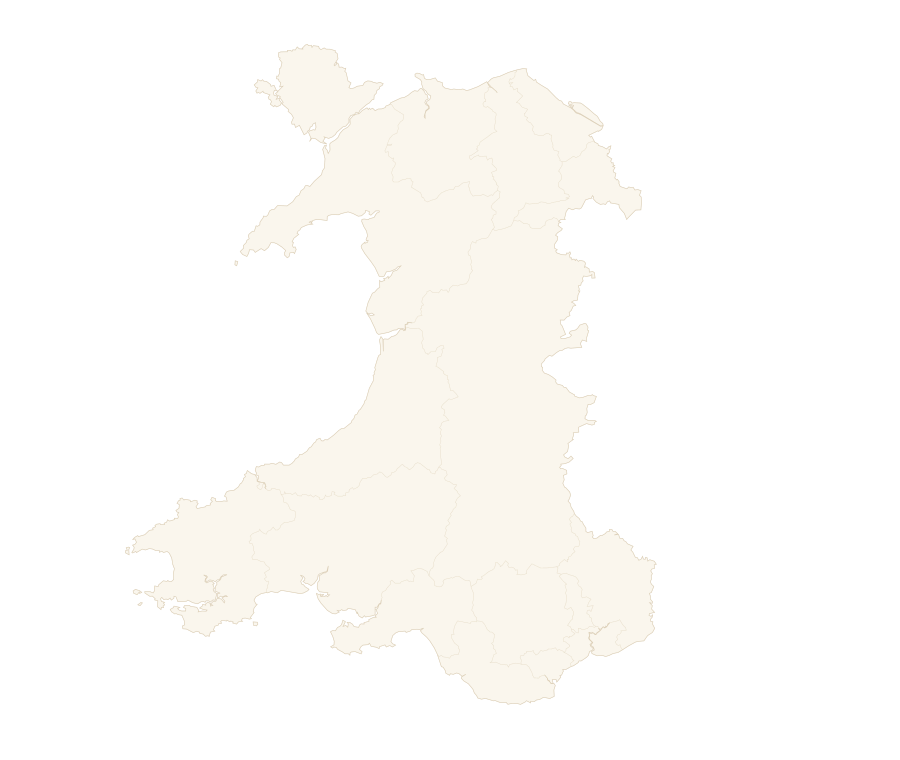
CoreHistoric reach
The seat of Williams
Seat vacantChief
No one leads the Williams community yet. When the movement opens, you can stand for its leadership, or help elect whoever does.
Current mission
No shared goal set yet. Once Williams has leadership, it sets the public focus: a restoration, a gathering, a real-world project that helps its own.
The Williams clan is being rebuilt. Join the waiting list for the movement today, and you help decide who leads it and what it does.
Help rebuild the Williams clan →What does the Williams name mean?
Son of William. Welsh 'ap William' compressed by the same Tudor-era administrative pressure that produced Jones, the genitive 's' added in the English fashion. William itself had arrived with the Normans and embedded across Wales by the late medieval period, particularly through the Marcher lordships.
The history of Williams
The ap that Wales dropped, and the s that England lent
In 1292, 48 per cent of recorded Welsh names were patronymics, and in some parishes the figure ran past 70 per cent. A man was his father's son and nothing more fixed than that: Evan son of Thomas was Evan ap Thomas, Evan's son John was John ab Evan, and John's son Rees was Rees ap John, so that the identifying name of a household changed with every generation by design. Strings such as Llewelyn ap Dafydd ab Ieuan ap Gruffudd ap Meredydd ran back four, five, sometimes seven generations, because Welsh law made descent from a named ancestor a matter of legal fact rather than family sentiment.
When those laws decayed in the later Middle Ages, the patronymic had two exits. One kept the ap and welded it to the front of the name: ap Hywel became Powell, ap Rhys became Price, ap Hugh became Pugh, ap Richard became Pritchard, ab Owen became Bowen, ap John became Upjohn. The other dropped the ap altogether and took the genitive s that English clerks had been attaching to personal names since the Middle Ages. Williams took the second road, which is why Wales has no Pwilliam to set beside Powell, and why Williams stands in the same rank as Jones, Roberts and Edwards rather than with the ap-names.
The hardening came from above. Under Henry VIII fixed surnames became hereditary among the Welsh gentry and spread slowly downward; the union of 1536 pulled Welsh landholding and office into English legal forms, and Henry's order that marital births be recorded under the father's surname gave every parish clerk a standing reason to write one name and keep writing it. Districts under strong English influence gave up patronymics first, along with town families and the wealthy, while in the rural north and west the old system stayed in use into the early 19th century - which is where Williamses are thickest on the ground.
Why two Williamses in one parish need not be cousins
The stock of Welsh surnames is small, and the Reformation made it smaller: as the variety of baptismal names contracted, so did the pool of fathers' names available to freeze into surnames. Five names built from that narrow pool - Jones, Williams, Davies, Evans, Thomas - all sat inside the top ten surnames recorded for England and Wales in 2000. One mechanism, five outputs, and no common ancestor behind any of them. Two families named Williams in the same Caernarfonshire village may have reached the name independently, from two different men called William, within a generation of one another.
The trap runs deeper than coincidence. The English s was not always filial: servants commonly took a modified form of an employer's name by the same addition, which is why Vickers reads as the vicar's man and Roberts can mean either Robert's son or Robert's servant. A Williams entered in a 16th-century register may therefore record a William's household rather than a William's child, and nothing in the spelling separates the two.
Wales fixed the collision socially rather than legally. From the 19th century families began prefixing the name of a house, a parish or the mother's line to the surname, producing compounds like Griffith-Jones, with the hyphen often arriving a generation after the pairing was already in use. The Gwynedd line that produced Sir Clough Williams-Ellis reads as exactly that repair: a second name doing the work the plain surname could no longer do in a county where Williams distinguished nobody from anybody.
Tregrug, the largest bailey in Wales, sold by Queen Mary in 1554
Above Llangibby in Monmouthshire stands Tregrug, which superseded a Norman motte-and-bailey first mentioned in 1262. The estate came to the de Clare family in 1245, and Bogo de Clare, third son of Richard de Clare, held it for some years before his death in 1294. An ambitious new residence enclosed by a high stone wall was begun in the early 14th century, probably by Gilbert de Clare; it then passed briefly to the Despensers, and it may have been Hugh Despenser who started the structure from which most of the standing ruin derives.
The scale still has no rival in the country. The bailey measures roughly 164 metres by 78, the largest single enclosure of any castle in England or Wales, entered through a huge gatehouse with two D-shaped towers of a design close to Beaumaris. Recent archaeological reading makes the place less a fortress than a pleasure ground: a hunting lodge with gardens in the manner of a late medieval pleasance, its latrine turrets finished in finely cut ashlar, which is not where a garrison commander spends his stone budget.
By the 16th century it had fallen out of use and into Crown hands, and in 1554 Queen Mary sold it to the Williams family of Usk. What they bought was less a working castle than a claim staked in masonry - the largest walled enclosure in Wales, empty, on the hill above their own valley. The family took the place into their name as Williams of Llangibby, and were still shaping the ground around it a century and a half later.
Sir Trevor Williams garrisons a hunting lodge
When the Civil War reached Monmouthshire, Sir Trevor Williams, 1st Baronet, refortified Tregrug and put a garrison inside it. He was manning walls raised for hunting parties, behind a gatehouse copied from a royal castle, in defences already three centuries out of date. The decision is a fair measure of how a Welsh gentry family read its own inheritance: obsolete or not, the Tudor purchase of 1554 was still the strongest thing the Williamses of Usk owned.
It did not survive the peace. The castle was slighted at the war's end and the family never rebuilt it. Instead they raised New Llangibby Castle nearby at the close of the century and turned the wreck into scenery for the new house, planting an avenue of Scots pines around 1707 to carry the eye up the hill toward it. The largest medieval enclosure in Wales finished its working life as a view from a drawing-room window.
David Williams castellates a farmhouse near the Dwyryd
Castell Deudraeth stands half a kilometre north-east of Portmeirion in Gwynedd, and despite the name the building is probably an 18th-century manor house rather than anything medieval. David Williams bought it in 1841 and spent the next two decades making the name accurate, enlarging and castellating it through the 1840s and 1850s. The result belongs to a recognisable Victorian moment in north Wales, when a landowner could buy a plain house and give it battlements without pretending they had ever been besieged.
The house stayed in the family until the death of Sir Osmond Williams in 1931. Sir Clough Williams-Ellis, Osmond's nephew by marriage and by then already at work on Portmeirion immediately to the south-west, bought the building and its parkland from the trustees of the estate, which brought the castellated Williams house inside the boundary of Portmeirion. After restoration it reopened in 2001, still carrying the name David Williams had spent twenty years earning for it.
The transaction shows the 19th-century hyphen doing its intended work. An estate passes from a Williams to a Williams-Ellis, uncle to nephew, and the compound surname is the only element in the sentence that identifies which Gwynedd family is meant. In a county where the plain name settled nothing, the added element was not decoration but administration.
Magnolias above Porthluney Cove
Caerhays in Cornwall was Arundell land in the early Middle Ages and passed by marriage about 1379, when Robert Trevanion married Johanna Arundell, daughter and heiress of Rudolph Arundell of Caerhays. The Trevanions held it for close to four centuries; with the death of William Trevanion in 1767 the estate went to his sister's son, John Bettesworth. The present semi-castellated house is later still, built between 1807 and 1810 half a mile south of the village of St Michael Caerhays, its long crenellated southern frontage closed at each end by a round tower, set against a wooded hillside above Porthluney Cove.
The Williams family came to it afterwards, and what they did with the place was not architectural. They gardened it. The estate holds a large collection of magnolias on a wooded hillside above the Channel, and the house holds an important mineral collection, much of it raised from the family's own Cornish mines. A working fortune ended as two collections, one under glass and one in flower, on an estate whose walls the family had no hand in building. Older fabric survives around the grounds, including an ancient chapel and the Watchhouse Walk down to the sea.
The Salem minister who walked out into a January snow
Roger Williams was born at Smithfield in the City of London about 1603, son of James Williams, a merchant tailor of the Welsh Williams line, and Alice Pemberton of St Sepulchre Holborn. Sir Edward Coke noticed the boy taking shorthand testimony in the Star Chamber and put him through Charterhouse and then Pembroke College, Cambridge, where he took his BA in 1627 and his MA in 1630. Ordained in the Church of England and serving as private chaplain to Sir William Masham of Otes in Essex, he sailed from Bristol on the Lyon on 1 December 1630 with his wife Mary Barnard and reached Boston in February 1631.
He refused the senior teaching ministry at Boston's First Church within weeks of landing, on the ground that the congregation had not formally separated from the Church of England. From the pastorate at Salem he pressed three arguments through 1634 and 1635: that the civil magistrate held no authority over the First Table of the Decalogue, that the colony's land patents from the King were void because title lay with the tribes and had to be purchased separately, and that compelling an oath of fidelity from every adult freeman violated liberty of conscience. In October 1635 the Massachusetts General Court convicted him of holding diverse new and dangerous opinions and ordered him out of the colony inside six weeks.
He left in January 1636 into the snow with a small group of followers, was sheltered through the winter by the sachems Massasoit of the Wampanoag and Canonicus of the Narragansett, bought land at the head of Narragansett Bay from Canonicus by formal deed of bargain, and founded Providence there in February 1636, naming it for the deliverance. Its compact carried no established church and no religious test for civil office, the first government in the English-settled colonies to work that way. He argued the case in print in The Bloudy Tenent of Persecution in 1644 against John Cotton, took the parliamentary patent of March 1644, served three terms as President of Providence Plantations to 1657, and died at Providence in April 1683.
Y Drych, Y Wladfa and the arithmetic of a crowded name
Welsh emigration was never heavy in proportion - Irish emigration to the United States may have run twenty-six times greater - but it was concentrated enough to plant the name in identifiable places. Contract miners from Wales went to the coal towns of the Pas-de-Calais and clustered in communities around their churches. In 1819 the Albion sailed from Cardigan for New Brunswick carrying twenty-seven Cardiganshire families, most of them farmers. In 1852 Thomas Benbow Phillips of Tregaron settled about a hundred Welsh people in Rio Grande do Sul in Brazil.
Where they landed thickly the language went with them. Jackson County in Ohio was known as Little Wales, one of several communities where Welsh was widely spoken; Malad City in Idaho, which began as a Welsh Mormon settlement, still claims a greater proportion of Welsh-descended inhabitants than anywhere outside Wales itself; Y Wladfa in Patagonia carried the same movement to Argentina; and the Welsh-language paper y Drych ran on until it gave up Welsh for English in the late 1940s. Inside Britain the movement was shorter and heavier, into Liverpool and Ashton-in-Makerfield during the Industrial Revolution, which is why English, Scottish and Irish families carry Welsh surnames today with no Welsh ancestor they can name.
A survey commissioned by the Welsh Government put the scale in figures: about 718,000 people in Wales, nearly 35 per cent of the population, hold a family name of Welsh origin, against 5.3 per cent in the rest of the United Kingdom, 4.7 in New Zealand, 4.1 in Australia and 3.8 in the United States - 16.3 million people in the countries studied. Williams is a large share of that, carried out by people who mostly owned no land at all, and what they took travelled better than an estate: the hymn a Williams of Pantycelyn wrote in 1762, sung as Guide me, O Thou Great Jehovah, went everywhere the name went.
Champions of the Williams name
The bearers whose lives are inseparable from this surname. Each has their own page, biography, achievements, geography, connection to the family.
Historic Places, Rebuilt
Explore the streets and seats the Williams name knew, rebuilt with AI as they stood in history.
Historic Places, Rebuilt · New
Edward I's walled bastide and mighty castle in North Wales, a generation after the conquest, the banded towers still rising.
Historic Places, Rebuilt · New
Owain Glyndŵr's mountain fortress and court at the high tide of Welsh independence, the English siege lines gathering below.
Historic Places, Rebuilt · New
The grandest castle-palace in Wales at its height, the moated Yellow Tower, fountain courts and long gallery, on the eve of the siege.
Historic Places, Rebuilt · New
The greatest coal port on earth at its peak, the hoists and colliers, the Coal Exchange and the streets of Tiger Bay.
Castles the Williams held
Strongholds this name held for a decade or more, look one up, or rebuild it to explore.
- Caerhays Castle
The Williams family later adapted the house and made its magnolia gardens.
- Castell Deudraeth
Held by the Williams family from David Williams's purchase in 1841 until the death of Sir Osmond Williams in 1931.
- Llangibby Castle
Held by the Williams family of Usk from 1554; Sir Trevor Williams refortified the castle in the Civil War.
The castles of the homeland
The great strongholds of the homeland, look one up, see what it looked like in its prime, and recreate it to explore.
 Caernarfon CastleRestored · prime 1330
 Conwy CastleRuin · prime 1287
 Pembroke CastleRestored · prime 1280
All castles in Wales → · Strongest castles in Wales → · Castles of Europe
Play As Your Clan
Hold a real castle against whatever you choose to send at it, take a ship out in her own service years, or stand at the shoulder of someone the record remembers. The chronicler sets the scene; the deeds are yours.
Notable bearers of the Williams name
- Roger Williams (1603–1683), founder of the colony of Rhode Island, advocate of religious liberty
- Hugh Owen Williams of Cochwillan, Tudor-period Welsh statesman
- John Williams (b. 1932), composer (Star Wars, Indiana Jones, Jaws)
Stories of Williams
Roger Williams founds Rhode Island
1636Roger Williams was born in London in 1603, the son of a merchant tailor of Welsh paternal extraction. He was educated at Charterhouse and Pembroke College, Cambridge, took orders, and emigrated to the Massachusetts Bay Colony in 1631 with his wife Mary. Within four years he had been twice charged before the Boston General Court for the radical doctrines that the magistrate had no power over conscience and that the King of England had no title to give away land that belonged to the native peoples. He was sentenced to deportation in October 1635 and ordered held in custody at Salem until the next ship in the spring. On the night of the fifteenth of January 1636, in deep snow, in fourteen weeks of an unusually severe winter, he walked out of his house ahead of the marshal who was coming to take him into custody, and into the woods south of Salem. He spent fourteen weeks of that winter under the hospitality of Massasoit and the Wampanoag and of Canonicus and the Narragansett. In June he founded a settlement at the head of Narragansett Bay, named it Providence in thanks for the deliverance, and bound it to the principle that civil authority extended to civil things only and that no person should be coerced in religion. Rhode Island was the first political community in the English-speaking world built on that principle.
Read the story →
Pantycelyn and Guide me, O Thou Great Jehovah
1762In the early summer of 1762, in the upstairs room of the farmhouse at Pantycelyn in northern Carmarthenshire that he had inherited from his father in 1742, William Williams Pantycelyn, forty-five years old, the hymn-writer of the Welsh Methodist revival of 1735–62, completed the Welsh-language hymn Arglwydd, arwain trwy'r anialwch (Guide me, O thou Great Redeemer in the standard English translation by Peter Williams of 1771, refined by William Williams's son John Williams in 1772; the standard English title since the eighteenth century has been Guide me, O thou Great Jehovah). The hymn was one of about nine hundred Welsh-language and one hundred and twenty English-language hymns Williams wrote between 1744 and his death in 1791, the foundational lyrical body of Welsh-Methodist congregational singing. Cwm Rhondda, the hymn-tune to which the English-language version of Guide me is conventionally sung, was composed by John Hughes of Pontypridd in 1907 for the centenary celebration of the Capel Rhondda chapel; the pairing of Williams's 1762 Welsh text and Hughes's 1907 Welsh tune is the foundational congregational hymn of the modern Welsh and Welsh-diaspora chapel tradition. Cwm Rhondda is the hymn most-commonly sung at the Welsh rugby international match before kick-off, by the Welsh-language post-1990 tradition of the Welsh Rugby Union, with the seventy-five-thousand-strong Cardiff Principality Stadium crowd carrying the three verses by heart in the original Welsh.
Read the story →
Frequently asked
What does the surname Williams mean?
Where does the Williams family come from?
Where did the Williams family historically hold territory?
Is Williams Welsh or English?
How old is the Williams surname?
What is the Williams family known for?
Is there a Williams family crest or coat of arms?
Who is the most famous Williams?
Who are some famous Williamses?
What stories are told about the Williams family?
What is the story of Roger Williams founds Rhode Island?
Where is the Williams surname found today?
What does the Clan Rising page for the Williams family cover?
Who is the head of the Williams family today?
Neighbouring clans
- RobertsStrong in the north, the patronymic of Robert, second to Williams in Caernarfonshire.
- HughesSon of Huw / son of Aodh, Welsh patronymic and Irish Mac Aodha under one spelling.
- OwenThe princely name, Owain in Welsh, the surname of the last revolt and the first Tudor.
- Pritchardap Richard, the contraction is the mechanism, written into the name.