14th century to todayLast updated 8 July 2026
The 10 Most Powerful Welsh Houses of All Time
Welsh power concentrated early in three native royal houses and then spread, after the conquest, into a smaller bench of gentry families and one Welsh-born line that took the English crown outright. These are the ten whose hold on Welsh ground and Welsh affairs ran deepest.
Criteria
Ranked on sustained political, military and economic power, measured across the period from the 14th century to today. Welsh patronymic surnames flattened the gentry bench after 1500, so the upper ranks are dominated by named princely houses; the Welsh-American diaspora is folded into the Morgan entry rather than ranked separately.
- Sustained political power across generations
- Military weight in the defence, and the taking, of Wales
- Economic reach, at home and across the border
- Measured from the 14th century to today
- Named princely houses lead, patronymic naming flattened the gentry bench after 1500
Kings of Gwynedd, the Llywelyns
The senior royal house of Wales. The House of Aberffraw, named for the seat at Aberffraw on Anglesey, ruled the kingdom of Gwynedd from the 9th century, the dominant native Welsh power for the better part of four hundred years. From their crowning territory in the north-west the Aberffraw kings extended Welsh law and lordship over neighbouring principalities, and in two remarkable generations came within reach of unifying all of Wales under a single princely authority.
Llywelyn ap Iorwerth ('Llywelyn the Great'), prince from 1195 to 1240, brought every other Welsh ruler under his overlordship through war and marriage, governing from Aberffraw with effective royal authority. His grandson Llywelyn ap Gruffudd ('Llywelyn the Last') was formally recognised as Prince of Wales by the English crown in the Treaty of Montgomery in 1267, the only time in the medieval period that the Welsh principality was acknowledged as a sovereign realm. The Aberffraw style and claim were absorbed into the English crown when the title 'Prince of Wales' was conferred on the future Edward II in 1301; every English and later British heir-apparent has carried it since.
The dynasty's cultural footprint runs through Welsh poetry, the legal codes of Hywel Dda (an Aberffraw inheritance), and the modern revival of Welsh national identity, where the Llywelyns serve as the founding figures. Aberffraw is the deepest sustained native political authority Wales produced, the longest-recognised royal claim in Welsh history, and the source of the most prestigious title still attached to the kingdom.
Kings of Powys
The royal house of Powys. The House of Mathrafal, named for the seat of Mathrafal in modern Montgomeryshire, ruled the central Welsh kingdom of Powys from the 9th century into the 13th, the second of the three great native Welsh royal lines. Powys stood between Gwynedd to the north and Deheubarth to the south, a contested ground that placed the Mathrafal kings at the centre of every major political settlement in medieval Wales.
The peak figures were Bleddyn ap Cynfyn, king of much of Wales from 1063 to 1075 after the death of Gruffydd ap Llywelyn, and Madog ap Maredudd, the last king of an undivided Powys, who held the kingdom from 1132 to 1160 as a respected statesman across Welsh and Norman courts alike. After Madog's death Powys split between his sons into Powys Fadog (north) and Powys Wenwynwyn (south), but both branches continued under cadet Mathrafal lines for another century.
The senior Mathrafal claim ultimately passed to Owain Glyndŵr through his descent from Madog ap Maredudd, which is partly what gave Glyndŵr's 1400 revolt its dynastic legitimacy across mid-Wales. The Mathrafal lineage continues through several cadet families and through marriage into the English aristocracy. The controversial question is whether the Powys kings held more national reach than the Dinefwr kings of the south; on the strategic centre-of-Wales argument Mathrafal edges it for second.
Dinefwr
Kings of Deheubarth, the Lord Rhys
The royal house of Deheubarth. The House of Dinefwr, named for the rock fortress of Dinefwr above the Tywi valley in modern Carmarthenshire, ruled the southern Welsh kingdom of Deheubarth from the 9th century into the 13th, the third of the three great native royal lines. At its peak Deheubarth covered roughly the modern counties of Pembrokeshire, Carmarthenshire, Ceredigion and Brecknock, the wealthiest and most agriculturally productive of the Welsh kingdoms.
The towering figure is Rhys ap Gruffydd ('Yr Arglwydd Rhys', 'the Lord Rhys'), prince of Deheubarth from 1155 to 1197. Lord Rhys held the south against the early Norman advance, attracted royal recognition from Henry II at the Council of Gloucester in 1175, and hosted the first recorded eisteddfod at Cardigan Castle in 1176, the formal founding event of the Welsh bardic tradition. Under Rhys, Deheubarth was the most stable Welsh polity of its age.
The Dinefwr line continued through the medieval period as the Lords Rhys of Dinefwr Castle, eventually becoming the Rice family (anglicised) and the modern Lords Dynevor, the title still extant. Dinefwr Castle itself stands today in the care of the National Trust. The kingdom Lord Rhys built carried a longer cultural footprint than its northern peers, the bardic tradition being a Dinefwr inheritance; Mathrafal's central Welsh strategic weight is what places it just above on national reach, but on cultural endurance Dinefwr is fully its equal.
Tudor
Welsh nobles to the English crown, 1485-1603
The Welsh line that took the English crown. The Tudor (Welsh: Tudur) family rose from minor Anglesey nobility through service to the Aberffraw princes; Tudur ap Goronwy was steward to Llywelyn the Last in the 13th century. The family's transformative moment came with Owen Tudor's clandestine marriage to Catherine of Valois (widow of Henry V) in the 1430s, which placed Owen's son Edmund Tudor in direct alignment with the Lancastrian royal line through Edmund's marriage to Margaret Beaufort.
That match produced Henry Tudor, born at Pembroke Castle in 1457, who landed in Pembrokeshire in August 1485, marched east through Wales gathering an army largely Welsh, and defeated Richard III at Bosworth on 22 August. He was crowned Henry VII, founding a dynasty that reshaped English (and through Wales, British) statecraft over the next 118 years.
Five Tudor monarchs reigned across that span, three of them transformative: Henry VII consolidated the throne and ended the Wars of the Roses; Henry VIII broke with Rome and established the Church of England; Elizabeth I, queen for forty-five years, presided over the defeat of the Spanish Armada, the high English Renaissance, and the establishment of England as an Atlantic naval power. The dynasty ended with Elizabeth in 1603, when the crown passed to her Stewart cousins.
The English ranking treats Tudor as the second of its royal lines; on Welsh ground the same dynasty is the most consequential family the country produced, the one that lifted a Welsh name onto a European throne.
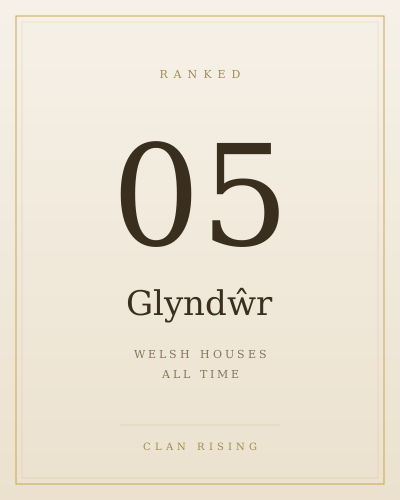
Glyndŵr
Owain's revolt, native Welsh resistance 1400-1415
The native Welsh revival. Owain Glyndŵr, descended from the Mathrafal kings of Powys and the Dinefwr kings of Deheubarth, was a successful Marcher landowner and lawyer before personal disputes with the Norman lord Reginald Grey escalated into open rebellion in September 1400, when Glyndŵr was acclaimed Prince of Wales at his manor of Glyndyfrdwy.
What began as a Welsh territorial dispute became within four years a full-blown national war of independence. By 1404 Glyndŵr controlled most of Wales, held the strategic castles of Aberystwyth and Harlech, and convened the first Welsh parliament at Machynlleth. He negotiated as a sovereign with the French crown, signed the Tripartite Indenture of 1405 with the Percy and Mortimer families to divide the kingdoms of Britain, and established a Welsh church independent of Canterbury. The revival held native control over the territory for nearly a decade, longer than any other native challenge to English rule in Wales.
After 1409 the revolt was contained and Glyndŵr himself disappeared from the historical record, never captured and never betrayed despite a substantial English bounty. He has remained the central figure in Welsh national memory ever since; Y Senedd, the Welsh Parliament reconstituted in 1999, takes its founding precedent from his Machynlleth assembly. Glyndŵr's revolt was shorter than the other royal houses' centuries; no other figure has carried more weight into modern Welsh political and cultural identity, which is what holds the position against the duration argument.
Play As Your Clan
Hold a real castle against whatever you send at it, command a ship in her own service years, or advise a life history followed closely. The chronicler sets the scene; the deeds are yours.
Herbert
Earls of Pembroke
Earls of Pembroke. The Herbert family rose to prominence under the Yorkist kings of the late 15th century; William Herbert was created Earl of Pembroke in 1468 for his service to Edward IV. The title was recreated in 1551 for William Herbert, 1st Earl of Pembroke of the second creation, who became one of the most powerful figures at the Tudor and early Stuart courts. From their Welsh seat at Raglan Castle and their English seats at Wilton and Cardiff Castle the Herberts ran a dual cultural-political operation across both kingdoms. Wilton House under the 4th Earl was the literary salon at the centre of late Tudor poetry, hosting Sir Philip Sidney and Edmund Spenser. The current 18th Earl of Pembroke still holds Wilton House. The Herberts also produced the metaphysical poet George Herbert and the 19th-century statesman Sidney Herbert, Secretary of State for War under Lord Aberdeen and a central figure in the reform of British military medicine alongside Florence Nightingale.
Wynn
Wynn of Gwydir, dominant North Wales gentry
The dominant gentry house of North Wales. The Wynns of Gwydir Castle in the Conwy Valley emerged in the 15th century as a junior branch of the royal house of Aberffraw and consolidated their hold across Caernarfonshire, Denbighshire and Merionethshire through the Tudor period. Sir John Wynn (1553-1627), 1st Baronet of Gwydir, was the great consolidator: high sheriff, member of the Council in the Marches of Wales, and author of The History of the Gwydir Family which set the template for Welsh genealogical writing. The Wynn estates passed by marriage into the Williams family of Wynnstay in the late 17th century, producing the Williams-Wynn line that became the great political house of Welsh Whigs and later Tories from the 18th century onwards. The Wynn name continues through several cadet branches and the Gwydir baronetcy.
Morgan
Tredegar industrialists at home, JP Morgan's American banking line abroad
Tredegar at home, JP Morgan abroad. The Morgans of Tredegar, descended from a senior Glamorgan family of the late medieval period, became the dominant landed and industrial house of south-east Wales from the 17th century onwards. The Morgan estate at Tredegar House (still standing in Newport) covered 40,000 acres at its peak; the family supplied multiple MPs, founded ironworks, and underwrote much of the early industrial infrastructure of Monmouthshire. Sir Henry Morgan, the 17th-century Welsh privateer and Lieutenant Governor of Jamaica, was a member of the Tredegar Morgan line.
The American banking branch ran through Junius Spencer Morgan, who emigrated and became a partner in London, and his son John Pierpont (J.P.) Morgan, the dominant figure in American finance from the 1870s through 1913. JP Morgan & Co. financed the US Treasury, organised the modern American corporation, and remains a global investment bank under his name today.
Vaughan
Trawscoed and Golden Grove
The senior Welsh gentry of mid-Wales. The Vaughans (Welsh: Fychan) emerged in multiple branches across the principalities from the 13th century, all descending from the royal house of Powys. The two leading lines were the Vaughans of Trawscoed in Ceredigion (Earls of Lisburne) and the Vaughans of Golden Grove in Carmarthenshire (Earls of Carbery). The 2nd Earl of Carbery was Lord President of Wales and the Marches under Charles II, governing the principality from Ludlow Castle in the 1660s and 1670s. The Trawscoed Vaughans produced Sir John Vaughan, Lord Chief Justice of the Common Pleas from 1668 to 1674, and the 17th-century metaphysical poet Henry Vaughan ('the Silurist'). The Earldom of Lisburne continues today with the 9th Earl at Trawscoed. The depth of cadet branches across mid-Wales and the literary inheritance is what carries Vaughan to ninth.
Williams
Williams-Wynn of Wynnstay, 'Prince in Wales'
Williams-Wynn of Wynnstay, 'Prince in Wales'. The Williamses of Llanforda in Shropshire inherited the great Wynn estates of North Wales by marriage in 1719, becoming Williams-Wynn of Wynnstay and from then through the 19th century the wealthiest and politically dominant family in Welsh-speaking Wales. Sir Watkin Williams-Wynn, 3rd Baronet (1693-1749), was the leader of the Jacobite Tories in the Commons and patron of the Honourable and Loyal Society of Antient Britons. The 4th Baronet, also Watkin (1748-1789), was nicknamed 'Prince in Wales' for his dominance of Denbighshire and Montgomeryshire politics, his patronage of Welsh culture (Owain Myfyr's Welsh manuscripts), and his vast Wynnstay estate. The Williams-Wynn baronetcy continues today, the family still seated near Ruabon. Williams is the most common surname in Wales; the Williams-Wynn line at Wynnstay is the editorial reason it ranks here, the great political household that gave a routine name its weight at the top table of Welsh politics.
Play As Your Clan
Hold a real castle against whatever you send at it, command a ship in her own service years, or advise a life history followed closely. The chronicler sets the scene; the deeds are yours.
Frequently asked
What was the most powerful Welsh house in history?
Where does the title Prince of Wales come from?
Are the Tudors a Welsh house?
Why do princely houses outrank surnames on the Welsh list?
Disagree with the order? The criteria are open and the comparative arguments are on the page entry by entry. The shape of these rankings will move as the live power-rankings companion piece begins to publish movement quarter by quarter. Submit a correction or argument.