House of Aberffraw
The royal house of Gwynedd, Llywelyn the Great's line, ended at Cilmeri in 1282.
- Origin
- Gwynedd, Wales
- Famous bearer
- Rhodri Mawr (c.820–878), King of Gwynedd, founder of the line
- Register
- Princely house
Ranked of all time
The 10 Most Powerful Welsh Houses of All Time
The Aberffraw arms and country

Coat of armsArms of LlywelynBorne by the Llywelyn line, one branch of the name rather than all of it.Sodacan · CC BY-SA 3.0

- Coat of arms: Granted to an individual and inherited down that one documented line. These are the arms of particular families of the name, not of everyone who shares the surname.
CoreHistoric reach
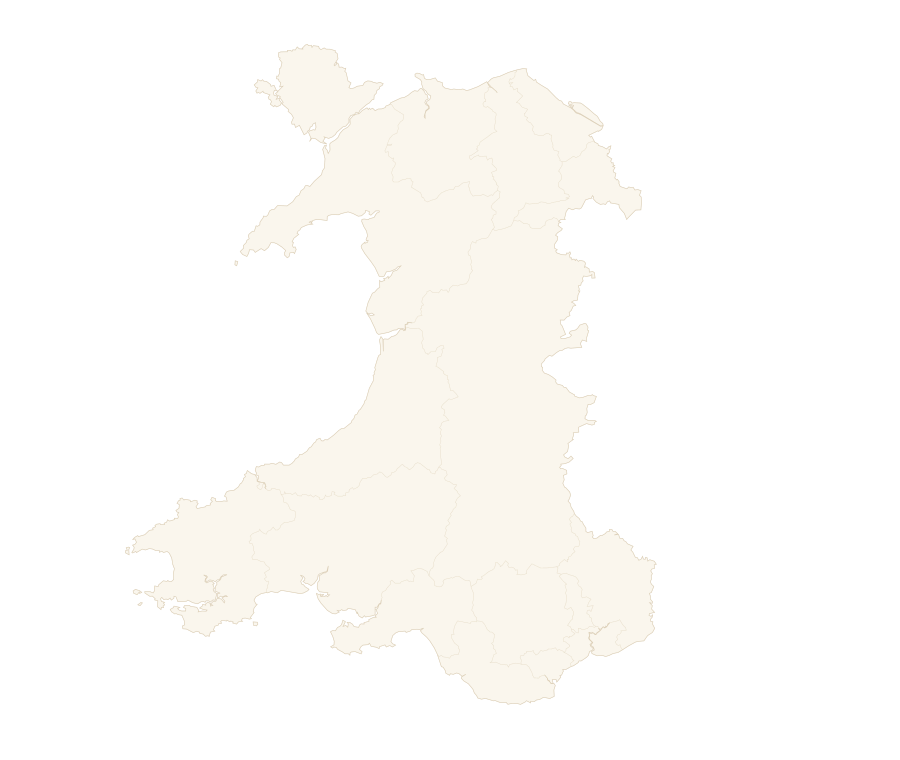
The seat of House of Aberffraw
Seat vacantChief
No one leads the House of Aberffraw community yet. When the movement opens, you can stand for its leadership, or help elect whoever does.
Current mission
No shared goal set yet. Once House of Aberffraw has leadership, it sets the public focus: a restoration, a gathering, a real-world project that helps its own.
The Aberffraw clan is being rebuilt. Join the waiting list for the movement today, and you help decide who leads it and what it does.
Help rebuild the Aberffraw clan →What does the Aberffraw name mean?
From Aberffraw, the Royal Court (llys) on the south-west coast of Anglesey, 'the mouth of the Ffraw' river, held by the princely line of Wales for four centuries. Where Scottish royal houses are named for places they came from, the House of Aberffraw is named for the place its kings ruled from. The line itself descends in unbroken male succession from Rhodri Mawr (d.878) and, through him, from Cunedda Wledig of the 5th century.
The history of House of Aberffraw
The king of Man who took Gwynedd
The dynasty begins with an outsider. Merfyn Frych was King of the Isle of Man, and he came into Gwynedd around 826 with a mother's right rather than a father's: his mother Esyllt was daughter to Cynan Dindaethwy, a king of the older Gwynedd line. Through the 810s Gwynedd had torn itself apart between Cynan and a rival claimant, Hywel Farf-fehinog, and Cynan's death in 816 left that faction without a man of their own.
Timing did the rest. Gwynedd was then effectively a client kingdom of Mercia, and Mercian power in England collapsed when Wessex broke it at Ellandun in 825. Merfyn's conquest followed shortly after, and the line took his name: the Merfynion, the descendants of Merfyn.
One thing about that line is disputed and worth saying plainly. The house has always been reckoned to run in unbroken male succession back to Cunedda Wledig of the fifth century, but Merfyn was the first ruler of Gwynedd who was not a male-line descendant of Cunedda. The Merfynion inherited the kingdom, not the bloodline the older kings had counted by.
Rhodri Mawr, Orm, and a kingdom lost twice
Merfyn died in 844 and his son Rhodri Mawr took both Gwynedd and Man. Rhodri is thin in the contemporary record: in 855 he killed Orm, a leader of the Norse Dubgenti, and in 877 the Norse drove him out of Gwynedd altogether. He recovered the kingdom the following year, largely because the Norse had turned to conquering Wessex, and was killed later in 878 by English forces, probably under Ceolwulf, who wanted the old Powysian hegemony over Gwynedd restored.
His sons finished the argument. Anarawd and Cadell broke Mercian power over Wales at the battle of the Conwy in 881, then spent the following decades overrunning Powys, Ceredigion and Dyfed. Out of Cadell's conquests in the south west came a junior branch of the same dynasty, the Cadelling, whose descendants would in time hold Deheubarth against their senior cousins in Gwynedd.
968, and the ransom Maredudd paid
Between roughly 950 and 998 Wales took a second phase of Viking attack, and it was not only raiding for goods. Men and women were carried off to be sold. Aberffraw itself was devastated in a raid in 968. King Maredudd ab Owain paid the ransom to get Welsh captives back out of slavery.
The third wave came alongside the Normans, and by then the dynasty had learned to use the Norse rather than only bleed from them. Cynan ab Iago took refuge in the Kingdom of Dublin and married a Norseman's daughter there. Their son Gruffudd ap Cynan spent the Norman invasion of Gwynedd, from 1081 to 1100, trying repeatedly to take the kingdom back, and got it in 1098: fighting alongside Magnus Barefoot, king of Dublin, of Norway and of the Isles, he beat the Normans at the battle of Anglesey Sound.
Owain Gwynedd and the title the Welsh gave themselves
Gruffudd's son Owain Gwynedd did to the Angevins what his father had done to the Normans. He defeated Henry II and the great host the king brought against him in 1157, and defeated him again in 1166. The other Welsh rulers then proclaimed Owain Princeps Wallensium, prince of the Welsh, which was less a new honour than formal acknowledgement of an old claim: that as senior-line descendants of Rhodri Mawr, the Aberffraw house was the principal royal house of Wales.
It did not survive him. Owain died in 1170 and his sons fell into fratricidal violence over the succession, the disorder out of which the legends of Prince Madog's transatlantic voyage are thought to have grown. Between 1081 and 1267 the kingdoms of Wales turned back Anglo-Norman and English expeditions twenty-one times, and the dynasty's worst losses were still self-inflicted.
Forty years of Llywelyn ap Iorwerth
Llywelyn ap Iorwerth was born around 1173 at Dolwyddelan in upper Gwynedd, only legitimate son of Iorwerth ab Owain Gwynedd, whose claim to the senior line had been set aside in favour of a younger half-brother. Raised after his father's early death at the court of his mother's Powysian kin, he came back as one claimant among several and took the country by force: he beat his uncle Dafydd ab Owain Gwynedd on the Conwy in 1194, took the Anglesey and Conwy heartland in 1199, and by 1200 no one disputed him.
War with his father-in-law King John in 1211 cost him the four cantrefs east of the Conwy; the rising of 1212 won them back; the baronial alliance of 1215 put him into Magna Carta, the only Welsh prince named in it, with his positions specifically secured. At the Council of Aberdyfi in 1216 he took the homage of the other Welsh rulers, Maredudd ap Robert of Cedewain, the sons of Madog ap Maredudd of Powys and the sons of Rhys ap Gruffydd of Deheubarth.
Henry III confirmed his lands at Worcester in 1218, and by 1230 he was styling himself Prince of Aberffraw and Lord of Snowdon, with a unified law-code drawn from the older Hywel Dda corpus to govern by. The stone castles went up in the same decades: Castell-y-Bere, Criccieth, Deganwy, Dolwyddelan, Dolbadarn.
Fifteen feet wide and forty feet long
Gwynedd was governed from twenty-two llysoedd, royal courts scattered across the kingdom, and Aberffraw was the head of them. It had been called the chief house of the Prince of Gwynedd since Rhodri Mawr's day, and around 1200 Llywelyn the Great was still holding court there to a standard meant to match the English kingdom next door, with Joan, a king of England's daughter, receiving Welsh and English royalty in it.
The household is described with startling precision. Thirty-five court offices, from the Master of the Palace down to the Domestic Bard, the Metheglin who brewed the mead, the Officer to Command Silence and the Officer to Support the Prince's Feet at Banquets. They held their posts as freeholders, took woollen cloth from the prince and linen from the queen, and were summoned by the palace horn. Forty-seven posts at minimum had to be filled daily.
The building itself was small. The hall's size is reckoned from Llywelyn ap Gruffudd's chamber at Harlech, judged to have been the same: fifteen feet wide and forty feet long. Nearby at Newborough stood Llys Rhosyr, first recorded on 10 April 1237, where excavation turned up pottery and coins dated between 1247 and 1314; a reconstruction of it stands today at St Fagans in Cardiff. Aberffraw's own hall was pulled down in 1317 and its timbers carted off for the building of Caernarfon Castle.
Aberconwy in 1240, Shrewsbury in 1283
Llywelyn the Great retired in 1238, took the Cistercian habit at Aberconwy, the abbey he founded in 1186, and presided at Strata Florida while the Welsh princes did homage to his son Dafydd as his successor. He died at Aberconwy on 11 April 1240. His stone coffin outlasted the abbey: after the dissolution it was carried to the parish church of St Grwst at Llanrwst, where it still is.
Dafydd ap Llywelyn ruled Gwynedd served by the family of Ednyfed Fychan, counsellors to the princes. After Dafydd came his nephew Llywelyn ap Gruffudd, and after Llywelyn's death in December 1282 his brother Dafydd ap Gruffudd, the last prince the dynasty produced. Dafydd was tried for treason by Edward I, once his ally, and executed at Shrewsbury on 3 October 1283. The kin closest to Llywelyn were imprisoned for life; the more distant went into deep hiding and out of the record.
The claimants who would not let it go
The claim outlived the principality by more than a century. In 1294 Madog ap Llywelyn, out of Gwynedd and Merioneth, raised a rebellion under the self-proclaimed title of Prince of Wales and failed. Owain Lawgoch, reckoned lineal successor to Llywelyn ap Gruffudd, pressed the inheritance from abroad until his assassination in July 1378, which ended the main branch's political life. In 1400 Owain Glyndwr, another descendant, proclaimed himself Prince of Wales and rebelled against the crown.
After that the descent became something families kept rather than fought for. The Wynns of Gwydir and the Anwyls of Tywyn both claimed descent from Owain Gwynedd, gentry houses carrying a royal pedigree into estate papers and sheriffs' rolls. The kingdom was gone by 1284; the line, and the name of the llys on Anglesey, were not.
Champions of the Aberffraw name
The bearers whose lives are inseparable from this surname. Each has their own page, biography, achievements, geography, connection to the family.
Historic Places, Rebuilt
Explore the streets and seats the Aberffraw name knew, rebuilt with AI as they stood in history.
Historic Places, Rebuilt · New
Edward I's walled bastide and mighty castle in North Wales, a generation after the conquest, the banded towers still rising.
Historic Places, Rebuilt · New
Owain Glyndŵr's mountain fortress and court at the high tide of Welsh independence, the English siege lines gathering below.
The castles of the homeland
The great strongholds of the homeland, look one up, see what it looked like in its prime, and recreate it to explore.
 Caernarfon CastleRestored · prime 1330
 Conwy CastleRuin · prime 1287
 Pembroke CastleRestored · prime 1280
All castles in Wales → · Strongest castles in Wales → · Castles of Europe
Play As Your Clan
Hold a real castle against whatever you choose to send at it, take a ship out in her own service years, or stand at the shoulder of someone the record remembers. The chronicler sets the scene; the deeds are yours.
Notable bearers of the Aberffraw name
- Rhodri Mawr (c.820–878), King of Gwynedd, founder of the line
- Llywelyn ap Iorwerth, 'the Great' (c.1173–1240), Prince of Wales
- Llywelyn ap Gruffudd, 'the Last' (c.1223–1282), last native Prince of Wales
Stories of House of Aberffraw
Frequently asked
What does the surname Aberffraw mean?
Where does the Aberffraw family come from?
Where did the Aberffraw family historically hold territory?
Is Aberffraw Welsh or English?
How old is the Aberffraw surname?
What is the Aberffraw family known for?
Is there a Aberffraw family crest or coat of arms?
Who is the most famous Aberffraw?
Who are some famous Aberffraws?
What stories are told about the Aberffraw family?
What is the story of Cilmeri?
Where is the Aberffraw surname found today?
What does the Clan Rising page for the Aberffraw family cover?
Who is the head of the Aberffraw family today?
Neighbouring clans
- RobertsStrong in the north, the patronymic of Robert, second to Williams in Caernarfonshire.
- HughesSon of Huw / son of Aodh, Welsh patronymic and Irish Mac Aodha under one spelling.
- Pritchardap Richard, the contraction is the mechanism, written into the name.
- TudorWelsh in origin, English in destiny, the line that took the throne at Bosworth.