House of Tudor
also Tudur
Welsh in origin, English in destiny, the line that took the throne at Bosworth.
- Origin
- Gwynedd, Wales
- Motto
- Beth bynnag a fynno Duw, a fydd
- Famous bearer
- Owen Tudor (c.1400–1461), Welsh courtier, husband of Catherine of Valois
- Register
- Princely house
Ranked of all time
The 10 Most Powerful Welsh Houses of All Time
Ranked of all time
The 15 Most Powerful English Houses of All Time
The Tudor arms and country

Coat of armsTudor RoseSodacan · CC BY-SA 3.0

- Coat of arms: Granted to an individual and inherited down that one documented line. These are the arms of particular families of the name, not of everyone who shares the surname.
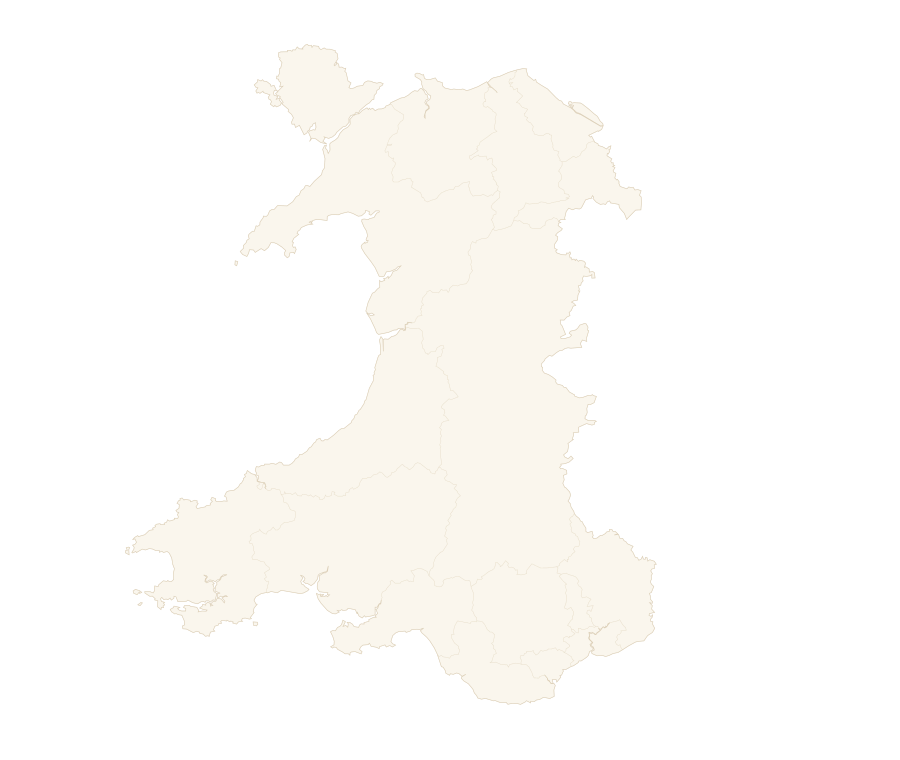
CoreHistoric reach
The seat of House of Tudor
Seat vacantChief
No one leads the House of Tudor community yet. When the movement opens, you can stand for its leadership, or help elect whoever does.
Current mission
No shared goal set yet. Once House of Tudor has leadership, it sets the public focus: a restoration, a gathering, a real-world project that helps its own.
The Tudor clan is being rebuilt. Join the waiting list for the movement today, and you help decide who leads it and what it does.
Help rebuild the Tudor clan →Motto
Beth bynnag a fynno Duw, a fydd
“Whatever God wills, will be”
What does the Tudor name mean?
From the Welsh personal name Tudur, itself from the older Tudwr, perhaps cognate with Latin Theodorus, 'gift of God', though the etymology is debated. The hereditary surname descends from Tudur ap Goronwy of the Tudors of Penmynydd in Anglesey, a 14th-century gentry line of impeccable Welsh princely lineage descended from Ednyfed Fychan, seneschal to Llywelyn the Great. Owen Tudor, Owain ap Maredudd ap Tudur, carried the name into England through his marriage to a French-born queen.
The history of House of Tudor
The steward's line at Penmynydd
The family begins not with a crown but with an office. Ednyfed Fychan, who died in 1246, was distain, chief steward, to Llywelyn the Great. What that office involved is known in general terms rather than from any record of Ednyfed's own days in it. A medieval steward began as the servant who supervised both his lord's estate and his household, and the post grew until great houses commonly kept two of them, one for the lands and one for the domestic routine indoors. A steward held his lord's castles when the lord was away and checked the taxes owed by the serfs on his manors. Held for Llywelyn the Great, it was the office on which this family built a lineage.
Ednyfed's descendants held Penmynydd on the island of Anglesey. They were a lineage of the House of Aberffraw without princely status: gentry with the pedigree of princes. The surname itself is named for one of them, Tudur ap Goronwy, an administrator of the Penmynydd family and the ancestor the later dynasty was called after. Nothing in that inheritance pointed at England.
What broke the pattern was the last great Welsh rising. Owain Glyndŵr's revolt ran from 1400 to 1415, and the Tudors of Penmynydd were his kinsmen and sided with him. They lost lands in consequence. A younger son of the line found his place instead in the household of an English queen.
Tudur, tud and rhi, and the ap that hardened into a surname
The name is older than the family and much older than the throne. Modern Welsh Tudur, Old Welsh Tutir, descends from Toutorix, from Proto-Celtic toutā, meaning people or tribe, and rīxs, king; compare modern Welsh tud, territory, and rhi, king. That makes it the exact Celtic counterpart of Germanic Theodoric. It is often written Tewdwr and glossed as the Welsh form of Theodore, from Latin Theodorus, 'gift of God', and the two were certainly conflated; the stricter account holds that Tudur and Tewdwr began as different and unrelated names. The etymology is genuinely disputed, and a reader is entitled to both halves of it.
Wales had no fixed surnames to inherit. A man was his father's son and nothing more: Evan ap Thomas, whose son John was John ab Evan, whose son Rees was Rees ap John, the name changing with every generation, with ferch for a daughter. In 1292 some 48 per cent of recorded Welsh names were patronymics, and in some parishes more than 70 per cent. The chains could be extended back through grandfathers and beyond, occasionally to the seventh generation, so that a name such as Llewelyn ap Dafydd ab Ieuan ap Gruffudd ap Meredydd was a spoken genealogy of the male line rather than a label.
The Tudor surname exists because one man stepped out of that system deliberately. Owen Tudor was Owain ap Maredudd ap Tudur ap Goronwy ap Tudur ap Goronwy ap Ednyfed Fychan, a working pedigree back to the steward of Llywelyn the Great. On being knighted he abandoned the patronymic and took a fixed surname, and he did not take, as custom would have given him, his father's name of Maredudd. He reached back a generation and took his grandfather's name, Tudur. A dynasty and a whole period of English history are named after that one choice.
Owen Tudor and the queen dowager
Owen Tudor, born about 1400, entered the household of Catherine of Valois, the French-born widow of Henry V, who had died in 1422. He served as one of the queen dowager's bodyguards. The evidence points to their marrying in secret in 1428, and other accounts put it about 1429; either way, it was a secret match between a younger son of a Welsh gentry house and the mother of the reigning king of England.
Two sons came of it, Edmund and Jasper, and they became among the most loyal supporters the House of Lancaster had in its long struggle with the House of York. Their half-brother Henry VI ennobled them both. Edmund was created Earl of Richmond on 15 December 1449 and Jasper Earl of Pembroke on 23 November 1452. In a single generation the Penmynydd line had gone from a diminished Anglesey estate to two English earldoms.
On 1 November 1455 Edmund Tudor married Lady Margaret Beaufort, great-granddaughter of John of Gaunt. The Beauforts were the children of Gaunt by Katherine Swynford, born before the couple married in 1396; the church declared them legitimate by papal bull that same year, confirmed by proclamation in Parliament in 1397, and Gaunt's son Henry IV recognised their legitimacy while declaring the line ineligible for the throne. The claim that marriage carried was therefore thin and legally barred. It was, in the end, enough.
The boy born at Pembroke
Edmund Tudor died on 3 November 1456. On 28 January 1457 his widow Margaret, who was only thirteen, gave birth to a son at her brother-in-law Jasper's residence, Pembroke Castle in south-west Wales. The child was Henry Tudor. He was born into the middle of the Wars of the Roses with a father already dead and a claim to the English throne that ran through his mother's barred line, and he spent his childhood at Raglan Castle in the house of Lord Herbert, a leading Yorkist.
The murder of Henry VI and the death of his son Edward at the Battle of Tewkesbury in 1471 left the Lancastrian cause resting on the boy. Jasper Tudor, fearing for his nephew's life, took him to Brittany. From the age of fourteen Henry lived in exile in Brittany and France for fourteen years, the last serious hope of a defeated party and a standing target for assassination and extradition.
His mother did the political work at home. Margaret Beaufort remained in England, remarried and lived quietly while advancing her son's cause, and as Richard III grew unpopular after taking the throne in 1483 she forged an alliance with discontented Yorkists in support of Henry. That year Henry vowed to marry Elizabeth of York, daughter of Edward IV and heiress of the Yorkist claim, a promise that turned an invasion by a Lancastrian exile into an offer of settlement to both sides.
Mill Bay, Bosworth, and the dragon of Cadwaladr
In August 1485 Henry and Jasper sailed from the mouth of the Seine to the Milford Haven waterway and came ashore at Mill Bay in Pembrokeshire, in the country of Henry's birth, with around two thousand French troops and Welsh exiles. He marched through south Wales gathering men as he went, under the red dragon standard of Cadwaladr, the last British king, an appeal aimed squarely at the old prophecies of a Welsh deliverer. Welsh and English support accumulated on the road east.
On 22 August 1485 the armies met near Market Bosworth in Leicestershire. Henry was outnumbered and far less experienced in war than the king facing him, and the battle hung on the Stanleys, who stood aside with their men until the decisive moment. Richard III, seeing how small Henry's personal guard was, led a mounted charge straight at him to settle the matter sword to sword; the Stanleys threw their force in on Henry's side, and Richard was unhorsed and killed fighting in the press, the last English king to die in battle. The crown, by tradition found in the field, was set on Henry's head at Crown Hill near Stoke Golding. He took the throne by right of conquest, and the Wars of the Roses were effectively finished.
The dragon that came ashore at Mill Bay did not go home again. It was carried in state to St Paul's Cathedral after the victory and then taken into the Tudor royal arms as a supporter, put there to signify the family's Welsh descent. The modern flag of Wales still carries Y Ddraig Goch, the red dragon, on the Tudor colours of green and white, and was officially recognised as the national flag in 1959.
The king who handed on a solvent kingdom
Henry VII moved fast to make the conquest permanent. On 18 January 1486, at Westminster Abbey, he honoured the pledge of three years earlier and married Elizabeth of York. They were third cousins, both great-great-grandchildren of John of Gaunt, and the marriage joined the warring houses and gave their children a claim no faction could argue with. Its badge was the Tudor rose, the white rose of York joined to the red rose of Lancaster, and it has been used by every English and then British monarch since as a royal badge.
The early reign was a run of risings, and he survived all of them. The rebellion of the Stafford brothers and Viscount Lovell in 1486 collapsed without fighting. In 1487 Yorkists led by John, Earl of Lincoln rose in support of Lambert Simnel, a boy put forward as the Earl of Warwick; the rising began in Ireland, where the Yorkist nobility under Gerald, Earl of Kildare proclaimed Simnel king and found him troops, and it ended with Lincoln killed at the Battle of Stoke Field. Rioting in Yorkshire followed in 1489. In 1497 Perkin Warbeck, claiming to be the younger of the princes in the Tower, landed in Cornwall with a few thousand men and was soon taken.
Abroad he was sparing. He went to war only twice, in 1489 in the French-Breton war and in 1496 and 1497 against Scotland, made peace with France in 1492, and let the Scottish war drop when the Cornish rebellion broke out in 1497. He preferred marriages to campaigns: the Treaty of Perpetual Peace with James IV in 1502 was followed by the marriage of his daughter Margaret to the Scottish king in 1503, and his heir Arthur married Catherine of Aragon, binding England to Ferdinand of Aragon and Isabella of Castile. Of seven children, four survived early childhood: Arthur, born 1486, Margaret in 1489, Henry in 1491 and Mary in 1496, who married Louis XII of France.
England had never been one of the wealthier European countries and was poorer still after the civil wars, and Henry's strictest work was on the money. He restored the royal finances until the Treasury held a considerable sum for his successor, strengthened the judicial system and denied every rival claimant. Arthur died in 1502, four months after his marriage, leaving his brother Henry as heir. The first Tudor king died at Richmond on 21 April 1509 and lies beneath the fan-vaulted chapel he built at Westminster Abbey, which still carries his name.
Henry VIII, the break with Rome, and the union of England and Wales
Henry VIII succeeded on 22 April 1509, married Catherine of Aragon on 11 June and was crowned with her at Westminster Abbey on 24 June. He was the only son of Henry VII and Elizabeth of York to reach maturity. In his early years he was described as tall, handsome, cultured and generous, gentle in debate and more companion than king, and he left the governing to others for the first two years before turning to it himself. He reigned until 1547 and proved a dominant ruler.
The absence of a son turned into the great constitutional event of the century. Cardinal Thomas Wolsey pressed Rome for an annulment of the marriage to Catherine and failed, falling from favour in 1529, and Thomas Cromwell replaced him as chief minister around 1532. To allow the king to dissolve that marriage and marry Anne Boleyn, Parliament then enacted the laws that broke the ties with Rome and declared the king Supreme Head of the Church of England, severing the English church from the papacy, and Archbishop Thomas Cranmer declared the first marriage void. A daughter, Elizabeth, was born on 7 September 1533 and named for the king's mother; a son, Edward, was born to Jane Seymour in 1537. Henry died on 28 January 1547, and his will restored both his daughters to the line of succession.
For Wales the decisive act of the reign was not the schism but the statute book. Cromwell designed and pushed through the Laws in Wales Acts, of 1535 and 1542, which completed the full union of England and the Principality of Wales in 1542; the Crown of Ireland Act of the same year asserted English authority over the Kingdom of Ireland. It is one of the sharper ironies in British history that the law which folded Wales into England was passed under a dynasty that had come out of Anglesey.
The union also finished off the naming system the family itself had left. Fixed surnames had been spreading in Wales since the 15th century, and in Henry VIII's reign they became hereditary among the Welsh gentry and then filtered slowly down to commoners, earliest where English influence was strongest and among town and wealthy families. Some names kept the ap in compressed form, which is where Powell comes from ap Hywel, Price from ap Rhys, Pugh from ap Hugh, Pritchard from ap Richard and Bowen from ab Owen. Most simply dropped it and added an s, which is why Jones, Williams, Davies, Evans and Thomas cover so much of Wales, and why two men of the same surname in one village need not be kin at all.
Edward and Mary: two short reigns and a new coinage
Edward VI was nine when he succeeded in 1547, and the nobility spent the reign fighting over the regency. His uncle Edward Seymour seized control, created himself Duke of Somerset on 15 February 1547 and dominated the Privy Council. He led a large and well equipped army into Scotland and beat the Scottish regent, the Earl of Arran, at the Battle of Pinkie on 10 September 1547, after which the young Mary, Queen of Scots was smuggled to France and betrothed to the Dauphin. The Crown ordered the publication of the Book of Common Prayer in 1549, which was condemned in Devon and Cornwall; in Cornwall many people spoke only Cornish and could make nothing of a uniform English service, and the Prayer Book Rebellion followed. Somerset was pushed out by John Dudley, later Duke of Northumberland, and a revised prayer book appeared in 1552.
Edward died on 6 July 1553 at fifteen, and with him the direct male line of the House of Tudor ended. His will had set aside his father's and named his cousin Lady Jane Grey, granddaughter of Henry VII's daughter Mary, and Jane was proclaimed queen on 10 July. Public support went instead to Mary, the heir under Henry VIII's will, and on 19 July Jane relinquished a throne she had never wanted. Mary rode into London in a triumphal procession with her younger sister Elizabeth beside her.
Mary I married Philip of Spain at Winchester Cathedral on 25 July 1554. Her government did serious work on an economy in trouble: it introduced a new coining system that lasted into the 18th century, moved against inflation, budget deficits and the trade crisis, revised the customs system, worked to counter the currency debasements of her predecessors, amalgamated several revenue courts and strengthened the governing authority of the middling and larger towns. It explored the commercial potential of Russian, African and Baltic markets, and Mary received the first Russian ambassador to England, opening relations between the two countries. Her determination to restore the Catholic faith also brought the Marian persecutions, in which more than 280 Protestants were burnt between 1554 and 1558, and that is what fixed her name in later memory. She lost Calais, the last English territory on French soil, in January 1558, and died on 17 November that year at the age of 42.
Gloriana: forty-four years, and the last of the name
Elizabeth I was at Hatfield House when the crown came to her, and rode to London to the cheers of ruling class and commons alike. She was twenty-five. She had been declared illegitimate after her mother Anne Boleyn was tried and condemned in 1536 on charges that were most likely fabricated, and was restored to the succession by the Third Succession Act of 1543. She was an excellent student, well schooled in Latin, French and Italian and something of Greek, a talented writer, a singer and a lutenist. Her first act of judgement was her chief minister: William Cecil, Baron Burghley, who served her from the beginning.
At her coronation in January 1559 many of the bishops refused to perform the service in English, and it fell to Owen Oglethorpe, the relatively minor Bishop of Carlisle, to crown her. Parliament then passed the Act of Supremacy and the Act of Uniformity, the Elizabethan Religious Settlement, which established the Protestant Church of England and made Elizabeth its Supreme Governor; the title Supreme Head used by her father and brother was thought inappropriate for a woman ruler. Every clergyman and statesman was put to an oath, with a second chance for anyone who refused the first time.
The great test came in 1588. Philip II of Spain launched an invasion fleet under the Duke of Medina Sidonia which outnumbered the English force of 22 galleons and 108 armed merchant ships. It was beaten by bad weather in the Channel, by poor Spanish planning and logistics, by smaller and faster English ships and fireships, and by the seamanship of Francis Drake and Charles Howard, Baron Howard of Effingham. At Tilbury that summer Elizabeth told the assembled troops that she had the body of a weak and feeble woman but the heart and stomach of a king, and the image of Gloriana was made.
The last decade was quieter and, in its way, more impressive. Bad harvests brought famine across England in the 1590s and she introduced the poor law, allowing those too ill to work a set sum from the state. She had borrowed from Parliament in twelve of her thirteen parliamentary sessions and repaid all of it, so that at her death the Crown was not merely free of debt but in credit. She died childless at Richmond Palace on 24 March 1603, forty-four years on the throne, the longest reign of the five Tudor monarchs and a stable era after the short and troubled reigns of her siblings. Cecil had been corresponding with James VI of Scotland, great-grandson of Margaret Tudor, and his succession that same day was unopposed.
The surname the kings never used, and the Tudors since
For a name so famous, the family barely used it. Kings and princes were not thought to need a surname; the royal surname appears in no official publication and hardly in histories of any sort before 1584, and the monarchs were not eager to advertise a paternal descent from a Welsh adventurer, preferring to stress continuity with the historic English and French royal houses. Their subjects did not think of them as Tudors, or of themselves as Tudor people. When Richard III called his rival Henry Tudor before Bosworth, it was an insult, meant to fix the man's Welshness against his own claim as Richard Plantagenet. The slur outlived the man who threw it and became the label the whole period is known by.
The line itself continued through women. Henry VII's daughter Margaret married James IV of Scotland in 1503, and it was her great-grandson who came south in 1603; the house survived through the female line into the Stuarts, then into the Hanoverians through James's granddaughter Sophia. Charles III is a direct descendant of Henry VII. The five Tudor monarchs held the throne for 118 years, and the family that produced them had been Anglesey gentry descended from a steward.
The surname today carries two unrelated histories, and it is worth a reader knowing which one they are looking at. Tudor is also a separate name of Romanian origin, related to Teodor, borne as a given name by figures such as the poet Tudor Arghezi and as a surname by Romanian bearers of no connection whatever to Penmynydd. On the British side the name has run through the professions and the sports pages: Antony Tudor the choreographer, the cricketers Alex Tudor and Richard Tudor, the footballer John Tudor, and two British admirals of the name. Henri Tudor, 1859 to 1928, was a Luxembourgian industrialist and inventor.
In America the name settled early and did well by itself. William Tudor, 1750 to 1819, was an attorney who represented Boston in the Massachusetts General Court, sat as a state senator, served as Secretary of the Commonwealth and helped found the Massachusetts Historical Society. William Tudor, 1779 to 1830, was a leading literary figure in Boston and a cofounder of the North American Review and the Boston Athenaeum, and Frederic Tudor, 1783 to 1864, was the entrepreneur known as Boston's Ice King. Later came the pianist David Tudor, the ornithologist and artist Guy Tudor, and Tasha Tudor, 1915 to 2008, the illustrator and children's author.
That scattering is the Welsh story in miniature. Welsh emigration was never large in proportion to the population, but it settled hard where it landed: Pennsylvania in particular, Jackson County in Ohio, which was once called Little Wales, Malad City in Idaho, which claims a higher proportion of inhabitants of Welsh descent than anywhere outside Wales, and Y Wladfa in Patagonia. Around 16.3 million people in the countries surveyed for the Welsh Government carry a family name of Welsh origin, including 4.7 per cent of New Zealanders, 4.1 per cent of Australians and 3.8 per cent of Americans. Tudor is among them, and the one that wore a crown.
Champions of the Tudor name
The bearers whose lives are inseparable from this surname. Each has their own page, biography, achievements, geography, connection to the family.
Historic Places, Rebuilt
Explore the streets and seats the Tudor name knew, rebuilt with AI as they stood in history.
Historic Places, Rebuilt · New
Edward I's walled bastide and mighty castle in North Wales, a generation after the conquest, the banded towers still rising.
Historic Places, Rebuilt · New
Owain Glyndŵr's mountain fortress and court at the high tide of Welsh independence, the English siege lines gathering below.
Landmarks the Tudor held
Palaces, houses and great buildings tied to this name, look one up, or rebuild it to explore.
- St James's Palace
Built by order of Henry VIII in the 1530s; a residence of the Tudor monarchs, secondary to Whitehall.
- Palace of Placentia
Principal Tudor royal palace, extensively rebuilt by Henry VII around 1500 and a birthplace of monarchs.
- Richmond Palace
Tudor royal residence erected c. 1501 by Henry VII and a favourite home of Elizabeth I, who died there in 1603.
The castles of the homeland
The great strongholds of the homeland, look one up, see what it looked like in its prime, and recreate it to explore.
 Caernarfon CastleRestored · prime 1330
 Conwy CastleRuin · prime 1287
 Pembroke CastleRestored · prime 1280
All castles in Wales → · Strongest castles in Wales → · Castles of Europe
Play As Your Clan
Hold a real castle against whatever you choose to send at it, take a ship out in her own service years, or stand at the shoulder of someone the record remembers. The chronicler sets the scene; the deeds are yours.
Notable bearers of the Tudor name
- Owen Tudor (c.1400–1461), Welsh courtier, husband of Catherine of Valois
- Henry VII (1457–1509), born Henry Tudor at Pembroke Castle
- Henry VIII, Edward VI, Mary I, Elizabeth I, the Tudor monarchs
Stories of House of Tudor
Bosworth
1485Henry Tudor was a Welsh-born exile of the Lancastrian line, raised in Brittany on a French pension, the holder of a tenuous claim to the English throne through his mother Margaret Beaufort. By the summer of 1485 Richard III's two-year reign was visibly thinning at the top: the boy princes were dead in the Tower, the great Yorkist magnates were drifting. On the seventh of August 1485 Henry landed at Mill Bay near Dale in Pembrokeshire with two thousand French and Welsh exiles. He marched up through Wales under the red dragon standard of Cadwaladr, picking up men. On the twenty-second of August he met Richard on the field at Bosworth in Leicestershire. Within four hours of first light he was crowned King of England on a low rise above the field with a battle-circlet taken from his enemy's helmet.
Read the story →
Henry VIII and the break with Rome
1534On the third of November 1534, in the House of Lords at the Palace of Westminster, the Act of Supremacy passed its third reading and received Royal Assent the same day. The fourteen-clause Act, drafted by Thomas Cromwell on the direct political commission of Henry VIII (the second Tudor monarch, then forty-three years old, in his twenty-sixth year on the throne), declared Henry to be the only Supreme Head in Earth of the Church of England, dissolved the jurisdictional connection between the English Church and the Roman See that had stood since the Augustine mission of 597 (nine hundred and thirty-seven years), and gave the Crown the direct legal authority over the doctrine, the ecclesiastical discipline, and the monastic properties of the English Church. The Act was the political-legal end-point of the six-year king's-divorce-case of Henry from Catherine of Aragon (1528–34); the 1531 Convocation Submission of the Clergy; the 1532 Submission of the Clergy Act; the 1533 Act in Restraint of Appeals; and the 1534 Act of Succession. The political-religious consequence ran through the Tudor century: the Dissolution of the Monasteries 1536–41 (the largest single transfer of land-ownership in English history before the 1845 Irish-Land-Act-and-Famine settlements); the execution of Sir Thomas More (1535) and Bishop John Fisher (1535); the Pilgrimage of Grace 1536; the 1547 Edwardian Reformation; the 1553–58 Marian Counter-Reformation; the 1559 Elizabethan Settlement. The break with Rome is, by every careful judgment of the Reformation historians (G. R. Elton, Diarmaid MacCulloch, Eamon Duffy), the foundational political-religious event of the modern English state.
Read the story →
Frequently asked
What does the surname Tudor mean?
Where does the Tudor family come from?
Where did the Tudor family historically hold territory?
Is Tudor Welsh or English?
How old is the Tudor surname?
What is the Tudor family known for?
What is the Tudor motto?
What does "Beth bynnag a fynno Duw, a fydd" mean in English?
Is there a Tudor family crest or coat of arms?
Who is the most famous Tudor?
Who are some famous Tudors?
What stories are told about the Tudor family?
What is the story of Bosworth?
Is Tudur the same family as Tudor?
Where is the Tudor surname found today?
What does the Clan Rising page for the Tudor family cover?
Who is the head of the Tudor family today?
A note from the editors
- Cross-border with England. The England catalogue will surface this entry alongside the Welsh home.
Neighbouring clans
- RobertsStrong in the north, the patronymic of Robert, second to Williams in Caernarfonshire.
- HughesSon of Huw / son of Aodh, Welsh patronymic and Irish Mac Aodha under one spelling.
- Pritchardap Richard, the contraction is the mechanism, written into the name.
- AberffrawThe royal house of Gwynedd, Llywelyn the Great's line, ended at Cilmeri in 1282.