Pritchard
also Prichard
ap Richard, the contraction is the mechanism, written into the name.
- Origin
- Gwynedd, Wales
- Famous bearer
- Rhys Prichard (c.1579–1644), "Yr Hen Ficer" (the Old Vicar) of Llandovery
- Register
- Welsh family
Where the Pritchard name comes from
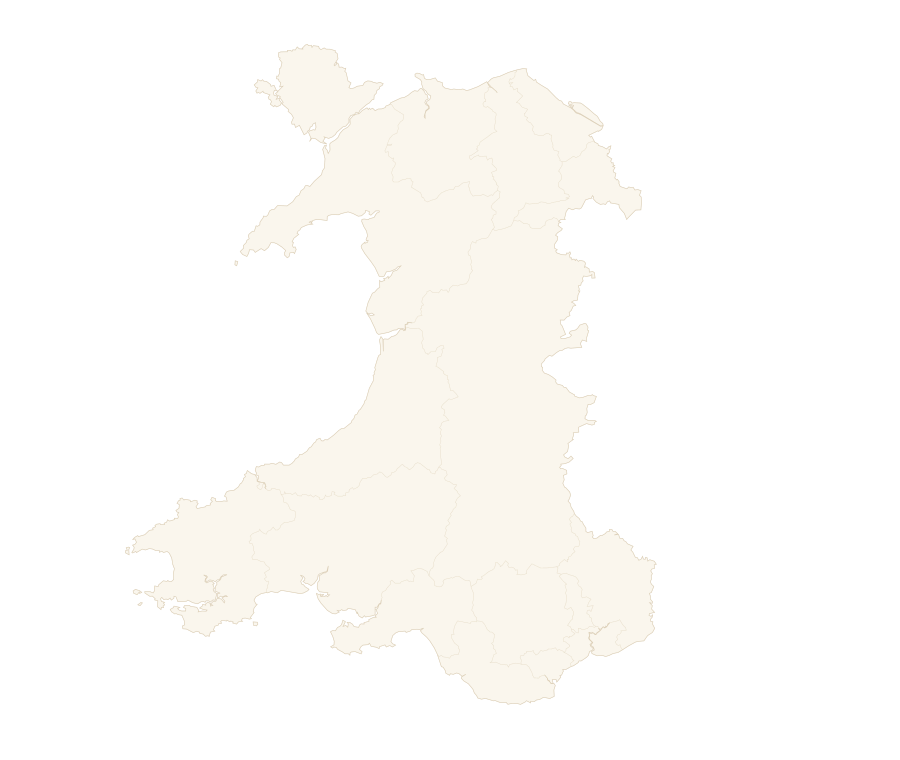
CoreHistoric reach
The seat of Pritchard
Seat vacantChief
No one leads the Pritchard community yet. When the movement opens, you can stand for its leadership, or help elect whoever does.
Current mission
No shared goal set yet. Once Pritchard has leadership, it sets the public focus: a restoration, a gathering, a real-world project that helps its own.
The Pritchard clan is being rebuilt. Join the waiting list for the movement today, and you help decide who leads it and what it does.
Help rebuild the Pritchard clan →What does the Pritchard name mean?
Son of Richard, 'ap Richard', contracted by the natural elision of spoken Welsh into 'p Richard' and then frozen as Pritchard when surnames became hereditary. The same contraction generated Powell (ap Hywel), Probert (ap Robert), Price (ap Rhys), Pugh (ap Hugh), Bevan (ab Evan) and Bowen (ab Owain). It is the patronymic mechanic itself, captured in the first letter of every name it produced.
The history of Pritchard
The letter that used to be a word
In 1292 some 48 per cent of recorded Welsh names were patronymics, and in certain parishes the figure passed 70 per cent. A man was not a Pritchard; he was ap Rhisiart, son of Richard, and his own son took his given name in turn. The strings ran back as far as seven generations, so that a name like Llewelyn ap Dafydd ab Ieuan ap Gruffudd ap Meredydd was a genealogy of the male line rather than a label. Welsh law wanted it so: descent from a named ancestor settled what a man could inherit.
Those laws were decaying by the later Middle Ages, and unification under Henry VIII in 1536 finished the job. Hereditary surnames took hold first among the Welsh gentry and spread only slowly to commoners; the same king ordered that marital births be recorded under the father's surname. Districts where English influence was strong, and town and wealthy families anywhere, had abandoned patronymics earlier, while in remoter parishes the old system survived into the early nineteenth century.
When the freeze came, some families kept the ap and swallowed it into the first letter of the new surname: Upjohn from ap John, Powell from ap Hywel, Price from ap Rhys, Pugh from ap Hugh, Bowen from ab Owen, Pritchard from ap Richard. Others dropped the prefix and added an English -s, which is why Jones, Roberts and Edwards now blanket the country. The stock of Welsh surnames stayed small, and two Pritchards in one village cannot be assumed to share an ancestor.
Dafydd ap Richard, lord of the manor in 1549
Llancaiach Fawr stands near Nelson in the Rhymney Valley, a semi-fortified Tudor manor house raised on the site of an earlier medieval structure. It is thought to date to about 1530 and to have been built for Dafydd ap Richard, though dendrochronology from a Time Team excavation puts the felling of the roof timbers between 1548 and 1565. Dafydd is recorded as lord of the manor in 1549, and his patronymic, ap Rhisiart, was modernised on paper to Prichard: the freeze happening here in one family, in stone.
The Prichards prospered in the house. In 1628 David Prichard extended it, adding the Grand Staircase that at last allowed easy access between floors, and had two family rooms panelled in oak to demonstrate their standing. Llancaiach Fawr is now reckoned one of the most important gentry houses to survive from the sixteenth and seventeenth centuries.
Colonel Edward Prichard holds his own house for the other side
When the Civil War broke out in 1642, David Prichard's son, Colonel Edward Prichard, was appointed Commissioner of Array, raising men and money for the King across Glamorganshire. In 1645 he hosted a visit by Charles I at Llancaiach Fawr. By February 1646 he was holding the same house staunchly for the Parliamentarians, against a siege headed by Edward Carne.
The house passed out of Prichard hands after 1645 and was put to work as a farmhouse; the Tithe Map of 1842 and the Ordnance Survey map of 1875 both show an orchard at the rear. Grade I listed, it operated as a living history museum until Caerphilly County Borough Council closed it permanently in December 2024 on budgetary grounds.
The Llandovery yeoman's son who came home as curate
Rhys Pritchard was born at Llandovery in Carmarthenshire in 1579, the son of a small yeoman family of the town. He took his BA in 1602 at Jesus College, Oxford, the Welsh college founded in 1571, was ordained deacon that year and priest in 1603, and returned to his native town as curate. In 1614 he was instituted Vicar of Llandovery, and held that vicarage for thirty years.
In 1626 he was appointed Chancellor of St Davids Cathedral and held the chancellorship in plurality with the Llandovery cure. The two preferments gave him a comfortable rather than a lavish living, and that financial independence is the base on which an unusual ministerial career was built.
Verse-tracts for the weddings, christenings and funerals
From about 1610 onward Pritchard took up the project that occupied the rest of his life. The Llandovery district was largely Welsh-speaking, and he set out to convert its parish vocabulary to the Christian moral life in Welsh: verse-tracts on the seven deadly sins, the Ten Commandments, the conduct of Christian household life, the duty of parents to children and of servants to masters, the observance of the Sabbath, and the avoidance of profanity and drunkenness.
He composed them in the simple four-line stanza forms of the popular Welsh ballad tradition, influenced by cynghanedd. He recited them at the parish weddings, christenings and funerals, then put them into print: broadside sheets at first, then small chap-book pamphlets through the Carmarthen and Cardiff printers from the 1620s. The parish handed them out, the country fairs carried them, and the carter-pedlars took them across south Wales.
That distribution made his name across the country in his own lifetime and earned him the cognomen Welsh memory has used since: Yr Hen Ficer, the Old Vicar. A loyal Royalist, he held the Llandovery vicarage through the early years of the Civil War. He died at Llandovery on the fifteenth of December 1644, in his sixty-fifth year, and was buried under the floor of his own church.
Canwyll y Cymry, and the press at Carmarthen
Pritchard never gathered the tracts himself. That was done after his death by the Puritan minister Stephen Hughes, who from a small Carmarthen press in the 1650s did more than anyone to print and distribute Welsh-language religious literature. Hughes brought out successive editions between 1646 and 1670 as Gwaith Mr Rees Pritchard, the Works of Mr Rees Pritchard, and gave the collection the title it has carried since: Canwyll y Cymry, the Welshmen's Candle.
It ran through fifty editions across the eighteenth and nineteenth centuries, the Methodist Charles of Bala alone printing over a hundred and twenty thousand copies between 1770 and 1810. Until the cheap Welsh Bible of the 1820s it was the most-printed Welsh-language book there was, and the popular religious culture of Wales for the following three centuries rests on it.
Thirty times the national average on Anglesey
At the census of 1881 the frequency of Pritchard was highest on Anglesey, over thirty times the national average, with Caernarfonshire next. The ranking then runs Brecknockshire, Herefordshire, Radnorshire, Denbighshire, Monmouthshire, Flintshire, Merioneth and Shropshire: a hard north Welsh core with a long tail east over the border. Prichard and Pritchard are the same name.
The name went into English public life without letting go of Wales. Hannah Pritchard (1711-1768) was a leading English actress of the eighteenth century, of Welsh descent; Thomas Farnolls Pritchard (c.1723-1777) worked as an English architect, Andrew Pritchard (1804-1882) as an English microscopist, Charles Pritchard (1808-1893) as a British astronomer. Matthew Pritchard (1669-1750) was a Roman Catholic bishop, George Pritchard (1796-1883) a British missionary.
Later bearers carried it further: Harold Arthur Prichard (1871-1947), British philosopher; E. E. Evans-Pritchard (1902-1973), English anthropologist; Elaine Pritchard (1926-2012), English chess master; John Pritchard (1921-1989), conductor. Cliff Pritchard (1881-1954) and Charlie Pritchard (1882-1916) both played rugby for Wales, and Cecil Pritchard (1902-1966) played international rugby at hooker.
The Pritchards who left by ship
Welsh emigration was modest in proportion beside the Irish, but it ran in identifiable channels: Liverpool and Ashton-in-Makerfield within Britain, contract miners into the Pas-de-Calais coalfield, Newfoundland and the Labrador coast, Y Wladfa in Patagonia, and the United States, where Jackson County in Ohio was called Little Wales.
Pritchards appear all along those routes. Ada Pritchard (1898-1993) and William Arthur 'Bill' Pritchard (1888-1981) both entered Canadian politics, Bill as a socialist politician and publisher. Alexander Pritchard (1825-1898) sat as an Australian politician; Katharine Susannah Prichard wrote as an Australian author; Ethel Pritchard (1880-1964) served as a New Zealand military and civilian nurse.
Champions of the Pritchard name
The bearers whose lives are inseparable from this surname. Each has their own page, biography, achievements, geography, connection to the family.
Historic Places, Rebuilt
Explore the streets and seats the Pritchard name knew, rebuilt with AI as they stood in history.
Historic Places, Rebuilt · New
Edward I's walled bastide and mighty castle in North Wales, a generation after the conquest, the banded towers still rising.
Historic Places, Rebuilt · New
Owain Glyndŵr's mountain fortress and court at the high tide of Welsh independence, the English siege lines gathering below.
Historic Places, Rebuilt · New
The grandest castle-palace in Wales at its height, the moated Yellow Tower, fountain courts and long gallery, on the eve of the siege.
Castles the Pritchard held
Strongholds this name held for a decade or more, look one up, or rebuild it to explore.
- Llancaiach Fawr
Home of the Prichards, Dafydd ap Richard was lord of the manor in 1549, until the house passed from the family after 1645.
The castles of the homeland
The great strongholds of the homeland, look one up, see what it looked like in its prime, and recreate it to explore.
 Caernarfon CastleRestored · prime 1330
 Conwy CastleRuin · prime 1287
 Pembroke CastleRestored · prime 1280
All castles in Wales → · Strongest castles in Wales → · Castles of Europe
Play As Your Clan
Hold a real castle against whatever you choose to send at it, take a ship out in her own service years, or stand at the shoulder of someone the record remembers. The chronicler sets the scene; the deeds are yours.
Notable bearers of the Pritchard name
- Rhys Prichard (c.1579–1644), "Yr Hen Ficer" (the Old Vicar) of Llandovery
- John Pritchard (1921–1989), conductor
- Hannah Pritchard (1711–1768), leading 18th-century English actress, of Welsh descent
Stories of Pritchard
Frequently asked
What does the surname Pritchard mean?
Where does the Pritchard family come from?
Where did the Pritchard family historically hold territory?
Is Pritchard Welsh or English?
How old is the Pritchard surname?
What is the Pritchard family known for?
Is there a Pritchard family crest or coat of arms?
Who is the most famous Pritchard?
Who are some famous Pritchards?
What stories are told about the Pritchard family?
What is the story of Yr Hen Ficer of Llandovery?
Is Prichard the same family as Pritchard?
Where is the Pritchard surname found today?
What does the Clan Rising page for the Pritchard family cover?
Who is the head of the Pritchard family today?
Neighbouring clans
- WilliamsSon of William, second only to Jones in Welsh density, and first in the north.
- RobertsStrong in the north, the patronymic of Robert, second to Williams in Caernarfonshire.
- HughesSon of Huw / son of Aodh, Welsh patronymic and Irish Mac Aodha under one spelling.
- OwenThe princely name, Owain in Welsh, the surname of the last revolt and the first Tudor.