Wynn
also Wyn, Winn
Wynn of Gwydir, dominant North Wales gentry.
- Origin
- Gwynedd, Wales
- Motto
- Tra môr, tra Brython
- Famous bearer
- Sir John Wynn, 1st Baronet of Gwydir (1553-1627), author of The History of the Gwydir Family
- Register
- Welsh family
Ranked of all time
The 10 Most Powerful Welsh Houses of All Time
The Wynn arms and country

Coat of armsEscutcheon of Wynn, Baron NewboroughBorne by Baron Newborough: the ennobled line of the name, not the name at large.CC BY-SA 4.0

- Coat of arms: Granted to an individual and inherited down that one documented line. These are the arms of particular families of the name, not of everyone who shares the surname.
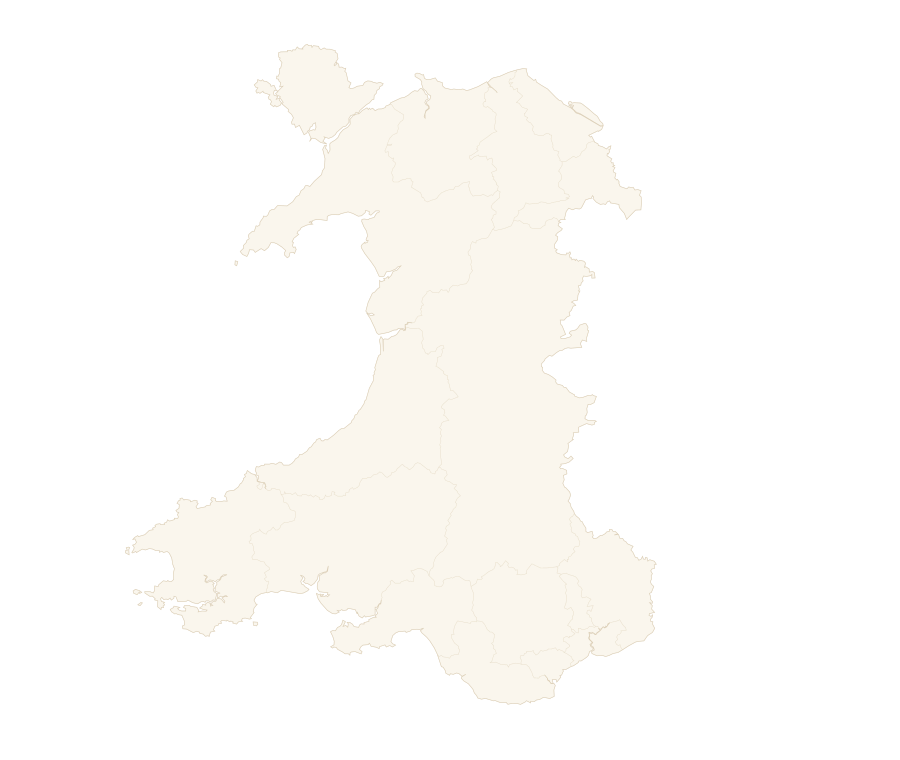
CoreHistoric reach
The seat of Wynn
Seat vacantChief
No one leads the Wynn community yet. When the movement opens, you can stand for its leadership, or help elect whoever does.
Current mission
No shared goal set yet. Once Wynn has leadership, it sets the public focus: a restoration, a gathering, a real-world project that helps its own.
The Wynn clan is being rebuilt. Join the waiting list for the movement today, and you help decide who leads it and what it does.
Help rebuild the Wynn clan →Motto
Tra môr, tra Brython
“While there is sea, there are Britons”
What does the Wynn name mean?
From the Welsh 'gwyn', fair or white, originally a personal byname (Owain Wyn, Owain the Fair) that crystallised into a hereditary surname through the Tudor period. The Wynn family of Gwydir Castle in the Conwy Valley emerged in the 15th century as the dominant gentry house of North Wales.
The history of Wynn
Owain the Fair, and the moment a nickname stopped moving
Patronymics accounted for some 48 per cent of Welsh names recorded in 1292, and for more than 70 per cent in certain parishes. A man was his father's son and little else: Evan ap Thomas fathered John ab Evan, who fathered Rees ap John, the name shifting with every birth. Chains ran back to a seventh generation, and strings like Llewelyn ap Dafydd ab Ieuan ap Gruffudd ap Meredydd were unremarkable, a spoken pedigree rather than a label, kept because Welsh law required a man to know his descent.
Wynn began outside that machinery. It comes from gwyn, fair or white, a nickname fastened to one man (Owain Wyn, Owain the Fair) describing him rather than his father. What froze it was the reign of Henry VIII, when hereditary surnames took hold among the Welsh gentry and spread only slowly to commoners; some rural districts were still naming the old way in the early nineteenth century.
The Gwydir line lets you watch the change inside one household. The founder is recorded as Maredudd ab Ieuan, elsewhere as Meredith ap Ieuan ap Robert; his Tudor descendant appears as Maurice Wynn ap John ap Maredudd, patronymic and surname in one name. Maurice's heir was simply John Wynn.
The lease at Dolwyddelan, 1488
Dolwyddelan Castle was probably begun by Llywelyn ab Iorwerth, ruler of Gwynedd, between 1210 and 1240, set to guard the road from Nant Conwy into Meirionydd. Its rectangular keep is characteristic of the thirteenth-century Welsh princes, close kin to Llywelyn's towers at Castell y Bere and Criccieth. Edward I captured it in 1283 and refortified it, but its military importance faded soon after.
In 1488 Maredudd ab Ieuan, the ancestor of the Wynns of Gwydir, bought the lease and repaired the castle. The sources are blunt about his reasons: he came of an Eifionydd family notorious for kindred feuds, and he moved to Dolwyddelan both to extend his influence and to put distance between himself and his own relatives. It is an unsentimental start for a house that would go on to run the political life of North Wales, and it is the first hard date the family owns.
Gwydir: wet land, or blood land
Gwydir Castle is a fortified manor house of about 1500 in the Conwy valley, a mile west of Llanrwst, rebuilt after the Wars of the Roses by Meredith ap Ieuan ap Robert, founder of the Wynn dynasty. Sir John Wynn's History of the Gwydir Family offers two readings of the name: a compound of gwy and tir, wet land, or of gwaed and tir, blood land. The family kept both.
The house was rebuilt again in the sixteenth century by Maurice Wynn, and by then Gwydir was the seat of a family that claimed descent from the kings of Gwynedd and behaved accordingly. The estate ran across Caernarfonshire, Denbighshire and Merionethshire and dominated north Wales through the sixteenth and seventeenth centuries, the house standing at the centre of a deer park of some 36,000 acres.
Seven times sheriff of Caernarfonshire
John Wynn was born at Gwydir in 1553, eldest of the eleven children of Maurice Wynn ap John ap Maredudd and Jane Bulkeley of Beaumaris. He was schooled at Furnivall's Inn and at the Inner Temple in London, the standard education for a Welsh gentleman's heir of his generation, and on his father's death in 1580 he succeeded at twenty-seven. He held the estate, and the wider Wynn interest in North Wales, for forty-seven years.
The offices came in quantity. He served seven times as High Sheriff of Caernarfonshire, the senior shrievalty office of the county, and sat as member of parliament for Caernarfonshire in 1586, 1589 and 1601. Elizabeth I appointed him in 1601 to the Council in the Marches of Wales, the body governing Wales under the Tudor settlement, and James I confirmed him in 1604, then created him first Baronet of Gwydir in June 1611, in the very first batch of the new baronetcies.
He built as well as held. Sir John extended the estates by systematic purchase and by marriage alliances with the Bulkeley, Mostyn and Williams families, established a substantial Wynn lead-mining interest in the Snowdonia foothills, and set in hand the Wynn Chapel at Llanrwst, built in 1633-34 and completed by his son, one of the finest Jacobean church buildings in North Wales.
The book that turned a family into a source
In the last decade of his life Sir John wrote the thing his name now rests on. The History of the Gwydir Family, composed between about 1614 and 1619, chronicles the Wynn line from its claimed twelfth-century descent from Owain Gwynedd, through the late-medieval politics of North Wales, down to his own generation, in clear Elizabethan English prose unusual in a Welsh-speaking author of his period.
The manuscript stayed in the family for a century and a half before the antiquary Daines Barrington printed it in 1770; J. Ballinger re-edited it in 1927. It set the template for Welsh genealogical writing and remains a foundational source for the political and social life of late-Tudor and early-Stuart North Wales. Historians read the Wynns not because the Wynns were the greatest house in Britain but because one of them wrote everything down.
Sir John died at Gwydir on 1 March 1627, in his seventy-fourth year, and was buried at Llanrwst parish church beside the chapel his sons would finish. His son Sir Richard Wynn, 2nd Baronet (1588-1649), carried the family into the royal household as Treasurer to Queen Henrietta Maria.
How Gwydir left the Wynns
The name held office long before and long after Sir John. Maurice Wynn, who died in 1580, was a Welsh courtier and politician; Robert Wynn, who died in 1598, sat as a Welsh member of parliament, and Ellis Wynn sat as an English one in the sixteenth century; Henry Wynn (1602-1671) was a Welsh politician and Richard Wynn (1655-1719) an English one.
The house itself went by marriage rather than by forfeiture. In 1678 Mary Wynn married Robert Bertie, 1st Duke of Ancaster and Kesteven, and Gwydir passed to the Barons Willoughby de Eresby. The senior Wynn line took a second turn in 1719, when it passed into the Williams family of Llanforda in Shropshire and produced the Williams-Wynn baronetcy of Wynnstay, the dominant political house of Welsh-speaking Wales in the eighteenth and nineteenth centuries. Sir Watkin Williams-Wynn, 4th Baronet (1748-1789), was known as the Prince in Wales and was a serious patron of Welsh culture.
The estate that had carried a 36,000-acre deer park did not survive the long eighteenth century well: much of it lay under continuous mortgage, Dolwyddelan was sold off in 1894, and most of Llanrhychwyn and Trefriw followed within two years. Gwydir kept enough standing for the future George V and Queen Mary, then Duke and Duchess of York, to stay there in April 1899, and it has been restored and reoccupied in the twentieth century.
Wynns who were never of Gwydir
Most people called Wynn have nothing to do with the Conwy valley, and Welsh naming is the reason. Because so many Welsh surnames come from a small pool of baptismal names, communities are full of families sharing a surname and no ancestor: it cannot be assumed that two men of the same name in the same village inherited it from the same forebear. The stock of Welsh surnames narrowed further after the Reformation cut the variety of baptismal names.
The spread is real all the same. An analysis commissioned by the Welsh Government found 718,000 people in Wales, nearly 35 per cent of the population, carrying a family name of Welsh origin, against 5.3 per cent across the rest of the United Kingdom, 4.7 per cent in New Zealand, 4.1 per cent in Australia and 3.8 per cent in the United States. Across the countries studied, 16.3 million people carry a Welsh-origin name.
The bearers scatter accordingly. William Wynn (1709-1760) was a Welsh poet, Glyn Wynn a Welsh soldier and politician, Glynn Wynn (1772-1809) an English politician, Emanuel Wynn a French pirate of the seventeenth century. Later came Edward Wynn (1889-1956), an Anglican bishop, Peter Wynn (1931-2017), an English mathematician, and the Welsh footballers George Wynn (1886-1966) and Ron Wynn (1923-1983).
Champions of the Wynn name
The bearers whose lives are inseparable from this surname. Each has their own page, biography, achievements, geography, connection to the family.
Historic Places, Rebuilt
Explore the streets and seats the Wynn name knew, rebuilt with AI as they stood in history.
Historic Places, Rebuilt · New
Edward I's walled bastide and mighty castle in North Wales, a generation after the conquest, the banded towers still rising.
Historic Places, Rebuilt · New
Owain Glyndŵr's mountain fortress and court at the high tide of Welsh independence, the English siege lines gathering below.
Castles the Wynn held
Strongholds this name held for a decade or more, look one up, or rebuild it to explore.
- Dolwyddelan Castle
Maredudd ab Ieuan, ancestor of the Wynns of Gwydir, purchased the lease in 1488 and repaired the castle.
- Gwydir Castle
Seat of the Wynn family, descendants of the Kings of Gwynedd, from the rebuilding by dynasty founder Meredith ap Ieuan ap Robert until 1678.
The castles of the homeland
The great strongholds of the homeland, look one up, see what it looked like in its prime, and recreate it to explore.
 Caernarfon CastleRestored · prime 1330
 Conwy CastleRuin · prime 1287
 Pembroke CastleRestored · prime 1280
All castles in Wales → · Strongest castles in Wales → · Castles of Europe
Play As Your Clan
Hold a real castle against whatever you choose to send at it, take a ship out in her own service years, or stand at the shoulder of someone the record remembers. The chronicler sets the scene; the deeds are yours.
Notable bearers of the Wynn name
- Sir John Wynn, 1st Baronet of Gwydir (1553-1627), author of The History of the Gwydir Family
- Sir Richard Wynn, 2nd Baronet of Gwydir (1588-1649), Treasurer to Henrietta Maria
- Sir Watkin Williams-Wynn, 4th Baronet (1748-1789), 'Prince in Wales', patron of Welsh culture