House of Mathrafal
Royal house of Powys, central kingdom of medieval Wales.
- Origin
- Powys, Wales
- Famous bearer
- Bleddyn ap Cynfyn (d.1075), King of Gwynedd and Powys, founder of the Mathrafal royal line
- Register
- Princely house
Ranked of all time
The 10 Most Powerful Welsh Houses of All Time
The Mathrafal arms and country

Coat of armsCoat of arms of PowysBorne by the Powys line, one branch of the name rather than all of it.AlexD · CC BY-SA 3.0

- Coat of arms: Granted to an individual and inherited down that one documented line. These are the arms of particular families of the name, not of everyone who shares the surname.
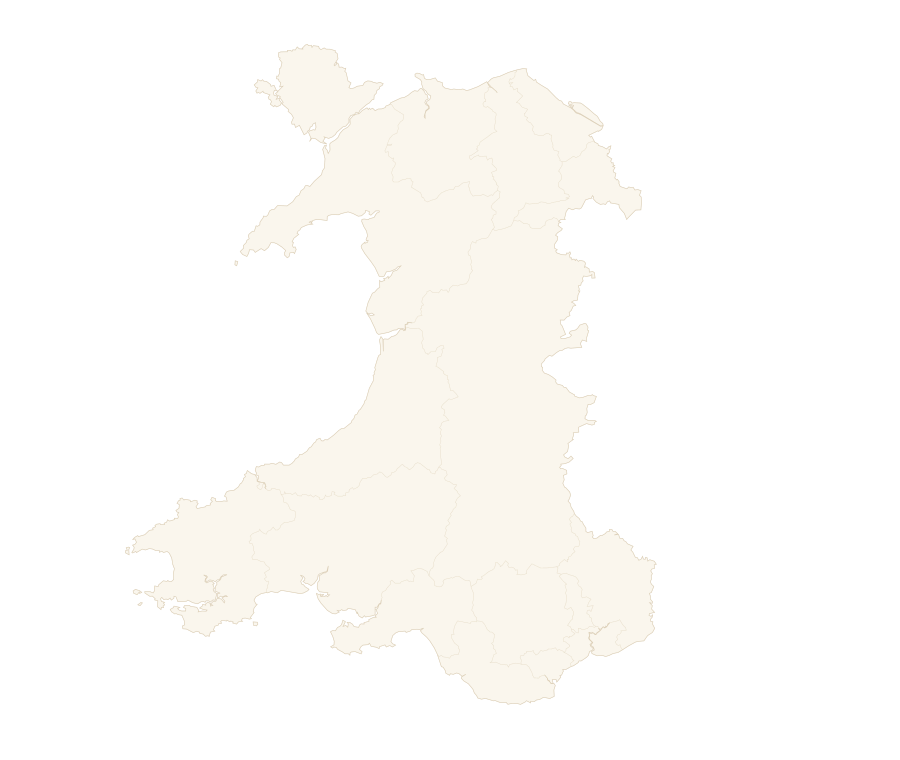
CoreHistoric reach
The seat of House of Mathrafal
Seat vacantChief
No one leads the House of Mathrafal community yet. When the movement opens, you can stand for its leadership, or help elect whoever does.
Current mission
No shared goal set yet. Once House of Mathrafal has leadership, it sets the public focus: a restoration, a gathering, a real-world project that helps its own.
The Mathrafal clan is being rebuilt. Join the waiting list for the movement today, and you help decide who leads it and what it does.
Help rebuild the Mathrafal clan →What does the Mathrafal name mean?
From Mathrafal, the royal court (llys) of the kingdom of Powys, located on the Vyrnwy river in modern Montgomeryshire. As with Aberffraw and Dinefwr, the dynasty took its style from the place its kings ruled from rather than from a single ancestral surname.
The history of House of Mathrafal
A court on the Vyrnwy, and a house named for it
Mathrafal is the llys, the royal court, that stood in the Vyrnwy valley of what is now Montgomeryshire, occupied as a princely court from the ninth century. The kings who ruled from it took their style from the ground rather than from an ancestor, as Aberffraw did in Gwynedd and Dinefwr in Deheubarth. Powys was the third of those kingdoms, the central one, wedged between the other two and against the English border.
Welsh genealogy also knows the line as the Lleision, the descendants of Lles Llawddeog, and plainly as the House of Powys. Whatever it was called, it was one of the three families contesting the rule of Wales, and the only one to come through the Edwardian conquest largely intact.
1063: the Godwinsons install two brothers
Gruffudd ap Llywelyn was the only man ever to rule the whole of Wales, and when Cynan ab Iago killed him in 1063 the kingdom he had assembled came apart. Harold and Tostig Godwinson, whose raids of 1062-1063 had broken Gruffudd's power, raised his uterine brothers Bleddyn and Rhiwallon ap Cynfyn over the northern half of it. The Mathrafal line begins there, in a settlement imposed from England on a Welsh throne.
Bleddyn did not stay grateful. He joined the Anglo-Saxon resistance to William the Conqueror, and the family's reach was widest between 1063 and 1081, when it held Gwynedd as well as Powys. Then the Gwynedd line recovered under Gruffudd ap Cynan and forced them out. The cost was counted in men: Bleddyn's son Rhiryd, king of Powys, was killed in war by Rhys ap Tewdwr of Dinefwr, into whose house Rhiwallon's daughter Gwladys had married as queen of Deheubarth.
Nest, Bellême and the sons of Bleddyn
The next generation faced the Normans whether it wanted to or not. Cadwgan ap Bleddyn, prince of Powys, married into the house of de Say, companions of the Conqueror, and allied with Gruffudd ap Cynan against the Montgomery magnates. His son Owain ap Cadwgan is remembered for the abduction of Nest, wife of Gerald de Windsor, and both he and his father lost lands to Henry I.
Iorwerth ap Bleddyn played the same game from the other end: he joined the rebellion of Robert of Bellême, third earl of Shrewsbury, then turned and betrayed him with William Pantulf. Another of the line went further still. Gruffydd Fychan ap Iorwerth, a Marcher lord, was a Knight of Rhodes and of the Order of Saint John, and fought in the crusades under the Hospitallers.
Maredudd rebuilds, and Madog inherits it whole
By the early twelfth century the family had been cut back to one man. Maredudd ap Bleddyn held much of the old kingdom of Powys, absorbed around 900 by the sons of Rhodri Mawr and not independent since. He rebuilt it, made his peace with Henry I, and retired into Snowdonia leaving the kingdom entire to his heir Madog. The Brut y Tywysogion follows him through it.
Madog succeeded in 1132 as undisputed sole ruler and held Powys undivided until his death, the longest tenure any king of Powys managed. Rather than resist the Marcher advance into the border country, he allied with the Marcher lords against the rising power of Owain Gwynedd to his west, kept an accommodating line towards the Empress Matilda's camp during the Anarchy of 1135-1153, and came out of it close to Henry II.
He was also a serious patron of the arts and the Church. Gwalchmai ap Meilyr wrote for him, and wrote the long elegy on his death; Cynddelw Brydydd Mawr, the Great Poet, left a body of verse to Madog and his sons among the largest surviving from twelfth-century Wales. The Dream of Rhonabwy opens at the Mathrafal court and calls Madog the most generous of Welsh princes. He died in February 1160 and was buried at the family abbey of Meifod.
Fadog in the north, Wenwynwyn in the south
Madog's heir Llywelyn was killed, and Powys came apart in renewed violence inside the family. By 1191 the kingdom existed as two principalities: Powys Fadog in the north, around Wrexham and the upper Dee, and Powys Wenwynwyn in the south, roughly modern Montgomeryshire and the country round Welshpool. Neither half ever reunited.
The two took opposite sides. Powys Fadog settled into a more or less loyal vassalage to Gwynedd; Powys Wenwynwyn became one of Gwynedd's main competitors. The family still produced princes who counted nationally: Owain Cyfeiliog, and his son Gwenwynwyn ab Owain who died in 1216, were major figures until the rise of Llywelyn ab Iorwerth in 1215 changed the arithmetic.
Shrewsbury, 1283: royalty traded for a lordship
When Edward I broke the Welsh royal houses, Mathrafal was the one that walked away. Alone among the families of royal descent in Wales it survived the conquest largely intact, having avoided the campaign of extermination by dealing at the Parliament of Shrewsbury in 1283: it gave up its claim to royalty and took an English lordship in exchange. The holdings in southern Powys became the Marcher lordship of Powys.
Holding it was another matter. Edward II married the heiress of the line, Hawys Gadarn, to his own supporter John Charlton, first Baron Charlton, under English law rather than Welsh, and the lordship left the family with her. The Mortimers displaced them in the early fourteenth century. The blood carried on through the Charlton Lords Powis and through Welsh gentry lines that hold it still.
The claim that came back in 1400
The northern branch, Powys Fadog, kept the senior Mathrafal line, and in 1400 it produced the last native Welshman to claim the title Prince of Wales. Owain Glyndŵr's case rested on descent from this dynasty and from Deheubarth together, and that is what gave his revolt dynastic weight across mid-Wales rather than the standing of a local grievance.
The rising did not outlast Henry V, but it was not spent for nothing: the Tudors of Penmynydd, cousins on his mother's side who fought beside him, produced Sir Owen Tudor, second husband of Queen Catherine of France, and through him the first Welsh house to hold the English throne.
Champions of the Mathrafal name
The bearers whose lives are inseparable from this surname. Each has their own page, biography, achievements, geography, connection to the family.
Castles that share the Mathrafal name
The same name on the map, look one up, see what it looked like in its prime, and recreate it to explore.

All castles in Wales → · Strongest castles in Wales → · Castles of Europe
Play As Your Clan
Hold a real castle against whatever you choose to send at it, take a ship out in her own service years, or stand at the shoulder of someone the record remembers. The chronicler sets the scene; the deeds are yours.
Notable bearers of the Mathrafal name
- Bleddyn ap Cynfyn (d.1075), King of Gwynedd and Powys, founder of the Mathrafal royal line
- Madog ap Maredudd (d.1160), last king of an undivided Powys
- Gwenwynwyn ab Owain Cyfeiliog (d.1216), Prince of Powys Wenwynwyn
Frequently asked
What does the surname Mathrafal mean?
Where does the Mathrafal family come from?
Where did the Mathrafal family historically hold territory?
Is Mathrafal Welsh or English?
How old is the Mathrafal surname?
What is the Mathrafal family known for?
Is there a Mathrafal family crest or coat of arms?
Who is the most famous Mathrafal?
Who are some famous Mathrafals?
Where is the Mathrafal surname found today?
What does the Clan Rising page for the Mathrafal family cover?
Who is the head of the Mathrafal family today?
Neighbouring clans
- EvansSon of John, by the Welsh road, the cousin name of Jones.
- LewisLlywelyn anglicised, a princely name carried into common use across the Marches and the south.
- OwenThe princely name, Owain in Welsh, the surname of the last revolt and the first Tudor.
- LloydLlwyd, the grey one, the great descriptive surname of the central Welsh ridge.