Evans
Son of John, by the Welsh road, the cousin name of Jones.
- Origin
- Deheubarth, Wales
- Famous bearer
- Mary Anne Evans, 'George Eliot' (1819–1880), novelist (Middlemarch, Daniel Deronda)
- Register
- Welsh family
The Evans arms and country

Coat of armsEscutcheon of the Evans baronets of Wightwick (1920)Borne by the Wightwick line, one branch of the name rather than all of it.Charles Matthews · CC BY-SA 4.0 
Coat of armsEscutcheon of the Evans baronets of Kilcreene (1683)Borne by the Kilcreene line, one branch of the name rather than all of it.Charles Matthews · CC BY-SA 4.0
.svg)
.svg)
- Coat of arms: Granted to an individual and inherited down that one documented line. These are the arms of particular families of the name, not of everyone who shares the surname.
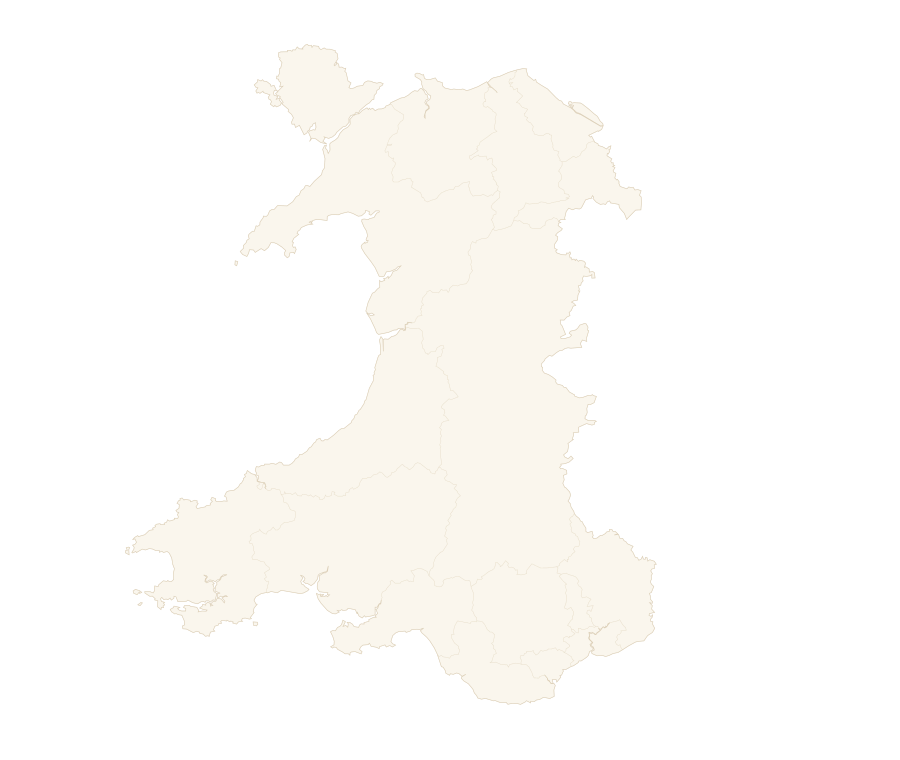
CoreHistoric reach
The seat of Evans
Seat vacantChief
No one leads the Evans community yet. When the movement opens, you can stand for its leadership, or help elect whoever does.
Current mission
No shared goal set yet. Once Evans has leadership, it sets the public focus: a restoration, a gathering, a real-world project that helps its own.
The Evans clan is being rebuilt. Join the waiting list for the movement today, and you help decide who leads it and what it does.
Help rebuild the Evans clan →What does the Evans name mean?
Son of Ifan or Iefan, the Welsh forms of John. The patronymic 'ab Ifan' (using 'ab' before a vowel) compressed into Evans; in parallel, English 'son of John' gave Jones. The two names are the same name, twice, Welsh and English mouths working on the same baptism.
The history of Evans
Ieuan, Ifan, Evan: Wales's own John
John was the commonest given name in the medieval West, and every language cut its own version: Latin Johannes, French Jean, Slavic Ivan, English John. Welsh had Ieuan, softened in speech to Iefan and Ifan, and the likeness between Ifan and Ivan is no accident. Welsh writes the v sound with the letter f, so Ifan is spoken "Ivan", and clerks working in English set down what they heard as Evan. Evans is the son of that man.
A second reading survives and should be stated: some derive Evan not from Ifan but from Yvain, the Latinised Norman-French form of Owain, and Owain Llawgoch was known abroad as Yvain des Galles. Either way the name reaches English out of a Welsh mouth.
One father, three surnames
Before fixed surnames a Welshman carried no family name, only his descent: his baptismal name joined by ap, or ab before a vowel, to his father's, and ferch for a daughter. The chain runs through this very name. Thomas fathered Evan, who was Evan ap Thomas; Evan fathered John, who was John ab Evan; John fathered Rees, who was Rees ap John. In 1292 forty-eight per cent of recorded Welsh names were patronymics, over seventy per cent in some parishes, and a chain could run seven generations deep, because Welsh law ran entitlement through descent. A pedigree was the document a man carried in his mouth.
When those chains froze, the pen decided the family name for good. A father called John recorded in the English form gave Jones. The same man recorded in the Welsh form, Ifan or Iefan, gave Evans. And where the ab was welded on rather than dropped, ab Ifan gave Bevan. Three of the commonest names in Wales, all meaning son of John, separated only by the clerk's language and his habit with the prefix.
Why a handful of names covers a whole country
Fixed surnames spread in Wales from the fifteenth century onwards, hereditary among the gentry under Henry VIII and only slowly among commoners after Wales was brought under English administration in 1536. What made the stock of names so small was a second event: after the Protestant Reformation the variety of baptismal names shrank, and because Welsh surnames were built from baptismal names, a narrow pool of first names froze into a narrow pool of surnames. Evans, Jones, Williams, Davies and Thomas were all still in the top ten recorded in England and Wales in 2000. Evans is fifth commonest in Wales, tenth in England, forty-eighth in the United States.
The consequence for anyone tracing a line is blunt: two people named Evans, even in one village, cannot be assumed to share an ancestor. Wales answered that in the nineteenth century by building second surnames from a house, a parish or the mother's family, later hyphenated. The shortage of names is the fingerprint of a whole nation registered at once.
Ceredigion and Powys, where the Welsh spelling held
Evans is thickest in mid and west Wales, in Ceredigion and Powys, and that is paperwork, not settlement. These are the districts where Welsh-language record-keeping lasted longest, so the Welsh form of the father's name is the one that reached the page; in rural areas the old patronymics were still in use into the early nineteenth century. The map of the surname is a map of where the language held its ground.
Welsh tradition threads the Ifan line further back still, to Ifan ab Owain Goch, named in folklore as a grandfather of Owain Glyndŵr, tying the name to the last rising of the Princes. That is tradition rather than charter evidence, but it is the story the name has long told about itself.
Down to the coal, out on the ships
Industry moved the name before emigration did. Glamorganshire held 71,000 people in 1801 and 1,122,000 by 1911, and families walked out of the western parishes into its pits and terraces. Others went to Liverpool and Ashton-in-Makerfield, which is why so many English families carry Welsh surnames.
The sea took the rest, often straight out of Evans country. In 1819 the ship Albion left Cardigan for New Brunswick with twenty-seven Cardiganshire farming families aboard. In 1852 Thomas Benbow Phillips of Tregaron founded a settlement of about a hundred Welsh people in Rio Grande do Sul, Brazil. Contract miners went to the coal towns of the Pas-de-Calais; others to Pennsylvania, and to Malad City in Idaho, a Welsh Mormon settlement that still claims more people of Welsh descent, proportionally, than anywhere outside Wales. Some 1.75 million Americans report Welsh ancestry, and 458,705 Canadians did so in 2011, against 2.9 million people living in Wales.
The Evanses who carried it furthest
Mary Anne Evans (1819–1880), a Warwickshire land agent's daughter descended from a Welsh-borders branch of the name, translated the German biblical critics, edited the Westminster Review and published as George Eliot. Middlemarch, The Mill on the Floss and Daniel Deronda made her the foundational moral realist of the English novel.
Sir Arthur Evans (1851–1941) began digging at Knossos in 1900, uncovered the Throne Room and gave a lost European civilisation the name Minoan. Sir Geraint Evans (1922–1992) carried the Welsh voice onto the great opera stages as one of the finest baritones of his century, and Edith Evans (1888–1976) held the English stage for half a century, remembered above all in The Importance of Being Earnest. For a name that began as a clerk's shorthand for somebody's father, that is a considerable inheritance.
Champions of the Evans name
The bearers whose lives are inseparable from this surname. Each has their own page, biography, achievements, geography, connection to the family.
Historic Places, Rebuilt
Explore the streets and seats the Evans name knew, rebuilt with AI as they stood in history.
Historic Places, Rebuilt · New
Edward I's walled bastide and mighty castle in North Wales, a generation after the conquest, the banded towers still rising.
Historic Places, Rebuilt · New
Owain Glyndŵr's mountain fortress and court at the high tide of Welsh independence, the English siege lines gathering below.
Historic Places, Rebuilt · New
The grandest castle-palace in Wales at its height, the moated Yellow Tower, fountain courts and long gallery, on the eve of the siege.
Historic Places, Rebuilt · New
The greatest coal port on earth at its peak, the hoists and colliers, the Coal Exchange and the streets of Tiger Bay.
The castles of the homeland
The great strongholds of the homeland, look one up, see what it looked like in its prime, and recreate it to explore.
 Caernarfon CastleRestored · prime 1330
 Conwy CastleRuin · prime 1287
 Pembroke CastleRestored · prime 1280
All castles in Wales → · Strongest castles in Wales → · Castles of Europe
Play As Your Clan
Hold a real castle against whatever you choose to send at it, take a ship out in her own service years, or stand at the shoulder of someone the record remembers. The chronicler sets the scene; the deeds are yours.
Notable bearers of the Evans name
- Mary Anne Evans, 'George Eliot' (1819–1880), novelist (Middlemarch, Daniel Deronda)
- Edith Evans (1888–1976), actress (The Importance of Being Earnest)
- Sir Geraint Evans (1922–1992), Welsh operatic baritone
- Sir Arthur Evans (1851–1941), archaeologist; discoverer of the Minoan civilisation at Knossos, 1900
Stories of Evans
Frequently asked
What does the surname Evans mean?
Where does the Evans family come from?
Where did the Evans family historically hold territory?
Is Evans Welsh or English?
How old is the Evans surname?
What is the Evans family known for?
Is there a Evans family crest or coat of arms?
Who is the most famous Evans?
Who are some famous Evanses?
What stories are told about the Evans family?
What is the story of Arthur Evans unearths the Throne Room at Knossos?
Where is the Evans surname found today?
What does the Clan Rising page for the Evans family cover?
Who is the head of the Evans family today?
Neighbouring clans
- LewisLlywelyn anglicised, a princely name carried into common use across the Marches and the south.
- OwenThe princely name, Owain in Welsh, the surname of the last revolt and the first Tudor.
- LloydLlwyd, the grey one, the great descriptive surname of the central Welsh ridge.
- Powellap Hywel, the contracted patronymic that descends from Hywel Dda, the king who wrote Welsh law.