Lloyd
also Llwyd, Lloyde
Llwyd, the grey one, the great descriptive surname of the central Welsh ridge.
- Origin
- Powys, Wales
- Famous bearer
- David Lloyd George (1863–1945), Prime Minister
- Register
- Welsh family
The Lloyd arms and country

Coat of armsEscutcheon of the Lloyd baronets of Rhu (1960)Borne by the Rhu line, one branch of the name rather than all of it.Charles Matthews · CC BY-SA 4.0 
Coat of armsEscutcheon of the Lloyd baronets of Yale (1647)Borne by the Yale line, one branch of the name rather than all of it.Charles Matthews · CC BY-SA 4.0
.svg)
.svg)
- Coat of arms: Granted to an individual and inherited down that one documented line. These are the arms of particular families of the name, not of everyone who shares the surname.
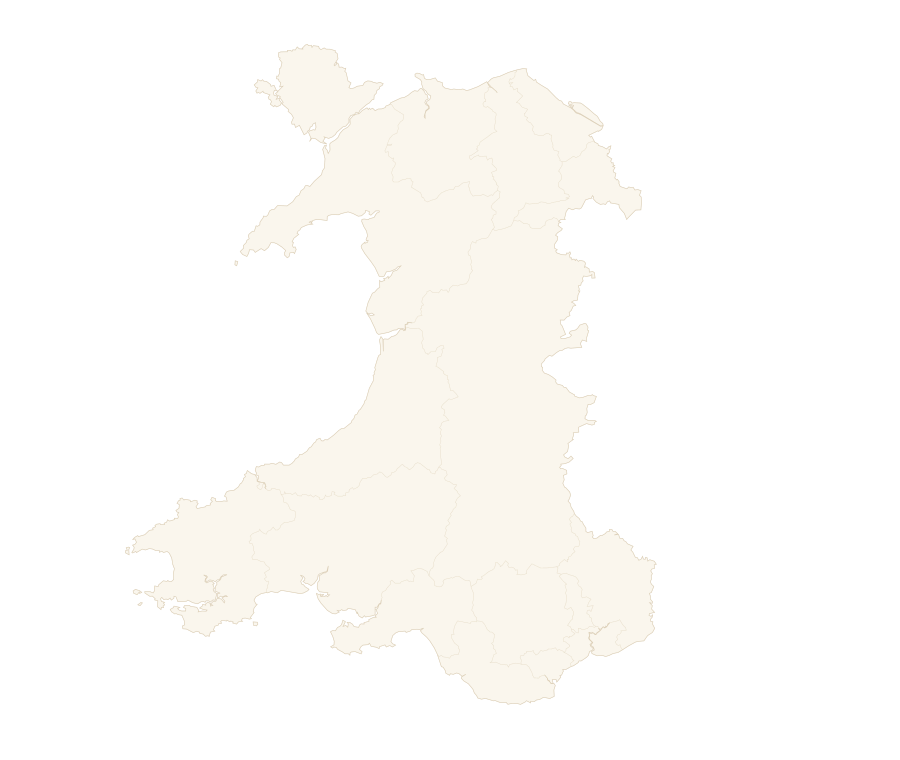
CoreHistoric reach
The seat of Lloyd
Seat vacantChief
No one leads the Lloyd community yet. When the movement opens, you can stand for its leadership, or help elect whoever does.
Current mission
No shared goal set yet. Once Lloyd has leadership, it sets the public focus: a restoration, a gathering, a real-world project that helps its own.
The Lloyd clan is being rebuilt. Join the waiting list for the movement today, and you help decide who leads it and what it does.
Help rebuild the Lloyd clan →What does the Lloyd name mean?
From the Welsh adjective 'llwyd', grey, brown-grey, hoary, used as a descriptive byname for a man of grey complexion or hair, then frozen into a hereditary surname by the Tudor administration. The double-l of Welsh has no English equivalent, and 'Lloyd' is the orthographic compromise that emerged. Lloyds Bank, founded by an English Quaker family in Birmingham in 1765, is unrelated.
The history of Lloyd
The grey one, and what the grey stopped meaning
Lloyd is the Welsh adjective llwyd, usually translated grey, and it describes a man rather than recording his father. It covered more ground than English grey does: T. J. Morgan and Prys Morgan set it across a range of browns as well, and ordinary Welsh keeps that sense, where dŵr llwyd is the brown water of a river in flood. Of a young man it most likely meant mouse-coloured hair, of an old one the grey of age.
By the time llwyd hardened into a family name it had largely stopped meaning grey at all, and the Morgans dismissed the antiquarian who explained a David Llwyd in one pedigree by supposing he had gone grey early. The word carried a second sense in the medieval period, holy, and it behaves oddly in the grammar because of it: Welsh adjectives normally soften after a personal name, and llwyd is the exception that keeps its hard consonant. It may also have marked a man as owed respect.
Hereditary while the rest of Wales still changed names
Welsh naming ran on ap. A man was his father's son and nothing more, Evan ap Thomas, then John ab Evan, then Rees ap John, the name rebuilt every generation, and strings running back to a seventh ancestor were unremarkable. The Encyclopaedia of Wales suggests the habit rested on Welsh law, where descent from an ancestor decided what a man was entitled to. In 1292 some 48 per cent of recorded Welsh names were patronymics, and in certain parishes over 70 per cent.
Lloyd did not come through that machinery, and that one fact separates it from the rest of the Welsh surname stock. Powell is ap Hywel with the ap worn down to a P, Pryce is ap Rhys, Bowen is ab Owen. Nothing of the kind happened to Lloyd, because llwyd was never anybody's baptismal name: it was an epithet, and an epithet attaches to the man, not to the line.
What makes Lloyd unusual is that it stuck anyway. Hereditary Welsh surnames were exceptional well into the early modern period, and llwyd is named as one of the exceptions, with goch, red, which became Gough: fixed epithets already passing down the generations as early as the 14th century, while most of Wales was still rebuilding its names each generation.
Floyd, Flood and Lloyd out of the same mouths
The Tudor century settled the rest of Wales. Surnames became hereditary among the gentry in Henry VIII's reign and spread slowly downward, the districts nearest English influence abandoning ap first, while some rural areas kept patronymics into the early 19th century. Wales came under a single administration with England in 1536, and administration means paper: rolls, rentals and wills, all written down by clerks.
Those clerks then met the Welsh ll, a voiceless hiss made at the side of the tongue with no English equivalent whatever. Often they gave up and wrote a single l; sometimes they reached for thl or ffl to show that this l had something extra in it. The diphthong wy, roughly the vowel of gooey said as one syllable, came out as oy.
The result is a whole family of spellings that are one Welsh word: Floyd, Flood, Fludd, Flude, Flewitt, Lhuyd, Loud, Thloyd. Most date from the Tudor period, and they are not separate names belonging to separate families. The same man could be entered as Lloyd on one page and Floyd on the next by a clerk doing his honest best with a sound his own language had never needed.
Why two Lloyds in one parish are usually strangers
Wales carries a remarkably small stock of surnames for the number of people using them, partly because the Reformation cut down the range of baptismal names the patronymics were built from. Two people named Jones, even in the same village, cannot be assumed to share an ancestor.
For a descriptive byname the point is sharper. A patronymic at least requires a father with the right first name; grey hair required nothing but a neighbour with eyes. There is no founder, no chief and no seat that owns this name, and a pedigree that joins one Lloyd family to another because the spelling matches has invented the join.
Two houses the name actually holds
One Lloyd family can be pointed at on a map. Whittington, on the Welsh Marches close to the old fort at Old Oswestry, was a motte and bailey rebuilt in stone in the 13th century and, after the defeat of Llewelyn in 1282, a lordly residence for the FitzWarins, a line of lords all named Fulk. In 1545 John Bourchier, 2nd Earl of Bath, traded the lordship to Henry VIII for former monastic estates nearer his Devon home, and it passed through various hands to William Albany, a London merchant taylor.
From 1750 Albany's descendants are the Lloyd family of Aston, near Oswestry, who own Whittington still, although they lived at Great Fernhill rather than in the castle. No descent from the Fulks is claimed for them. What survives is the stone gatehouse flanked by two round towers, conserved and restored and open to visitors under a preservation trust: a named address kept in one family's hands since 1750.
A second Lloyd house stands in Ireland. Strancally, near Youghal in County Waterford, was built about 1830 by the architects James and George Richard Pain for John Keily, above the River Blackwater and in front of the ruin of an old Desmond castle raised by Raymond le Gros. In 1856 the castle and an estate of 5,000 acres were bought by George Whitelocke Lloyd, then twenty-four years old and of a wealthy Anglo-Irish manufacturing family. Nothing connects him to the Lloyds of Aston or to any particular Welsh line, and nothing needs to.
The cottage boy from Llanystumdwy
David Lloyd George was born in Manchester on 17 January 1863 and raised from infancy at Llanystumdwy in Caernarfonshire, in a Welsh-speaking, chapel-going household kept by his widowed mother and his shoemaker uncle. He qualified as a solicitor, and in 1890 was elected member of parliament for the Caernarvon Boroughs, a seat he would hold for fifty-five years. As Chancellor of the Exchequer from 1908 he carried the People's Budget of 1909 and the National Insurance Act of 1911, which established the first national systems of health and unemployment insurance in Britain and are reckoned among the founding stones of the modern welfare state.
He became Prime Minister in December 1916, at the darkest point of the First World War, reorganised the direction of the war through a small War Cabinet and a unified Allied command, and under his leadership Britain and the Allies carried the war to victory in November 1918. The following year he led the British delegation at the Paris Peace Conference. He was the first Welsh speaker and the first man of genuinely modest origins to reach the premiership, he governed in his second language, and he remains the only Welshman to have led a British government. Near the end of his life he was created Earl Lloyd-George of Dwyfor.
Not the bank, and Llwyd put back
Lloyds Bank is no part of this history: it was founded in Birmingham in 1765 by an English Quaker family and has nothing to do with the Welsh llwyd. The traffic has lately reversed on the Tudor clerks: Llwyd, the spelling closest to the Welsh word, had long fallen out of use, and in recent years it has been deliberately put back.
Selwyn Lloyd (1904–1978) carried the name to the Foreign Office and afterwards to the Speaker's chair in the Commons. Lloyd began as one man's hair, noticed by his neighbours and never meant to outlive him. It is now the great descriptive surname of Wales, densest in Powys and Ceredigion, and carried by people whose one certain kinship is the word itself.
Champions of the Lloyd name
The bearers whose lives are inseparable from this surname. Each has their own page, biography, achievements, geography, connection to the family.
Historic Places, Rebuilt
Explore the streets and seats the Lloyd name knew, rebuilt with AI as they stood in history.
Historic Places, Rebuilt · New
Edward I's walled bastide and mighty castle in North Wales, a generation after the conquest, the banded towers still rising.
Historic Places, Rebuilt · New
Owain Glyndŵr's mountain fortress and court at the high tide of Welsh independence, the English siege lines gathering below.
Historic Places, Rebuilt · New
The grandest castle-palace in Wales at its height, the moated Yellow Tower, fountain courts and long gallery, on the eve of the siege.
Castles the Lloyd held
Strongholds this name held for a decade or more, look one up, or rebuild it to explore.
- Whittington Castle
Owned since 1750 by the Lloyds of Aston, near Oswestry, who still hold the castle.
- Strancally Castle
Bought with 5,000 acres by George Whitelocke Lloyd in 1856.
The castles of the homeland
The great strongholds of the homeland, look one up, see what it looked like in its prime, and recreate it to explore.
 Caernarfon CastleRestored · prime 1330
 Conwy CastleRuin · prime 1287
 Pembroke CastleRestored · prime 1280
All castles in Wales → · Strongest castles in Wales → · Castles of Europe
Play As Your Clan
Hold a real castle against whatever you choose to send at it, take a ship out in her own service years, or stand at the shoulder of someone the record remembers. The chronicler sets the scene; the deeds are yours.
Notable bearers of the Lloyd name
- David Lloyd George (1863–1945), Prime Minister
- Marie Lloyd (1870–1922), music hall performer (born Matilda Wood, stage name from the bank)
- Selwyn Lloyd (1904–1978), Foreign Secretary, Speaker of the House
Stories of Lloyd
Frequently asked
What does the surname Lloyd mean?
Where does the Lloyd family come from?
Where did the Lloyd family historically hold territory?
Is Lloyd Welsh or English?
How old is the Lloyd surname?
What is the Lloyd family known for?
Is there a Lloyd family crest or coat of arms?
Who is the most famous Lloyd?
Who are some famous Lloyds?
What stories are told about the Lloyd family?
What is the story of Lloyd George at Versailles?
Is Llwyd the same family as Lloyd?
Is Lloyde the same family as Lloyd?
Where is the Lloyd surname found today?
What does the Clan Rising page for the Lloyd family cover?
Who is the head of the Lloyd family today?
Neighbouring clans
- EvansSon of John, by the Welsh road, the cousin name of Jones.
- LewisLlywelyn anglicised, a princely name carried into common use across the Marches and the south.
- OwenThe princely name, Owain in Welsh, the surname of the last revolt and the first Tudor.
- Powellap Hywel, the contracted patronymic that descends from Hywel Dda, the king who wrote Welsh law.