Historic Cities · Wales
Cardiff through the ages
Cardiff is the capital and largest city of Wales. Cardiff had a population of 383,919 in 2024 and forms a principal area officially known as the City and County of Cardiff. The city is the eleventh largest in the United Kingdom.

Cardiff in 1300
Norman Cardiff
Cardiff in 1300 is a compact Norman lordship town clustered where the River Taff meets the Bristol Channel, its shell keep crowning a great motte within older Roman walls. The walk moves from the tidal quays and packed market to the grid of burgage plots, friaries and parish towers, finishing on the keep with a view over the Vale farmers who bring goods to town.
The skyline is dominated by the round stone shell keep on a high earthen motte and the low Roman curtain walls that still outline the borough. Rows of narrow timber houses with thatch and clay plaster stand on ordered burgage plots; open market stalls, timber wharves and sailing coasters crowd the muddy banks of the Taff. Friary roofs, church towers of local stone and frequent wooden gates punctuate a small, tightly knit town in cool coastal light.
The route: 20 streets, squares and views
Bristol Channel Shore → River Taff Mouth → The Key Quay → Quayside Warehouses → Wharf Stairs → West Gate → Town Walls → High Street → Burgage Rows → Market Place → …
Step inside, 13 interiors
Hides and Wool Bay · Cooper's Workshop · Wall Guardroom · Draper's Shop · Wool-Carder's Cottage · Market Granary · Alehouse Taproom · Friary Choir · Friary Refectory · Parish Chancel · Great Hall · Miller's Wheelhouse · Lord's Solar
Planned from the Wikipedia record: History of Cardiff.
Cardiff in 1910
Coal-boom Cardiff
Cardiff in 1910 is the busiest coal port on earth, its docks stacked with wagons and steam colliers while the Coal Exchange rings with money and contracts. The walk follows the tide of coal and people from the bay into the heart of the city: docks, merchant squares, tramlined shopping streets, the castle and the new white civic buildings in Cathays Park.
A low coastal skyline of chimneys, masts and castellated towers rises from the muddy estuary; the docks are dark with coal, brick warehouses and iron cranes, while the Pierhead's red terracotta and the new Portland‑stone facades of Cathays Park give two bright punctuation marks. Streets are narrow and tramlined or broad tree‑lined promenades; slate roofs, red brick and painted shopfronts, fumes and coal dust at the harbour, cleaner stone and civic lawns inland.
The route: 22 streets, squares and views
Cardiff Bay Entrance → The Pierhead Building → Bute West Dock → Butetown Quays → Mount Stuart Square → The Coal Exchange → Customs Quay → Butetown Boarding Houses → James Street → Adam Street → …
Step inside, 15 interiors
Committee Chamber · Weighhouse and Tally Office · Quayside Taproom · Merchants' Counting House · Trading Floor · Members' Smoking Room · Customs Examination Room · Seamen's Dormitory · Drapery and Millinery · Glass-Roofed Meat Hall · Banking Hall · Vaulted Quay Tavern · Arab Room · Banqueting Hall · Marble Hall
Planned from the Wikipedia record: History of Cardiff.
Its story
The story of Cardiff.
The Fort of the Taff: Silures, Legions and Viking Base
The ground had been settled by about 6000 BC, and four Iron Age hillfort and enclosure sites lie within the county boundary. The territory belonged to the Silures, a Celtic British tribe whose lands also covered what became Breconshire, Monmouthshire and Glamorgan. They fought the Roman advance alongside Caratacus in 47 and 48, and in 52 defeated a Roman legion thought to be the Twentieth. Archaeological evidence shows they established a settlement in central Cardiff in the 50s AD, probably in the years after that victory, with timber-framed buildings up to 45 metres by 25.
Excavations inside the walls of Cardiff Castle suggest Roman legions reached the area as early as AD 54–68. The Silures were not finally subdued until about AD 75, under the long campaign of Sextus Julius Frontinus, and the Romans built their fort where the Taff and the Ely meet the Bristol Channel, directly over the earlier Silurian settlement. A civilian settlement of traders and discharged soldiers grew alongside it. Around 250 a new fort went up with stone walls three metres thick behind an earth bank, built to meet raids from Hibernia. Coins of the reign of Gratian show the site still inhabited in the 4th century; it was abandoned near the end of that century as the last legions left Britannia with Magnus Maximus.
The Welsh name Caerdydd derives from Middle Welsh Caerdyf, from post-Roman Brythonic words meaning the fort of the Taff. Little is recorded between the Roman withdrawal and the Norman conquest; the settlement probably shrank or was abandoned, and the area passed to the family of Meurig ap Tewdrig, king in Glywysing, later Glamorgan. By 850 Vikings were raiding the Welsh coast and using Cardiff as a base and later as a port; the street names Dumballs Road and Womanby Street come from them.
The Norman Keep, the Marcher Lordship and Glyndŵr's Fire of 1404
Work on a castle keep inside the old Roman walls began in the late 11th century, though its origin is disputed: it is dated to 1081, when William I passed through on an armed pilgrimage across South Wales and ordered the work begun, and also to 1091 and Robert Fitzhamon, Lord of Glamorgan. Town walls had been built by 1111, recorded by Caradoc of Llancarfan in Brut y Tywysogion. A town grew under the castle made up mainly of settlers from England, holding between 1,500 and 2,000 people through the Middle Ages, an ordinary size for a Welsh town, and serving as the centre of the Norman Marcher Lordship of Glamorgan. Ralph, styled Prepositus de Kardi, took office as the first mayor.
Fitzhamon died in 1107; his daughter Mabel married Robert, 1st Earl of Gloucester, illegitimate son of Henry I, who built the first stone keep and used it to hold Robert II, Duke of Normandy, prisoner from 1126 until his death in 1134, on the order of Henry I, the duke's younger brother.
Cardiff was attacked repeatedly between 1158 and 1316. Ifor Bach captured the Earl of Gloucester who then held the castle; Morgan ap Maredudd is said to have struck the settlement during the revolt of Madog ap Llywelyn in 1294; and in 1316 Ifor Bach's great-grandson Llywelyn Bren attacked the castle in a revolt of his own, for which he was illegally executed in the town in 1318 on the order of Hugh Despenser the Younger. By the end of the 13th century Cardiff was the only town in Wales with more than 2,000 inhabitants, still contained within its walls. It took charters from William La Zouche in 1331, Edward III in 1359 and Henry IV in 1400, was declared a staple port in 1327, and from 1340 held two annual fairs alongside its weekly markets. In 1404 Owain Glyndŵr burned the town and took the castle; with most buildings timber-framed and packed tight inside the walls, much of Cardiff was destroyed, then rebuilt on the same street plan.
County Town of Glamorganshire, the Flood of 1607 and St Fagans
The Laws in Wales Acts of 1535–1542 created the shire of Glamorgan and made Cardiff its county town; around the same time the Herbert family became the most powerful in the area. In 1538 Henry VIII closed the town's Dominican and Franciscan friaries, whose remains were quarried for building material. Cardiff became a borough in 1542 and gained representation in the House of Commons the same year, was made a head port for the collection of customs duties in 1573, and received a royal charter from Elizabeth I and a second in 1608 under James I. The Pembrokeshire historian George Owen described it in 1602 as "the fayrest towne in Wales yett not the welthiest".
A flood in the Bristol Channel on 30 January 1607, now thought to have been a tidal wave, shifted the course of the River Taff and ruined St Mary's Parish Church. During the Second English Civil War the Battle of St Fagans was fought just west of the town between Royalist rebels and a detachment of the New Model Army; the Parliamentarian victory was decisive and opened the way for Oliver Cromwell to conquer Wales. About 200 soldiers, most of them Royalists, were killed. It was the last major battle fought in Wales.
By the end of the following century Cardiff had slipped down the Welsh urban hierarchy. In 1766 John Stuart, 1st Marquess of Bute, married into the Herbert family and was later created Baron Cardiff; he began renovating the castle in 1778. None of it changed the town's standing: Iolo Morganwg called Cardiff "an obscure and inconsiderable place", and the census of 1801 counted only 1,870 people, making it the twenty-fifth largest town in Wales, far behind Merthyr Tydfil and Swansea.
Bute's Docks and the Coal Trade, 1793–1891
John Crichton-Stuart, 2nd Marquess of Bute, born in 1793, spent his life building the Cardiff docks and was afterwards called the creator of modern Cardiff. The years after the Napoleonic Wars brought social and industrial unrest, beginning with the trial and hanging of Dic Penderyn in 1831. What transformed the town was the demand for coal to make iron and later steel, carried down by packhorse from Merthyr Tydfil, then along a 25-mile canal to the Taff estuary, and finally by the Taff Vale Railway, which replaced the canal barges and brought marshalling yards with it.
From the 1830s, when the Marquess of Bute built his dock, Cardiff became the main port for coal exports from the Cynon, Rhondda and Rhymney valleys, and its population grew at nearly 80 per cent a decade between 1840 and 1870. Most of that came from migration inside and outside Wales: at the census of 1841 a quarter of the town's people were English-born and more than a tenth had been born in Ireland. By the census of 1881 Cardiff had overtaken Merthyr and Swansea to become the largest town in Wales.
Cardiff became a county borough on 1 April 1889, by which point it held more than 123,000 people. The industrial base widened when the owners of the Dowlais Ironworks at Merthyr built a steelworks beside the docks at East Moors, which Lord Bute opened on 4 February 1891.
Tiger Bay, the Coal Exchange and the Retreat of Welsh
The port district, known as Tiger Bay, became at its peak the busiest port in the world and for a time the world's most important coal port. In the years before the First World War more than ten million tonnes of coal were shipped out of Cardiff Docks each year. The town's dominance was challenged in the 1880s when David Davies of Llandinam and the Barry Railway Company promoted rival docks at Barry, accessible at all tides; Davies claimed his venture would make "grass to grow in the streets of Cardiff". From 1901 Barry's coal exports exceeded Cardiff's, but the administration of the trade stayed put: the price of coal on the British market was settled at Cardiff's Coal Exchange, where the first million-pound deal was struck in 1907.
The ships brought people as well as cargo. Yemeni and Somali sailors settling in the 19th century founded what became the longest-established Muslim community in the United Kingdom. A Welsh Jewish community had been re-established in the 18th century, after the Edict of Expulsion of 1290 had barred Jews from living in England and Wales; the substantial Jewish population of South Wales has largely disappeared, and where Cardiff had seven synagogues at the turn of the 20th century, the Orthodox congregations were later consolidated into the Cardiff United Synagogue at Cyncoed, dedicated by Chief Rabbi Jonathan Sacks in 2003.
The growth cost the town its language. Welsh had been the majority language in Cardiff from the 13th century until the Victorian expansion. As late as 1850, five of the twelve Anglican churches inside the modern city boundaries held services exclusively in Welsh and only two exclusively in English; by 1891 the proportion of Welsh speakers had fallen to 27.9 per cent, and only Lisvane, Llanedeyrn and Creigiau remained majority Welsh-speaking.
City in 1905, Blitzed in the War, Capital in 1955
Edward VII granted Cardiff city status on 28 October 1905. National institutions accumulated (the National Museum of Wales, the Welsh National War Memorial, the University of Wales Registry Building), but the National Library of Wales went elsewhere, partly because its founder Sir John Williams considered Cardiff to have "a non-Welsh population".
After a brief post-war boom the docks entered a long decline. By 1936 their trade was worth less than half its 1913 value, tracking the collapse in demand for Welsh coal. Bombing in the Cardiff Blitz devastated Llandaff Cathedral, and in the immediate post-war years the city's connection with the Bute family came to an end.
Capital status was contested for decades. A poll of Welsh local authorities in 1924 gave Cardiff only 76 of 161 votes, and the question was not taken up again until 1950. A fresh vote returned 134 of 161 in Cardiff's favour after Cardiganshire County Council came out for it. On 20 December 1955, answering a question in the House of Commons, the Home Secretary Gwilym Lloyd George said the government would regard Cardiff as the capital city of Wales. The Encyclopedia of Wales records that the decision "had more to do with the fact that it contained marginal Conservative constituencies than any reasoned view of what functions a Welsh capital should have". The city hosted the Commonwealth Games in 1958, but became a centre of national administration only with the establishment of the Welsh Office in 1964, which in turn drew other national bodies to the city.
East Moors Closes, the Bay Rebuilt, the Senedd Arrives, 1974–2024
Reorganisation in 1974 ended Cardiff's role as county town of Glamorgan, and in 1996 the district council became a unitary authority, the City and County of Cardiff. The East Moors Steelworks closed in 1978 and the city lost population through the 1980s, then recovered to become one of the few cities outside London whose population grew in the 1990s. The Cardiff Bay Development Corporation drove the rebuilding of the south of the city; an evaluation published in 2004 judged that it had reinforced Cardiff's competitive position but had failed to attract the major inward investors originally expected.
Cardiff voters rejected the establishment of the National Assembly for Wales in the 1997 devolution referendum, by 55.4 per cent to 44.2 on a 47 per cent turnout, a result Denis Balsom ascribed partly to a preference in Cardiff and elsewhere for a British rather than an exclusively Welsh identity. The Assembly was nonetheless sited at Tŷ Hywel in Cardiff Bay in 1999, with a new debating chamber designed by Richard Rogers opened on the adjacent site in 2005.
The city's first Welsh-language school, Ysgol Gymraeg Bryntaf, was founded in the 1950s, and the number of Welsh speakers aged three and over doubled between the censuses of 1991 and 2021, from 18,071 to 42,757, or from 6.6 to 12.2 per cent. One study found speakers of at least 94 languages in the city, Somali, Urdu, Bengali and Arabic the most common among them; the first Hindu temple opened at Grangetown on 6 April 1979 on the site of an abandoned synagogue. The population stood at 362,400 at the 2021 census and 383,919 in 2024. Cardiff holds about a tenth of the people of Wales and produces close to a fifth of its GDP.
From the archive
Cardiff on paper: the old town as it was mapped.
A period plan or bird's-eye view of the old town, drawn between 1500 and 1850, the streets this page's reconstructions walk. Public domain, with its source named.
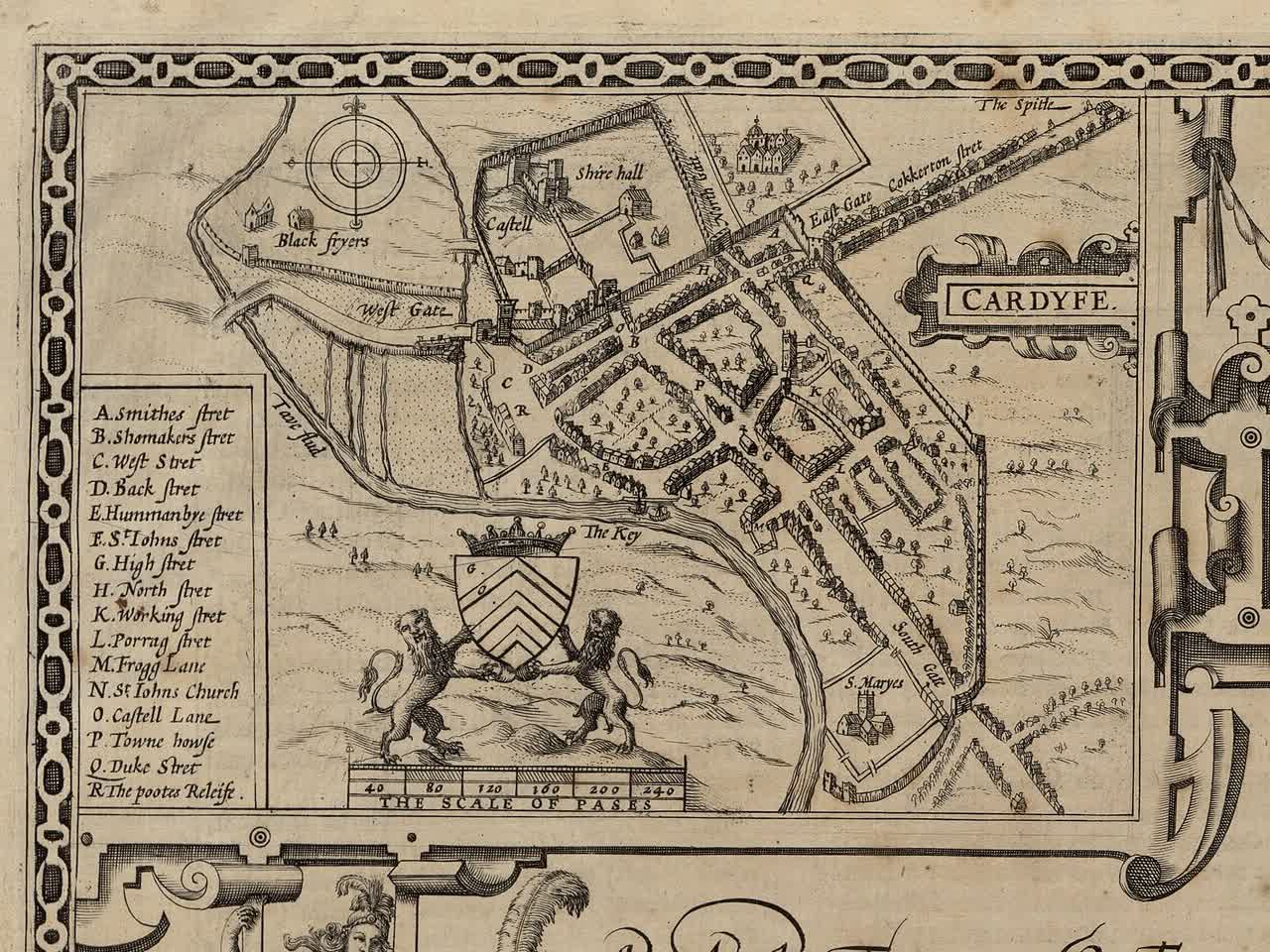
Cardiff town plan, inset from John Speed's map of Glamorganshire
Speed's bird's-eye inset of walled Cardiff: the castle and Shire Hall, West and East Gates, High Street and Working Street keyed A-R, St Mary's by the South Gate, and the quay on the Taff.
1610 · Speed, John (1552-1629). Cartographe Hondius, Jodocus I (1563-1612). Graveur · Wikimedia Commons
Public domain (plate dated 1610)


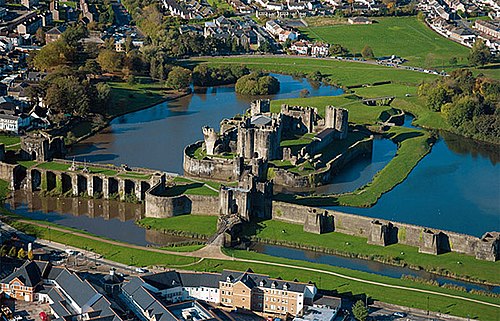
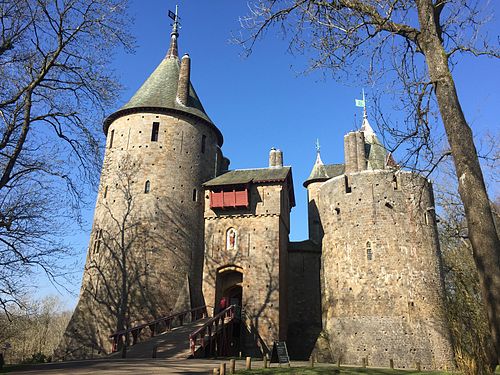
Castles of Cardiff



More cities to explore
 EnglandBristolExplore it in 1497 · 1850
 EnglandBathExplore it in AD 100 · 1500 · 1790
 WalesCaernarfonExplore it in AD 120 · 1330
 NetherlandsUtrechtExplore it in 1400 · 1700
Castles of Europe · Landmarks of Europe · create your own reconstruction.