Historic Cities · England
Bristol through the ages
Bristol is a city and ceremonial county in South West England. It is on the River Avon, and bordered by Gloucestershire to the north and Somerset to the south, with a short coastline on the Bristol Channel to the west. The county includes most of the Bristol conurbation, but the urban area extends into South Gloucestershire, Bath and North East Somerset, and North Somerset.

Bristol in 1497
Cabot's Bristol
Bristol in 1497 is a busy late‑medieval port on the tidal Avon, outward‑looking and busy with international trade as merchants ready ships for western voyages. The walk shows quays crowded with wine and dried fish, timbered high streets and market crosses, the castle and abbey precincts, and the soaring exterior of St Mary Redcliffe above the water.
The skyline is dominated by the lofty stone spire and clerestory of St Mary Redcliffe, the squat keep and curtain of Bristol Castle, and a jagged roofscape of steep timber gables and low, tile and thatch roofs. Narrow streets funnel to the raised market cross; quays and the straightened Great Ditch are lined with ships’ masts, casks and drying cod. Stone and timber mix in façades; smoke, chalky limewash and the brown of oak framing colour the town under a changeable west‑country sky.
The route: 22 streets, squares and views
Clifton Down View → Avon Approach → St Augustine's Marsh → The Great Ditch → Redcliffe Quay → St Mary Redcliffe → Redcliffe Streets → Temple Precinct → Quays of the Frome → Bristol Bridge → …
Step inside, 12 interiors
Quayside Sail Loft · Great Parish Nave · South Porch Vestibule · Shipwright's Workshop · Gatehouse Chamber · Great Hall of the Castle · Tolzey Merchant Hall · Covered Corn Market · Wine Merchant's Vault · Weavers' Upper Hall · Canons' Choir and Nave · Canonical Chapter House
Planned from the Wikipedia record: History of Bristol.
Bristol in 1850
Brunel's Bristol
Bristol in 1850 stands at a moment of industrial ambition and maritime renewal: Brunel's rail terminus and iron steamship sit alongside old quays, tobacco warehouses and Georgian terraces. This walk traces the city from the wooded rim of the Avon Gorge down through Clifton and the busy Floating Harbour to Brunel's Temple Meads and a high hilltop panorama.
The cityscape is a stitched horizon of limestone and stucco terraces on the gorge, soot-darkened brick warehouses and the gleam of newly used iron on steamships and railway structures. Narrow cobbles and quays edge the wide, placid Floating Harbour; masts and rigging stand beside low glass cones and tall bonded tobacco sheds. Smoky chimneys and gas lamps punctuate a compact skyline of church spires, unfinished suspension towers, and the broad slate roofs of industrial sheds.
The route: 23 streets, squares and views
View from Leigh Woods → Clifton Suspension Towers → Clifton Terraces → Clifton Village Triangle → Park Street → College Green and Cathedral → Queen Square → Corn Exchange and The Nails → St Nicholas Market → King Street → …
Step inside, 12 interiors
Georgian Drawing Room · Exchange under the Dome · Market Hall Arcade · Nave of St Mary Redcliffe · Ship Chandlery Shop · Sluice Engine House · Promenade Saloon · Tobacco Bond Warehouse · Warehouse Counting House · Glass Cone Furnace · Hammerbeam Train Shed · Station Master's Office
Planned from the Wikipedia record: History of Bristol.
Its story
The story of Bristol.
Brycgstow: the Bridge, the Mint and the Dublin Slave Trade
There was a Roman port here before there was a town: Abona, at what is now Sea Mills, listed in the 3rd-century Antonine Itinerary. The town itself was founded on a low hill between the Frome and the Avon at some point before the early 11th century; the main evidence is a coin of Aethelred struck here around 1010, which shows a market town with a mint already working. The name Brycg stowe means "place by the bridge", and the local habit of adding an L to the end of words is thought to have turned it into Bristol. The Anglo-Saxon Chronicle has Harold Godwinson taking ship to Brycgstow in 1052 and drawing ships from the town in 1062 to move against Gruffydd ap Llywelyn.
Brycgstow was also a major centre of the Anglo-Saxon slave trade. Men, women and children taken in Wales or in northern England were traded through Bristol to Dublin, and from there the Viking rulers of Dublin sold them on across the known world. Wulfstan, the Saxon bishop of Worcester, whose diocese included Bristol, preached against the trade regularly, and it was eventually forbidden by the crown, though it carried on in secret for many years.
The Castle Earls, the Irish Connection and the Jewish Community, 1066-1290
After the Norman conquest a motte-and-bailey was raised on the site of the present Castle Park, and Bristol was held by Geoffrey de Montbray, Bishop of Coutances, who used the town as his headquarters in the rebellion against William Rufus. The castle passed with the Honour of Gloucester to Robert Fitzhamon and then to Robert of Caen, first Earl of Gloucester, who backed his half-sister Matilda after Henry I died in 1135. Stephen of Blois abandoned an attempt to besiege Bristol in 1138 because the castle appeared impregnable, and was imprisoned there after his capture in 1141.
Robert Fitzharding, a wealthy Bristolian who had backed Matilda through the war and was later made Lord of Berkeley, founded St Augustine's Abbey in 1140. Bristol's dealings with Ireland ran deep from the start: Diarmait Mac Murchada, the deposed king of Leinster, was exiled here, Bristol merchants helped fund Richard de Clare and the Norman invasion that followed, and in 1172 Henry II gave Bristolians the right to live in and trade from Dublin.
The medieval Jewish community here was one of the smaller ones in England. Its members were accused in a blood libel in 1183, of which little detail survives. An archa was established late in the 12th century, without which Jews could not legally conduct business. In 1210 every Jewish householder in England was imprisoned in Bristol and a levy imposed on them, recorded as 60,000 or 66,000 marks. During the Second Barons' War the city's archa was burned and the community violently attacked; a further attack in 1275 caused no fatalities. The community was expelled in 1290 with the rest of England's Jews. A surviving ritual bath, now called Jacob's Well, was first read as a mikveh and later reinterpreted as a Bet Tohorah serving the Jewish cemetery at Jews Acre.
Wool Out, Wine In: the County of Bristol, 1247-1509
By the 13th century Bristol was a busy port, with a stone bridge across the Avon built around 1247. Woollen cloth became the main export through the 14th and 15th centuries and wine from Gascony and Bordeaux the principal import, alongside a heavy trade with the Anglo-Irish ports of Waterford and Cork and with Portugal; from about 1420 to 1480 the port also took stockfish, a freeze-dried cod, from Iceland. In 1373 Redcliffe and Bedminster were taken into the town and Edward III proclaimed it separate from Gloucestershire and Somerset, "a county by itself, to be called the county of Bristol in perpetuity" - the first town in England given that status.
By the mid-14th century Bristol is reckoned to have been England's third-largest town after London and York, with perhaps 15,000 to 20,000 people on the eve of the Black Death of 1348-49. Between a third and a half of them died, and the population stayed between 10,000 and 12,000 for most of the 15th and 16th centuries. William Canynge, born around 1399, was five times mayor and twice the town's MP, and spent much of his fortune rebuilding St Mary Redcliffe after lightning damaged it in 1446.
Henry VII sponsored the Venetian John Cabot's voyage from Bristol in 1497, which made landfall in North America, and Cabot came back speaking of the quantities of cod off the new land. He sailed again with five ships in 1498 and is generally believed not to have returned. William Weston led an expedition to the 'New found land' in 1499, the first commanded by an Englishman, but the city's merchants seem to have lost interest after 1509, having spent heavily for little profit.
Cathedral, Smuggling and the Siege of 1645
The Dissolution took Bristol's friaries, monastic hospitals and priories, and in 1541 the civic leaders bought up former church lands for a thousand pounds; there is no record of Bristolians objecting to the royal seizures. In 1542 the former Abbey of St Augustine became Bristol Cathedral, a new diocese was founded and Bristol was made a city. Trade grew on wine, olive oil, iron and dyes inward and cloth, lead and hides outward, and many of the leading merchants smuggled; that illicit trade grew enormously after 1558 and became integral to the city's economy.
The corporation bought the castle in 1630. When the First Civil War broke out in 1642 the city took the Parliamentary side and partly restored its fortifications, but Royalist troops under Prince Rupert captured Bristol on 26 July 1643, doing extensive damage to town and castle and taking eight armed merchant vessels that became the nucleus of the Royalist fleet; the city's workshops were turned over to making muskets. After the New Model Army beat the Royalists at Langport in the summer of 1645, Sir Thomas Fairfax marched on Bristol, besieged it for three weeks and then attacked, and Rupert surrendered on 10 September. In 1656 Cromwell ordered the castle destroyed.
Newfoundland Cod, the Triangular Trade and Its Opponents
Bristol fishermen had worked the Grand Banks of Newfoundland since the 16th century and began settling there permanently in larger numbers in the 17th, founding colonies at Bristol's Hope and Cuper's Cove. The rise of England's American colonies made the city's western position an advantage, and by the middle of the 18th century Bristol was one of the two leading outports in England. Much of that growth rested on the trade in enslaved Africans. In 1755 the city held 237 slave traders against London's 147, and it had been a major supplier of enslaved people to South Carolina before 1750. Between the late 17th century and abolition in 1807 more than 2,000 slaving voyages were made by Bristol ships, carrying an estimated half a million people from Africa to the Americas in brutal conditions; average profits ran at seventy per cent a voyage, and more than fifteen per cent of those transported died or were murdered on the Middle Passage. Some enslaved people were brought to the city itself from the Caribbean, among them Scipio Africanus, buried at Henbury, and Pero Jones, brought here by the slave trader and plantation owner John Pinney.
The trade reshaped the Avon valley: demand for cheap brassware to exchange in Africa produced a boom in copper and brass manufacture between Conham and Keynsham, with glass, soap, sugar, paper and chemical industries growing alongside. Opposition grew too. John Wesley founded the first Methodist chapel, the New Room in Broadmead, in 1739 and published Thoughts Upon Slavery in 1774; the Society of Friends began lobbying in Bristol in 1783. Thomas Clarkson came to study the trade and, through sailors he met at the Seven Stars, learned how slaver captains and mates "plied and stupefied seamen with drink" to sign them up, and Hannah More published "Slavery, A Poem" in 1788. Edmund Burke, elected Whig MP for Bristol in 1774, lost the seat in 1780 after his detestation of the slave trade angered his merchant sponsors. The city's leading families remained strongly anti-abolitionist.
Brunel, the Riots and the Slipping of the Port, 1764-1876
Bristol Bridge, the only crossing that avoided a ferry, was rebuilt between 1764 and 1768, with a toll charged to pay for it. When the toll was extended in 1793 the Bristol Bridge Riot followed: eleven people were killed and forty-five injured, among the deadliest riots of the century. In 1831 the Lords' rejection of the second Reform Bill brought worse, when Sir Charles Wetherell, a magistrate who strongly opposed the Bill, came to open the new Assize Courts and was chased by a crowd to the Mansion House in Queen Square. The Act passed in 1832, and the city's boundaries were widened for the first time since 1373.
The port was losing ground. Competition from Liverpool from about 1760, war with France from 1793 and abolition in 1807 left Bristol behind the newer manufacturing centres of the north and the Midlands; cotton never took hold, and sugar, brass and glass declined. The long tidal passage up the Avon Gorge, which had made the port secure in the Middle Ages, was now a liability, and the Floating Harbour built to William Jessop's design between 1804 and 1809 did not overcome it; by 1867 the meanders of the Avon kept out any vessel over 300 feet, and the port facilities migrated downstream to Avonmouth. Even so the population quintupled across the century, reaching 140,158 by 1841, and tobacco importing and cigarette manufacture flourished under W. D. & H. O. Wills.
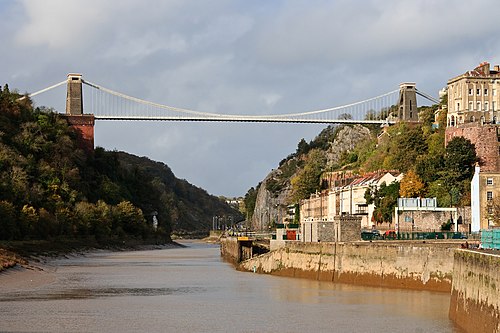
Isambard Kingdom Brunel designed the Great Western Railway from Bristol to London, the Bristol-built steamships SS Great Western and SS Great Britain, and the Clifton Suspension Bridge. Mary Carpenter founded ragged schools and reformatories, and University College, forerunner of the University of Bristol, was founded in 1876.
Aeroplanes, the Blitz and the Bus Boycott, 1910-2020
In 1910 Sir George White, the owner of Bristol Tramways, founded the British and Colonial Aeroplane Company, later the Bristol Aeroplane Company, which built the Bristol Scout and the F.2 Fighter in the First World War and whose engine department passed to Rolls-Royce in 1966. Shipbuilding in the city docks, chiefly by Charles Hill & Sons, mattered until the 1970s. The council built more than 15,000 houses between 1919 and 1939, clearing some of the worst central slums onto new estates at Southmead, Knowle, Sea Mills and Horfield.
As a centre of aircraft manufacture and a major port, Bristol was a target for the Luftwaffe. The city centre was severely damaged, above all in November and December 1940 when the Broadmead area was flattened. About 1,300 people living or working in the city were killed and nearly 100,000 buildings were damaged, at least 3,000 beyond repair. The original central shopping area near the bridge and castle is now a park with two bombed-out churches and fragments of the castle in it.
The British Concorde prototype made its maiden flight from Filton on 9 April 1969. Postwar immigration from Commonwealth countries brought racist tension with it. In 1963 the Bristol Omnibus Company operated a colour bar, refusing to employ Black or Asian bus crews; the Bristol Bus Boycott successfully challenged it and is considered to have been instrumental in the passing of race relations legislation. In 1980 a police raid on a cafe in St Paul's set off the St Pauls riot, a protest against racism and police harassment that showed the alienation of the city's Afro-Caribbean residents. The docks moved seven miles downstream to Avonmouth and the deep-water Royal Portbury Dock, and in the late 20th century the emptied harbourside was redeveloped rather than left derelict. On 7 June 2020 protestors pulled the statue of Edward Colston from its plinth and pushed it into the harbour; it was recovered on 11 June and became a museum exhibit, after more than a decade of argument over its plaque, which commemorated Colston's philanthropy in the city and said nothing of his part in the Royal African Company and the Bristol slave trade.
From the archive
Bristol on paper: the old town as it was mapped.
A period plan or bird's-eye view of the old town, drawn between 1500 and 1850, the streets this page's reconstructions walk. Public domain, with its source named.
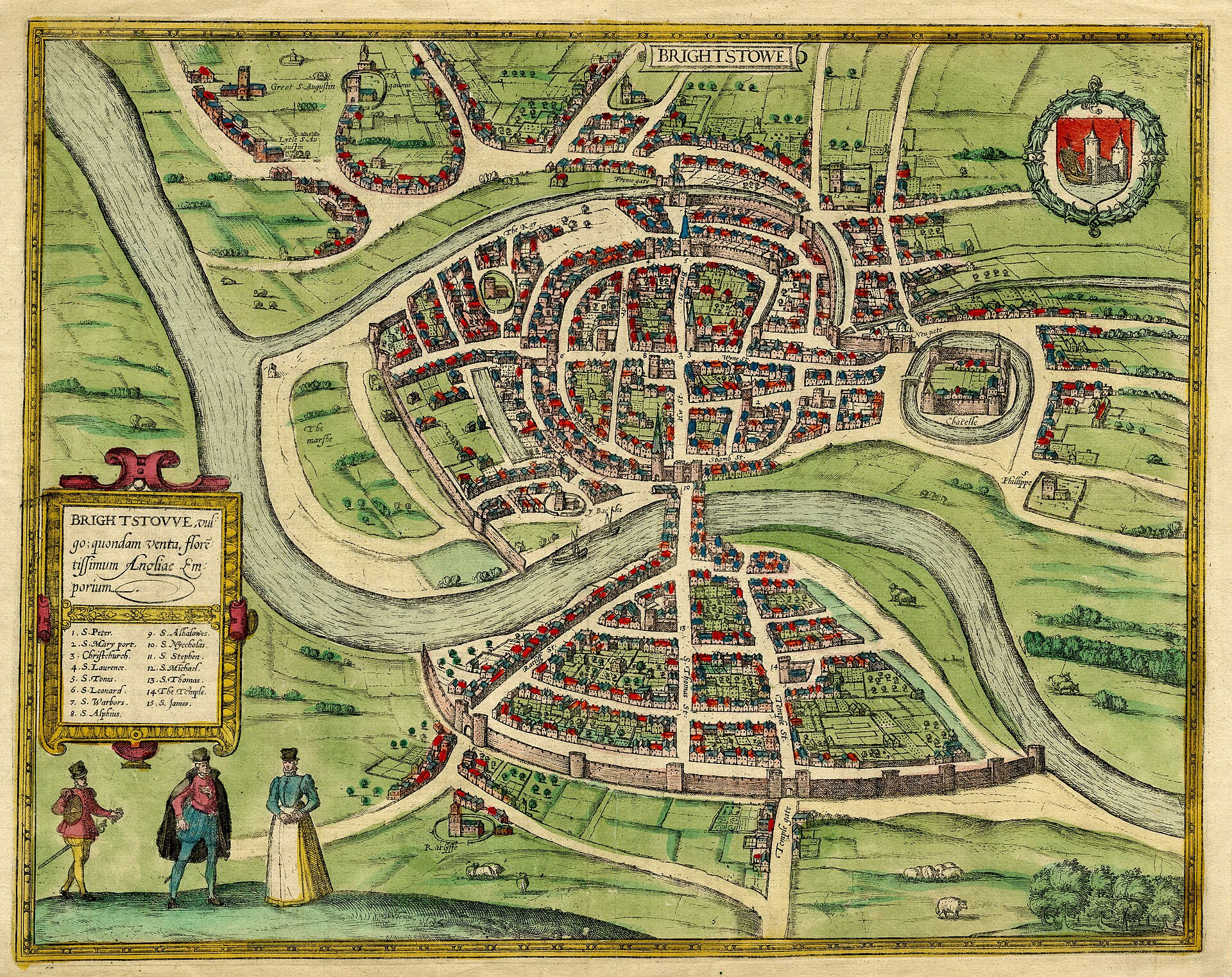
Bird's-eye view of Brightstowe (Bristol), from Braun & Hogenberg's Civitates Orbis Terrarum
Shows town walls and gates, the River Avon with split channels and bridges, the street plan, a castle on an island and several named churches.
1574 · Published by: Georg Braun Published by: Frans Hogenberg · Wikimedia Commons
Public domain (plate dated 1574)
In this city
Landmarks of Bristol, see each in its prime

Ships tied to Bristol
- RMS Mauretania: Her first-class lounge panelling lines a Bristol bar that carries her name
- SS Great Britain: Floated out at Bristol in 1843 and back in her original Bristol dry dock today
Castles of Bristol

More cities to explore
 EnglandBathExplore it in AD 100 · 1500 · 1790
 WalesCardiffExplore it in 1300 · 1910
 EnglandLondonExplore it in AD 200 · 1390 · 1600 · 1885
 EnglandYorkExplore it in AD 300 · AD 950 · 1420 · 1800
Castles of Europe · Landmarks of Europe · create your own reconstruction.