Historic Cities · England
London through the ages
London is the capital and largest city of England and the United Kingdom, with a population of 9.1 million people in 2024. Its wider metropolitan area is the largest in Western Europe, with a population of 15.4 million.

London in AD 200
Roman Londinium
This is Roman Londinium around the time the city was circled by its new stone wall and reached the height of its public programme. The walk moves from the river and bridge into the forum and basilica, past the amphitheatre and military works at Cripplegate, along timber quays and markets, and finishes on the western hill above the city.
A compact riverside port of timber houses, wooden quays and packed warehouses, ringed by a newly raised stone city wall. Dominant in the low skyline are the broad colonnades and tiled roofs of the forum and basilica, the squat earth-and-stone form of the amphitheatre and scattered bathhouse roofs. Streets mostly run in a Roman grid of paved mainways and narrower lanes; colours are red clay tiles, pale lime plaster, dark timber and the green-brown Thames.
The route: 22 streets, squares and views
Southwark Shore → Roman Bridge → Bridgehead Market → Timber Quays → Ludgate Waterfront → Forum and Basilica → Forum Square → Basilica Portico → Walbrook Stream Mouth → Amphitheatre (Guildhall) → …
Step inside, 14 interiors
Bridge Stall Shop · Riverside Timber Warehouse · Shipwright's Assembly Shed · Basilica Aisled Hall · Forum Curia Chamber · Amphitheatre Central Arena · Cripplegate Granary Store · Fort Commandant's Office · Governor's Audience Hall · Eastern Quays Warehouse · Mosaic Dining Room · Calidarium Hot Room · Frigidarium Cold Pool · Merchant's Atrium
Planned from the Wikipedia record: Londinium.
London in 1390
Chaucer's medieval London
This is late fourteenth‑century London after the Black Death, a dense trading hub within medieval walls where Old St Paul's spire and the Tower of London dominate the skyline. The walk moves from the river approaches, across London Bridge crowded with houses and a chapel, through the markets of Cheapside and the city's wards, and ends high above the city on the cathedral's spire.
The skyline is a ragged comb of church spires and timber gables: stone towers of the Tower and cathedral, and the tall timber-and-lead spire of Old St Paul's. Streets within the city walls are narrow and shaded between jettied timber houses, market stalls and guildhalls; the Thames is lined with quays and small wharves. London Bridge is a continuous street of houses and shops projecting over the river on massive stone piers; goods, horses and barges crowd the banks.
The route: 23 streets, squares and views
Southwark River Approach → Borough Market and Bankside → London Bridge Houses and Chapel → Bridgehead by St Magnus → Queenhithe Quay → Billingsgate Fishmarket → Baynard's Castle Shore → Tower Hill and the Tower → Lower Thames Street Quays → Aldgate and City Wall → …
Step inside, 15 interiors
Tabard Inn Common Room · Chapel of St Thomas · St Magnus Parish Church · Queenhithe Custom-house · Billingsgate Fish Hall · St John's Chapel · Aldgate Gate Guardroom · Lombard Counting-house · Mercers' Hall · Guildhall Great Hall · Cheapside Tavern Room · Paternoster Scribes' Workshop · Cathedral Nave · Choir and High Altar · Westminster Hall Great Hall
Planned from the Wikipedia record: Norman and medieval London.
London in 1600
Shakespeare's London
London in 1600 is an overflowing, timber‑framed world at the height of Elizabethan energy: theatres and bear‑gardens crowd Bankside, the Thames carries a flotilla of wherries, and the City of London bristles with jettied houses and narrow markets. This walk moves from the rivered approach through Southwark and across Old London Bridge into the maze of streets, markets and quays that centre on St Paul's and the Tower.
The skyline is a jagged stitch of church towers, chimneys and gabled timber houses; many streets are flanked by overhanging jettied upper floors and dark oak beams, plaster panels whitewashed between timbers. St Paul's shows its great lead roof but no lofty spire, and London Bridge stands lined with houses and the Dutch prefabricated Nonsuch House. The Thames is busy with small wherries and lined with specialised quays and low wooden wharfs under a variable English light.
The route: 22 streets, squares and views
Lambeth Marshes View → The Globe → Bear Garden, Bankside → The Rose Theatre → Borough High Street → The Clink Prison → Southwark Stairs → London Bridge → Eastcheap → Billingsgate Wharf → …
Step inside, 14 interiors
Main Stage and Tiring-House · Tavern Common Room · Bear Garden Gallery · Rose Stage and Galleries · Butchers' Shambles · Chapel and Wardrobe · Wharfside Counting House · Nonsuch House Chamber · Fish Market Hall · Royal Armoury · Menagerie Court · St Paul's Nave · Stationers' Workshop · Middle Temple Hall
Planned from the Wikipedia record: Tudor London.
London in 1885
Victorian London
London in 1885 is the vast, teeming capital of the British Empire, swollen by railways, steamers and a skyline of church spires and factory chimneys. This walk traces river quays and Parliament, markets and courts, museums and train-sheds beneath gaslight and ubiquitous coal smoke.
A low, chimneyed horizon topped by the dome of St Paul’s and the pinnacles of the Gothic Palace of Westminster, the Thames crowded with masts and steamers. Streets of red-brown brick and soot-dark stone, iron-and-glass train sheds, and white Portland-stone civic façades are lit by rows of gas lamps that dim in the frequent fog. Hansom cabs and omnibuses move through pavements heaped with market-stalls, dock cranes and the occasional green of parks.
The route: 24 streets, squares and views
Greenwich Park → London Bridge → Borough High Street → Southwark Cathedral → Borough Market → Tower of London → St Katharine Docks → Tower Hill → Leadenhall Market → Bank of England → …
Step inside, 12 interiors
Medieval Nave · Butchers' Shed · White Tower Great Hall · Riverside Warehouse · Central Arcade · Bullion Office · Whispering Gallery · Covered Market Hall · Nave and Quire · House of Commons Chamber · Central Hall · Great Train Shed
Planned from the Wikipedia record: 19th-century London.
Its story
The story of London.
Londinium and Lundenwic: the Bridging Point, AD 47–1066
The Romans established Londinium as a civilian town about four years after the invasion of AD 43, at the point where the Thames was narrow enough to bridge. Around AD 60 the Iceni under their queen Boudica destroyed it; rebuilt as a planned town, it held around 60,000 people at its height in the second century, drawn from Britannia, continental Europe, the Middle East and North Africa. Whether it ever served as capital of the province is disputed. The landward wall went up between 180 and 225, and a riverside wall from about 255 after repeated raids by Saxon pirates; that line still roughly defines the City of London. Roman rule in Britain ended in 410 and the walled city was practically abandoned by the close of the century.
From about the sixth century Anglo-Saxon settlers built outside the old walls along what is now the Strand: Lundenwic, the -wic suffix denoting a trading place, laid out on a grid and housing perhaps 10,000 to 12,000 people. London received its first post-Roman bishop, Mellitus, after King Sæberht of the East Saxons converted in 604, and seems to have come under direct Mercian control in the 730s. Vikings sacked it in 842 and 851 and the Danish Great Heathen Army wintered there in 871; it stayed in Danish hands until 886, when Alfred the Great's forces took it and settlement moved back inside the Roman walls for defence. The city twice broke Cnut's sieges in 1016 and passed to him only after his victory at Assandun. Edward the Confessor founded Westminster Abbey and spent much of his time upstream at Westminster, which from then steadily supplanted the City as the seat of government.
Norman Fortresses, the Guilds and the Expulsion of 1290
London submitted to William at Berkhamsted after Hastings, and the new regime planted fortresses inside the walls to hold it, above all the Tower of London, where timber work was rapidly replaced by the first stone castle in England. William granted a charter in 1067 confirming the city's existing rights and laws, and its self-government was consolidated by the election rights King John granted in 1199 and 1215. Trade was organised into craft guilds, which effectively controlled the city and elected the Lord Mayor, and the population grew to somewhere between 80,000 and nearly 100,000 by 1300; the Black Death then took near a third of it by one account and at least half by another. In 1381 rebels led by Wat Tyler stormed the Tower during the Peasants' Revolt and executed the Lord Chancellor, Archbishop Simon Sudbury, along with the Lord Treasurer, before Tyler was stabbed to death by the Lord Mayor, William Walworth, at Smithfield.
The first Jews arrived in about 1070 and London became a centre of England's Jewish population. In 1190 there was violence against them after a rumour that the new king had ordered their massacre, following their appearance at his coronation. In 1224, after an accusation of ritual murder, the community was subjected to a steep punitive levy; in 1232 Henry III confiscated its principal synagogue, claiming the chanting was audible in a neighbouring church. In 1264, during the Second Barons' War, Simon de Montfort's rebels occupied London and killed 500 Jews while attempting to seize records of debts. In 1290 the Edict of Expulsion issued by Edward I forced the community out of England altogether. They left for France, Holland and farther afield; their property was seized, and many suffered robbery and murder as they departed.
The Steelyard, the Chartered Companies and the Civil War, 1475–1647
In 1475 the Hanseatic League set up its main English trading base, the Steelyard, in London, which it held until 1853. Woollen cloth went out from fourteenth- and fifteenth-century London undyed and undressed to the Low Countries. The city was the principal early centre of Protestantism in England. Before the Reformation more than half its area belonged to religious houses, and Henry VIII's dissolution, which had abolished most of the larger monastic houses by 1538, put nearly all of that property into other hands.
Trade widened to Russia, the Levant and the Americas, and monopoly companies were chartered in London, the Muscovy Company in 1555 and the East India Company in 1600, which came in the end to rule India. The population rose from an estimated 50,000 in 1530 to about 225,000 in 1605, fed by migrants from England and Wales and from abroad, among them Huguenots from France. Newcomers were not welcome: xenophobia grew after the 1580s, with routine threats of violence, attempts to expel foreigners and great difficulty in acquiring English citizenship, and many left permanently for the more hospitable Dutch cities. London took Parliament's side in the Civil War and ringed itself with an earthen rampart enclosing Westminster and Southwark as well as the City; the Royalists never seriously threatened it again, and its money made an important contribution to the Parliamentarian victory. The fortifications failed their only test when the New Model Army entered the city in 1647.
Plague, Fire and the Entrepôt, 1665–1700
The outbreak of 1665–1666 is the one remembered as the Great Plague. It killed a fifth of the population, though accounts of the toll differ, around 60,000 by one, some 100,000 by another. Samuel Pepys, who chronicled the epidemic in his diary, recorded above 7,400 dead in a single week.
The Great Fire broke out at one o'clock on the morning of Sunday 2 September 1666 at a bakery in Pudding Lane. It destroyed about 60 per cent of the city, including Old St Paul's Cathedral, 87 parish churches, 44 livery company halls and the Royal Exchange, though the loss of life is believed to have been 16 at most. Rebuilding plans from Christopher Wren, John Evelyn and Robert Hooke came to nothing and the city went back up on the old street plan, most of which survives, in brick as required by the Rebuilding of London Act 1666; Wren rebuilt the ruined parish churches and St Paul's.
Aristocratic residents who did not return took houses in the West End near the court, completing the separation between the mercantile City and the world of Westminster. East of the walls the docks extended downstream and drew dock and processing workers into Whitechapel, Wapping, Stepney and Limehouse, generally in slum conditions. The revocation of the Edict of Nantes in 1685 brought a large Huguenot migration, and they established a silk industry at Spitalfields. In 1700 London handled 80 per cent of England's imports, 69 per cent of its exports and 86 per cent of its re-exports: silk, sugar, tea and tobacco from the Americas and Asia. The city was never primarily industrial, but a trading and redistribution centre working through England's merchant navy.
Capital of Empire: Railways, Sewers and Slums, 1700–1900
Georgian London spread beyond its old limits at an accelerating pace, with districts such as Mayfair built for the rich in the West End and the Port of London expanding downstream. The population grew from 1 million in 1800 to 6.7 million a century later, and London was the world's largest city from about 1831 to 1925. The railways remade it, from the London Bridge to Greenwich line of 1836 to the great termini and the first Underground lines by 1863, letting the middle class and the wealthy commute in from neighbouring counties and leaving the inner districts to the poor. Cholera claimed 14,000 lives in 1848 and 6,000 in 1866, and raw sewage went straight into the Thames until the Great Stink of 1858 forced consent for Joseph Bazalgette's sewers, more than 2,100 kilometres of tunnels and pipes, after which the death toll dropped sharply.
As the capital of the empire, London drew migrants from the colonies and from poorer parts of Europe. A large Irish population settled during the Victorian period, many of them refugees from the Great Famine of 1845–1849; at one point Catholic Irish made up about 20 per cent of London's population, typically living in overcrowded slums. The city also became home to a sizeable Jewish community, noted for its enterprise in the clothing trade and in merchandising. In 1888 the County of London was created under the London County Council, the first elected London-wide administrative body.
Zeppelins, the Blitz and the Postwar City, 1914–2000
German zeppelin airships brought London its first bombing raids in the First World War, killing around 700 people. Between the wars the built-up area grew faster than at any time before or since, spilling out of the County of London into the neighbouring counties. Unemployment in the Depression was severe, and in the East End both the Communist Party of Great Britain and the British Union of Fascists gained serious support, with clashes between them culminating in the Battle of Cable Street in 1936. Large numbers of Jewish immigrants fleeing Nazi Germany settled in London during the 1930s, mostly in the East End. The population reached a peak of 8.6 million in 1939.
The heaviest bombing came in the Blitz, between 7 September 1940 and 10 May 1941, when London was subjected to 71 separate raids and more than 18,000 tonnes of high explosive. One raid in December 1940, known as the Second Great Fire of London, sent a firestorm through much of the City, though St Paul's Cathedral came through unscathed. V-1 flying bombs and V-2 rockets fired from occupied Europe followed in 1944 and 1945, stopping only when Allied forces captured the launch sites. Just under 30,000 Londoners had been killed by the bombing by the war's end and over 50,000 seriously injured, with tens of thousands of buildings destroyed and Docklands the worst hit part of the city.
The Great Smog of 1952 lasted five days and killed between 10,000 and 12,000 people by modern estimates, against a government figure at the time of 4,000; the Clean Air Act 1956 followed and was effective. From the 1950s immigration increased, largely from Commonwealth countries including Jamaica, India, Bangladesh and Pakistan, and integration was not always easy, racial tension surfaced in events such as the Brixton riots of 10 to 12 April 1981. From the early 1970s to the mid-1990s the Provisional IRA attacked the city repeatedly. The port failed because the old docks could not take modern container ships: the principal ports moved downstream to Felixstowe and Tilbury, and the derelict Docklands was redeveloped into flats and offices from the mid-1980s. Greater London and 32 boroughs replaced the old county in 1965 under the Greater London Council, abolished in 1986; London-wide government returned with the Greater London Authority in 2000.
Olympics, Bombings and a City of Nine Million, 2005–2024
On 6 July 2005 London won the right to host the 2012 Olympics and Paralympics; the following day three bombs went off on Underground trains and a fourth on a double-decker bus near King's Cross, killing more than 50 people and injuring 750. Rioting that began in several London boroughs in August 2011 spread to towns across England. In 2011 the population passed 8 million for the first time in decades, and White British formed less than half of it for the first time. London was the only region in England where Remain took the highest share of the vote in the 2016 referendum on European Union membership. By 9 May 2023 it had received around 18,000 refugees from Ukraine. The population stood at 9.1 million in 2024, and Greater London is run by 33 local authorities and the Greater London Authority, while the City of London (the Roman foundation, still within its medieval boundaries) remains the primary financial district.
From the archive
London on paper: the old town as it was mapped.
A period plan or bird's-eye view of the old town, drawn between 1500 and 1850, the streets this page's reconstructions walk. Public domain, with its source named.
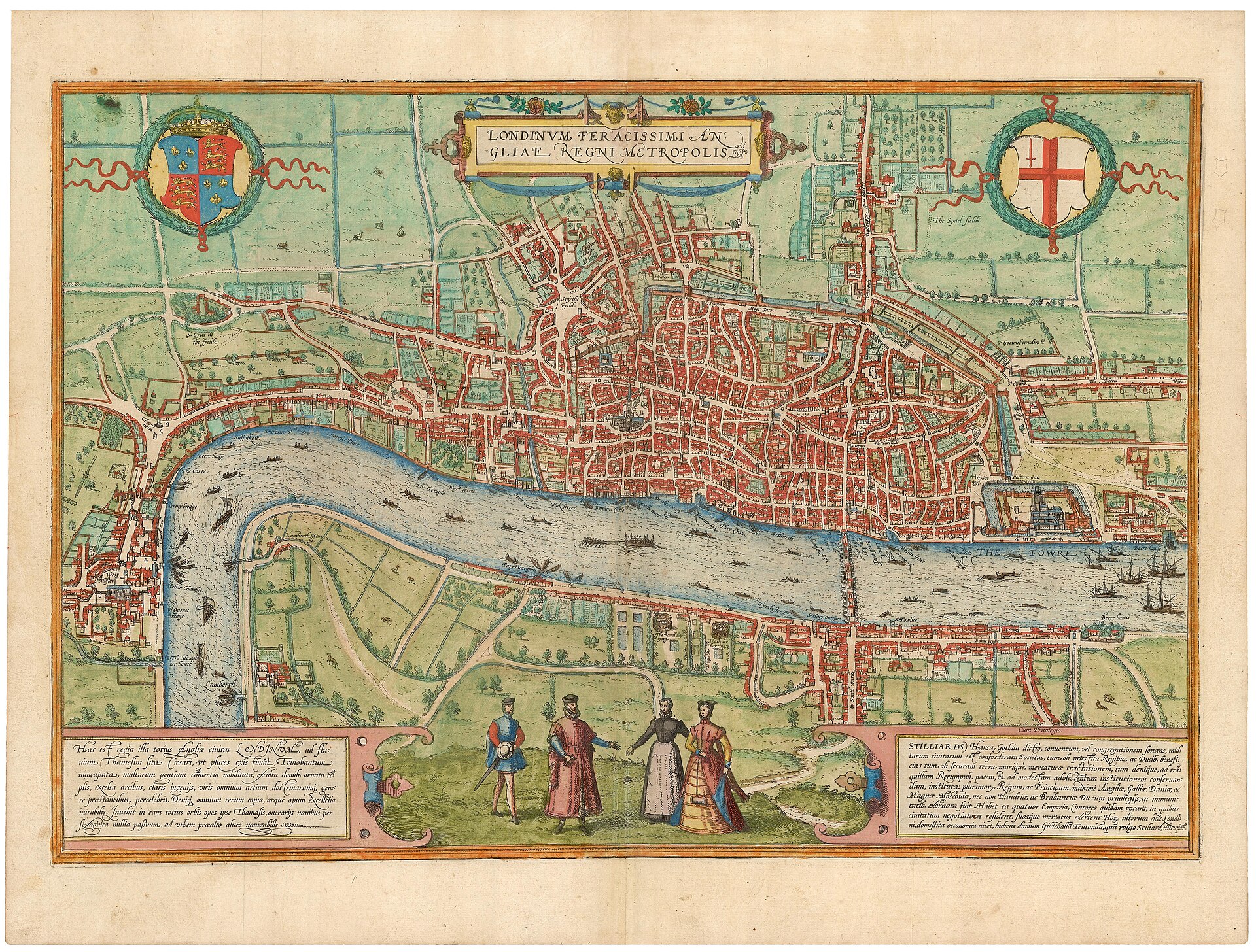
Town plan of London (Londinum feracissimi Angliae regni metropolis), from Braun & Hogenberg's Civitates Orbis Terrarum
Shows the River Thames with London Bridge and the Tower, dense medieval street blocks, city gates and numerous church spires.
1574 · Georg Braun & Frans Hogenberg · Wikimedia Commons
Public domain (plate dated 1574)
In this city
Landmarks of London, see each in its prime


Ships tied to London
- Cutty Sark: Sailed the London-China tea run from 1870, docking here with each season's cargo
- HMS Beagle: First rigged man-of-war afloat above the old London Bridge, at George IV's coronation
- HMS Belfast: Has hosted the City of London Sea Cadets since 1973; 204,656 visitors in 2025
- HMS Challenger: Her expedition report was published in London between 1880 and 1895
- RMS Mauretania: Her bell sits at Lloyd's Register in London, wreathed each Remembrance Day
- RRS Discovery: Ran annually from London to Hudson Bay 1905-11, and left London for BANZARE in 1929
Castles of London


More cities to explore
 EnglandCambridgeExplore it in 1450 · 1660 · 1890
 EnglandOxfordExplore it in 1400 · 1670 · 1890
 EnglandYorkExplore it in AD 300 · AD 950 · 1420 · 1800
 EnglandBathExplore it in AD 100 · 1500 · 1790
Castles of Europe · Landmarks of Europe · create your own reconstruction.