
England · Restored
Tower of London
The Tower of London is a historic Norman-origin citadel on the north bank of the River Thames in London. It is a complex of several buildings, dominated by the White Tower keep, set within two concentric rings of curtain walls, towers and a defended river wharf. The site has served varied functions including royal residence, armoury, prison and treasury and its general medieval layout was completed under Edward I.
First raised
1066
Its prime
1285
Today
Restored
Ranked among Europe’s castles
As it stood in 1285
What Tower of London looked like in its prime.
A massive square keep (the White Tower) of pale Kentish ragstone stands at the core, with projecting square corner towers, a round stair-turret to the north-east and a semi-circular apse to the south-east for the chapel. The keep rises above two concentric curtain walls with crenellated battlements and multiple flanking towers. The castle sits directly beside the Thames with a stone wharf and water-gate, the whole complex appearing complete and regularly coursed in medieval masonry.
Its story
The story of Tower of London.
Overawing the Londoners, 1066-1101
Victorious at Hastings on 14 October 1066, William the Conqueror took a circuitous route towards London, ravaging Southwark when he found the fortified bridge held by Saxon troops; with its supply lines cut, the isolated city yielded in December without a fight. An advance party went ahead to found a castle, raised, in the words of William of Poitiers, "against the restlessness of the huge and brutal populace. For he realised that it was of the first importance to overawe the Londoners." The work went up against the south-east corner of the Roman town walls, used as prefabricated defences, with the Thames covering the south; the first phase was a ditch and a timber palisade.
Construction of the White Tower is usually considered to have begun in 1078, though the exact date is uncertain: William made Gundulf, Bishop of Rochester, responsible for it, and it may not have been finished until after the king's death in 1087. It is among the earliest stone keeps in England, and probably complete by 1100, when Bishop Ranulf Flambard, loathed by the English for exacting harsh taxes, was imprisoned in it. He is the first recorded prisoner held at the Tower and also the first to escape it: on 2 February 1101 he hosted a banquet for his captors, plied them with drink, and lowered himself on a rope smuggled in a butt of wine. One contemporary chronicler accused him of witchcraft.
Mandeville's Bargain and the First Siege, 1135-1216
When Henry I died in 1135 leaving a disputed succession, Stephen of Blois crossed from France within days, and the speed with which he secured London marks what the city and its castle were worth. The Tower's Constable, Geoffrey de Mandeville, treated the castle as a commodity: after Stephen was captured at the Battle of Lincoln in 1141 he sold his allegiance to the Empress Matilda, and when her support waned he sold it back the following year, becoming through the constableship "the richest and most powerful man in England". Caught in secret talks with Matilda again, he was arrested and made to cede his castles; the post, hereditary until then, went thereafter to a royal appointee.
With Richard I on crusade, his Lord Chancellor William Longchamp held the constableship himself and strengthened his main fortress while Richard's brother John manoeuvred to seize power. The Pipe rolls record £2,881 1s 10d spent at the Tower between 3 December 1189 and 11 November 1190, and Roger of Howden wrote that Longchamp dug a moat around the castle and tried in vain to fill it from the Thames. The works were tested in October 1191, when the Tower was besieged for the first time in its history: Longchamp capitulated to John after three days, judging he had more to gain from surrender. In 1214 Robert Fitzwalter led an army into London and besieged it again; under-garrisoned, it held, and the siege lifted only when John signed Magna Carta. When the king reneged and the First Barons' War broke out, the garrison itself joined the barons.
Henry III's Ditch and Edward I's Third Ring, 1216-1290
Henry III wanted the Tower formidable and comfortable at once: nearly £10,000 went into it between 1216 and 1227, more than any English castle of the period but Windsor. Londoners had long despised the place, and celebrated when his new gatehouse collapsed in 1240. Surrendering the castle was among the reforms Simon de Montfort's barons extracted in 1258; Henry sought papal leave to break his oath and installed himself there with mercenaries in 1261, and the truce that followed obliged him to hand it back. In April 1267, with custody granted to Cardinal Ottobuon, Gilbert de Clare, 6th Earl of Hertford, marched on London declaring the Tower "not a post to be trusted in the hands of a foreigner, much less of an ecclesiastic", and with a large army and siege engines still could not take it.
Edward I spent £21,000 between 1275 and 1285, more than double what his father had put into the place. He filled in Henry's moat, ran a new curtain wall along its line to form a third ward wrapping the whole castle, and dug a new moat 50 metres wide beyond it. On ground reclaimed from the Thames he built St Thomas's Tower between 1275 and 1279, later known as Traitors' Gate, its dock covered with arrowslits in case of attack from the river. The layout has remained essentially as he left it in 1285. Jewish Londoners had used the Tower as a retreat from anti-Jewish violence; in 1278 six hundred Jews were imprisoned in it on charges of coin clipping, twelve years before Edward's Edict of Expulsion forced the Jewish population out of the country.
The Royal Menagerie: Leopards, a Polar Bear and an Elephant, 1235–2008
Wild animals were kept at the Tower from King John's reign (the records of 1210-12 carry payments to lion keepers), and the menagerie is named again and again under Henry III. The Holy Roman Emperor Frederick II sent him three leopards about 1235. In 1252 the sheriffs were ordered to find fourpence a day towards the keep of a polar bear, a gift that year from Haakon IV of Norway, which drew crowds when it fished in the Thames on the end of a chain. In 1254 or 1255 Louis IX of France sent an African elephant, housed in a wooden building forty feet by twenty and drawn by Matthew Paris in his Chronica Majora; it died in 1258, perhaps from being given red wine, perhaps from the English cold. Edward I added a lion and a lynx in 1288 and appointed the first official Keeper, and the semi-circular barbican he had built in 1277 came in time to be called the Lion Tower. In 1436 every lion died and the Keeper, William Kerby, lost his place.
The collection outlasted the fortress's usefulness. The menagerie was refurbished between 1604 and 1606 with an exercise yard in the moat beside the Lion Tower and an overhead platform from which the royal party could watch lion baiting; six lions were reported in 1657 and eleven by 1708, alongside other cats, eagles, owls and a jackal. By the eighteenth century it was open to the public for three half-pence, or for a cat or dog to be fed to the lions, and by the end of the century for ninepence. Old Martin, a large grizzly bear, came from the Hudson's Bay Company to George III in 1811; by 1828 the keeper Alfred Copps had over 280 animals of at least sixty species. After George IV died the Duke of Wellington ordered the menagerie closed (the accounts differ on whether a lion had bitten a soldier or a monkey had bitten Ensign Seymour), and most of the stock went to the new London Zoo in 1831, the last animals leaving in 1835. The buildings came down in 1852, but Copps was entitled to the Lion Tower as a house for life and it stood until he died in 1853. Two Barbary lion skulls turned up in the moat in 2008, radiocarbon-dated to 1280-1385 and 1420-1480.
Mortimer, Wat Tyler and the Wars of the Roses, 1323-1483
The Tower was the most important royal prison in the country and not a very secure one, throughout its history people bribed the guards. In 1323 the Sub-Lieutenant let Roger Mortimer's men inside; they hacked a hole in his cell wall and he escaped to a waiting boat and on to France. Returning in 1326, one of his first acts was to capture the Tower and release its prisoners; in 1330 Edward III and his supporters caught Mortimer and threw him into it. During the Peasants' Revolt of 1381 the castle was besieged with Richard II inside, and when he rode out to meet Wat Tyler a crowd broke in without meeting resistance and looted the Jewel House; Archbishop Simon Sudbury, who had taken sanctuary in St John's Chapel, was carried out and beheaded on Tower Hill.
The Wars of the Roses brought guns to the walls. A Yorkist force besieged the Tower in 1460 and damaged it by artillery fire, but it surrendered only after Henry VI was taken at the Battle of Northampton; he was later imprisoned there and probably murdered. In 1471 the Yorkist garrison exchanged fire with Lancastrians holding Southwark and sallied out to join a pincer movement against those assaulting Aldgate. Over the course of the wars the castle was fortified against gunfire and loopholed for cannon and handguns, with an enclosure called the Bulwark raised south of Tower Hill. Traditional accounts hold that the twelve-year-old Edward V and his brother Richard were confined here in 1483; they were last seen in public in June, the month their uncle was proclaimed Richard III, and are thought most likely to have been murdered late in the summer.
Sent to the Tower: Cromwell's Stone and Fawkes's Confession
Under the Tudors the Tower stopped being a home; the chronicler Raphael Holinshed judged it now "an armouries and house of munition, and thereunto a place for the safekeeping of offenders than a palace roiall for a king or queen to sojourne in". In 1517 its cannon fired on City crowds during the xenophobic Evil May Day riots, probably to intimidate rather than to kill; no rioter is thought to have been hurt. Thomas Cromwell spent £3,593 on repairs in 1532 and imported nearly 3,000 tons of Caen stone, but the defences still fell short of fortifications built to withstand powerful artillery, and after Henry VIII's death the palace buildings were left virtually uninhabitable.
The prison filled the space the palace left. Torture required Privy Council sanction and was rarer than the legend allows (48 recorded cases between 1540 and 1640, the peak of imprisonment at the Tower), though Guy Fawkes, brought in on 6 November 1605, signed a full confession to the Gunpowder Plot after it. Anne Boleyn was beheaded here in 1536 and buried in the chapel of St Peter ad Vincula, but only seven people were executed within the castle before the twentieth century, a privacy reserved for prisoners whose public execution was thought dangerous; 112 were put to death on Tower Hill over four hundred years. After Lady Jane Grey's execution on 12 February 1554, Mary I imprisoned her sister Elizabeth here on suspicion of causing the rebellion Sir Thomas Wyatt had raised in her name.
The Ordnance, the Empty Jewel House and the Great Fire, 1640–1666
The Civil War took the Tower without a shot. London's Trained Bands moved in during 1640 and gun platforms were built, but when Charles I's attempt to arrest five members of parliament failed in 1642 and he fled the city, Parliament removed the Lieutenant, Sir John Byron, the Bands changed sides, and the citizenry blockaded the castle until Byron gave it up with the king's permission; by the outbreak of war that November it was already Parliament's. In 1649 the Jewel House was emptied on Cromwell's decree, its metal sent to the Mint to be melted and the crowns "totallie broken and defaced", so that only a twelfth-century spoon and three ceremonial swords of the coronation regalia survived to the restoration of 1660. When the Great Fire turned east towards the Tower's gunpowder stores on 4 September 1666, the garrison stopped waiting for orders and blew up houses on a large scale to make firebreaks, halting it.
Colonel Blood's Attempt on the Crown Jewels, 1661–1671
The regalia had been kept at the Tower probably since Henry III's reign, in a Jewel House built for it, and it was as much a reserve as a symbol: the treasure could be pawned when money was wanted, which kept the monarch independent of the aristocracy and the jewels closely guarded. The post of keeper of the jewels, armouries and other things was well paid, twelvepence a day under Edward III, and grew to cover buying royal jewels, gold and silver and appointing the royal goldsmiths. Replacements for what Cromwell's men had broken up were made for the coronation of Charles II in 1661, worked from drawings of Charles I's regalia, with the gems rented because the treasury could not afford to buy them.
In 1669 the Jewel House was demolished and the jewels moved into Martin Tower, where they were shown to the paying public. Two years later Colonel Thomas Blood took advantage of it: he and his accomplices bound and gagged the keeper and had their hands on the Imperial State Crown, the Sceptre and the Orb when the keeper's son arrived unexpectedly and raised the alarm.
From Fortress to Museum, 1666–1885
The Tower had drawn visitors since the Elizabethan period, when foreign travellers wrote it up as one of the sights of London, and what they came for was the menagerie and the displays of armour; the Crown Jewels have been on public show since 1669. Numbers rose through the nineteenth century despite the Duke of Wellington's objection to visitors, until a purpose-built ticket office had to be put up in 1851, and by the end of the century more than half a million people came each year. Much of that appetite was fed by William Harrison Ainsworth, whose novel The Tower of London: A Historical Romance fixed in the public mind an image of underground torture chambers and confession-machines; it was also Ainsworth who suggested opening the Beauchamp Tower so that visitors could read the inscriptions cut by sixteenth- and seventeenth-century prisoners, which is what set Salvin's restoration going.
Between 1666 and 1676 the palace buildings of the innermost ward were removed and the ground around the White Tower cleared, so that anyone approaching had to cross open space. By the Hanoverian repairs of 1750 to 1770 the guns had been cut from 118 to 45, and one contemporary commentator judged that the castle "would not hold out four and twenty hours against an army prepared for a siege". The silted moat was drained and filled between 1843 and 1845, after disease traced to poor water killed several of the garrison; the rise of Chartism in the following decade prompted the last major fortification programme at the Tower. As the Mint and other institutions moved out between 1845 and 1885, Anthony Salvin, working at Prince Albert's behest, and then John Taylor restored it to what was felt to be its medieval appearance, Taylor ruthlessly removing whatever fell short of his idea of it.
The Wars and the Last Spy Shot, 1914–1941
Both world wars returned the castle to use as a prison: eleven men were tried in private and shot for espionage in the first, and Josef Jakobs on 15 August 1941 in the second, in a prefabricated miniature rifle range in the outer ward that stood until 1969. Rudolf Hess, held four days in 1941, was the last state prisoner. High-explosive bombs on 23 September 1940 destroyed several buildings and narrowly missed the White Tower, and the damage was repaired after the war before the Tower reopened to the public. Had Germany invaded, the castle, the Royal Mint and the warehouses beside them were to have formed one of three "keeps" in the last-ditch defence of the capital, its final role as a fortification.
The Ravens, the Warders and Historic Royal Palaces, 1974–2022
The Yeomen Warders were the permanent garrison, and the Constable could call on the men of the Tower Hamlets to reinforce them, an area far larger than the modern borough, which owed him military service in his standing role as Lord Lieutenant of the Tower Hamlets. The earliest surviving reference to that duty dates from 1554, in Mary I's reign, though the obligation is thought to run back much further. Something of the garrison remains: the regimental headquarters of the Royal Regiment of Fusiliers is still here, a detachment of the King's Guard mounts guard and joins the Warders in the Ceremony of the Keys each day, and the Honourable Artillery Company fires salutes from the Tower, sixty-two rounds for royal occasions, forty-one otherwise.
A bomb in the White Tower Mortar Room in 1974 killed one person and injured forty-one; nobody claimed it, and the police investigated suspicions that the IRA was behind it. The Tower was added to the UNESCO World Heritage list in 1988, and since 1990 it has been in the care of Historic Royal Palaces, an independent charity that takes no money from government or the Crown; the medieval palace remains have been open since 2006. Skyscraper building nearby has pushed the site towards the United Nations' Heritage in Danger list. The Constable, appointed for a five-year term, remains the senior post and General Sir Gordon Messenger was appointed to it in 2022, with day-to-day administration delegated to the Resident Governor. At least six ravens are kept at all times, in the belief that if they leave the kingdom will fall, under the care of a Ravenmaster drawn from the Yeomen Warders.
Step inside
12 places to explore in 1285.
The record describes 12 distinct spots at Tower of London, including 4 interiors: white tower great hall (upper floor), st john's chapel (apse and nave), chapel crypt / vault strong-room and more. Create your own photoreal reconstruction and explore every one, more scenes means more rooms, more angles, and more of the place to stand in.
Build Your Own Castle
Recreate Tower of London with AI to explore it.
The artist rebuilds it as it stood in 1285, a photoreal reconstruction that belongs to you alone. Pay with coins, no subscription needed.
Recreate this castle →Defend this castle →From the archive
Tower of London on paper: the measured plan and period views.
The survey plan and photographs below are the ground truth this page's reconstructions are checked against, drawn and photographed while the castle was still a working garrison. Every image is public-domain or openly licensed, with its source named.
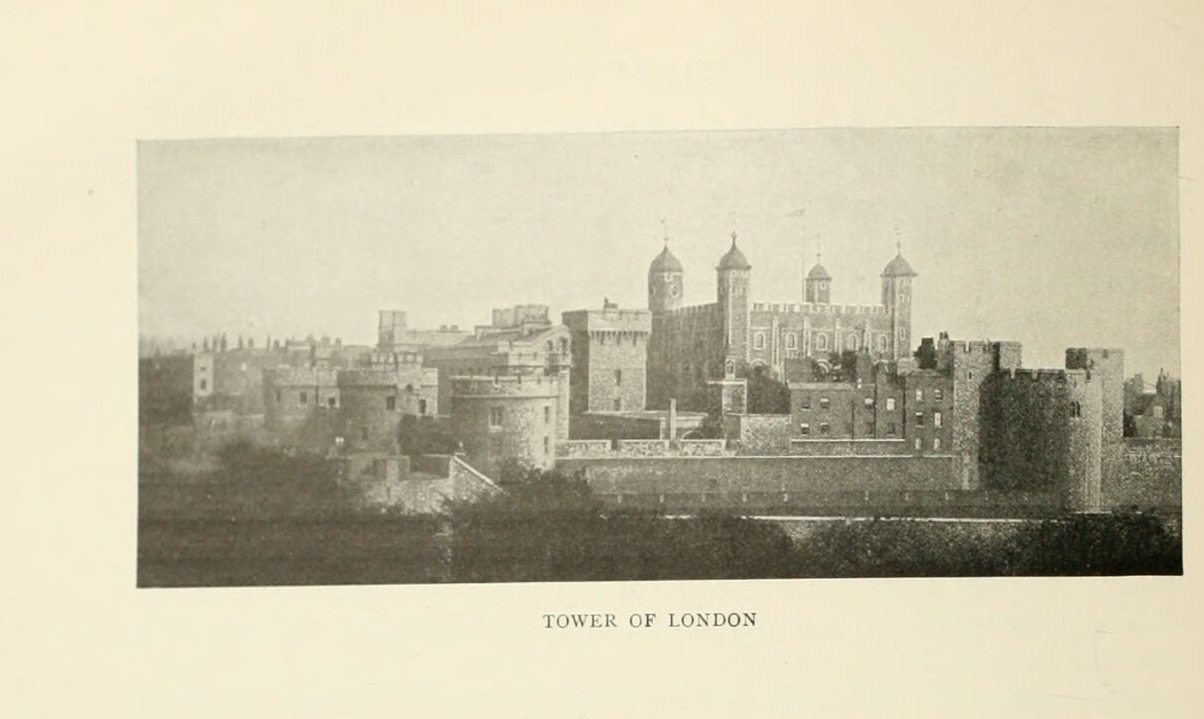
TOWER OF LONDON
1897 · J. D. Mackenzie, The Castles of England, vol. 1 (1897)
Public domain
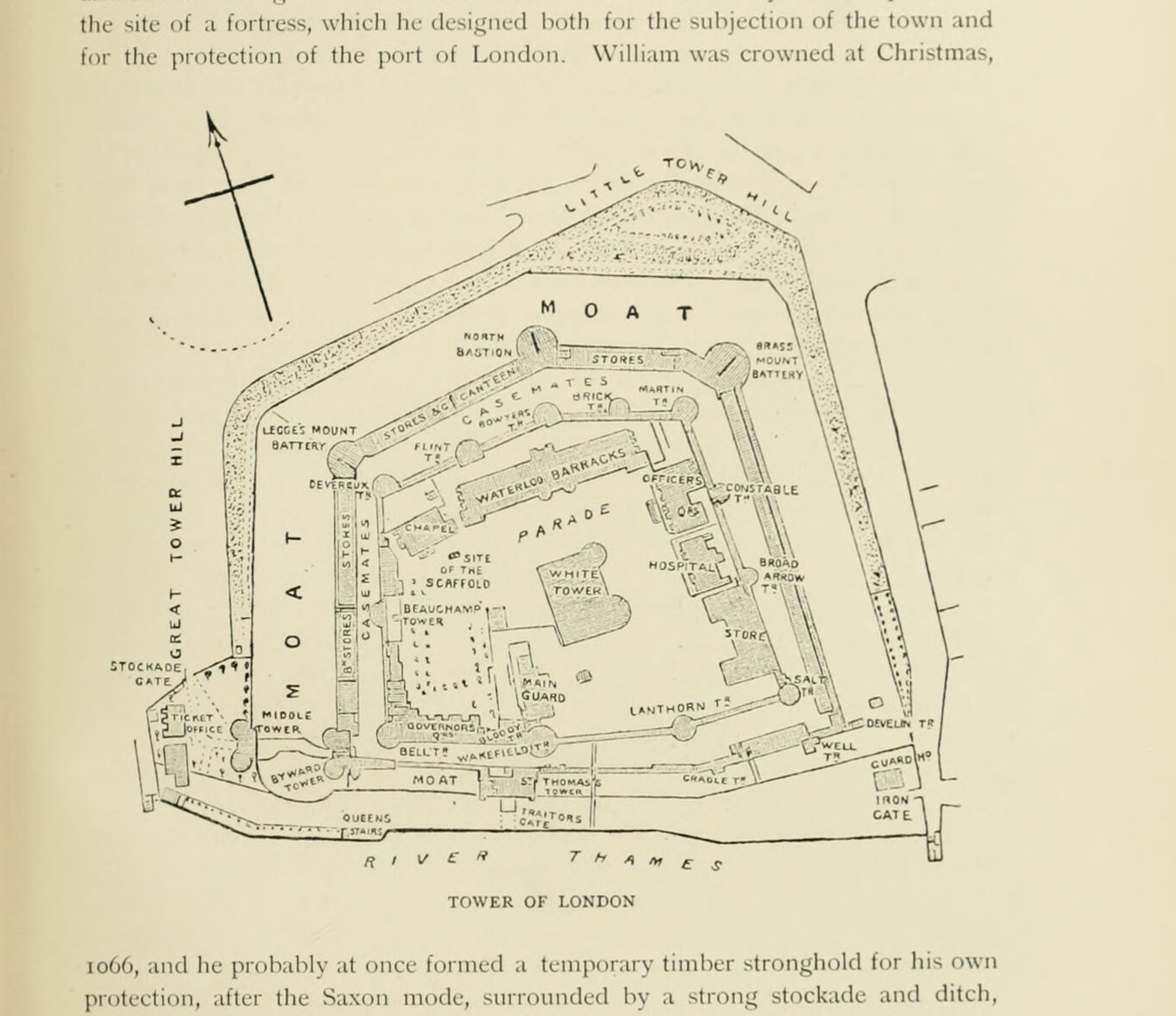
TOWER OF LONDON
1897 · J. D. Mackenzie, The Castles of England, vol. 1 (1897)
Public domain
Nearby
Landmarks within reach of Tower of London.


Questions about Tower of London
What is the history of the Tower of London?
What is inside the Tower of London?
Who owns the Tower of London now?
Why was the Tower of London built?
Where is the Tower of London?
When was the Tower of London built?
What did the Tower of London look like in its prime?
Is the Tower of London still standing?
Who built the Tower of London?
Can you visit the Tower of London?
More castles of England


Explore the city


