England · Restored
Windsor Castle
Windsor Castle is a royal residence in Windsor, Berkshire, long occupied by English and British monarchs and incorporating nearly a millennium of building phases. The site combines fortification, palace and chapel elements, with a central motte and Round Tower, a concentric Upper Ward containing the State Apartments, and the 15th-century St George's Chapel within its walls.
First raised
1070
Its prime
1820
Today
Restored
Ranked among Europe’s castles
As it stood in 1820
What Windsor Castle looked like in its prime.
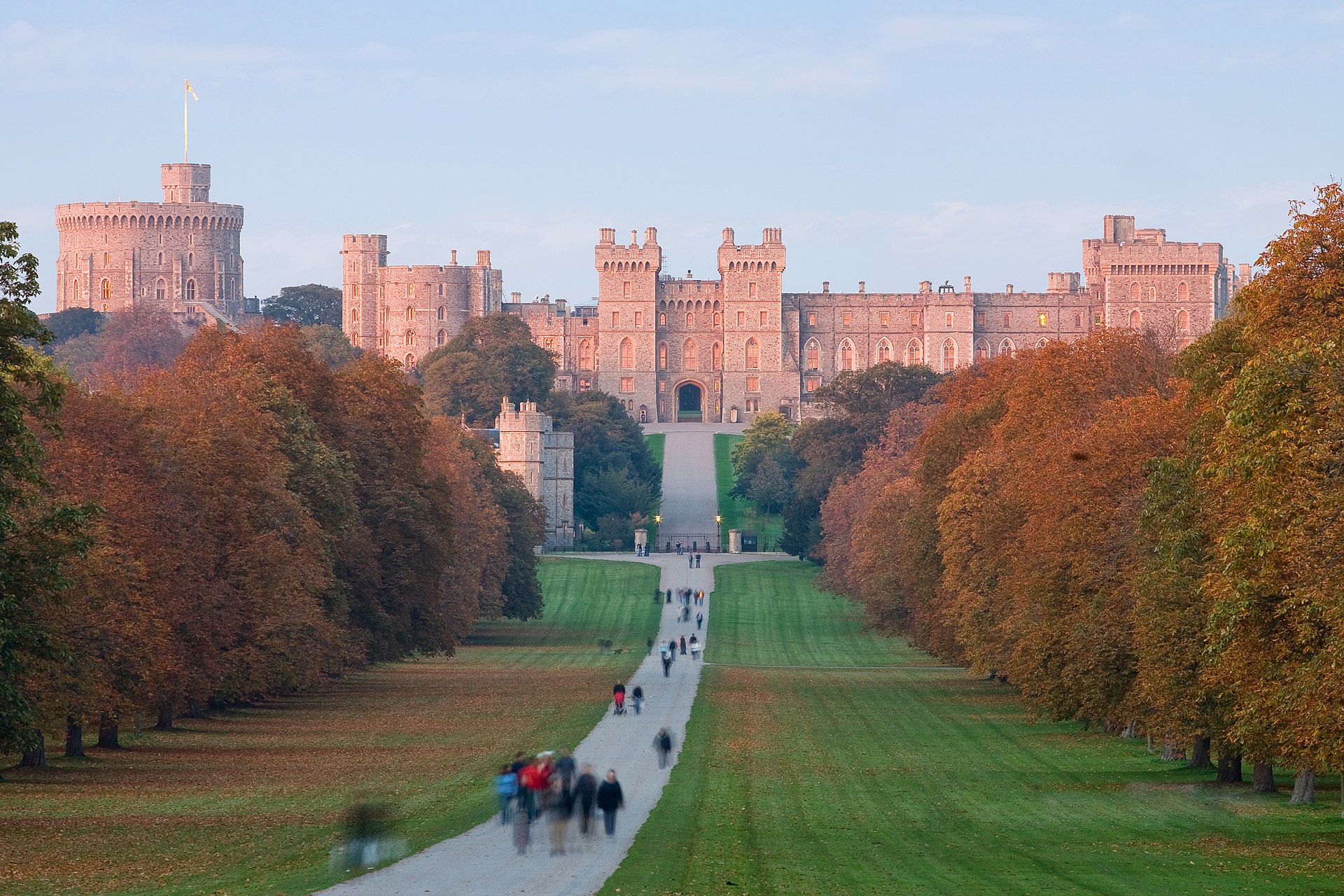
A broad, tree‑lined approach leads up to a castellated quadrangle dominated by a large cylindrical Round Tower set on a motte at the west edge. The Upper Ward presents battlemented curtain walls, rectangular and square towers with crenellations, and a central gatehouse facing the long axial avenue. Walls are of warm Bagshot Heath stone with galleted mortar and Bath stone Gothic dressings; terraces step down to parkland and the River Thames beyond. St George's Chapel rises with perpendicular pinnacles inside the ward.
Its story
The story of Windsor Castle.
William's Ring of Castles and the Motte That Slipped, 1070–1179
William the Conqueror commissioned Windsor in the decade after the Conquest, one of a ring of motte-and-bailey castles around London, each a day's march, about 20 miles, from the City and from its neighbour, so that any one of them could be reinforced in a crisis. Its position did the work: the River Thames, a key medieval route into London, and Windsor Forest, a royal hunting preserve the Saxon kings had used. The first castle was timber, a keep on a man-made mound behind a small bailey wall, set on a chalk bluff 100 feet above the river.
The early Norman kings preferred Edward the Confessor's old palace at Old Windsor; Henry I was the first to use the castle as a residence, keeping Whitsuntide there in 1110 during a period of heightened insecurity. It has been occupied by the monarch ever since, longer than any other palace in Europe. The mound could not carry what stood on it: archaeological evidence shows its southern side subsided by over six feet, and the collapsed wooden keep was replaced in stone. It was not enough. Rebuilding between 1165 and 1179, Henry II found cracks opening again in the keep's south face, pulled the walls back from the edge of the motte to relieve the mound, and laid massive foundations along the south side.
Two Sieges and Henry III's £10,000 Palace, 1214–1296
King John spent on the lodgings at Windsor rather than the defences, and the castle was soon tested. It was besieged in 1214 during the revolt of the English barons, and in 1215 John used it as his base through the negotiations that ended with Magna Carta at nearby Runnymede. In 1216 baronial and French troops under the Count of Nevers besieged it a second time, and John's constable, Engelard de Cigogné, held out through the longest siege of the First Barons' War.
Henry did not stop at the Lower Ward. The Middle Ward was heavily reinforced with a stone wall along its south side, anchored at either end by the new Edward III and Henry III towers, and a gatehouse went up where the Henry VIII Gate now stands.
Cigogné repaired the damage in 1216 and 1221 for Henry III, who rebuilt the Lower Ward walls in stone between 1224 and 1230 and raised the Curfew, Garter and Salisbury towers. The Curfew Tower survives from that work, still holding a former dungeon and the remnants of a sally port, the secret exit kept for a garrison under siege. Windsor drew more of Henry's money than any other of his properties: a palace built between 1240 and 1263 for Eleanor of Provence and his children, and a 70-foot chapel contemporaries set beside the Sainte-Chapelle in Paris. The work cost more than £10,000 and split the castle in two, a private Upper Ward, and a Lower Ward given to the public face of the monarchy.
The Great Hall on the north side of the Lower Ward was repaired and enlarged with a new kitchen and a covered walkway between the two, and the decoration of the whole was rich enough to be counted one of the high-water marks of English medieval art. Little else was built at Windsor in the thirteenth century, and when the Great Hall burned down in 1296 it was not rebuilt.
Edward III's £51,000 and the Order of the Garter, 1344–1377
Edward III was born at Windsor. In 1344 he announced an Order of the Round Table there and began a building to house it, described by chroniclers as round and 200 feet across; it was never finished. He abandoned that order for reasons which remain unclear and founded the Order of the Garter instead, again with Windsor as its headquarters, then set William of Wykeham to rebuild Henry III's palace into something symbolic of royal power and chivalry.
Edward had the military successes of his grandfather Edward I in mind, and the collapse of royal authority under his father, and wanted from Wykeham an innovative, "self-consciously aesthetic, muscled, martial architecture", with the Poor Knights of Windsor attached to the new order to serve it. He lodged in the Round Tower himself while the work went on around him, and had the Norman Gate built to secure the west entrance to the Upper Ward.
Between 1350 and 1377 Edward spent £51,000 at Windsor: the largest sum any English medieval monarch spent on a single building operation, over one and a half times his typical annual income, and met in part from ransoms after Crécy, Calais and Poitiers. The defensive features were primarily for show, possibly a backdrop for jousting between the two halves of the Order. The castle held French prisoners taken at Poitiers, King John II among them, kept for a considerable ransom. It has been called the most expensive secular building project of the entire Middle Ages in England. England's earliest weight-driven mechanical clock was installed for Edward in the Round Tower in 1354, and Wykeham went on from Windsor to build New College, Oxford, and Winchester College, where the castle's influence is easy to see.
The prisoners taken at Poitiers came to Windsor in 1357. Later in the century Richard II had restoration work done on St George's Chapel; it was carried out by Geoffrey Chaucer, who served him as a diplomat and as Clerk of the King's Works.
From Henry IV's Coup to the Yorkist Chapel, 1399–1513
Henry IV seized the castle during his coup in 1399, though he failed to catch Richard II, who had escaped to London. The Wars of the Roses were fought mainly as pitched battles, and Windsor saw none of them. Through the long minority of Henry VI (born here, and known as Henry of Windsor) the Garter Feasts became infrequent and thinly attended. Edward IV had the captured Margaret of Anjou detained at the castle, and began the present St George's Chapel in 1475 to show that his dynasty were the permanent rulers of England.
Henry V had the Holy Roman Emperor here in 1417, a diplomatic event on a scale that stretched the castle's accommodation to its limits. Edward IV, who seized power in 1461, set about reviving the Garter and held a particularly lavish feast in 1472, and his chapel may have been meant to rival the one Henry VI had ordered at nearby Eton. Richard III made only brief use of Windsor before Bosworth, but had Henry VI's body moved here from Chertsey Abbey so that pilgrims could reach it more easily. Henry VII held a huge Garter feast on succeeding in 1488, finished the roof of St George's, rebuilt the roof of the Great Kitchen in 1489 and put up a three-storey tower at the west end of the palace for his own apartments; his plan to turn the old Lady Chapel into a shrine to Henry VI was abandoned when the canonisation never came, though the pilgrims kept arriving. Philip I of Castile was received here in 1506, and Edmund de la Pole, one of the last Yorkist claimants, was imprisoned at Windsor before his execution in 1513.
Henry VIII's Terrace and Elizabeth's Brass Cannon, 1510–1603
Henry VIII's timber North Wharf terrace carried an outside staircase into the king's apartments, comfort bought at the price of considerably weakening the castle's defences. He ran his response to the Pilgrimage of Grace from Windsor in 1536, using it as a secure base in the south, and was buried in St George's Chapel in 1547. Edward VI disliked the place ("Methink I am in a prison, here are no galleries, nor no gardens to walk in"), yet sheltered there with the Duke of Somerset through the rebellions of 1549. Elizabeth I used it as a refuge in crises, "knowing it could stand a siege if need be", and bought ten new brass cannons for its defence.
Henry rebuilt the principal castle gateway in about 1510 and put a tennis court at the foot of the motte in the Upper Ward. Early in his reign he had given the eastern Lady Chapel to Cardinal Wolsey for a mausoleum, and Benedetto Grazzini converted much of it to an Italian Renaissance design before Wolsey's fall ended the work, with contemporaries reckoning some £60,000 spent on it; Henry carried the project on and it was still unfinished when he was buried there. Throughout the Tudor period the castle also served as a retreat from plague in London.
Elizabeth spent more on Windsor than on any of her other palaces. She turned Henry's timber wharf into a permanent stone terrace, with statues, carvings and an octagonal outdoor banqueting house, and raised its western end for privacy; the chapel was refitted with stalls, a gallery and a new ceiling, and a bridge was thrown over the southern ditch to reach the park. Space was the constant difficulty (the castle was simply not as large as the newer royal palaces), and the flow of foreign visitors it strained to hold was caught, for her entertainment, in Shakespeare's The Merry Wives of Windsor.
John Venn's Garrison and the Burial in the Snow, 1629–1649
Charles I had the whole castle surveyed in 1629 by a team that included Inigo Jones, though little of what they recommended was done. Nicholas Stone improved the chapel gallery in the Mannerist style and built a gateway on the North Terrace, and the Dutch goldsmith Christian van Vianen made a baroque gold service for the altar of St George's, plate that would not survive the war.
After Edgehill in October 1642, Parliament feared Charles I would advance on London, and John Venn took the castle with twelve companies of foot to hold the route along the Thames, becoming its governor for the duration of the war. Looting of St George's Chapel began immediately: Edward IV's bejewelled coat of mail was stolen, the organs, windows and books destroyed, and some 3,580 ounces of gold and silver plate had gone by the end of the war. That November Prince Rupert of the Rhine attacked Windsor; his small cavalry force took the town but could not overcome the castle walls, and was forced to retreat.
Over the winter of 1642–1643 the castle became the headquarters of the Earl of Essex: the canons were expelled, the Horseshoe Cloister held captured Royalists, the Lady Chapel became a magazine, and the underpaid garrison killed 500 royal deer across the Great Park and burned the fences for firewood. In November 1648 the Parliamentary Army Council moved in and decided to try the king for treason. Charles was held here for the last three weeks of his reign, and after his execution in January 1649 his body was carried back through a snowstorm and interred without ceremony in the vault beneath St George's Chapel, where Henry VIII already lay.
Charles came back to Windsor in 1647 as a prisoner of Parliament, held there for a time before being moved to Hampton Court; a Royalist plan to seize the castle in 1648 was never acted on.
Charles II's Star Building and the Restoration Castle, 1660–1714
The Interregnum left paupers squatting in the towers and the king's house a wreck. Charles II made Prince Rupert Constable in 1668, and Rupert reordered the defences and repaired the Round Tower, fitting out his own chambers with an "extraordinary" number of weapons and armour. Windsor was the only royal palace Charles fully modernised after the Restoration, paid for largely from increased royal revenues out of Ireland in the 1670s: Hugh May built out onto the North Terrace to raise the Star Building, named for the huge gilt Garter star Charles set on its side, and with Antonio Verrio and Grinling Gibbons produced "the most extravagantly Baroque interiors ever executed in England".
Rupert rebuilt the real tennis court as well, and Charles tried to restock the Great Park with deer brought from Germany, though the herds never recovered the numbers the war had taken. May took down and rebuilt the walls of Edward III's hall and chapel, putting in larger windows while keeping the height and dimensions of the medieval building; the castle could now hold the whole court but had no chambers for the King's Council, so Charles used the good roads around Windsor and held his council meetings at Hampton Court. William III commissioned Nicholas Hawksmoor and Sir Christopher Wren to remodel the Upper Ward in classical style and died before it began. Queen Anne, fond of the place, set Henry Wise to work on a Maestricht Garden below the North Terrace that was never finished, made the racecourse at Ascot, and began the annual royal procession to it from the castle.
Georgian Neglect, Wyatville's Million and the Widow of Windsor, 1714–1901
George I and George II left the castle to decay; apartments in the Upper Ward were handed out as grace-and-favour lodgings to prominent widows and friends of the Crown, and by the 1740s Windsor had become an early tourist attraction, where anyone who could pay the castle keeper might come in to see curiosities such as its narwhal tusk, and from the 1750s buy a guidebook, George Bickham's of 1753, Joseph Pote's of 1755. As the State Apartments went on deteriorating, even the general public could visit regularly.
George I and George II left the castle to decay. George III spent over £150,000 on a Gothic remodelling with James Wyatt, until his illness turned the State Apartments into his confinement from 1810; George IV was then voted £300,000 by Parliament and gave the work to Jeffry Wyatville, who raised the Round Tower by 30 feet. The final bill passed a million pounds.
Victoria and Albert made Windsor their principal residence, though the queen early on called it "dull and tiresome" and "prison-like". Albert died in the Blue Room in 1861 and was buried at Frogmore; his rooms were kept exactly as they had been at the moment of his death, and Victoria held the castle in mourning for years afterwards as the Widow of Windsor. Anthony Salvin rebuilt the State Dining Room after a serious fire in 1853, and he and Edward Blore, working under Albert's direction, rebuilt the Garter, Curfew and Salisbury towers, the houses of the Military Knights and a new Guardhouse, and cut the Hundred Steps down into the town. The Windsor Castle and Town Approaches Act of 1848 allowed the old roads through the park to be closed and re-routed, enclosing the private Home Park, with additional public rights of access granted over the rest.
The House of Windsor, the War and the Fire, 1917–1997
Anti-German feeling in the First World War led George V to rename the dynasty the House of Windsor in 1917, and in the Second the king, queen and their daughters slept here under a specially strengthened roof while it was reported, for morale, that the king remained at Buckingham Palace. Fresh subsidence in the old motte was detected in 1988, threatening the Round Tower with collapse until it was underpinned. On 20 November 1992 fire burned for 15 hours, destroying nine principal state rooms and severely damaging more than a hundred others; 200 firefighters and over 1.5 million gallons of water brought it under control, and the £37 million restoration was completed in 1997.
Step inside
11 places to explore in 1820.
The record describes 11 distinct spots at Windsor Castle, including 5 interiors: grand reception room (state apartments interior), white, green and crimson drawing rooms (state apartments), queen's presence and audience chambers (baroque interiors) and more. Create your own photoreal reconstruction and explore every one, more scenes means more rooms, more angles, and more of the place to stand in.
Build Your Own Castle
Recreate Windsor Castle with AI to explore it.
The artist rebuilds it as it stood in 1820, a photoreal reconstruction that belongs to you alone. Pay with coins, no subscription needed.
Recreate this castle →Defend this castle →From the archive
Windsor Castle on paper: the measured plan and period views.
The survey plan and photographs below are the ground truth this page's reconstructions are checked against, drawn and photographed while the castle was still a working garrison. Every image is public-domain or openly licensed, with its source named.

Flickr - …trialsanderrors - Windsor, view of the castle from the river, Berkshire, England, ca. 1895
ca. 1890-1900 · Photochrom Prints Collection (via Wikimedia Commons)
Public domain
WINDSOR CASTLE.
1897 · J. D. Mackenzie, The Castles of England, vol. 1 (1897)
Public domain
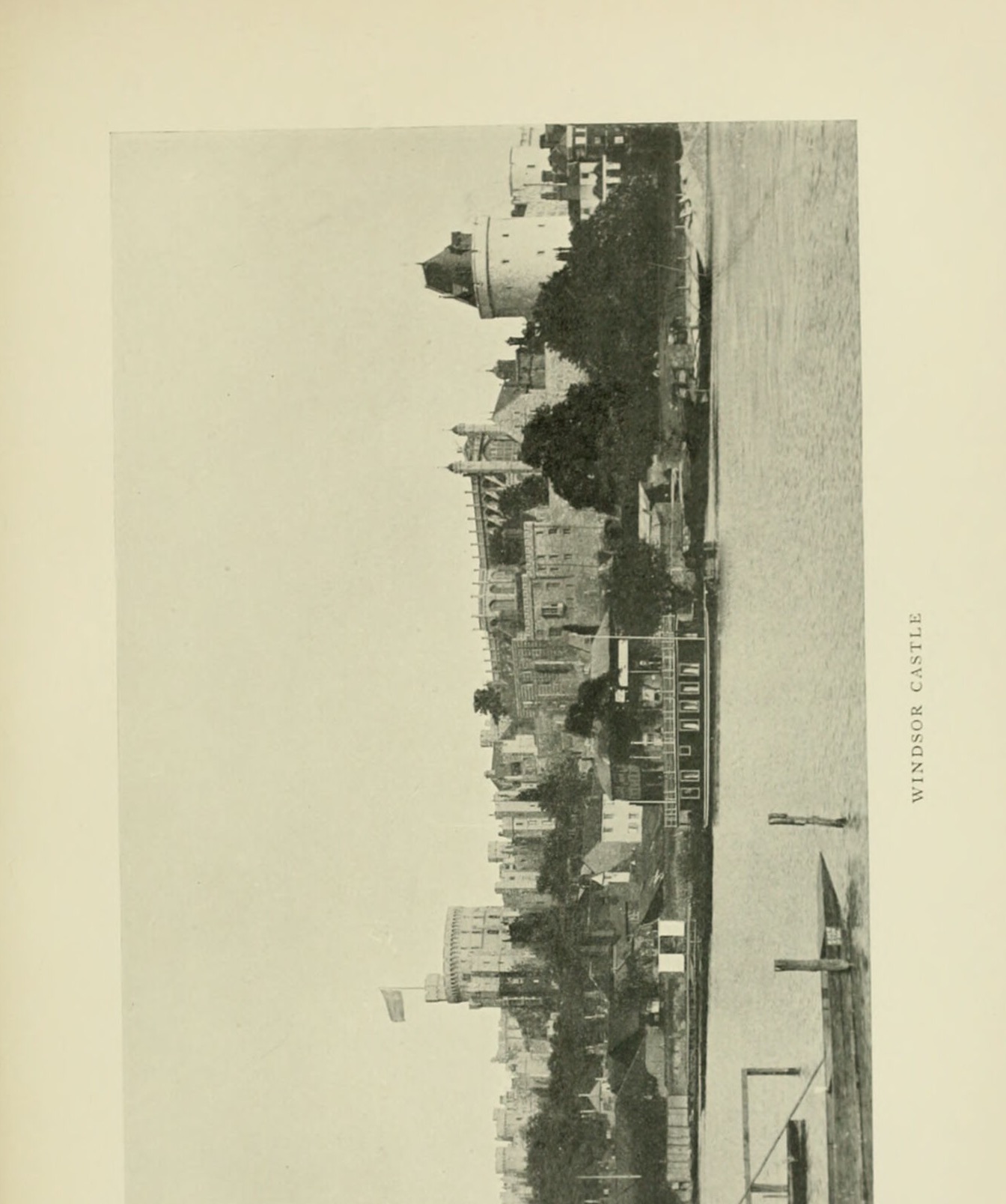
WINDSOR CASTLE
1897 · J. D. Mackenzie, The Castles of England, vol. 1 (1897)
Public domain
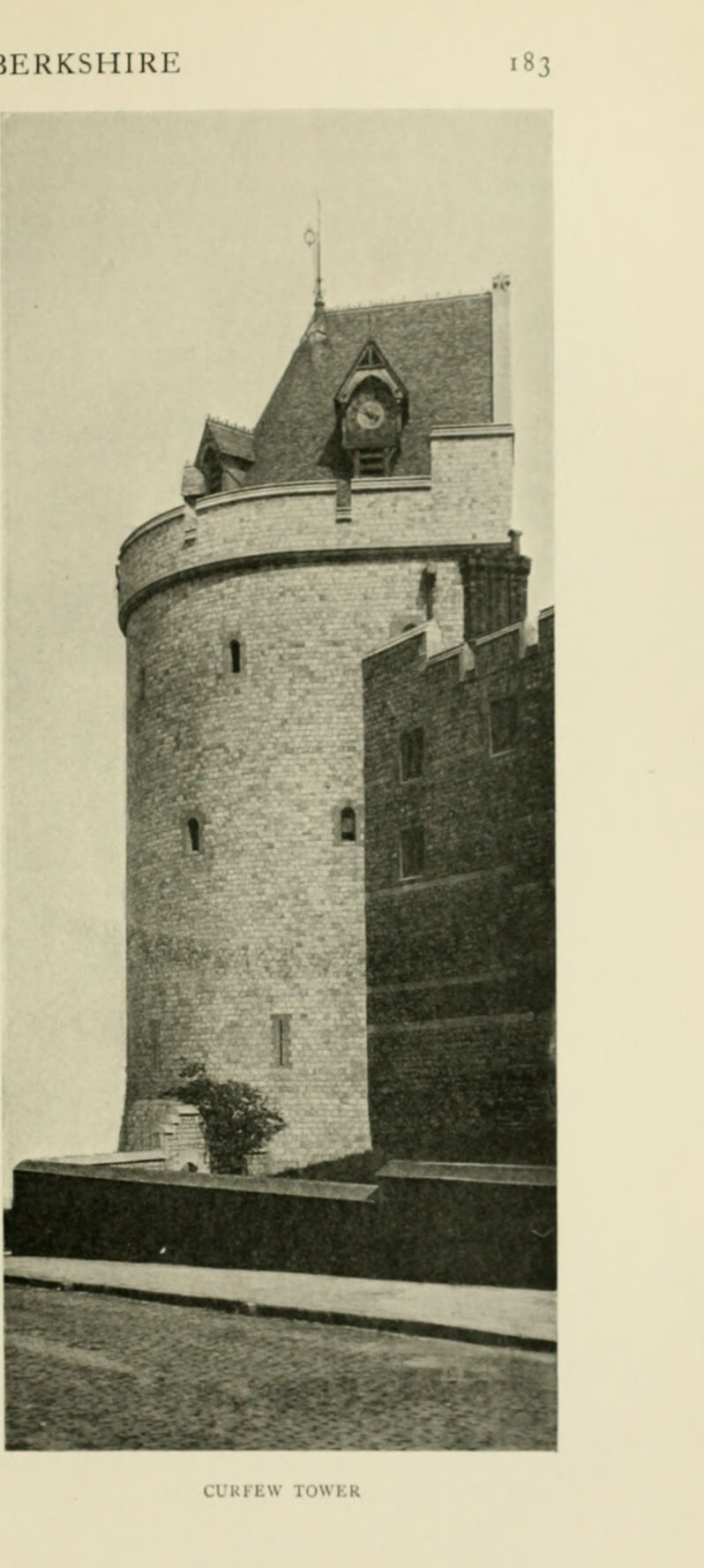
CURFEW TOWER
1897 · J. D. Mackenzie, The Castles of England, vol. 1 (1897)
Public domain
Nearby


