Church · England · Still standing
St George's Chapel, Windsor
St George's Chapel at Windsor Castle is a late-medieval Perpendicular Gothic royal chapel founded in the 14th century and substantially rebuilt in the late 15th and early 16th centuries. It is the spiritual home of the Order of the Garter and has long served for royal services, weddings and burials.
First raised
1475
Its prime
1528
Today
Still standing
As it stood in 1528
What St George's Chapel, Windsor looked like in its prime.
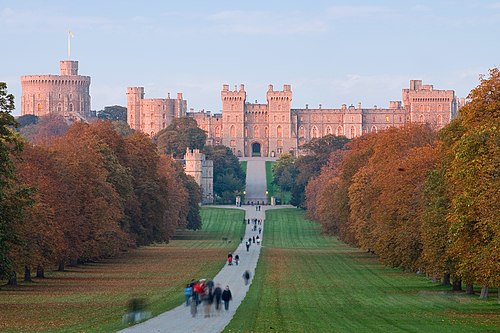
A long, horizontal Perpendicular-Gothic chapel of pale honey-coloured ashlar, with repeated tall mullioned-and-transomed traceried windows filling each bay. A crenellated parapet and closely spaced pinnacles run along the roofline, each topped by carved heraldic animals; corner octagonal turrets and a small domed pavilion mark the end bays. The façade sits behind a low stone retaining wall and clipped lawn; inside are high stone vaulted ceilings and clear, multicoloured stained-glass lights in deep window recesses.
Its story
The story of St George's Chapel, Windsor.
Edward III's College at Windsor, 1348-1354
In 1348 Edward III founded two religious colleges: St Stephen's at Westminster and St George's at Windsor. The new Windsor college was attached to the Chapel of St Edward the Confessor, which Henry III had built in the early thirteenth century in the Lower Ward of the castle. The chapel was re-dedicated to the Blessed Virgin Mary, George the Martyr and Edward the Confessor, though it soon became known only by its dedication to St George. Edward III also built the Aerary Porch in 1353-54.
Rebuilt by Edward IV and the Tudors, 1475-1528
The years 1475 to 1528 saw a radical redevelopment set in motion by Edward IV, continued by Henry VII under Sir Reginald Bray, and afterwards by Henry VIII. The thirteenth-century Chapel of St Edward the Confessor was enlarged into a cathedral-like space under the direction of Richard Beauchamp, Bishop of Salisbury, and the master mason Henry Janyns. The iron gates in the sanctuary and the locks on the chapel doors are the work of the medieval Cornish metalsmith John Tresilian.
Edward IV was buried at the chapel in 1483; Henry VI was reburied there the following year, brought from Chertsey Abbey, and Elizabeth Woodville was interred on 12 June 1492. The Rutland Chantry, forming the northern transept, was founded in 1491 in honour of Sir Thomas St Leger and Anne of York, elder sister of Edward IV and Richard III. A monumental brass on the chantry's east wall records that it was founded "with two priests singing forevermore". St George's Chapel is among the most important medieval chantry foundations to have survived in England.
Plundered in the Civil War, 1642-1649
Parliamentary forces broke into and plundered the chapel and its treasury on 23 October 1642. Further pillage came in 1643, when the fifteenth-century chapter house was destroyed, lead was stripped from the chapel roofs, and some elements of Henry VIII's unfinished funeral monument were stolen. In 1648 the metalwork was sold by the Commonwealth to pay for garrisoning Windsor Castle. Following his execution in 1649, Charles I was buried in a small vault in the centre of the choir, which already held the coffins of Henry VIII and Jane Seymour.
Wren's Verdict to Brakspear's Restoration, 1682-1925
The sixteenth-century Royal Beasts on the chapel's pinnacles were removed in 1682 on the advice of Sir Christopher Wren, who had criticised the calcareous Reigate Stone they were made from. George III revived royal interest in Windsor Castle, much overlooked since the House of Hanover came to the throne in 1714. On 12 August 1776 the royal family attended Sunday morning service at St George's for the first time, calling it "the Cathedral", and George III inspired and in large part funded an extensive restoration from 1780 to 1790. Under Victoria the east end of the choir was reworked in memory of Prince Albert, and the Lady Chapel, abandoned by Henry VII, was completed and renamed the Albert Memorial Chapel. In the nineteenth century St George's Chapel and nearby Frogmore Gardens superseded Westminster Abbey as the royal family's chosen burial place.
By the early twentieth century the bowing walls, cracked vaulting, decayed stone and stripped lead required urgent attention. A ten-year restoration began in 1920 under the consulting architect Sir Harold Brakspear; as part of that programme the Anglo-Congolese sculptor Mahomet Thomas Phillips produced a falcon and a unicorn in 1923. The seventy-six heraldic Royal Beasts on the pinnacles date from 1925.
Garter Chapel and Royal Burial Place, 1931-2022
The Society of the Friends of St George's, a registered charity, was established in 1931 to assist the College of St George in maintaining the chapel. The Garter Service was revived in 1948 by George VI for the 600th anniversary of the founding of the Order and has been an annual event since. A member's banner, helmet and sword are taken down at death; the enamelled brass stall plates never are, and the stalls carry 800 plates of members throughout the Order's history.
The King George VI Memorial Chapel was built in 1969 to a design by George Pace, between the Rutland Chapel and the north choir. George VI, interred in the Royal Vault on 15 February 1952, was moved into it on 26 March 1969; Princess Margaret and Elizabeth Bowes-Lyon followed in 2002, and Elizabeth II in 2022, the year Prince Philip was also moved there from the Royal Vault. The chapel is a royal peculiar, under the direct jurisdiction of the monarch, and is the Chapel of the Order of the Garter; it has been a Grade I listed building since 2 October 1975. Its running is the responsibility of the dean and canons of Windsor, who make up the College of St George.
Step inside
8 places to explore in 1528.
The record describes 8 distinct spots at St George's Chapel, Windsor, including 4 interiors: nave leading to the quire (interior), sanctuary with tresilian iron gates, rutland chantry (north transept) and more. Create your own photoreal reconstruction and explore every one, more scenes means more photos, more angles and more of the immersive experience.
Build Your Own Castle
Recreate St George's Chapel, Windsor with AI to explore it.
The artist rebuilds it as it stood in 1528, a photoreal reconstruction that belongs to you alone. Pay with coins, no subscription needed.
Recreate Church to Explore →Nearby