Clan Rising
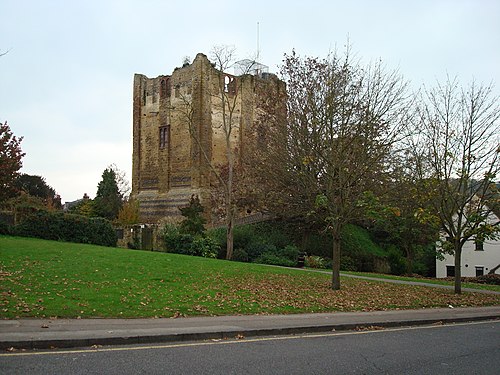
Greys Court today

England · Still standing

Greys Court

Greys Court is a Tudor country house and gardens in the Chiltern Hills at Rotherfield Greys, Oxfordshire. The site includes a courtyard house largely built in the Tudor period, extensive walled gardens, and the surviving medieval fortified tower (c.1347). The property is Grade I listed and remains furnished as a family home; it is owned and open to the public under the National Trust.

Photograph via Wikimedia Commons

First raised

1348

Its prime

1780

Today

Still standing

As it stood in 1780

What Greys Court looked like in its prime.

A mainly Tudor-style country house arranged around a cobbled courtyard, set against the southern Chiltern Hills and enclosed walled gardens. The grounds include an ornamental vegetable garden, old-fashioned rose beds and wisteria climbing the garden walls, and an ice-house sunk into the slope. A single medieval fortified tower (built c.1347) rises above the garden and surrounding countryside; a Tudor wheelhouse stands among the service buildings. Interiors include notable 18th-century decorative plasterwork.

Its story

The story of Greys Court.

Anchetil de Greye and the Manor of Redrefield

The Domesday survey of 1086 records Redrefield as the principal of six manors held by the Norman knight Anchetil de Greye, born around 1052 and still living after the survey was taken. He is the ancestor of the Grey family, and the name they carried is the name the place carries still.

A Founder Knight of the Garter, 1346

John de Grey, 1st Baron Grey de Rotherfield, was one of the original founder Knights of the Garter, and in 1346 he was granted a licence to crenellate his house at Rotherfield. In the same years he considerably enlarged the group of buildings on the site, adding a castle around 1347. Of that work only the fortified tower survives; the rest of the medieval castle has gone.

A Red Rose a Year: the Knollys Tenure, 1514–1642

The estate passed to the Crown in 1485, and in 1514 it was granted to Robert Knollys for an annual rental of a red rose. It stayed with the Knollys family until 1642, and it was during their tenure that the present house and its associated buildings were raised — Tudor work set around a courtyard.

Sir William Paul bought the house in 1686. It left the Paul family in 1724, carried by the dowry of his son William's daughter to Sir William Stapleton, 4th Baronet, and remained with the Stapletons for more than two hundred years.

The Brunners and the National Trust

Between 1935 and 1937 the house was occupied by Evelyn Fleming, mother of the author Ian Fleming. In 1937 Sir Felix Brunner and his wife Elizabeth, Lady Brunner — granddaughter of the Victorian actor-manager Sir Henry Irving — bought Greys Court from the Stapletons. The family gave the property to the National Trust in 1969, though Lady Brunner went on living there until her death in 2003. Archbishop Robert Runcie dedicated the garden maze on 12 October 1981.

Step inside

10 places to explore in 1780.

The record describes 10 distinct spots at Greys Court, including 3 interiors: fortified tower (interior), 18th-century plasterwork room, furnished family room. Create your own photoreal reconstruction and explore every one, more scenes means more rooms, more angles, and more of the place to stand in.

Approach from country laneTudor courtyardWalled garden entranceOrnamental vegetable gardenIce-house entranceTudor wheelhouseFortified tower (exterior)Fortified tower (interior)18th-century plasterwork roomFurnished family room

Build Your Own Castle

Recreate Greys Court with AI to explore it.

The artist rebuilds it as it stood in 1780, a photoreal reconstruction that belongs to you alone. Pay with coins, no subscription needed.

Recreate this castle →

Castle Siege

Play Castle Siege at Greys Court.

A strategy game played on Greys Court’s real ground plan: the same surveyed walls shown in the archive below. Post your finite garrison on the battlements between assaults, then hold out as rams, siege towers, trebuchets and sappers arrive in ever-worse waves.

Sign in free to see the garrison muster. One castle costs 150 Clan Coins and is yours forever.

Sign in to take command →

See every castle’s leaderboard →

Whose castle

Clans who held Greys Court.

The families that held Greys Court for a decade or more across its history, follow a name to its clan.

  • Grey

    Held by the Grey family from Anchetil de Greye's Domesday manor of 1086 until the estate passed to the Crown in 1485.

  • Knollys

    Granted to Robert Knollys in 1514 for an annual rental of a red rose; held by the Knollys family until 1642.

  • Paul

    Bought by Sir William Paul in 1686; passed via his granddaughter's dowry in 1724.

  • Stapleton

    Held by the Stapleton baronets from 1724 until the sale of 1937.

  • Brunner

    Held by Sir Felix and Lady Brunner from 1937; donated to the National Trust in 1969.

From the archive

Greys Court on paper: the measured plan and period views.

The survey plan and photographs below are the ground truth this page's reconstructions are checked against, drawn and photographed while the castle was still a working garrison. Every image is public-domain or openly licensed, with its source named.
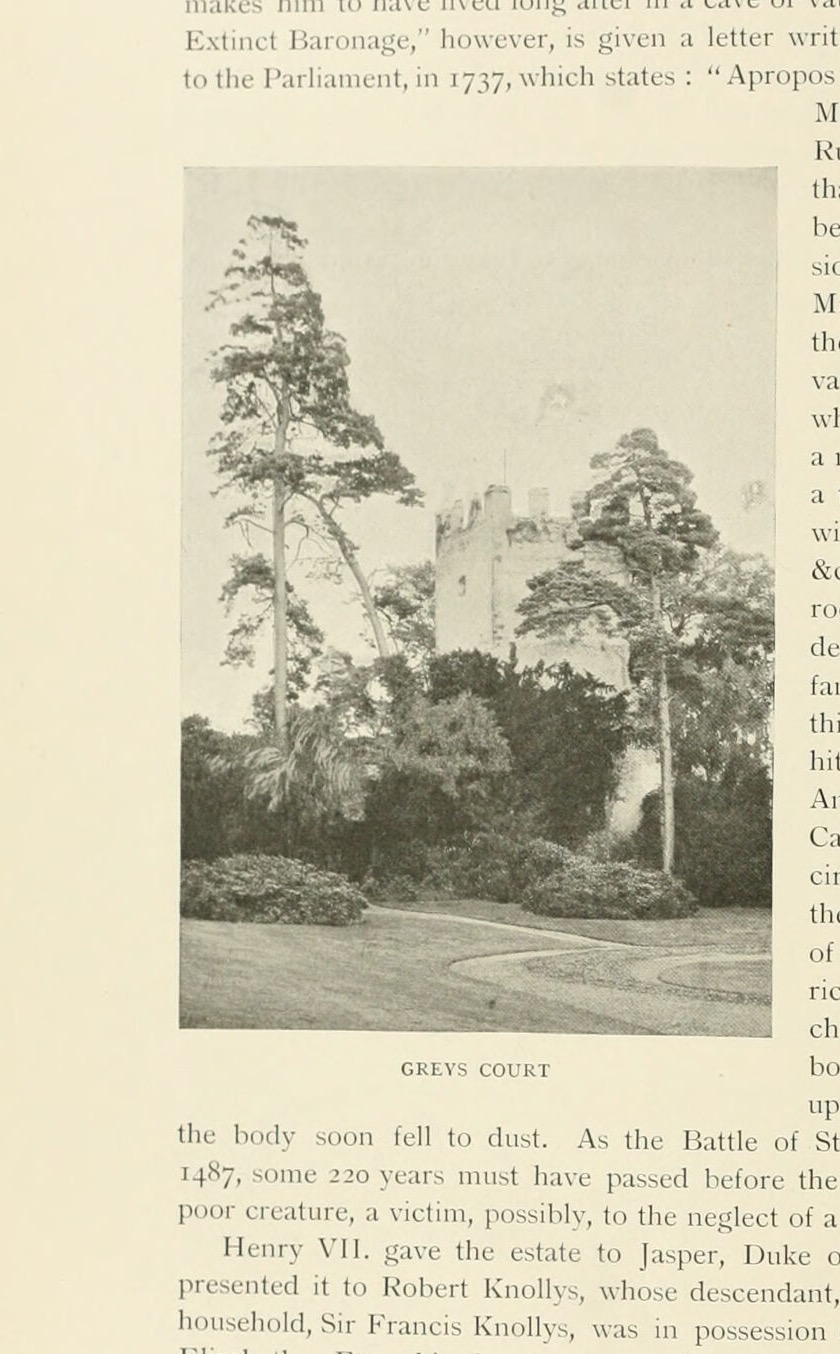
GREYS COURT, Greys Court

GREYS COURT

1897 · J. D. Mackenzie, The Castles of England, vol. 1 (1897)

Public domain

Questions about Greys Court

What is the history of Greys Court?

Greys Court began as a fortified residence in the 14th century, when John de Grey was licensed to crenellate his house and added a castle around 1347. The estate passed to the Crown in 1485 and was granted to Robert Knollys in 1514. The present house and associated buildings were constructed during the Knollys family’s tenure, which lasted until 1642.

What is inside Greys Court?

Inside Greys Court, visitors can see a furnished family home and notable 18th-century decorative plasterwork. The surviving fortified tower also has a documented interior, while the house is arranged around a Tudor courtyard. The interiors remain furnished rather than presenting the building solely as a ruined medieval castle.

Where is Greys Court?

Greys Court is in Rotherfield Greys, in Oxfordshire, within the southern Chiltern Hills. It is near Henley-on-Thames, making that town the nearest recognised place named in the supplied descriptions. The house and gardens occupy a rural setting rather than an urban centre.

When was Greys Court built?

Greys Court was built in the 14th century, with the medieval castle added around 1347–1348. John de Grey received a licence to crenellate the house in 1346, and the present Tudor house and associated buildings were constructed later during the Knollys family’s tenure, before 1642.

Why was Greys Court built, and what was it used for?

Greys Court was built first as a fortified and crenellated residence, rather than solely as a country house. John de Grey enlarged the existing buildings and added a castle around 1347. Its later use developed into that of a Tudor country house and a furnished family home, while the medieval fortified tower survived beside it.

Does anyone live at Greys Court now?

Yes, people still live at Greys Court: it remains furnished as a family home. Lady Brunner continued to live there until her death in 2003, and the property was donated to the National Trust in 1969. The supplied material does not identify a current resident by name.

Which family or clan held Greys Court?

Greys Court was held by the Grey family from Anchetil de Greye’s manor, recorded in 1086, until the estate passed to the Crown in 1485. The Knollys family held it from 1514 to 1642, followed by Sir William Paul and then the Stapleton baronets from 1724 to 1937. Sir Felix and Lady Brunner held it from 1937 and donated it to the National Trust in 1969.

What did Greys Court look like in its prime?

In its prime, Greys Court was a mainly Tudor-style country house arranged around a cobbled courtyard, with enclosed walled gardens. A medieval fortified tower rose above the garden and surrounding countryside, while a Tudor wheelhouse stood among the service buildings. The grounds also included rose beds, wisteria, an ornamental vegetable garden and an ice-house sunk into the slope.

Is Greys Court still standing or is it a ruin?

Greys Court is still standing and intact, not a ruin. The Tudor country house remains furnished as a family home, while the single surviving medieval fortified tower stands beside it. The tower is described as the only remaining part of the medieval castle, and the grounds also retain the Tudor wheelhouse and walled gardens.

Who built Greys Court?

Greys Court was commissioned by John de Grey, 1st Baron Grey de Rotherfield. He received a licence to crenellate his house in 1346, enlarged the existing buildings and added a castle around 1347. No architect or designer is identified in the supplied material.

Can you visit Greys Court?

Yes, Greys Court is open to the public. It is a historic house museum and an English country house, and it is open to the public under the National Trust. The property remains furnished as a family home, so its public role exists alongside its continuing residential character.
All castles of England · Castles of Europe · the best castles in Europe · explore the finished reconstructions.