
England · Restored
Guildford Castle
Guildford Castle is a Norman motte-and-bailey fortress whose large quadrangular keep dominates a raised grassy mound in the centre of Guildford, Surrey. Built in the late 11th–12th centuries and upgraded into a royal residence in the 13th century, the keep and remaining earthworks survive today within public castle gardens and form a local historic landmark.
First raised
1100
Its prime
1250
Today
Restored
As it stood in 1250
What Guildford Castle looked like in its prime.
A massive quadrangular stone keep (about 47 by 45 feet) rising over 70 feet from the centre of a steep motte, with walls some 10 feet thick at the base that taper toward the top; built of local Bargate sandstone with strong mortar and a crenellated parapet and lead roof. The keep sits within a roughly circular earthwork motte and ditch with the bailey spread down the slope toward Castle Hill, where lower stone palace and hall buildings present larger 13th-century windows.
Its story
The story of Guildford Castle.
A Norman Motte Raised After Domesday
After Hastings in 1066 William led his army to Canterbury and then sacked the towns along the Pilgrims' Way, Guildford among them. He, or one of his barons, is thought to have built the castle that followed, though the Domesday Book of 1086 makes no mention of it, so the work probably began after that date. The first phase was earth and timber: a motte ringed by a ditch, with a bailey behind a wooden palisade, and a wooden keep on the mound serving as a look-out for the soldiers stationed there.
In the late eleventh or early twelfth century a wall of Bargate stone was raised around the top of the motte to make a shell keep, and around the 1130s a stone tower was added, again in Bargate stone brought from nearby Godalming, its foundations carried down to the chalk bedrock. Quadrangular, 47 feet by 45.5 feet, with walls some 10 feet thick at the base and tapering upward, it was entered at first-floor level for defence; the ground floor had no windows at all. The first floor held a main chamber, a chapel and a wardrobe with latrine, and a second storey added shortly afterwards took the tower over 70 feet high under a lead roof.
Strengthened but Never Stormed
Guildford was a royal residence first and a fortress second, and it was never attacked, but it was reinforced whenever the kingdom turned on itself. The keep is thought to have been heightened during the civil war of Stephen's reign, between 1135 and 1154, and the castle was strengthened again during the revolt of Henry II's sons in 1173–74. On 9 July 1216 Prince Louis took possession of it during the First Barons' War against King John, without a blow being struck.
Simon de Montfort's rebellion in the 1260s brought no fighting here either, though Henry III's son Prince Edward, the future Edward I, captured a rebel named Adam Gurdon in a battle at Alton and brought him to Guildford. Under Edward I the castle served as a mustering point for the king's wars abroad.
Henry III Turns a Castle into a Palace
By the twelfth century the king had moved out of the keep into better apartments in the bailey, where a stone great hall stood with lodgings and chapels for king and queen. Henry III improved the place so thoroughly in the thirteenth century that it came to be spoken of as a palace: the queen's apartment gained large new windows and two marble columns, the great hall coloured glass and paintings, and the king had his own chamber painted green with gold and silver stars and laid out a garden enclosed by marble columns.
In 1245 Henry bought extra land to extend the bailey and build a set of rooms for his son and heir Edward, finished in 1246. A fire damaged the hall in 1254, and the work went on regardless; the new gate on Quarry Street was completed in 1256.
Constables, Sheriffs and the County Gaol
William de Coniers was constable in 1218 and Elias de Maunsel in 1247. In 1259 custody passed to William de Aguillon, then sheriff of Surrey, probably so that the castle might be used as a prison. Edward de Say, keeper of the king's prisoners, was ordered to repair it in 1307; in 1367 it was given to Andrew Sackville, sheriff of Surrey and Sussex, both as a gaol and as a dwelling; and in 1377 Sir Simon Burleigh, who had been tutor to the new king Richard II, was made constable.
The keep served as the common gaol for Surrey and Sussex until 1487, when the people of Sussex petitioned parliament to have their prisoners moved to Lewes, which had a more secure establishment and a better location. The petition was granted.
Decay, a Cockpit, and the Corporation
Guildford, like other royal inland castles, was no longer needed for defence and was left to slide. From the 1360s a royal moated hunting lodge across the river was enlarged, and royalty stayed there instead; by 1379 only the king's great chamber survived, the rest of the royal apartments having decayed beyond repair. John Daborne was made keeper of the castle garden in 1544, and his family, involved with the place for the rest of the sixteenth century, are thought to have inserted the brick windows and fireplaces. James I granted the castle estate to Francis Carter in 1611, and in the 1630s, the tower's roof having been stripped, the shell was put to use as a cockpit while the grounds were farmed and rented out.
The Duke of Norfolk bought the castle around 1820. In 1885 Lord Grantley of Wonersh, who owned a large part of it, sold to the Guildford Corporation, and the tower and walls were restored and opened to the public as pleasure gardens in 1888, marking Queen Victoria's Golden Jubilee of the previous year.
Step inside
11 places to explore in 1250.
The record describes 11 distinct spots at Guildford Castle, including 6 interiors: first-floor main chamber in the keep, keep chapel, second-floor two-seat garderobe and more. Create your own photoreal reconstruction and explore every one, more scenes means more rooms, more angles, and more of the place to stand in.
Build Your Own Castle
Recreate Guildford Castle with AI to explore it.
The artist rebuilds it as it stood in 1250, a photoreal reconstruction that belongs to you alone. Pay with coins, no subscription needed.
Recreate this castle →Defend this castle →Whose castle
Clans who held Guildford Castle.
The families that held Guildford Castle for a decade or more across its history, follow a name to its clan.
Granted to Francis Carter by James I in 1611.
From the archive
Guildford Castle on paper: the measured plan and period views.
The survey plan and photographs below are the ground truth this page's reconstructions are checked against, drawn and photographed while the castle was still a working garrison. Every image is public-domain or openly licensed, with its source named.
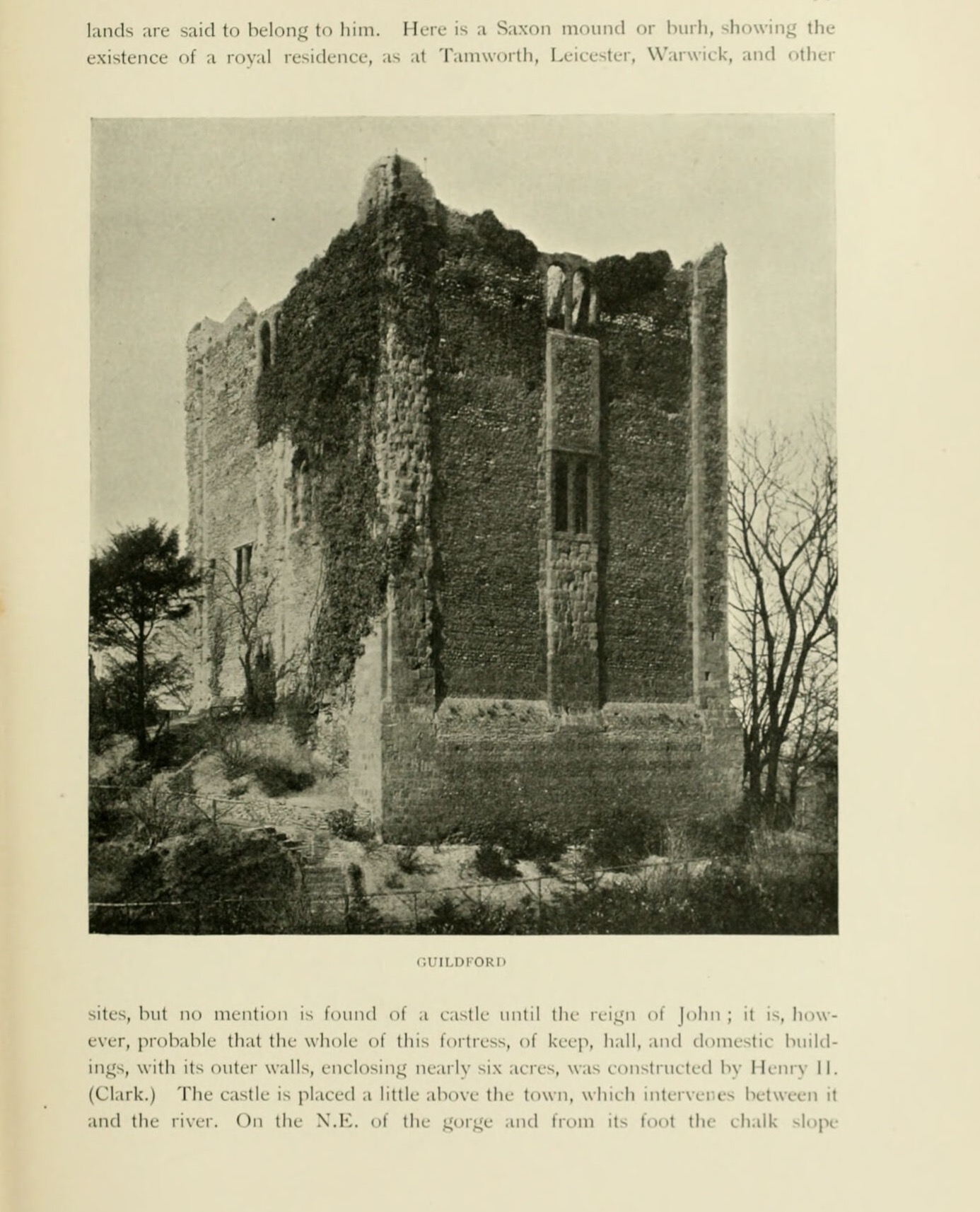
GUILDFORD
1897 · J. D. Mackenzie, The Castles of England, vol. 1 (1897)
Public domain
Nearby


