Gray
also Grey
The grey one, descriptive, aristocratic, or anatomical.
- Origin
- North East, England
- Famous bearer
- Charles Grey, 2nd Earl Grey (1764–1845), Prime Minister; the Reform Act 1832
- Register
- English family
The Gray arms, crest badge, tartan and country

Crest badgeClan member crest badge - Clan GrayCeltus · CC BY-SA 3.0 
TartanTartan gray huntingThe hunting sett: the same pattern in muted browns and greens, worn in the field where the brighter colours would show.Christie C Gray · OGL v1.0 
Coat of armsArms of the Lord GrayBorne by Lord Gray: the ennobled line of the name, not the name at large.CC BY-SA 4.0 
Coat of armsThe coat of arms of the Gray familyEthan · CC BY-SA 3.0


- Crest badge: The chief's crest inside a belt and buckle: the badge a clansman wears to show whose following he is in.
- Tartan: The checked cloth the family is known by.
- Coat of arms: Granted to an individual and inherited down that one documented line. These are the arms of particular families of the name, not of everyone who shares the surname.
What is the Gray clan tartan?
One Gray sett is recorded, and it is the swatch above (the hunting sett, in muted browns and greens). A sett is the block of coloured bands the cloth is built from, repeated in both directions; the whole plaid is that one square enlarged.
Gray is an English name, and the sett is a Scottish invention. Tartan registration grew outward from the Highlands to cover surnames carried well beyond them, and a weaver who could sell a Gray tartan sold one: some of these setts are Victorian and some were designed within living memory. That is how most names outside the Highlands came by a sett at all. Nobody polices any of it. Wearing the Gray sett declares allegiance to the name, not descent from any particular line of it.
This name is thick on both sides of the border, so the map shows the whole of Britain and Ireland with every region it touches highlighted. It is a regional pattern for the surname, not proof that your branch lived in each place.
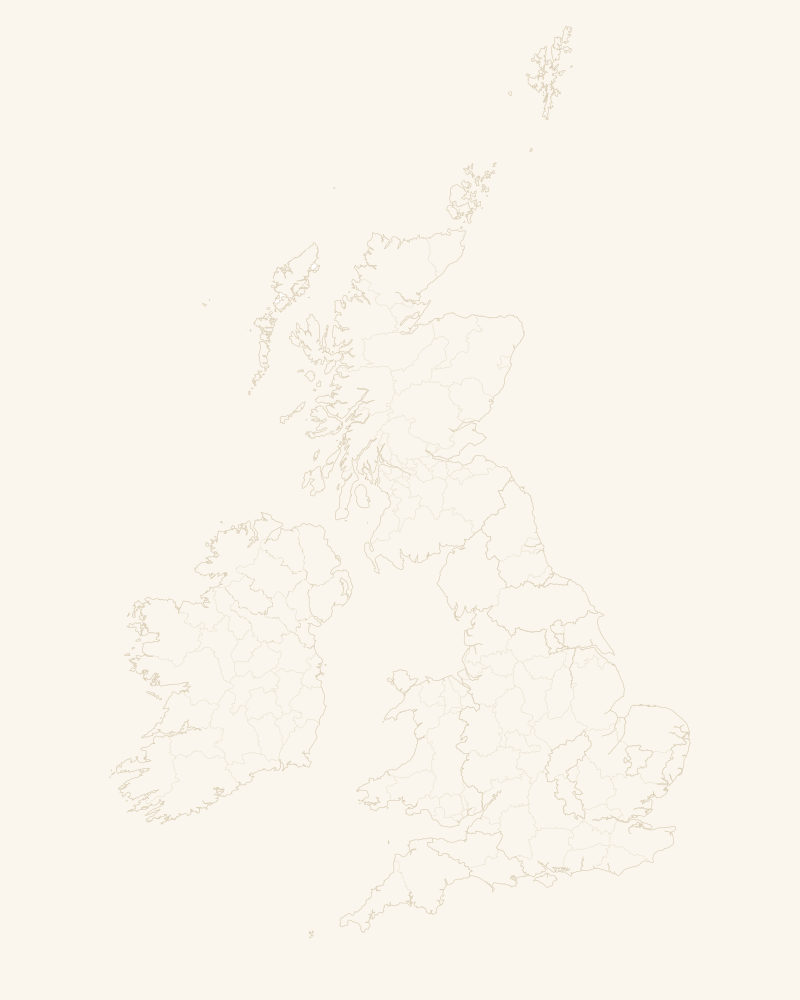
CoreHistoric reach
The seat of Gray
Seat vacantChief
No one leads the Gray community yet. When the movement opens, you can stand for its leadership, or help elect whoever does.
Current mission
No shared goal set yet. Once Gray has leadership, it sets the public focus: a restoration, a gathering, a real-world project that helps its own.
The Gray clan is being rebuilt. Join the waiting list for the movement today, and you help decide who leads it and what it does.
Help rebuild the Gray clan →What does the Gray name mean?
Descriptive, grey-haired or grey-complexioned. The variant spellings Gray (more common in Scotland and the United States) and Grey (more common in England) are equivalent in origin. The Grey family of Howick in Northumberland and the Greys of Wilton produced the political and aristocratic Greys of England, the line headed by the Earls Grey. Both spellings are the same surname, and a family's choice between them tracks region rather than descent.
The history of Gray
Grey hair in a village of Johns and Williams
Gray began as a description of a man's head. The colour word is one of the oldest in the language: the first recorded use of grey as a colour name in English dates to 700 CE, from Old English græg, through Middle English grai or grei, and it is close kin to Dutch grauw and German grau. Even outside the Germanic family the word travelled, with Spanish gris, Italian grigio and Medieval Latin griseus all reckoned to be Germanic loanwords. The standard account of the surname is blunt about where it came from: in most Scottish instances the name Gray is the Scots colour word, cognate with Old English græg, and it was applied to a man probably as a hair colour. Somewhere behind every branch of the name is a person other people described rather than named.
That mattered because medieval Europe was desperately short of given names. Of the boys born in London in 1510, 24.4 per cent were christened John, 13.3 per cent Thomas and 11.7 per cent William; right through the early modern period the three commonest male names covered close to half the male population. English surnames were formed by reference to one thing or another about the individual (his trade, his father's name, where he came from, or how he looked) and at first they were not necessarily inherited at all. The broadest class of all is the cognominal: names that began life as nicknames. Grey sits there, alongside Short, Brown and Schwartzkopf.
It is worth saying that a nickname is not always a straight report. Scholars of naming point out that Short may in some cases have been an ironic byname fastened on a very tall man, and the same caution applies here. Your first Gray may have gone white-headed at thirty, or worn a grey beard into old age when his neighbours did not live to grow one, or had a sallow, grey complexion, or the byname may have been a joke among men who knew exactly what he actually looked like. The sources will not tell you which. What they do tell you is that the description was pointed enough to stick to him, and then to his children, who never had the trait at all.
Grey also carried a social charge that a modern reader misses. In antiquity and through the Middle Ages grey was the colour of undyed wool, and so the colour most commonly worn by peasants and the poor. It was the habit colour of the Cistercians and of the Franciscan and Capuchin friars, worn as a deliberate sign of vows of humility and poverty: the Franciscans in England and Scotland were known simply as the grey friars, and the name still clings to streets and burial grounds across Britain. To call a man Grey in the 13th century was not a neutral act. Because the observation was so obvious it was made independently in village after village, which is why the name is common everywhere and concentrated nowhere, and why most people called Gray or Grey today are not related to one another, still less to the great houses that follow.
Anchetil de Greye and the other road into the name
There is a second, entirely separate root, and it arrived by ship. The English Grey family descends from the Anglo-Norman de Greye family, whose patriarch was Anchetil de Greye (c. 1052 – after 1086), a Norman chevalier and a vassal of William FitzOsbern, 1st Earl of Hereford. The Normans he came with were themselves recent arrivals in France: in 911 the Carolingian ruler Charles the Simple allowed a band of Vikings under Rollo to settle at the mouth of the Seine by the Treaty of Saint-Clair-sur-Epte, in exchange for guarding the coast against other Vikings. Those Northmen gave Normandy and the Normans their name, took the local faith and the local language, and within five generations were the most formidable soldiers in western Europe.
Anchetil de Greye is named among the companions of William the Conqueror at the Battle of Hastings in 1066, and that claim carries more weight than most. Later lists of the Conqueror's companions are notoriously padded with invented names; only about 35 individuals can be reliably placed at Hastings at all, and Anchetil is one of the few who can. His reward is on record. The Domesday Book of 1086 lists him as lord of six manors in Oxfordshire, and one of them kept his name: Greys Court stayed in the family's hands from that Domesday holding until the estate passed to the Crown in 1485, more than four centuries later.
The way this branch of the name was formed is the opposite of a nickname. Family names in England are generally reckoned to have taken hold with the making of the Domesday Book in 1086, first among the feudal nobility and gentry and only slowly downwards through society. Some of the incoming Norman nobility marked themselves out by putting 'de' (of, from) before the name of their village or estate back in France. That is a territorial surname, and it is a direct consequence of feudal landholding: the name says which piece of ground the man answers for. So de Greye is a landholder's badge, while Gray the byname is a neighbour's remark, and the two roads run into the same modern spelling.
The freezing of surnames took centuries. One historian dates the first recorded use of a modern surname inherited across several generations to 1140; by 1400 most English families, and most families in Lowland Scotland, were using hereditary surnames. The change was not universally welcomed. In the late Middle Ages in England compulsory surnames were resisted precisely because people associated them with taxation: a fixed name is what allows a clerk to find you again next year.
Codnor, Wilton and Ruthin: three baronies from one stock
Anchetil's descendants multiplied into baronies. In the 13th century the Greys were ennobled three times over, as Barons Grey of Codnor, of Ruthyn and of Wilton, and the three lines then ran their own courses for centuries. Codnor Castle in Derbyshire was held by Henry de Grey by 1211 and stayed with the Lords Grey of Codnor until the last of that line died without a legitimate heir in the reign of Henry VII. Wilton Castle was held by the Barons Grey of Wilton from 1308 or earlier, and the family's grip on it lasted almost 250 years, until 1557, when William Grey sold the place to raise his own ransom out of French hands.
The Wilton line produced the most consequential of the medieval Greys. Reginald de Grey, 1st Baron Grey de Wilton (c. 1240–1308), son of Sir John de Grey, was one of three commanders appointed by Edward I for the campaign of 1282 against Llywelyn ap Gruffudd, the last native Prince of Wales, the war that ended Welsh independence. His London property, the manor of Portpoole, became Gray's Inn, one of the four Inns of Court, and the surname has sat over the door of the English legal profession ever since.
Out of the conquest of Wales came the family's Welsh lordship. Ruthin Castle in Denbighshire was the base of the de Grey Barons Grey de Ruthyn and the head of their marcher lordship of Dyffryn Clwyd, a border palatinate where the lord, not the king, made the law. Roger Grey, 1st Baron Grey of Ruthin (1298–1353), was a soldier; his descendant Reynold Grey, 3rd Baron Grey of Ruthin (1362–1440), was a marcher lord and governor of Ireland, holding the Welsh march and the Irish lordship in a single lifetime.
Other Greys of these generations turn up wherever the medieval English crown needed a reliable man. Richard de Grey (died 1271) was governor of the Channel Islands and Warden of the Cinque Ports, the two commands that controlled the crossing to France. John de Grey, 1st Baron Grey de Rotherfield (c. 1300–1359), is listed in the Bruges Garter Book as a founding knight of the Order of the Garter and a companion of Edward the Black Prince, and served as Lord Steward of the Royal Household to Edward III: a founder member of the most exclusive order of chivalry in Europe. Walter de Gray made the same climb inside the Church, as prelate and politician, and Walter de Gray Birch, the historian, still carried the name eight centuries later.
The Border Greys of Northumberland
The hardest country the name held was the Anglo-Scottish border, where a castle was not an ornament. A branch of the de Grey family held Heaton Castle from about 1250, rebuilt it as a quadrangular fortress in 1415 and was still patching its walls in the 1580s: three and a half centuries of continuous, grinding maintenance on a house within raiding distance of Scotland. Thomas Grey of Heaton (1384–1415) is remembered instead as a conspirator, and died in the year his family's castle was rebuilt.
Wark on Tweed Castle sat directly on the river frontier, and Sir Ralph Grey held it until he handed control to the crown on the outbreak of war in 1557, the same year another Grey was selling Wilton to buy himself out of a French prison, which gives a fair measure of what the family's wars cost it. Dunstanburgh, the vast coastal ruin in Northumberland, came to the Greys after James I sold the castle in 1604, and they owned it for several centuries afterwards. Chipchase Castle was held by the Greys of Backworth from 1821 to 1861.
The one that endured is Chillingham. It has been the seat of the Grey family since the 15th century, and their descendants hold it still, an unbroken line of possession running from the Wars of the Roses to the present day, which very few families in England can match. For a reader tracing the name in Northumberland, Chillingham is the fixed point: the Greys were not visitors to that county, they were part of its furniture.
Nine days in July 1553
The Greys' closest approach to the throne lasted a fortnight and cost them everything. Henry Grey, 1st Duke of Suffolk, married Frances Grey, Duchess of Suffolk, daughter of Mary Tudor, Queen of France, and their daughter was therefore a great-granddaughter of Henry VII. On that claim, and on her avowed Protestantism, the dying Edward VI named his cousin Lady Jane Grey as his successor. She was queen of England and Ireland from 10 July 1553 until her deposition by Mary I on 19 July: nine days. In February 1554 Jane and her father were both executed for treason.
Her birth date is not certain, which is itself a comment on how quickly the record closes over a young woman: the family record gives 1536 and the standard genealogy of the house gives about 1537, and the sources here do not settle it. What is certain is the scale of the wreck. Gleaston Castle in Lancashire was held by the Grey family right up to the moment Henry Grey, 1st Duke of Suffolk, went to the block in 1554, and it went with him. Jane's younger sister, Lady Katherine Grey (1540–1568), Countess of Hertford, spent much of her short life in confinement for the crime of being next in the same line.
The Suffolk Greys were only the most spectacular of the family's Tudor and late-medieval courtiers. Edmund Grey, 1st Earl of Kent (1416–1490), was a magnate and administrator through the Wars of the Roses; Thomas Grey, 1st Marquess of Dorset (1457–1501), was a courtier at the new Tudor court; Richard Grey (1458–1483) was a soldier and constable of Wallingford Castle. Elizabeth Grey, 5th Baroness Lisle, held a barony in her own right and died in 1519 at fourteen. Anne Grey, Baroness Hussey (c. 1490–1545), carried the name into another great household.
Ireland took a steady stream of them, and rarely gently. John Grey (1387–1459), a soldier of the Hundred Years' War, served as Lord Deputy of Ireland; so did Leonard Grey, 1st Viscount Grane (1492–1551); so did Arthur Grey, 14th Baron Grey de Wilton (1536–1593). Three men of one surname, across a century and a half, sent to govern the same island for the English crown, which is why the name Grey is written deep into Irish records as well as English ones.
The Lords Gray of Foulis, Broughty and Castle Huntly
Scotland has its own Grays, and its own peerage title: Lord Gray, in the Peerage of Scotland, seated in the Carse of Gowrie between Dundee and Perth. Around 1452 Lord Gray of Fowlis built Castle Huntly under licence from James II of Scotland (a royal licence to crenellate was not given to nobodies) and the castle stood in the family's hands until it changed hands in 1614. In 1490 Andrew, 2nd Lord Gray, was granted Broughty, on the north shore of the Tay estuary, and it was he who built the tower house that still guards the river mouth there.
Broughty is where the Scottish Grays enter the national story at its worst moment. In 1547, during the war the Scots remember as the Rough Wooing, Lord Gray of Foulis sold the castle to the English. The Tay was the artery to Dundee and Perth, and handing its lock to an invading army was as consequential a betrayal as a Scottish lord could commit. The site is on this atlas because of it. A family history that only records the honours is not a history; the Grays took the crown's licences and the crown's grants, and in 1547 one of them took an English price.
The line ran on regardless, as Scottish lines do. Patrick Gray, 4th Lord Gray, died in 1584; his grandson Patrick Gray, 6th Lord Gray, died in 1612, the two of them spanning the reign of Mary, Queen of Scots and the union of the crowns. Kinfauns Castle above the Tay came to the Lords Gray through Margaret Blair's marriage in 1741, and it was the 14th Lord Gray who pulled down the old house and built the present castellated mansion there between 1822 and 1826, nearly four centuries after his ancestor got his licence from James II.
The name written into the ground west of Dundee
If you want to stand in Gray country, go to the parish of Liff in Angus, four and a half miles west-north-west of Dundee. The family's name is stamped across the map there: the Den of Gray, Denmill of Gray, where a schoolhouse stood in 1805, Denhead of Gray, on the walking route children took to the railway, and Mains of Gray, which the painter James McIntosh Patrick returned to again and again in canvases such as 'Winter Sunlight, Mains of Gray' and 'Berry Picking, Mains of Gray'. Those are not commemorations. They are simply what the ground was called, because the Grays held it.
Half a mile south of Liff village stands House of Gray, a large neoclassical mansion built by the tenth Lord Gray between 1714 and 1716, one of many houses the family built or owned in that country, alongside Fowlis Castle, Broughty Castle, Castle Huntly and Kinfauns. It was still unfinished in 1722 when John Macky, spy, travel writer and expatriate Scot, came to look at it, and his verdict is the most human line in the whole record of the family: 'The House of Gray is but just building, consisting of a Front and two Wings, in the middle of three Avenues of well-grown Trees; and, when finished, will be one of the prettiest Seats in Scotland: But altho' the Symmetry of the Apartments are exactly just, I am afraid the House will be too big for the Estate.' The architectural historians McKean and Walker call it an excellent example of Scottish architecture in transition, noting its pedimented rectangular block flanked by ogee-capped stair-towers. Its drawings appear in Vitruvius Scoticus, the book of great Scottish houses begun by William Adam in the 1720s and finally published in 1812, and that inclusion has led many people to credit Adam himself with the design; modern scholars generally give it to Alexander McGill, or to McGill working with John Strachan, though the modern editor of Vitruvius Scoticus notes that no supporting evidence for the McGill attribution has ever been offered.
The Grays were still the lords of that parish within living memory of the emigration years. When it became clear in the later 1830s that Liff's 1774 church was unsound (its walls bulging and cracked, its roof sinking), Lord Gray gave land to its south-east and building stone from his own quarry in the Den of Gray, and the church that went up in 1839 at a cost of £2,200 is the one that stands today. Macky's worry proved right in the end. The Gray Estate was broken up in 1918 and House of Gray was sold to James Ogilvie, a Dundee mill owner. It later held evacuated children from the Dundee orphanage during the Second World War, then served a canning company as a soft-fruit store, fell derelict by the mid-1970s, survived two failed restorations between 1978 and 1995, and sat on the Buildings at Risk Register for Scotland. In January 2025 planning permission was granted to turn it into an eighteen-bedroom hotel, and work began in mid-2025. The Cedars of Lebanon in its grounds, already famous by the mid-19th century, are still standing.
Most Grays of that parish were never lords of anything, and their world is on record too. The land had belonged to the Abbey of Scone until the Reformation, after which the abbey feued it out and a kirktown grew up around the church, a clachan whose joint farming gave it a rough social and economic unity. That croft system lasted around 200 years on holdings as small as thirteen or fourteen acres, and in the 18th century it was swept away by the making of large estates; of the neighbouring parish of Fowlis it was written that as the amalgamation went on the crofters' houses were cast down, sixty of them pulled down within living memory, and their occupants forced to seek refuge in towns. By the First Statistical Account of 1791 more than 2,000 acres there were divided into just twelve farms, and the weaving of coarse linen had become the principal employment. That is the pressure that put Grays on ships.
Gray or Grey, and where the name travelled
Diaspora readers usually arrive with one question: is it Gray or Grey, and did my family change it? Both spellings are correct and they mean the same thing. Grey is the dominant form in British and Commonwealth usage and Gray in American usage, but the split only hardened around the 20th century, well after most emigration; in surname terms Gray is the more common form in Scotland and the United States, Grey the more common in England. Families slid between them without ceremony: the western novelist born Zane Gray in 1872 published as Zane Grey. If your ancestor's spelling changed on a passenger list, nothing was lost.
The most famous line of the name is the Greys of Howick in Northumberland, Earls Grey from 1806, one of the central Whig political families of the 18th and 19th centuries. Charles Grey, 2nd Earl Grey (1764–1845), had resigned as foreign secretary in 1807 rather than accept the King's flat rejection of Catholic emancipation, and came back as Prime Minister from 1830 to 1834. His government carried the Reform Act 1832, which widened the parliamentary franchise and swept away the worst of the rotten boroughs, and in 1833 it abolished slavery throughout the British Empire by buying the enslaved out of their owners' hands. He is also, improbably, the reason there is a bergamot tea named after an English earl.
His family kept at it. Henry Grey, 3rd Earl Grey (1802–1894), was a leading politician of the next generation; Albert Grey, 4th Earl Grey (1851–1917), was Governor General of Canada and gave his name to the Grey Cup, still Canadian football's championship. Edward Grey, 1st Viscount Grey of Fallodon (1862–1933), is the longest-serving Foreign Secretary in British history, in post from 1905 to 1916; his policy was the defence of France against German aggression without a binding alliance with Paris, and his most consequential achievement was the Anglo-Russian entente of 1907. He later served as ambassador to the United States. Sir George Grey (1812–1898) carried the name further still, as governor of South Australia, of the Cape Colony, and of New Zealand twice over, which is one reason the surname is thick on the ground in Australasia. Anchitell Grey (1624–1702), MP for Derby, kept the parliamentary diary that is still one of the best records we have of debates in the Restoration Commons, a fitting entry for a family that turns up in the room whenever something is being decided.
Away from politics the name has an unusually good record in books, laboratories and studios. Thomas Gray (1716–1771), born in London, wrote 'Elegy Written in a Country Churchyard' (1751), among the most influential English poems of its century and a forerunner of Romanticism. Henry Gray (1827–1861), surgeon and anatomist, published Gray's Anatomy in 1858; he died at thirty-four, and the book has never been out of print since. Stephen Gray (1666–1736) was an English astronomer and natural philosopher; Asa Gray (1810–1888) became America's foremost botanist; Elisha Gray was an electrical engineer at the birth of the telephone; Nigel de Grey (1886–1951) was a British codebreaker. Maria Georgina Grey (1816–1906) campaigned for the education of girls. Eileen Gray was an Irish furniture designer and architect of the first rank, Beryl Grey (1927–2022) an English ballerina, Alasdair Gray (1934–2019) a Scottish novelist and artist, and Marion Cameron Gray (1902–1979) a Scottish mathematician with a graph named after her. From an Oxfordshire manor in Domesday, from the Carse of Gowrie, from the Northumberland border and from a hundred villages where somebody simply looked grey, the name reached Ohio and Otago. The plain grey byname and the Norman lord's badge ended in the same spelling, and both are yours to claim.
Champions of the Gray name
The bearers whose lives are inseparable from this surname. Each has their own page, biography, achievements, geography, connection to the family.
Historic Places, Rebuilt
Explore the streets and seats the Gray name knew, rebuilt with AI as they stood in history.
Castles the Gray held
Strongholds this name held for a decade or more, look one up, or rebuild it to explore.
- Chillingham Castle
Seat of the Grey family from the 15th century; their descendants hold it still.
- Dunstanburgh Castle
Owned by the Grey family for several centuries after James I sold the castle in 1604.
- Greys Court
Held by the Grey family from Anchetil de Greye's Domesday manor of 1086 until the estate passed to the Crown in 1485.
- Ruthin Castle
Base of the de Grey Barons Grey de Ruthyn and the head of their marcher lordship of Dyffryn Clwyd.
- Broughty Castle
Granted to Andrew, 2nd Lord Gray, in 1490, who built the tower house; Lord Gray of Foulis sold it to the English in 1547.
- Kinfauns Castle
Held by the Lords Gray from Margaret Blair's 1741 marriage; the 14th Lord Gray built the present castle, 1822–26.
- Castle Huntly
Built around 1452 by Lord Gray of Fowlis under licence from James II of Scotland; the castle changed hands in 1614.
- Codnor Castle
Held by the Lords Grey of Codnor from Henry de Grey, by 1211, until the last of the line died without a legitimate heir in the reign of Henry VII.
- Chipchase Castle
Held by the Greys of Backworth, 1821–1861.
- Wilton Castle
Held by the Barons Grey of Wilton from 1308 or before until 1557, when William Grey sold it to pay his French ransom.
- Wark on Tweed Castle
Held by Sir Ralph Grey, who passed control to the crown on the outbreak of war in 1557.
- Heaton Castle
Held by a branch of the de Grey family from about 1250; they rebuilt it as a quadrangular castle in 1415 and attempted repairs into the 1580s.
- Gleaston Castle
Held by the Grey family until Henry Grey, 1st Duke of Suffolk, was executed for treason in 1554.
The castles of the homeland
The great strongholds of the homeland, look one up, see what it looked like in its prime, and recreate it to explore.
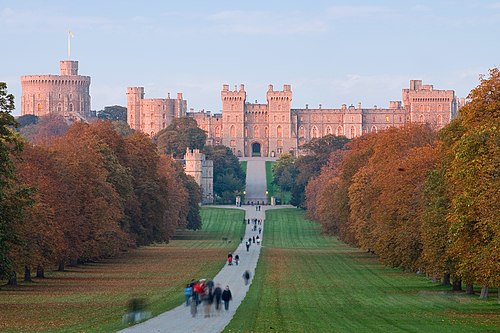 Windsor CastleRestored · prime 1820
 Tower of LondonRestored · prime 1285
 Bamburgh CastleRestored · prime 1904
All castles in England → · Strongest castles in England → · Castles of Europe
Play As Your Clan
Hold a real castle against whatever you choose to send at it, take a ship out in her own service years, or stand at the shoulder of someone the record remembers. The chronicler sets the scene; the deeds are yours.
Notable bearers of the Gray name
- Charles Grey, 2nd Earl Grey (1764–1845), Prime Minister; the Reform Act 1832
- Thomas Gray (1716–1771), poet, 'Elegy Written in a Country Churchyard'
- Henry Gray (1827–1861), anatomist, Gray's Anatomy
- Lady Jane Grey (1536–1554), Nine Days' Queen