Robinson
Son of Robin, the Danelaw's favourite -son, and the first woman President of Ireland.
- Origin
- Yorkshire & the Humber, England
- Famous bearer
- Mary Robinson (b. 1944), seventh President of Ireland 1990–1997
- Register
- English family
The Robinson arms and country

Coat of armsArms of RobinsonJonas Magnus Lystad · CC BY-SA 4.0 
Coat of armsArms of Robinson, Baron MartonmereBorne by Baron Martonmere: the ennobled line of the name, not the name at large.MostEpic · CC BY-SA 4.0


- Coat of arms: Granted to an individual and inherited down that one documented line. These are the arms of particular families of the name, not of everyone who shares the surname.
This name is thick on both sides of the border, so the map shows the whole of Britain and Ireland with every region it touches highlighted. It is a regional pattern for the surname, not proof that your branch lived in each place.
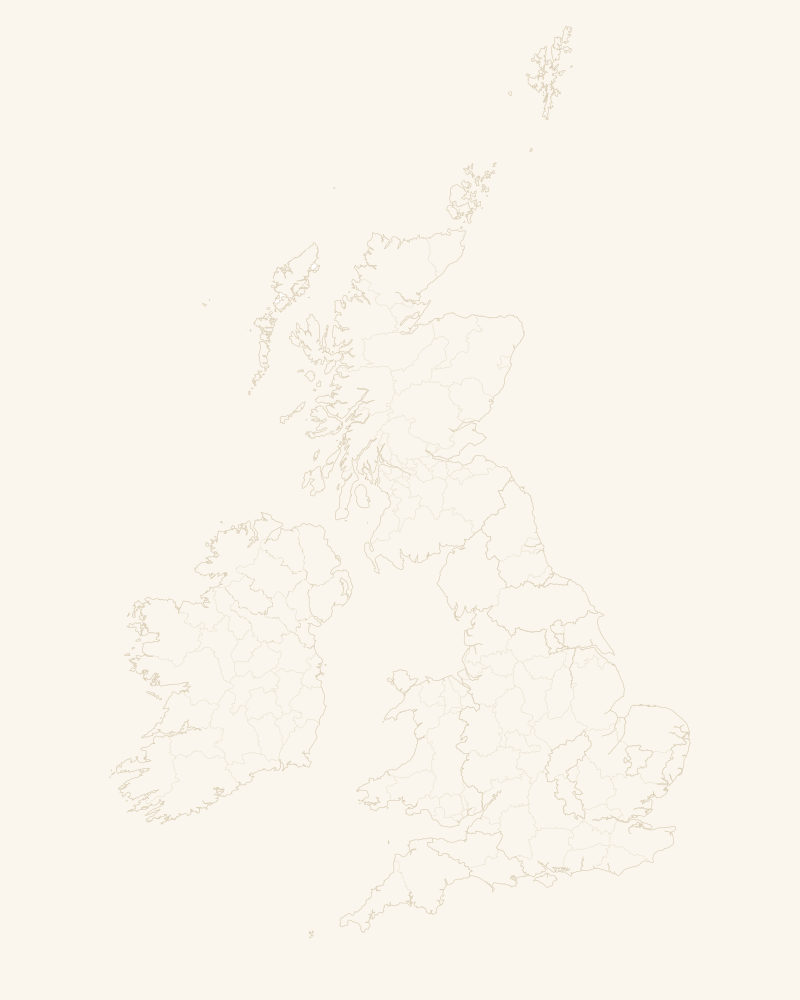
CoreHistoric reach
The seat of Robinson
Seat vacantChief
No one leads the Robinson community yet. When the movement opens, you can stand for its leadership, or help elect whoever does.
Current mission
No shared goal set yet. Once Robinson has leadership, it sets the public focus: a restoration, a gathering, a real-world project that helps its own.
The Robinson clan is being rebuilt. Join the waiting list for the movement today, and you help decide who leads it and what it does.
Help rebuild the Robinson clan →What does the Robinson name mean?
Son of Robin, Robin a diminutive of Robert. Northern England favours -son patronymics where Welsh lines often read Roberts. The Irish-Robinson pool, by the 1660s Cromwellian-Williamite planter migrations, is principally an Anglo-Irish Protestant settler-family surname concentrated in the Pale counties and Ulster.
The history of Robinson
Robin, the little Robert, and the two surnames he made
Robinson is the son of Robin, and Robin was not a name anyone was christened. It is the household form of Robert, the shortening a family used at the door and across a yard, and the surname is built on that rather than on the baptismal name itself. Robert had arrived with the Norman settlement, one of the French names that displaced the Anglo-Saxon stock once Anglo-Norman became the language of the ruling class. Robinson is a patronymic at one remove: an English ending fastened to a French pet form of a Germanic name.
One font-name, two surnames, and which of them a household ended with depended on where a clerk first wrote it down. In the northern English counties the tie between father and son was made with -son, and Robin's son hardened into Robinson. Across the Welsh border the same Robert took the short English -s instead and produced Roberts, a form that can mark the servant of a Robert as readily as the son of one. Robinson carries no such doubt: it names a father, and nothing else.
The English weight of the name is northern and has stayed northern. Robinson runs thick through York and the three Ridings of Yorkshire, up into Northumberland and Tyneside, and through Durham and Wearside down to the Tees, the counties where -son patronymics run thickest. Its wider footprint runs west into Cumbria and Lancashire, down the Midland shires and south through the home counties into London.
One thing has to be said plainly about the name in America. Many African American family names have their origin in slavery, where a surname was assigned by an enslaver rather than inherited down a European line, and Robinson is one of the names carried by both routes. Those families' histories are real, and they are not the history of this English name. This page follows the European ancestral line.
The planters' Robinsons, the Pale and Ulster
There is a second pool of English Robinsons, and it is in Ireland. The name arrives there with the Cromwellian and Williamite plantations, the migrations that from the 1660s onward moved English Protestant families onto Irish land, and it settled principally in the counties of the Pale and in Ulster. An Irish Robinson is therefore usually Anglo-Irish rather than Gaelic, a settler surname on Irish ground rather than a native one.
That settler layer is what eventually put the surname at the centre of Irish public life, although not by descent. Nicholas Robinson, of an Anglo-Irish legal family of the name, was practising as a solicitor when he married a young barrister from County Mayo in 1970. Her name was Mary Bourke; Robinson is the surname she took on marrying him, not one she was born to, and she carried it into the highest office of the Irish state and then into the chief human-rights post of the United Nations.
Victoria House, Ballina, and a Trinity chair at twenty-five
Mary Therese Winifred Bourke was born on 21 May 1944 at Victoria House in the centre of Ballina, County Mayo, the daughter of two doctors: Aubrey Bourke of the Ballina practice and Tessa O'Donnell of Carndonagh in Inishowen. Her family held most of the strands of Irish politics at once. One ancestor had been a leading activist in the Irish National Land League of Mayo and the Irish Republican Brotherhood, while an uncle, Sir Paget John Bourke, was knighted by Queen Elizabeth II after a career as a judge in the Colonial Service.
She went from Mount Anville in Dublin to read law at Trinity College, and because the Catholic Church's ban on Catholics attending Trinity was still in force her parents first had to ask Archbishop McQuaid for permission. She was one of three women in her class, was elected a scholar in 1965 and took first-class honours in 1967. Her inaugural address as auditor of the Dublin University Law Society that year told the room what the next thirty years would be about: take the prohibition of divorce out of the Constitution, end the ban on contraceptives, decriminalise homosexuality and suicide. She was called to the Irish Bar in 1967, took an LL.M at Harvard in 1968, and in 1969, aged twenty-five, was made Reid Professor of Criminal Law at Trinity and elected to Seanad Eireann as an independent senator for the university.
Twenty years in the Seanad, and the cases that moved the law
She sat in the Seanad from 1969 to 1989, served on Dublin Corporation from 1979 to 1983, joined the Labour Party in 1976 and left it in 1985, and did her most durable work in court rather than in the chamber. Her own account of what she was for was unhedged: to separate Catholic teaching from the criminal law, and so reform the law on contraceptives, legalise homosexuality and change the constitutional ban on divorce.
The cases came one after another. She argued McGee v. Attorney General before the Supreme Court in 1973, at twenty-nine, and won married couples the constitutional right to import contraceptives. De Burca v. Attorney General in 1976 opened jury service to women. Norris v. Attorney General in 1980 was the first assault on the criminalisation of homosexuality, and David Norris carried it on from there to the European Court of Human Rights in 1988. Through the 1980s she campaigned for the Status of Children Act and for the constitutional amendment on divorce, and she was joint Senior Counsel on a large share of the major Irish constitutional cases of the 1970s and 1980s.
Some of it was quieter and just as sharp. The widows of politicians drew a pension where the widowers did not, so she took a discrimination case to the Labour Court on behalf of her own husband and won it on 12 May 1979. In July 1979 she went to court for a couple taxed more heavily married than single, and after the state appealed their win the Supreme Court decided for them in April 1980. She secured the right to legal aid in civil cases, and Ireland's entry into the European Economic Community delivered two of her objects outright: equal pay for women in the public service from June 1973, and the lifting of the civil service marriage bar the month after. On 23 May 1989 she announced that she would not seek re-election.
Every parish hall in the country, November 1990
The 1990 presidential election was not expected to produce her. She took the Labour nomination over the former Minister for Health Noel Browne by four to one, added the Workers' Party, strong among working-class voters in Dublin and Cork, and had The Irish Times behind her. Fianna Fail ran the Tanaiste Brian Lenihan, the clear favourite after three decades in politics; Fine Gael ran Austin Currie. Nominated first, and the first woman ever nominated, she used the head start to cover more ground than either of them, on foot, hall by hall, the length of the country.
Lenihan led the first count with 44 per cent of first preferences to her 39. Currie's transfers went where transfers against Fianna Fail were expected to go, and on 7 November 1990 she was elected on the second count as the seventh President of Ireland. She was the first woman to hold the office, the first to win a contested presidential election without Fianna Fail support, and the first to win from second place on first preferences. RTE broadcast her victory speech live in place of the Angelus, and her first television interview as President-elect was on the children's programme The Den.
A light in the window, a handshake at Clonard
She was inaugurated on 3 December 1990 and set about using an office that had been largely ceremonial. She put a lamp in the window of Aras an Uachtarain and kept it burning for the emigrants, a small thing that became what the diaspora knew her for. In 1992 she travelled to Somalia in the famine and went on to the United Nations to report what she had found; in 1994 she went to Rwanda. In each case she was the first head of state to go.
In the summer of 1993 she did two things no Irish president had done. On 27 May she became the first serving President of Ireland to visit the United Kingdom, meeting Queen Elizabeth II at Buckingham Palace. Weeks later, in June, she went to west Belfast and shook hands with Gerry Adams of Sinn Fein at Clonard Monastery. The Tanaiste, Dick Spring, had advised against it and his disapproval was well circulated in the Irish press, but the government would not formally instruct her and she went. On her visits north she met the others too, David Trimble of the Ulster Unionists and John Hume of the SDLP among them.
As President she signed into law the measures she had spent a career arguing for: the full liberalisation of contraception, the decriminalisation of homosexuality in 1993 with an equal age of consent that much of the world had not then managed, and the legalisation of divorce in 1996. She addressed the Oireachtas twice, where only two such addresses had been delivered in the previous fifty-two years. Her approval rating reached 93 per cent, the highest any Irish president has held, and Brian Lenihan said before his death that she was a better President than he could have been.
Geneva, the Elders, and climate justice
She resigned the presidency on 12 September 1997, a few weeks short of the end of her term, to become United Nations High Commissioner for Human Rights. Kofi Annan had head-hunted her with a purpose: the post had grown administrative, and he wanted it to speak. She set out her intentions in the Romanes Lecture at Oxford that November, became in 1998 the first High Commissioner to visit Tibet, and criticised both the Irish permit system for non-EU immigrants and the use of capital punishment in the United States. She had meant to serve four years and stayed five at Annan's request, to preside over the 2001 World Conference against Racism at Durban, leaving the office in 2002.
Everything since has been the same work with no state behind it. She founded Realizing Rights: the Ethical Globalization Initiative, ran it to its planned close in 2010, and then established the Mary Robinson Foundation: Climate Justice, which argues the case of the populations hurt first and worst by a warming they did least to cause. She was Chancellor of the University of Dublin from 1998 to 2019, the first woman in the post, and was succeeded there by Mary McAleese. She was a founding member of the Elders alongside Nelson Mandela, Graca Machel and Desmond Tutu and took their chair on 1 November 2018, and Ban Ki-moon sent her as special envoy to the Great Lakes region of Africa in 2013 and for climate change in 2014.
A house full of illustrators at Stroud Green
The English Robinson the English know best is a cartoonist, and he was born into the trade. William Heath Robinson was born at Hornsey Rise in London on 31 May 1872, into a family of artists at Stroud Green in Finsbury Park. His grandfather Thomas, his father Thomas Robinson (1838-1902) and his brothers Thomas Heath Robinson (1869-1954) and Charles Robinson (1870-1937) all worked as illustrators, and his uncle Charles illustrated for The Illustrated London News. Three generations of one household drew for a living.
He began where the family had begun, on books: Hans Christian Andersen's Danish Fairy Tales and Legends in 1897, The Arabian Nights in 1899, Charles Kingsley's The Water-Babies in 1915, Walter de la Mare's Peacock Pie in 1916. Percy Bradshaw picked him as one of twenty leading illustrators for The Art of the Illustrator in 1917 and 1918, and he taught by post at Bradshaw's Press Art School, commenting on the work students sent in. He wrote and illustrated three children's books of his own, and the first, The Adventures of Uncle Lubin of 1902, is where the unlikely machines begin.
Kettles, knotted string, and the machine at Bletchley
What he drew was elaborate contrivances for achieving almost nothing. The machines ran on steam boilers or kettles heated by a candle, were threaded with complicated pulleys and knotted string, and were kept going by balding, bespectacled men in overalls. Absurdities, his own 1934 selection of favourites, offers a simple apparatus for removing a wart from the top of the head, a method of resuscitating stale railway scones for redistribution at station buffets, and a multimovement tabby silencer that threw water at serenading cats. Through the First World War he turned out cartoons of ever more improbable secret weapons for the combatants, and in 1935 the Great Western Railway gave him a free hand to reimagine its own history as the ninety-six page Railway Ribaldry.
The name then came loose from the man. The earliest citation in the Oxford English Dictionary of Heath Robinson as a noun, meaning any unnecessarily complex and implausible contrivance, is from 1917, while he was still drawing them, and the phrase lasted because Britain spent the next war short of everything and making do and mending. A Heath Robinson contraption is a temporary fix got up out of ingenuity and whatever is to hand, usually string and tape. The United States coined Rube Goldberg for the same idea and Denmark had Storm Petersen. Very few cartoonists are given a common noun.
His own life was quieter than his machines. He married Josephine Latey, daughter of the newspaper editor John Latey, in 1903, moved to Pinner in Middlesex in 1908 and to Cranleigh in Surrey in 1918, and had five children. Too old to enlist in the First World War, he took on two German prisoners of war to garden for him after the Armistice. He was working on illustrations for Lilian M. Clopet's Once Upon a Time when he died in September 1944, and he is buried in East Finchley Cemetery. Two things outlasted him. One of the automatic analysis machines built at Bletchley Park to help break German message traffic was named Heath Robinson in his honour, and it was the direct predecessor of Colossus, the world's first programmable digital electronic computer. The other is the Heath Robinson Museum, opened at Pinner in October 2016, close to where he lived and worked, holding nearly a thousand of his originals.
Champions of the Robinson name
The bearers whose lives are inseparable from this surname. Each has their own page, biography, achievements, geography, connection to the family.
Also found in
The Robinson name has substantial historical presence beyond England. See it on Ireland.
Historic Places, Rebuilt
Explore the streets and seats the Robinson name knew, rebuilt with AI as they stood in history.
The castles of the homeland
The great strongholds of the homeland, look one up, see what it looked like in its prime, and recreate it to explore.
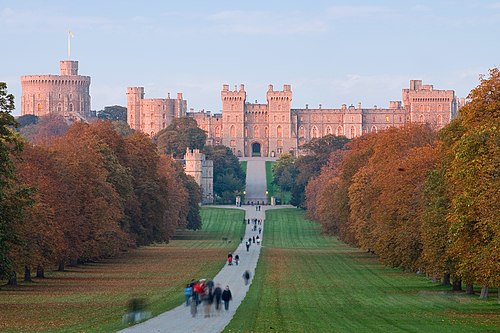 Windsor CastleRestored · prime 1820
 Tower of LondonRestored · prime 1285
 Bamburgh CastleRestored · prime 1904
All castles in England → · Strongest castles in England → · Castles of Europe
Play As Your Clan
Hold a real castle against whatever you choose to send at it, take a ship out in her own service years, or stand at the shoulder of someone the record remembers. The chronicler sets the scene; the deeds are yours.
Notable bearers of the Robinson name
- Mary Robinson (b. 1944), seventh President of Ireland 1990–1997
- W. Heath Robinson (1872–1944), cartoonist