Hall
At the hall.
- Origin
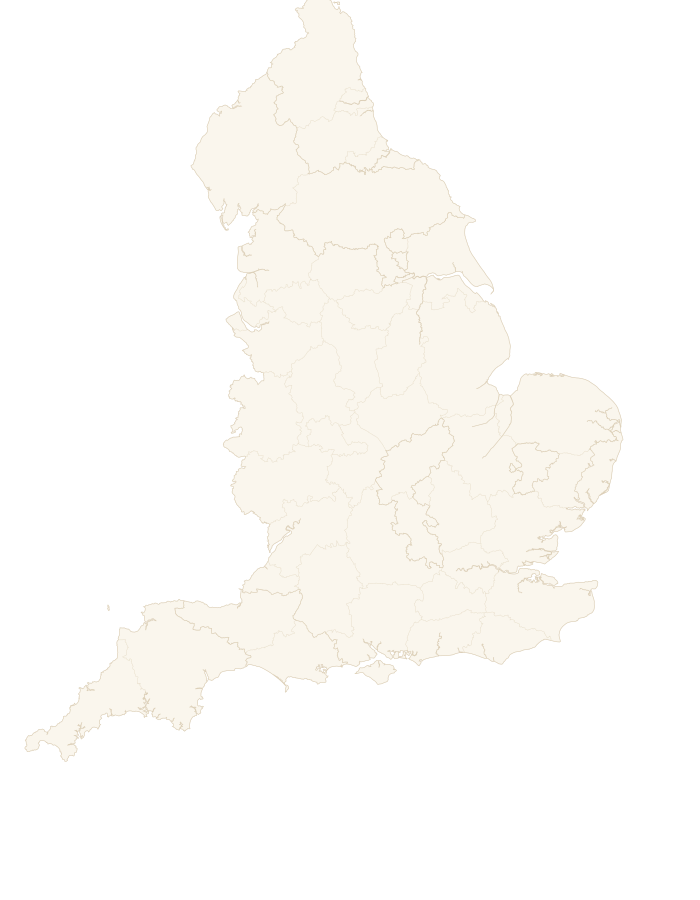
- North West, England
- Famous bearer
- Radclyffe Hall (1880–1943), novelist, The Well of Loneliness
- Register
- English family
The Hall tartan and country

TartanTartan HallAtlas D Hall · OGL v1.0

- Tartan: The checked cloth the family is known by.
What is the Hall clan tartan?
One Hall sett is recorded, and it is the swatch above. A sett is the block of coloured bands the cloth is built from, repeated in both directions; the whole plaid is that one square enlarged.
Hall is an English name, and the sett is a Scottish invention. Tartan registration grew outward from the Highlands to cover surnames carried well beyond them, and a weaver who could sell a Hall tartan sold one: some of these setts are Victorian and some were designed within living memory. That is how most names outside the Highlands came by a sett at all. Nobody polices any of it. Wearing the Hall sett declares allegiance to the name, not descent from any particular line of it.
CoreHistoric reach
The seat of Hall
Seat vacantChief
No one leads the Hall community yet. When the movement opens, you can stand for its leadership, or help elect whoever does.
Current mission
No shared goal set yet. Once Hall has leadership, it sets the public focus: a restoration, a gathering, a real-world project that helps its own.
The Hall clan is being rebuilt. Join the waiting list for the movement today, and you help decide who leads it and what it does.
Help rebuild the Hall clan →What does the Hall name mean?
Locative or servile, living at or working in the lord's hall. Old English heall.
The history of Hall
The room the whole household slept in
In the Iron Age and the early Middle Ages in northern Europe, the mead hall was where a lord and his retainers ate and also slept. The hall held the hearth, and everyone in the house ate, worked and slept in it. In a later medieval castle or manor house it was simply the largest room in the building, usually immediately inside the main door, and the servants still bedded down there.
Heating and privacy broke it up. The master withdrew into his own bedchamber, then servants and children were given quarters, then the kitchen went out into a building of its own. Until the early modern era most people in England still lived in one room; only in the 17th century did the lower classes commonly gain a second, the hall and parlour plan that stayed in use in parts of the United States from 1620 to 1860.
A man known by the building he belonged to
Hall is a locative name and, very often, a servile one: the man living at or working in the lord's hall, from Old English heall. Early English surnames referred to some aspect of the individual, his trade, his father's name, his birthplace or his appearance, and were not at first inherited. Hall is the sharpest of the habitation names, because it names not a village but one building inside it, the biggest one, and the man whose working life was organised around it. English servants also took names from an employer or his office, which is where Vickers, the vicar's man, comes from.
The record shows the same name in three languages. In Scotland it was written in Latin as de Aula, "of the hall": Waldeu de Aula witnessed a charter by Walter de Veteri Ponte before 1200. A century on, John of the Hall sat on an inquest made at Berwick in 1302, and about 1311 Thomas dictus del Halle, Thomas called of the hall, witnessed a resignation of land at Grenryg in the barony of Lesmahagow. One job, three clerks, one surname.
Why there was a hall to be named after
England filled with lordly halls, and with the households that ran them, because of 1066. William, crowned at Westminster Abbey on 25 December 1066, dispossessed English landowners in favour of his continental followers; historians put the Norman landholders at around 8,000, and the Domesday Book of 1086 records only about 5 per cent of land south of the Tees still in English hands. Land was now held directly from the king for military service, and every holder needed a hall to run his land from.
Family names in England are generally dated to that same survey. Norman incomers put de before their village or estate in France, a territorial surname made by feudal landownership, and the habit worked down the social order until, by 1400, most English families and those of Lowland Scotland had hereditary surnames. Hall belongs to that spread from the other end of the room: not the lord's name, the household's.
A long-repeated tradition instead descends the English Halls from Earl Fitzwilliam of Greatford Hall in Lincolnshire, whose younger son Arthur was called Hall to distinguish him from his elder brother and is on record about 1090. Read that as tradition, not record; the earliest Halls who can be pointed at are the charter witnesses above. Others carry Scandinavian bynames out of the Danelaw that converged on the same spelling. A residence name this ordinary was coined many times over by unrelated families, which is why so many Halls are not cousins.
The riding Halls of the Border
One body of Halls is a family in the full sense. In northern England and southern Scotland they became one of the sixty major riding families of the English and Scottish Marches, the militarised frontier that took in the Debatable Lands. Their traditional homes were Redesdale, East Teviotdale and Liddesdale, with others at Garvald, Glasgow and Perth, and large numbers over the line in what is now Northumberland, where the name is still common.
They rode. Like the other frontier surnames they took part in the cross-border raids for cattle and other property known as reiving, and held themselves loyal to neither crown, the family name holding allegiance over all else. That is the distinction that matters here: the ordinary English Hall is named for service in another man's great house, the Border Hall is a riding surname, a kindred that put its own name above two kingdoms.
The ballad "The Death of Parcy Reed" remembers them harshly. Members of Clan Hall betrayed Parcy Reed, the Laird of Troughend, and stood idly by while the Crosiers murdered him, which fixed their name as one of the most notorious on the Border.
Halls who came to hold halls of their own
Thomas de Aula, a surgeon, became the first Hall of Fulbar in Renfrewshire when Robert II granted him land in the tenement of Staneley, barony of Renfrew, in 1370 for faithful service. Read the name literally and the moment is a good one: a man whose surname said he belonged to another man's hall was given ground to keep his own.
It happened more than once. Fast Castle, on its stack of rock above the Berwickshire coast, passed finally to the Halls. Sir John Hall of Dunglass, Lord Provost of Edinburgh in 1689, held Craigcrook Castle from 1669 to 1682. In Ireland the Halls bought Narrow Water Castle in the 1670s, occupied the tower until the early 19th century, and still hold the 19th-century mansion beside it: three and a half centuries of one family on the same ground.
Where the Halls went
From the 16th century the name travelled with the emigrations out of England and Scotland, and travelled well. Hall is the 17th commonest surname in England and Wales, with about 181,000 bearers, and the 24th in the United States, where an estimated 494,000 Halls outnumber the whole population of Bristol. Nowhere are they thicker on the ground than Australia: one family in 582 in Melbourne, one in 590 in Canberra, one in 601 in Sydney.
Marguerite Radclyffe Hall (1880–1943), known as John, wrote The Well of Loneliness (1928), the foundational English-language lesbian novel; its suppression at the Bow Street magistrates' court in November 1928 effectively defined British literary censorship for the next thirty years. Joyce Hall reached Kansas City in January 1910, a Nebraska postcard salesman with two shoeboxes of greeting-card stock under his arm, and over sixty-five years built Hallmark Cards into the largest greeting-card company in the world. Sir Peter Hall, a station-master's son from Bury St Edmunds, founded the Royal Shakespeare Company at Stratford-upon-Avon in 1960 and directed the National Theatre from 1973 to 1988. A name that began among the servants of the great house ended by naming the men who built the halls a country now sits in.
Champions of the Hall name
The bearers whose lives are inseparable from this surname. Each has their own page, biography, achievements, geography, connection to the family.
- Joyce Hall
The Nebraska postcard salesman who in January 1910 arrived in Kansas City with two shoeboxes of greeting-card stock under his arm and across the next sixty-five years built Hallmark Cards into the largest greeting-card company in the world, the foundational firm of the modern American greeting-card industry.
- Sir Peter Hall
The Bury St Edmunds station-master's son whose 1960 founding of the Royal Shakespeare Company at Stratford-upon-Avon and his fifteen-year directorship of the National Theatre from 1973 to 1988 made the two foundational institutional structures of the modern English-language classical theatre.
Historic Places, Rebuilt
Explore the streets and seats the Hall name knew, rebuilt with AI as they stood in history.
Castles the Hall held
Strongholds this name held for a decade or more, look one up, or rebuild it to explore.
- Fast Castle
The castle passed finally to the Hall family.
- Craigcrook Castle
Home of Sir John Hall of Dunglass, Lord Provost of Edinburgh in 1689, from 1669 to 1682.
- Narrow Water Castle
The Halls bought the castle in the 1670s, occupied the tower until the early 19th century, and still hold the adjacent 19th-century mansion as a private residence.
Castles that share the Hall name
The same name on the map, look one up, see what it looked like in its prime, and recreate it to explore.
 Workington HallRuin · prime 1785
 Costessey HallDemolished · prime 1836
 Morley Old HallStill standing · prime 1600
All castles in England → · Strongest castles in England → · Castles of Europe
Play As Your Clan
Hold a real castle against whatever you choose to send at it, take a ship out in her own service years, or stand at the shoulder of someone the record remembers. The chronicler sets the scene; the deeds are yours.
Notable bearers of the Hall name
- Radclyffe Hall (1880–1943), novelist, The Well of Loneliness