Wood
By the wood.
- Origin
- West Midlands, England
- Famous bearer
- Sir Henry Wood (1869–1944), Proms founder
- Register
- English family
The Wood arms, crest badge, tartan and country

Crest badgeClan member crest badge - Clan WoodCeltus · CC BY-SA 3.0 
TartanWood TartanDeadcanary 82 · CC BY-SA 4.0 
Coat of armsWood (of Enfield, Middlesex) armsBorne by the Enfield line, one branch of the name rather than all of it.Lobsterthermidor · CC BY-SA 3.0 
Coat of armsCoat of arms of the Wood baronets of Hatherley House (1837)Borne by the Hatherley House line, one branch of the name rather than all of it.Unknown engraver · Public domain


_arms.svg)
.jpg)
- Crest badge: The chief's crest inside a belt and buckle: the badge a clansman wears to show whose following he is in.
- Tartan: The checked cloth the family is known by.
- Coat of arms: Granted to an individual and inherited down that one documented line. These are the arms of particular families of the name, not of everyone who shares the surname.
What is the Wood clan tartan?
One Wood sett is recorded, and it is the swatch above. A sett is the block of coloured bands the cloth is built from, repeated in both directions; the whole plaid is that one square enlarged.
Wood is an English name, and the sett is a Scottish invention. Tartan registration grew outward from the Highlands to cover surnames carried well beyond them, and a weaver who could sell a Wood tartan sold one: some of these setts are Victorian and some were designed within living memory. That is how most names outside the Highlands came by a sett at all. Nobody polices any of it. Wearing the Wood sett declares allegiance to the name, not descent from any particular line of it.
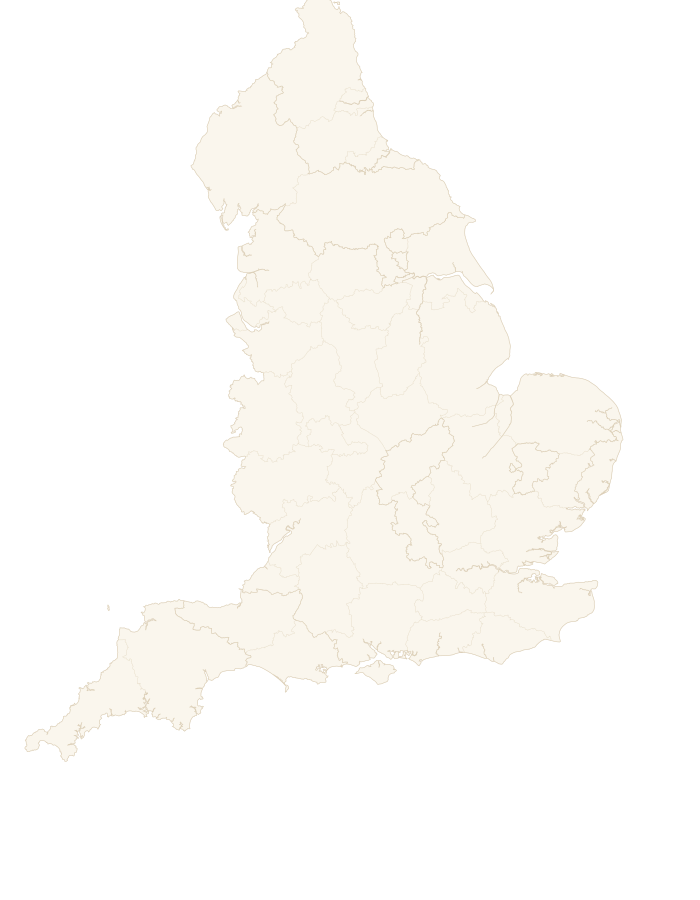
CoreHistoric reach
The seat of Wood
Seat vacantChief
No one leads the Wood community yet. When the movement opens, you can stand for its leadership, or help elect whoever does.
Current mission
No shared goal set yet. Once Wood has leadership, it sets the public focus: a restoration, a gathering, a real-world project that helps its own.
The Wood clan is being rebuilt. Join the waiting list for the movement today, and you help decide who leads it and what it does.
Help rebuild the Wood clan →What does the Wood name mean?
Locative, the wood. Old English wudu.
The history of Wood
The man they called de la Wode, Hertfordshire 1242
The oldest form of the name in the English record is not Wood at all but de la Wode, entered against a Hertfordshire tenant in 1242, literally "of the wood", a clerk's shorthand for a man whose holding sat at the treeline rather than on the village street. Behind it lies Middle English wode, from Old English wudu, from the Proto-Germanic widu: the ordinary word for standing timber and for the ground it covered. It said where a man lived and what he lived beside, and in a manor court that was identification enough.
A second and much rarer Wood came from an insult. Old English wōd and Middle English wode meant frenzied, wild, out of one's senses, and the man set down as le Wode in Worcestershire in 1221 (twenty-one years before the Hertfordshire tenant) was being labelled, not located. The two roots collapsed into a single spelling within a few generations, which is why no Wood line can claim the name means only one thing: most ancestors were named for the trees, a few for their temper.
Why the clerks wrote it de Bosco
The name was fixed in an age when the men who wrote it down did not write English. After 1066 the language of official documents moved from Old English to Latin and the ruling class spoke Anglo-Norman, so a Norman scribe recording a wood-dweller's byname reached for his own vocabulary and produced de Bosco, from the Old French bois. The same family could stand as atte Wode on one roll and de Bosco on the next, with no change of blood, only a change of clerk.
The wood was newly a legal thing to live beside, too. William's government imported the forest laws, setting aside great tracts of England as royal forest where the king's deer and the king's timber outranked the tenant's plough, and the Domesday survey of 1086 catalogued who held what, wood and waste included. To be named for the wood in that century was to be named for a jurisdiction as much as for trees, a boundary a man could be fined for crossing.
A surname a thousand villages invented separately
Hereditary surnames entered England from the top. The Norman incomers marked themselves with de and the name of a Norman village or an English estate; the habit spread from the feudal nobility and gentry downward, and by the fourteenth century most English and most Scottish people carried a surname, with Wales following only after the union under Henry VIII in 1536. In late-medieval England fixed names were also resisted in places, on the suspicion that they were an instrument of taxation.
Because the wood was everywhere, so was the byname. Wood was coined independently in every county that had trees and a clerk, which is how it comes to stand 26th among surnames in England, Wales and the Isle of Man, 53rd in Scotland and 78th in the United States with no single founding line behind those numbers. The four-year study led by the University of the West of England, published in 2016 as the Oxford English Dictionary of Family Names in Britain and Ireland, traced 45,602 surnames and found over 90 per cent of them native to Britain and Ireland; its leader Richard Coates ranked names taken from a place (a hill, a village green, a wood) beside Smith and Baker as one of the founding classes.
Greenwood, Underwood and the rest of the kit
Wood worked as a building block as much as a name. It heads Woodward, Woodhouse, Woodman, Woodcock, Woodruff and Woodstock, and tails Greenwood, Eastwood, Westwood, Northwood, Underwood, Hazelwood, Inglewood and Kirkwood: each one a different family in a different wood, and none of them a branch of Wood. Woodd, Woode, Wode and Woods are the same name written by different hands; the compounds are not.
Emigration added a layer the English rolls cannot show. Wald, the German equivalent, was routinely anglicised to Wood by German-speaking emigrants settling in the United States, Canada, Australia and South Africa, so a diaspora Wood may descend from a Hessian forest rather than a Hertfordshire one: the same word, translated instead of inherited. Wald survives unchanged among the families who never made the crossing.
Two hundred and twenty-seven years of a ruin at Middleham
In 1662 the Wood family bought Middleham Castle in Wensleydale, one of the great fortresses of the north: begun in 1190 by Robert Fitzrandolph, third lord of Middleham and Spennithorne, to watch the road from Richmond to Skipton, and carrying a keep of 105 feet by 78, among the largest in England though it rises only two storeys. The Nevilles held it from 1270, and Richard Neville, Earl of Warwick, the Kingmaker, raised the boy who became Richard III in his household there after Wakefield in 1460.
What the Woods bought was already a shell. Henry VII seized it after Bosworth in 1485 and it stayed in royal hands until the reign of James I; under Elizabeth I, Lord Huntingdon proposed pulling it down and building a manor house out of the pieces. Sir Henry Linley took it in 1604, and the sale to the Woods followed in 1662, a purchase of a name and a hillside rather than a working castle.
They kept it for 227 years, until 1889, longer than the Nevilles' own two centuries, and let it go to ruin. Its dressed stone walked down the hill into the walls and outbuildings of the village below, which is why Middleham's houses are partly built of a castle. What survives is in the care of English Heritage, and the Wood tenure is remembered less for anything raised at Middleham than for what was allowed to fall.
The Burslem potbank that made the first Toby jug
Ralph Wood I (1715–1772), the "miller of Burslem", was apprenticed to John Astbury in 1730 and learned coloured glazes working with Thomas Whieldon at Fenton Low. He set up his own salt-glazed ware at Burslem in 1754, was modelling human and animal figures, stags above all, by about 1760, supplied models to Josiah Wedgwood, and is credited with the first Toby jug, the "Toby Philpot" of around 1762. His brother Aaron modelled the useful tablewares and fathered Enoch Wood.
Ralph Wood II (1748–1795), related through his mother to Wedgwood, coloured his figures with overglaze enamels and sold them to Wedgwood in 1782 and 1783, but the business ran on rougher ground than his father's: a Bristol shop from 1773 to 1781 whose assets went in bankruptcy, while his brother John kept the Burslem works going. He also employed John Voyez, the French-trained modeller Wedgwood had dismissed and then prosecuted, who served a sentence in Stafford Gaol in 1769 and whose hand is read in the thick-lidded eyes, flattened noses and pugnacious faces of the Wood figures.
Ralph Wood III, baptised in May 1774, carried the Hill Potworks on after his father until his own death in 1801, and the Ralph Wood figures stopped with him. The models outlived the family: the best of them were still being pressed, imitated and copied long after the last Ralph, and attribution has grown cautious enough that pieces once given to the Woods are now hedged as "Whieldon-type".
The optician's son who conducted fifty summers
Henry Joseph Wood was born above his father's optician's shop at 16 Oxford Street on 3 March 1869, taught music at home by his mother Martha Morris, playing the organ at St Mary the Virgin, Aldermanbury from the age of twelve, and admitted to the Royal Academy of Music in 1886 on the strength of that organ-playing. He learned conducting under Ebenezer Prout and spent 1887 to 1889 as répétiteur at the Royal English Opera House before the touring-opera and Crystal Palace work of the early 1890s.
Robert Newman's proposal of February 1895 (cheap nightly summer concerts at the new Queen's Hall in Langham Place) handed him a platform he then refused to surrender for fifty consecutive seasons, from 1895 to 1944, across roughly five thousand Prom performances and thirty-eight Last Nights. What he did with the platform mattered as much as the endurance: the first English performances of Mahler, Sibelius, Strauss, Schoenberg, Ravel, Debussy, Bartók and Janáček were his, along with Elgar's Enigma Variations at the Queen's Hall in 1899 and Holst's Planets in 1920.
He was knighted in 1911 and made a Companion of Honour in 1944. The Queen's Hall was destroyed in the Blitz in May 1941 and the concerts moved to the Royal Albert Hall, where they have been held ever since; the BBC had taken them over in 1927 and retitled them the BBC Proms in 1976. Wood died at Hitchin Hospital in Hertfordshire on 19 August 1944, ten days into his fiftieth season, having conducted its first ten concerts.
Champions of the Wood name
The bearers whose lives are inseparable from this surname. Each has their own page, biography, achievements, geography, connection to the family.
Castles the Wood held
Strongholds this name held for a decade or more, look one up, or rebuild it to explore.
- Middleham Castle
Held by the Wood family, 1662–1889.
The castles of the homeland
The great strongholds of the homeland, look one up, see what it looked like in its prime, and recreate it to explore.
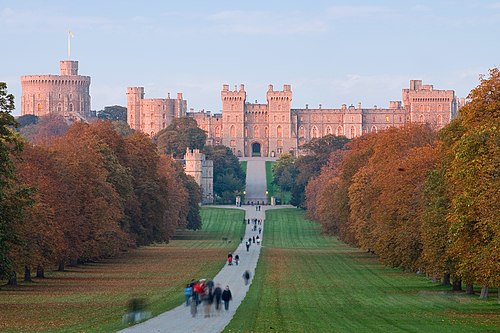 Windsor CastleRestored · prime 1820
 Tower of LondonRestored · prime 1285
 Bamburgh CastleRestored · prime 1904
All castles in England → · Strongest castles in England → · Castles of Europe
Play As Your Clan
Hold a real castle against whatever you choose to send at it, take a ship out in her own service years, or stand at the shoulder of someone the record remembers. The chronicler sets the scene; the deeds are yours.
Notable bearers of the Wood name
- Sir Henry Wood (1869–1944), Proms founder