Hill
On the hill, and the Penny Post and the National Trust.
- Origin
- West Midlands, England
- Famous bearer
- Sir Rowland Hill (1795–1879), postal reformer, founder of the modern penny postal system
- Register
- English family
The Hill arms and country

Coat of armsHill (of Houndston,Dorset) ArmsBorne by the Houndston line, one branch of the name rather than all of it.Public domain 
Coat of armsArms of Hill, Marquess of DownshireBorne by the Marquess of Downshire: the ennobled line of the name, not the name at large.Wikimandia · CC BY-SA 4.0
_Arms.png)

- Coat of arms: Granted to an individual and inherited down that one documented line. These are the arms of particular families of the name, not of everyone who shares the surname.
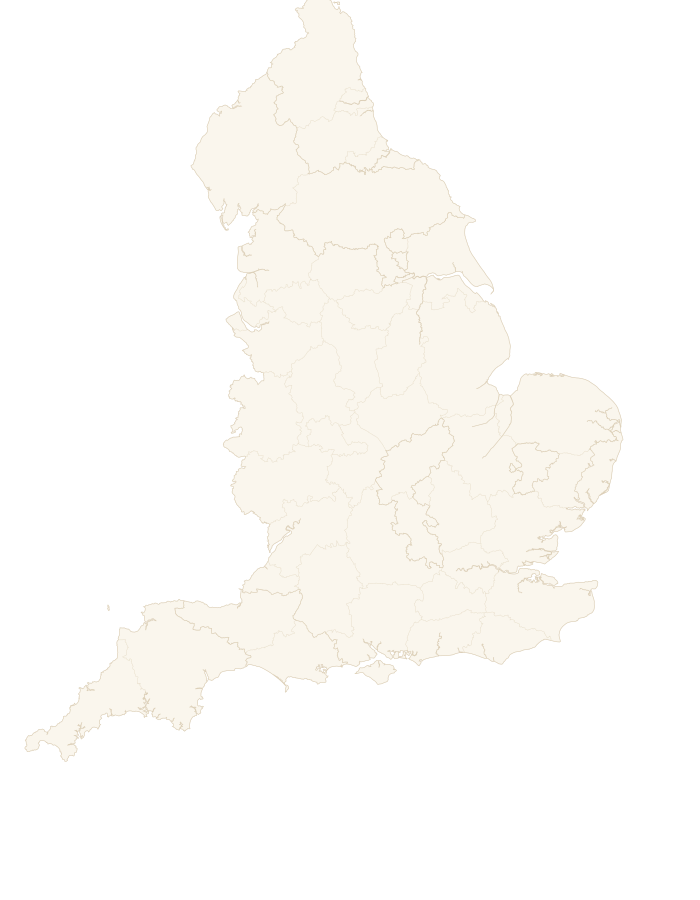
CoreHistoric reach
The seat of Hill
Seat vacantChief
No one leads the Hill community yet. When the movement opens, you can stand for its leadership, or help elect whoever does.
Current mission
No shared goal set yet. Once Hill has leadership, it sets the public focus: a restoration, a gathering, a real-world project that helps its own.
The Hill clan is being rebuilt. Join the waiting list for the movement today, and you help decide who leads it and what it does.
Help rebuild the Hill clan →What does the Hill name mean?
Locative, Old English hyll.
The history of Hill
Hyll: a surname taken straight off the ground
Hill is a locative name, from Old English hyll, and it means exactly what it says: a person who lived on a hill. The onomastician Richard Coates, setting out the classes of British surname, put it in the same bracket as Green ("names can be linked to a place, for example, Hill or Green, which relates to a village green") as against the occupational Smith and Baker or the patronymic Jackson and Jenkinson. Because a rise is a feature of almost every parish, the name has no founder and no single home. It stands 36th most common in England, 18th in Scotland and 37th in the United States, and the catalogue's own tiles for the name run from Cornwall, Devon and Somerset through Shropshire and the Black Country to Lincolnshire, the City of York and the East Riding, without a heartland anywhere in that spread.
The dating matters more than the etymology. In England the introduction of family names is generally attributed to the preparation of the Domesday Book in 1086, after the Norman Conquest, and the evidence indicates that surnames were adopted first among the feudal nobility and gentry and spread slowly downward through society. Christopher Daniell puts the first recorded use of a modern surname inherited by multiple generations at 1140. By 1400 most English families, and those of Lowland Scotland, had taken hereditary surnames, and the Hill record in the sources begins almost exactly there, with John Hill, a Member of the Parliament of England, dead in 1408.
The Conquest is what fixed the raw material. The Domesday survey of 1086 catalogued the landholdings of the kingdom shire by shire, and it documents an expropriation so complete that only about five per cent of land in England south of the Tees remained in English hands, and the language of official documents shifted from Old English to Latin. A clerk writing a tenant's name from the hill he lived on was therefore recording an English word about English ground inside a French-speaking, Latin-writing administration. The landlords changed. The ground did not, and neither did the word for it.
Bishop, judge and natural philosopher: the name from 1401 to 1729
The first Hills to hold serious office appear as the surname settles. Richard Hill (1401–1496) was Bishop of London; John Hill, dead in 1408, sat in the Parliament of England; and Nicholas Hill, an Irish Anglican priest recorded in office between 1428 and 1457, puts the name in the Irish church generations before the Ulster estates that would make Hills into marquesses. These are not one family. They are the first evidence that a name coined independently in a dozen shires had begun to be inherited rather than merely described.
The Tudor century produced the most consequential of the early bearers: Rowland Hill (c.1495–1561), Tudor statesman and publisher of the Geneva Bible, the first Hill in the record to put his hand to a book that mattered nationally, and the first of at least six Rowland Hills the surname would carry. Beside him stand Thomas Hill (1528–1574), astrologer, author and translator, remembered chiefly as a writer on gardening; Robert Hill (1550–1623), clergyman; and Nicholas Hill (1570 – c.1610), English natural philosopher, a Hill working at the speculative edge of Elizabethan science.
Through the seventeenth century the name is thick in the law, the pulpit and the counting house. Roger Hill (1605–1667) was a judge and Member of Parliament; Thomas Hill, dead in 1653, was a Puritan divine; Joseph Hill (1625–1707) an academic, nonconformist clergyman and lexicographer; Abraham Hill (1633–1721) a merchant; Roger Hill of Denham (1642–1729) a landowner, courtier and Whig politician. The military line opens with Moyses Hill, an English knight and army officer who died in 1630: the earliest soldier of the name in the record, and a full century ahead of the officers who made the name famous in uniform.
Hillsborough, and the Hills who became Marquesses of Downshire
The grandest house the surname ever held is not a castle at all. Hillsborough, in County Down, is a Georgian country house built in the eighteenth century for the Hill family, Marquesses of Downshire, and it stayed in Hill hands until 1922, when the 7th Marquess sold it to the British government. Hillsborough was bought, and bought because the new state had a problem the Hills happened to be able to solve.
With the old viceregal seat in Dublin no longer usable, the new region of Northern Ireland needed an official residence, and the Hill house supplied it. It became the seat of the Governor and then of the Secretary of State, and the monarch's official home in Northern Ireland; since 2014 Historic Royal Palaces has opened it to the public. The result is that a family house named for the family (Hillsborough, the borough of the Hills) remains a working seat of state a century after the family left it, which is a longer afterlife than most surviving dynasties manage.
The Downshire Hills themselves surface in the record mostly through their daughters. Lady Charlotte Hill (1794–1821) was a daughter of Arthur Hill, 2nd Marquess of Downshire; Lady Charlotte Augusta Hill (1815–1861), daughter of the 3rd Marquess, married Sir George Chetwynd, 3rd Baronet. Those two are the only bearers the record ties to the marquessate by name. Around them stand titled Hills the sources do not connect to it: Lord George Hill (1801–1879), a British Army officer and MP; Lord Arthur Hill (1846–1931), an Anglo-Irish soldier and Conservative politician; Lady Arthur Hill (1848–1944), an English composer; and Arthur Hill (1873–1913), a British soldier and Unionist politician, dead at forty. Ireland kept other Hills again: the architects William Hill (1798–1844), Henry Hill (1806–1887) and Arthur Hill (1846–1921), and the painter Nathaniel Hill (1861–1930).
Rowland after Rowland: the soldiers and the Viscounts Hill
The eighteenth century put the name into Parliament and into uniform. Thomas Hill (1693–1782) sat as Member for Shrewsbury; John Hill, a British Army officer, died in 1735; and the best-known soldier the name ever carried was Rowland Hill, 1st Viscount Hill (1772–1842), British Army officer and politician. Nothing in the record links those three to one another. What the record does carry is a run of Hills through the officer lists of the generations either side: Robert Chambre Hill (1778–1860), a British Army cavalry officer, Thomas Noel Hill (1784–1832), a British Army officer, and John Thomas Hill (1811–1902), a British Army general.
The viscountcy then did what English titles do to a surname: it froze a forename. Rowland Hill, 2nd Viscount Hill (1800–1875) was a British politician; the 3rd Viscount, Rowland Clegg-Hill (1833–1895), was a Conservative politician whose doubled surname is a textbook case of the English habit of adding another family's name as a condition of inheritance. Compound surnames of exactly this kind (Hepburne-Scott, Vane-Tempest-Stewart) are how landed English families absorbed an estate without losing the name attached to it, and Clegg-Hill is the Hills' entry in that ledger.
The forename spread far beyond the peerage. Rowland Hill (1744–1833) was an English preacher and an advocate of vaccination; Rowland Hill (1795–1879) devised the British postal system; Rowley Hill (1836–1887) was Anglican bishop of Sodor and Man; George Rowland Hill (1855–1928) was an English football official. The surnames of important families being used as given names is a distinctive feature of English naming, usually to signal political support or patronage, and the Hills ran the trick in reverse: a Christian name so bound to the surname that Rowland Hill is less a person than a recurring office.
Thirty-six pages that rebuilt the post
Rowland Hill was born at Blackwell Street, Kidderminster, Worcestershire, on 3 December 1795, third son of Thomas Wright Hill, a schoolmaster of the Birmingham and Kidderminster Unitarian schools, and Sarah Lea of Wolverhampton. He taught in his father's Hill Top School at Birmingham from his twelfth year as a junior pupil-teacher, and from 1819 to 1833 ran the family's enlarged Hazelwood School at Edgbaston, known across the Whig and Radical world for its constitution of pupil self-government and its abolition of corporal punishment. In 1833 he left teaching for the secretaryship of the South Australian Colonization Commission, the body planning the colony of South Australia under Edward Gibbon Wakefield's systematic colonisation theory, and held it until 1839 in parallel with the postal work.
The Post Office he attacked was a public scandal. Postage was charged by distance and by the number of sheets, was paid on delivery by the recipient, and ran to one shilling and threepence, roughly a day's wages for a labourer, for a single sheet from London to Edinburgh. Regular correspondence was therefore confined to the well-off and to the parliamentary franking class, and Treasury returns showed Post Office revenue falling year on year through the 1820s and 1830s as smuggled letters and informal hand-carrying displaced the official mails.
In January 1837, in his forty-second year, Hill published Post Office Reform: Its Importance and Practicability, thirty-six pages containing three propositions. Make the rate uniform across the country regardless of distance. Make it very low: a penny per half-ounce. And make the sender prepay, by an adhesive label or a stamped envelope. He showed by detailed Treasury arithmetic that the volume gained at the lower rate would more than cover the loss per letter, and that prepayment by the sender would kill the cost of collection that was eating a quarter of the Post Office's running cost.
Melbourne's Whig ministry carried it over the Postmaster-General and the Tory peers as the Penny Postage Act of August 1839, and the Uniform Penny Post began across the United Kingdom on 10 January 1840. The Penny Black, bearing the head of Queen Victoria, was issued on 6 May 1840, the first prepaid adhesive postage label in the history of any postal system, and now the most-collected stamp in philately and the holder of the record auction price for a single stamp. Volume went from seventy-six million letters in 1839 to a hundred and seventy million in 1840 and three hundred and forty-seven million by 1850; revenue had fully recovered by 1855. Hill was Secretary to the Postmaster-General from 1846 to 1854 and Secretary to the Post Office from 1854 to 1864, was knighted KCB in 1860, died at Hampstead on 27 August 1879, and was buried in Westminster Abbey beside George Stephenson. His statue stands in King Edward Street outside the General Post Office at St Martin's-le-Grand. The Universal Postal Union codified his architecture as the international standard in 1874; every prepaid stamp in every country descends from those thirty-six pages.
Hazelwood: the Birmingham schoolroom that turned out reformers
The penny post did not come from nowhere. It came out of a Unitarian schoolmaster's household in Birmingham, and the same household produced a run of reformers across a single generation. Thomas Wright Hill (1763–1851) was an English mathematician and schoolmaster, and his school was the family's workshop: in 1822 his sons published Plans for the Government and Liberal Instruction of Boys in Large Numbers Drawn from Experience, the central English text of progressive school reform in the early nineteenth century, and the argument that a school could be run by its own pupils without the rod.
The sources name Rowland's brothers only as a group, and never say which of the reforming Hills of the period were among them. What they do record is a cluster of the surname doing that exact work in those exact decades. Matthew Davenport Hill (1792–1872) was an English lawyer, prison reform campaigner and MP. Edwin Hill (1793–1876) was an English postal official and inventor, an engineer inside the machine Rowland had redesigned from the outside. Rosamond Davenport Hill (1825–1902) was a British educational administrator and prison reformer, and George Birkbeck Hill (1835–1903) a British writer.
That is an unusual concentration for one surname in one century: a school, a postal system, a prison-reform campaign and an educational administration, all under the same six letters. It is also the reason the name reads institutionally in the nineteenth century. The Hills of Hazelwood were not gentry with an estate to conserve; they were professional reformers who published their methods and let anyone copy them, which is precisely why the penny post could be copied by every postal administration in the world.
Octavia Hill, and the women of the name
Octavia Hill (1838–1912) is the second Hill whose work outlived her by an institution (the National Trust, co-founded in January 1895) and she was not alone of the name in that work. Miranda Hill (1836–1910) was an English social reformer of the same generation, and Alsager Hay Hill (1839–1906) another; Margaret Hill (1885–1970) carried the same label into the following century. Four social reformers of one surname inside eighty years, with nothing in the record connecting them to each other: reform was the name's subject long before it was any one family's.
Other women of the name worked in fields that recorded them badly and kept them anyway. Amelia Robertson Hill (1821–1904) was a Scottish artist and sculptor; Georgiana Hill (1825–1903) an English cookery writer, and a second Georgiana Hill (1858–1924) a British historian and women's rights activist. Jenny Hill (1848–1896) was an English music hall performer, working the halls in the same decades Octavia Hill was working the courts and tenements of the reforming societies.
The twentieth century widened the list without changing its character. Elizabeth Hill (1900–1996) was a British linguist; Rosalind Hill (1908–1997) an English historian; Lady Anne Hill (1911–2006) a British bookseller and writer; Felicity Hill (1915–2019) British military personnel; Rose Hill (1914–2003) an English actress and operatic soprano; Bronwyn Hill (born 1960) a British civil servant. None of them founded a Trust. Between them they map the century's professions almost exactly as they opened to women.
Scots Hills: the pulpit, the surgery and the camera
Hill is the 18th most common surname in Scotland, and the Scottish bearers cluster in the manse and the medical school rather than on any estate. James Hill (1703–1776) was a Scottish surgeon; George Hill (1750–1819), Alexander Hill (1785–1867) and John Hill (1747–1805), the last a classicist as well, were Scottish ministers, all three born inside forty years of each other. James Peter Hill (1873–1954) was a Scottish embryologist and Ian Hill (1904–1982) a Scottish physician.
The best-known Scottish bearer worked with a lens. David Octavius Hill (1802–1870) was a painter, photographer and arts activist, working at the moment photography stopped being a curiosity, and Amelia Robertson Hill (1821–1904) was a Scottish artist and sculptor of the same generation. Henry Erskine Hill (1864–1939) was a Scottish priest and author. The name runs through the Scottish football record too, from Bob Hill (1867–1938) to Frank Hill (1906–1993), a player and manager, and on to Ally Hill (1934–2018).
Wales holds the name too, and holds it mostly in sport and song: Frank Hill (1866–1927) played rugby union for Wales, Eustace Hill (1869–1933) and Vernon Hill (1871–1932) were Welsh cricketers, Charlie Hill (1918–1998) and Freddie Hill (born 1914) Welsh footballers, and Greg Hill (born 1949) is a Welsh editor and poet. Mark Hill (born 1972) is a Welsh musician, songwriter and record producer. A name meaning what Hill means was never going to stay on one side of Offa's Dyke.
The name abroad, and the name in the modern record
Hills crossed the Atlantic early. Edward Hill, dead about 1662, was a Virginia planter, soldier and politician, and Edward Hill Jr. (1637–1700) followed him as a planter and local official; Richard Hill (1652–1729) was a judge in Pennsylvania. The southern hemisphere took its share in the next century: John Hill (c.1810–1860) explored South Australia, Walter Hill (1819–1904) worked there as a botanist and garden curator, Alfred Hill (1869–1960) composed and conducted, Lionel Hill (1881–1963) went into Australian politics, and Clem Hill (1877–1945) played cricket for the country. Emily Hill (1847–1930) was a New Zealand politician and suffragist, Philip Carteret Hill (1821–1894) Premier of Nova Scotia from 1875 to 1878, and Joshua Hill (1773–1844) contrived to make himself leader of Pitcairn Island.
The laboratory took the name further than the estate ever did. Archibald Hill (1886–1977) and Leonard Hill (1866–1952) were British physiologists; Austin Bradford Hill (1897–1991) an English epidemiologist and statistician; Robin Hill (1899–1991) a British plant biochemist; David Keynes Hill (1915–2002) a British biophysicist. Micaiah John Muller Hill (1856–1929) and Rodney Hill (1921–2011) were mathematicians, Bill Hill (1940–2021) a geneticist and statistician, Allen Hill (1937–2021) a British chemist, and Adrian V. S. Hill (born 1958) an Irish vaccinologist.
Two Hills hold the Victoria Cross: Alan Richard Hill (1859–1944) and Albert Hill (1895–1971); and one, William Ebsworth Hill (1817–1895), made violins in London that still carry the name on their labels. On the other side of the law sat Billy Hill (1911–1984), an English criminal, and Maggie Hill (1898–1949), a British mobster. Albert Hill (1889–1969) ran for Britain, Ron Hill (1938–2021) ran long distance for it, Richard Hill (born 1973) played rugby union for England and the British Lions, and three British racing drivers of the name (Graham Hill (1929–1975), Damon Hill (born 1960) and Josh Hill (born 1991)) span three generations of the sport.
On stage and page the surname is everywhere at once: Benny Hill (1924–1992) and Harry Hill (born 1964) in comedy, Bernard Hill (1944–2024) and Conleth Hill (born 1964) acting, Geoffrey Hill (1932–2016) writing poetry, Reginald Hill (1936–2012) crime novels and Eric Hill (1927–2014) children's books, Christopher Hill (1912–2003) writing the history of the century that made most of the rest of this record possible. There is no clan seat to visit and no chief to petition. There is a Georgian house in County Down that still flies a standard, a school in Edgbaston that abolished the cane, and a penny stamp that changed how the world writes to itself.
Champions of the Hill name
The bearers whose lives are inseparable from this surname. Each has their own page, biography, achievements, geography, connection to the family.
Castles the Hill held
Strongholds this name held for a decade or more, look one up, or rebuild it to explore.
- Hillsborough Castle
Built in the 18th century for the Hill family, Marquesses of Downshire, who held it until 1922.
Castles that share the Hill name
The same name on the map, look one up, see what it looked like in its prime, and recreate it to explore.
 Baile HillPartial ruin · prime 1068
 Castle HillRuin · prime 1300
 Watch Hill CastlePartial ruin · prime 1175
All castles in England → · Strongest castles in England → · Castles of Europe
Play As Your Clan
Hold a real castle against whatever you choose to send at it, take a ship out in her own service years, or stand at the shoulder of someone the record remembers. The chronicler sets the scene; the deeds are yours.
Notable bearers of the Hill name
- Sir Rowland Hill (1795–1879), postal reformer, founder of the modern penny postal system
- Octavia Hill (1838–1912), housing reformer, co-founder of the National Trust
Stories of Hill
Rowland Hill and the Penny Post
1840On the morning of the sixth of May 1840, at the front counter of the General Post Office in St Martin's-le-Grand in central London, the postal clerk at the head of the queue sold to a Mr James Chalmers the first sheet of the Penny Black, the world's first prepaid adhesive postage stamp, designed by Sir Rowland Hill, the principal architect of the Postal Reform Act of August 1839. The stamp, a black engraving of Queen Victoria's profile by William Wyon, cost one penny and could be used to send any letter under half an ounce to anywhere in the United Kingdom. Until that morning, the British postal system had charged the recipient on delivery at a graduated rate by distance and weight that placed a one-page letter from London to Edinburgh at one shilling and three pence (about half a day's labourer's wages in 1839). The reform collapsed the cost to one penny flat-rate, prepaid by the sender. The volume of British post almost doubled within the first year, quadrupled within seven, and increased thirtyfold by 1900. The Penny Post is, by every careful judgment of the historians of communication, the foundational modern mass-communication reform of the nineteenth century and the template for every later postal system in the world. Rowland Hill was knighted in 1860 and given a Parliamentary grant of £20,000 at his retirement in 1864.
Read the story →
Octavia Hill founds the National Trust
1895On the afternoon of the twelfth of January 1895, in the upstairs drawing-room of the Westminster town house of the Duke of Westminster (Grosvenor House on Park Lane), Octavia Hill, the fifty-six-year-old Wisbech-born housing-and-open-spaces reformer, together with the Reverend Hardwicke Rawnsley (the Lake-District canon and campaigner against Lakeland railway development) and the solicitor Sir Robert Hunter (the senior counsel of the Commons Preservation Society since 1865), formally constituted the National Trust for Places of Historic Interest or Natural Beauty as a registered company under the Companies Act. The Trust's founding purpose, by the first paragraph of its Memorandum of Association, was to promote the permanent preservation, for the benefit of the nation, of lands and tenements (including buildings) of beauty or historic interest. The first acquisition of the Trust, in March 1895, was a small piece of clifftop land at Dinas Oleu above Barmouth in Merionethshire, given by the donor Mrs Fanny Talbot for the public use. By 2025 the Trust owns, by the register, about 1.5% of the total land area of England, Wales and Northern Ireland (about 250,000 hectares), over 500 historic houses, a quarter of the Lake District, 780 miles of coastline, and has, by its membership register, the largest single voluntary conservation membership of any organisation in the world.
Read the story →