Clan Rising
Castle Hill today

England · Ruin

Castle Hill

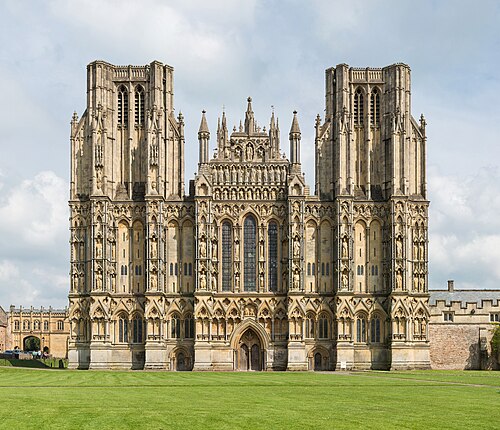
Castle Hill (Mere Castle) was a mid-13th-century stone fortification erected by Richard, Earl of Cornwall, on a flattened chalk ridge above the town of Mere in Wiltshire. Originally it had a rectangular plan with six towers, inner buildings, gates, a hall, chapel and a deep well; it was abandoned in the 14th century and later stripped of its stone. Only earthworks and a few traces remain today; the site is a scheduled monument owned by the Duchy of Cornwall.

Photograph via Wikimedia Commons

Its prime

1300

Today

Ruin

As it stood in 1300

What Castle Hill looked like in its prime.

Perched on a flattened, scarped chalk ridge, the castle was a rectangular stone-built stronghold with a continuous curtain wall punctuated by six towers. The west side was protected by a roughly five-metre-deep ditch cut into the slope and the main approaches ran up the south side. Within the walls were clustered inner buildings including a great hall, a chapel and service ranges arranged around an inner courtyard, and a deep well served the site.

Its story

The story of Castle Hill.

Castle Hill, also called Mere Castle, was built in 1253 by Richard, Earl of Cornwall, who had acquired the manor of Mere ten years earlier. Set on a flattened chalk ridge above the Wiltshire town, it was a stone castle of rectangular plan with six towers, inner buildings, gates, a hall, a chapel and a deep well.

Edward II gave the castle to his royal favourite Piers Gaveston, whom he made Earl of Cornwall. After Edward's fall from power in 1327, John, his second son, took possession as the new Earl of Cornwall. The castle was abandoned in the 14th century and stripped of its stone and metalwork.

Only earthworks and a few traces remain. The site is a scheduled monument owned by the Duchy of Cornwall and leased to the local parish council, and a ceremony is still held on the castle site each Easter.

Step inside

9 places to explore in 1300.

The record describes 9 distinct spots at Castle Hill, including 5 interiors: inner gate and entrance passage (interior threshold), inner bailey / central courtyard (interior), great hall (interior) and more. Create your own photoreal reconstruction and explore every one, more scenes means more rooms, more angles, and more of the place to stand in.

West ditch and scarped slope (exterior)South-side approach road (exterior)Outer gate / gatehouse (exterior/interior threshold)Inner gate and entrance passage (interior threshold)Inner bailey / central courtyard (interior)Great hall (interior)Chapel (interior)Well and service yard (interior/exterior)Curtain wall and one of six towers (exterior)

Build Your Own Castle

Recreate Castle Hill with AI to explore it.

The artist rebuilds it as it stood in 1300, a photoreal reconstruction that belongs to you alone. Pay with coins, no subscription needed.

Recreate this castle →Defend this castle →

From the archive

Castle Hill on paper: the measured plan and period views.

The survey plan and photographs below are the ground truth this page's reconstructions are checked against, drawn and photographed while the castle was still a working garrison. Every image is public-domain or openly licensed, with its source named.
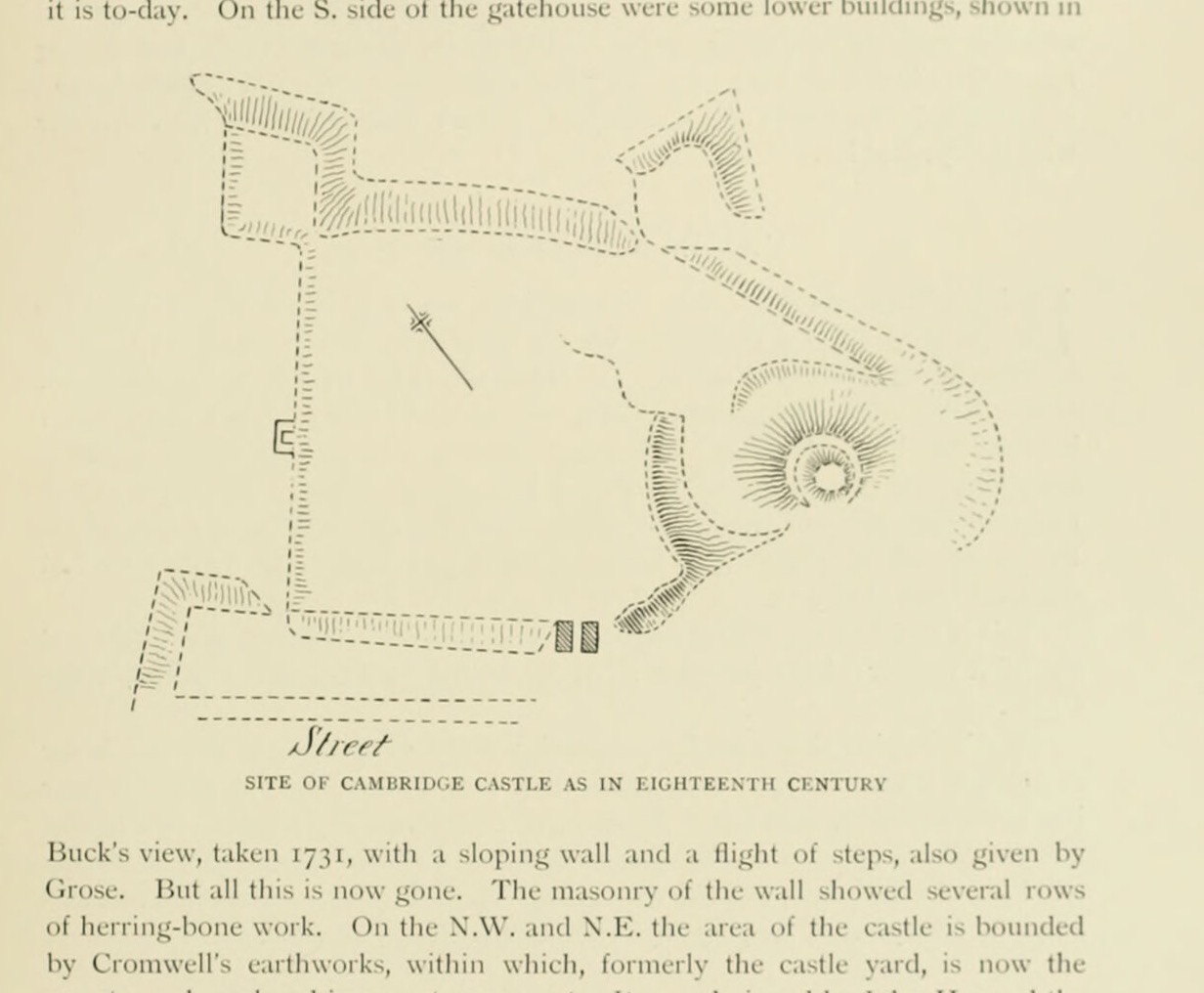
SITE OF CAMBRIDGE CASTLE AS IN EIGHTEENTH CENTURY, Castle Hill

SITE OF CAMBRIDGE CASTLE AS IN EIGHTEENTH CENTURY

1897 · J. D. Mackenzie, The Castles of England, vol. 1 (1897)

Public domain

Questions about Castle Hill

What is the history of Castle Hill?

Castle Hill was built in the 13th century as a stone fortification by Richard, Earl of Cornwall. Edward II later gave it to Piers Gaveston, and after Gaveston and Edward fell from power in 1327, John, Edward’s second son, took possession. The castle was abandoned in the 14th century and stripped of its stone and metalwork.

What is inside Castle Hill / what can you see in it?

Inside Castle Hill were an inner courtyard, a great hall, a chapel, service ranges and a deep well. The castle also had inner and outer gates, with an entrance passage leading into the complex. These spaces survive mainly as earthworks and traces rather than complete rooms.

Who owns Castle Hill now?

Castle Hill is owned by the Duchy of Cornwall. It is leased to the local parish council, and the site is protected under law as a scheduled monument. The ownership and lease are current descriptions of the site’s present arrangement.

Why was Castle Hill built, and what was it used for?

Castle Hill was built as a stone castle and fortification overlooking Mere. Its rectangular stronghold, towers, gates, hall, chapel and well provided a defended site with buildings for living and service. It was later abandoned in the 14th century, after which its stone and metalwork were removed.

Where is Castle Hill?

Castle Hill is on a flattened chalk ridge above the town of Mere in Wiltshire, England. The hill overlooks the town, with a ditch cut into its west side and approaches running up the south side. Mere is the nearest named settlement in the supplied description.

When was Castle Hill built?

Castle Hill was built in 1253, in the 13th century. Richard, Earl of Cornwall, began building the castle after acquiring the manor of Mere in 1243. The castle was renovated in 1300, possibly in response to the threat of rebellion in England.

What did Castle Hill look like in its prime?

In its prime, Castle Hill was a rectangular stone-built stronghold on a flattened, scarped chalk ridge. A continuous curtain wall had six towers, while a roughly five-metre-deep ditch protected the west side. Inside were a courtyard, great hall, chapel, service ranges, gates and a deep well.

Is Castle Hill still standing / is it a ruin?

Castle Hill is a ruin today, with only earthworks and a few traces remaining. The castle was abandoned in the 14th century and later stripped of its stone and metalwork. By 1660, visitors’ accounts implied that the stonework had all been dismantled.
All castles of England · Castles of Europe · the best castles in Europe · explore the finished reconstructions.