Wright
The maker, every guild town shaped one.
- Origin
- West Midlands, England
- Famous bearer
- Joseph Wright of Derby (1734–1797), painter
- Register
- English family
The Wright arms and country

Coat of armsArms of the Wright family of Kelvedon Hall in EssexBorne by the Kelvedon Hall line, one branch of the name rather than all of it.CC BY-SA 3.0

- Coat of arms: Granted to an individual and inherited down that one documented line. These are the arms of particular families of the name, not of everyone who shares the surname.
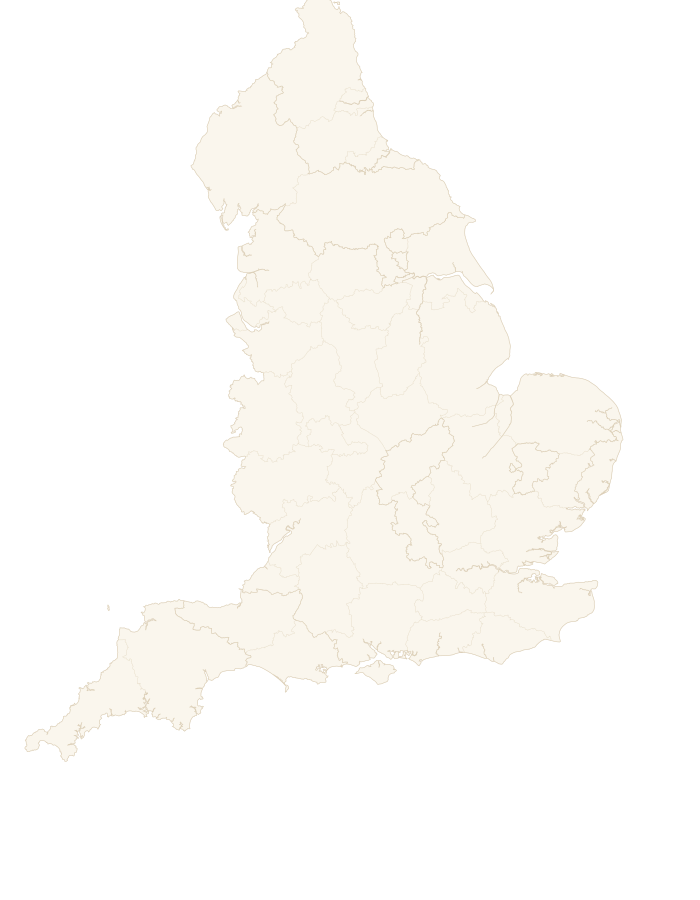
CoreHistoric reach
The seat of Wright
Seat vacantChief
No one leads the Wright community yet. When the movement opens, you can stand for its leadership, or help elect whoever does.
Current mission
No shared goal set yet. Once Wright has leadership, it sets the public focus: a restoration, a gathering, a real-world project that helps its own.
The Wright clan is being rebuilt. Join the waiting list for the movement today, and you help decide who leads it and what it does.
Help rebuild the Wright clan →What does the Wright name mean?
Old English wyrhta, worker, maker, specialised early to the carpenter-wright. Northern Middle English yields Wright where the south often froze Carpenter for the same trade.
The history of Wright
The word that meant maker before it meant a man
Wright comes from the Old English wryhta, in use by about 700, meaning a worker or shaper of wood and cognate with the word work itself. In northern Middle English and in Scots it was simply the word for a builder, taking a qualifier only when the timber was specialised: wheelwright, shipwright, boatwright, arkwright.
The rival word came with the Normans. Carpentier, from the Latin carpentarius, a maker of a carriage, arrived after 1066 with the Anglo-Norman of the new ruling class, and where it won, the surname Carpenter froze in place instead. The north and the midlands kept wright, hereditary there by 1300, and in Scotland the word never retreated at all: it is still current Scottish English for a skilled woodworker. By 2014 Wright was the eleventh most common surname in England. It is also the standard anglicisation of the Gaelic Mac an t-Saoir, MacIntyre, son of the wright.
What a wright actually built
The joints a medieval wright cut were ancient before England had a name: archaeologists have recovered a well in eastern Germany built some seven thousand years ago from split oak timbers with mortise-and-tenon joints and notched corners. Almost none of it was written down; it went hand to hand down the generations, and what survives is the work, in the eleventh-century fabric of Greensted church and the Norwegian stave churches of the twelfth and thirteenth.
Until the end of the nineteenth century a wright framed a building post and beam, the method now called timber framing. He was first onto the site and last off it: nothing began until the frame, the roof and the floors stood, and the doors, skirtings and window architraves went in after the plasterers.
The wheel, and the arithmetic inside it
The specialism the name most often marked was the wheelwright, and it is harder than it looks. A solid wheel cut from tree slabs needs little skill; a spoked wheel is lighter, can be built wider than the local trees allow, and demands precise spacing and careful calculation to come out a true circle. Districts with no wheelwright in reach kept making solid wheels long after.
The wheelwright worked outward from the centre: the nave, then the spokes tenoned into it, then the felloes that make up the rim. Elm for the nave, whose interwoven grain will not split when the spokes are driven home tight; oak for the spokes, because it does not bend or compress and carries load straight from rim to hub; ash for the felloes, springy enough to take the road like a suspension. Last came the tyre. A blacksmith made an iron tyre a little smaller than the wheel and heated it until it expanded, and it was hauled on with a levered hook and quenched, shrinking hard onto the rim and closing every joint at once.
One word, a dozen surnames
Wright stayed a live occupational title until the middle of the nineteenth century, surviving mostly in compounds: wheelwright, wainwright for the man who built wains, shipwright, boatwright, arkwright, housewright, barnwright, and playwright, the only one still in daily English. Several hardened into surnames of their own, which is why Cartwright and Wainwright stand in the registers beside the plain Wright.
A shipwright built and repaired vessels afloat, and one rated to a ship's company as the ship's carpenter walked the carpenter's walk inside the hull at sea, looking for leaks. Housewright and barnwright were used the same way ashore, and are still heard among carpenters who work by traditional methods and materials. The plain Wright, with no qualifier, kept the wider sense: the word came to cover any occupational worker before it settled as a name.
Apprentice, journeyman, master, and the bodies that kept the word
Nobody became a wright by saying so. The trade ran on grades: apprentice, then journeyman on completing the term, then master after further years of proof. In Germany, Iceland and Japan the master qualification is still an arduous examination in legal and economic knowledge as well as craft, because only a master may employ and teach apprentices. Into the early twentieth century a newly made journeyman travelled to another region to learn its building styles before coming home with them.
In Scotland two burgh incorporations still carry the word in its old sense and still exist to promote the woodworking trade: the Incorporation of Wrights of the Trades House of Glasgow, and the Incorporation of Wrights and Masons of the Edinburgh Trades. In London the Worshipful Company of Wheelwrights still keeps the list of working wheelwrights in England, Wales and Northern Ireland.
How a job description became a name a son could inherit
English surnames began as descriptions, not inheritances, taken from a man's trade or his father, and at first they died with him. The Domesday survey of 1086 is usually taken as the point at which family names entered England, and the historian Christopher Daniell identifies 1140 as perhaps the first recorded use of a surname carried by more than one generation. The habit began with the nobility and worked downward, resisted in late medieval England because registration by name meant taxation. By 1400 most English families and most in Lowland Scotland had hereditary surnames.
The pressure behind that was arithmetic. Of the boys born in London in 1510, 24.4 per cent were christened John, 13.3 per cent Thomas and 11.7 per cent William, so half the men in a street answered to three names between them. The trade tag told them apart, and written down often enough it became a name. That is also why bearers are so often not kin: Wright arose separately wherever a man worked wood, and two Wrights in one county record need not be kin at all.
Joseph Wright of Derby and the candlelit experiment
The name's great figure in art is Joseph Wright of Derby (1734-1797), the foremost painter of the late Enlightenment. He worked in dramatic chiaroscuro, and what he chose to light were the candlelit scenes of the eighteenth-century scientific revolution.
An Experiment on a Bird in the Air Pump, painted in 1768, is the picture the name is remembered by.
The bicycle shop on West Third Street
Wilbur Wright was born at Millville in Indiana on 16 April 1867 and Orville at Dayton in Ohio on 19 August 1871, sons of Bishop Milton Wright of the United Brethren. The paternal line was English-Puritan New England, descending from a Captain Samuel Wright who crossed from England to Massachusetts in the middle of the seventeenth century. Neither finished high school. In 1892 they opened the Wright Cycle Company at 1127 West Third Street in Dayton, building bicycles of their own design, and that shop was their working capital for eighteen years.
In 1899 Wilbur wrote to the Smithsonian Institution for everything published on heavier-than-air flight, and having read it the brothers concluded the accepted lift tables were wrong. So they built a wind tunnel in the back of the shop, six feet long and sixteen inches square, and there through the winter of 1901 to 1902 measured over two hundred wing profiles on instruments of their own design, producing the first reliable lift-and-drag data in aerodynamics. It is the method of the old trade exactly: measure the thing yourself, then cut.
Their 1902 glider, flown at Kill Devil Hills near Kitty Hawk on the Outer Banks of North Carolina, showed three-axis control for the first time; patented in 1906, it is still the control architecture of every fixed-wing aircraft. On the morning of 17 December 1903, with Orville lying flat on the lower wing and a twelve-horsepower petrol engine at full throttle, they made the first powered, controlled, sustained heavier-than-air flight in history: twelve seconds, a hundred and twenty feet, five witnesses on the sand. The fourth flight of that morning, Wilbur at the controls, ran fifty-nine seconds and eight hundred and fifty-two feet.
Champions of the Wright name
The bearers whose lives are inseparable from this surname. Each has their own page, biography, achievements, geography, connection to the family.
The castles of the homeland
The great strongholds of the homeland, look one up, see what it looked like in its prime, and recreate it to explore.
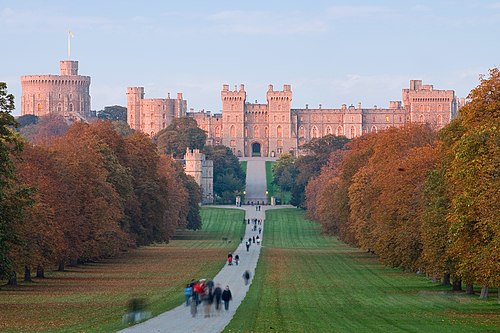 Windsor CastleRestored · prime 1820
 Tower of LondonRestored · prime 1285
 Bamburgh CastleRestored · prime 1904
All castles in England → · Strongest castles in England → · Castles of Europe
Play As Your Clan
Hold a real castle against whatever you choose to send at it, take a ship out in her own service years, or stand at the shoulder of someone the record remembers. The chronicler sets the scene; the deeds are yours.
Notable bearers of the Wright name
- Joseph Wright of Derby (1734–1797), painter
- Wilbur Wright (1867–1912) & Orville Wright (1871–1948), aviation pioneers
Stories of Wright
An Experiment on a Bird in the Air Pump
1768In the spring of 1768, in his studio at 28 Queen Street in Derby, the thirty-three-year-old Joseph Wright completed the oil painting An Experiment on a Bird in the Air Pump (oil on canvas, 183 × 244 cm). The painting shows a itinerant natural-philosopher demonstrating a vacuum experiment to a domestic audience of about seven adults and three children in the late-evening lamp-light of a provincial English house. The vacuum experiment in progress is the air-pump-with-a-glass-globe-and-a-cockatoo, in which the natural-philosopher slowly evacuates the air from the globe and the cockatoo in the globe begins to suffocate; the natural-philosopher can, by re-opening the tap, save the bird. The question of the painting is the moment of the experiment at which the natural-philosopher chooses whether to re-admit the air or to let the cockatoo die for the edification of the audience. The painting is, by every careful judgment of the Enlightenment-art-history (Ronald Paulson, David Solkin, Stephen Daniels), the foundational image of the eighteenth-century English-Enlightenment-encounter-with-experimental-science: the Wright canvas is, in plain reading, the British civilian-domestic version of what Wright had been seeing on his trips to Liverpool and Birmingham among the Lunar Society Enlightenment circle of Erasmus Darwin, Josiah Wedgwood, Matthew Boulton and Joseph Priestley. The painting was bought by Dr Benjamin Bates of Aylesbury in 1768 for £210; it was sold at auction in 1863, bought by the Tate Gallery in 1929, and is, since 1986, in the National Gallery, Trafalgar Square, where it has hung continuously.
Read the story →
The Wright brothers at Kitty Hawk
1903At ten thirty-five in the morning of Thursday the seventeenth of December 1903, on a flat strip of sand at the south end of Kill Devil Hills, a dune-and-grass settlement about four miles south of the fishing-village of Kitty Hawk on the Outer Banks of North Carolina, the American bicycle-mechanics-and-aviation-pioneers Orville and Wilbur Wright (Orville, thirty-two, the younger brother; Wilbur, thirty-six, the elder; both of Welsh-and-English ancestry on the paternal Wright line of the Wilbur-and-Orville great-great-grandfather Captain Daniel Wright the 1657 English-Puritan-emigrant to Massachusetts) made the first powered, controlled, sustained heavier-than-air flight in human history. The flight, in the Wright-Flyer-One (a twelve-horsepower-engine biplane of about six hundred pounds total weight, with a forty-foot wingspan and a pusher-propeller configuration), was made by Orville lying flat across the lower wing, hand on the pitch-control elevator, the engine running at full throttle on the launching-rail. The flight ran twelve seconds, covered about a hundred and twenty feet, reached an altitude of about ten feet, and landed safely in soft sand. Wilbur flew the fourth flight of the morning (the brothers had alternated flights all morning on the pre-arranged turn-and-turn-about) for fifty-nine seconds and eight hundred and fifty feet, the longest of the four December 17 flights. Powered controlled flight had been demonstrated.
Read the story →