White
The fair one.
- Origin
- South West, England
- Famous bearer
- Gilbert White (1720–1793), naturalist, The Natural History of Selborne
- Register
- English family
The White arms and country

Coat of armsEscutcheon of the White baronets of Salle Park (1922)Borne by the Salle Park line, one branch of the name rather than all of it.Charles Matthews · CC BY-SA 4.0 
Coat of armsEscutcheon of the White baronets of Boulge Hall (1937)Borne by the Boulge Hall line, one branch of the name rather than all of it.Charles Matthews · CC BY-SA 4.0
.svg)
.svg)
- Coat of arms: Granted to an individual and inherited down that one documented line. These are the arms of particular families of the name, not of everyone who shares the surname.
CoreHistoric reach
The seat of White
Seat vacantChief
No one leads the White community yet. When the movement opens, you can stand for its leadership, or help elect whoever does.
Current mission
No shared goal set yet. Once White has leadership, it sets the public focus: a restoration, a gathering, a real-world project that helps its own.
The White clan is being rebuilt. Join the waiting list for the movement today, and you help decide who leads it and what it does.
Help rebuild the White clan →What does the White name mean?
Descriptive, fair complexion or white hair. Old English hwīt.
The history of White
The third way a surname gets made
Most people know two ways a family name is born: from the work a man did, which is how Europe filled with Smiths and Bakers and Millers, or from his father, which is how it filled with Jacksons and Richardsons. White belongs to a third class, and it is the one explained least often: the byname handed to a man for how he looked. Onomastics calls these cognominal surnames, and they are the broadest group of all, taking in appearance, temperament and habit alike. When a four-year University of the West of England study finished analysing 45,602 surnames in 2016 for the Oxford English Dictionary of Family Names in Britain and Ireland, its leader Richard Coates set the classes out in that order: occupational names like Smith and Baker, place names like Hill or Green, patronymic names enshrining the father's, "and there are also names where the origin describes the original bearer such as Brown, Short, or Thin".
What White described is sitting in the word itself. Old English hwīt, white, applied to a living man for fair hair or a pale complexion. It sounds a slight thing to name a family after until you remember how few given names there were to go round. Of the boys born in London in 1510, 24.4 per cent were called John, 13.3 per cent Thomas and 11.7 per cent William, and across the early modern period the top three male names covered close to half the male population. In a parish where every third man answered to John, the tag that separated one John from the next was the working part of his name, and the neighbours chose it, not him.
Coates added a caution worth carrying: Short may in fact have been an ironic nickname for a tall person. The same trap sits under the surnames that look occupational but are not (King, Bishop, Abbot, Sheriff, Knight) where, as Bernard Deacon suggests, the first bearer probably acted like a king or a bishop, or was as corpulent as one. White is likelier to have meant what it says: a plain, visible, unmalicious thing to call a man, which is exactly why so many parishes reached for it independently.
How one man's nickname froze into a family's name
The earliest English surnames are documented in the 11th century among the barons, and the introduction of family names is generally attributed to the preparation of the Domesday Book in 1086, in the wake of the Norman Conquest. They started at the top, adopted first among the feudal nobility and gentry and spreading slowly down. Christopher Daniell puts the first recorded use of a surname inherited by multiple generations at 1140, and even that one is irregular, the sons of a Frenchman named Robert taking the name FitzGerald in honour of an earlier relative called Gerald rather than after their own father.
For a long stretch after that, a byname like White was a description rather than an inheritance: English surnames were formed with reference to some aspect of the individual (trade, father, birthplace, physical features) and were not necessarily passed on. The freezing came later and unevenly. By 1400 most English families, and those of Lowland Scotland, had adopted hereditary surnames; Wales only followed after unification under Henry VIII in 1536. It was not welcomed. Mandatory surnames were resisted in late medieval England, because being permanently named was associated with being permanently taxed.
That is the moment the name stops being about hair. Once White was heritable, the grandsons of the fair man were Whites whatever colour they were, and Henry VIII, who reigned from 1509 to 1547, ordered that marital births be recorded under the father's surname, making the arrangement a matter of record rather than custom. Every White alive today descends from a particular man in a particular parish who was pointed out for his fair head, and from the clerk who wrote it down one time too many for it ever to come off.
Hwīt, hvítr, blanc: why every European language has its Whites
The word is deep Germanic. Old English hwīt continues the reconstructed Proto-Germanic hwitaz, which also gave Old High German (h)wîz, Old Norse hvítr and Gothic hweits; modern Icelandic hvítur comes straight off the Old Norse form. Behind them all stands the Proto-Indo-European root kwid-, surviving as far east as Sanskrit śveta, to be white or bright, and Slavonic světŭ, light.
The Romance half of Europe took a different Germanic word for the same idea. Proto-Germanic also had blankaz, white, bright, blinding, which was borrowed into Late Latin as blancus and became French and Catalan and Occitan blanc, Spanish blanco, Italian bianco, Galician-Portuguese branco. So the Blancs of France, the Blancos of Spain and the Biancos of Italy are not a separate notion from the Whites of England. They are the same Germanic root that went south with the migrations and came back as a Latin-looking word.
That is why the colour bynames cluster the way they do across the continent, all at once and in every language. White stands beside Brown and Black in English; Spanish did the same job with Moreno, dark, and Delgado, thin; German has Schwartzkopf. No fashion spread this. It is what happens everywhere the moment a community needs to tell one John, one Juan and one Johann apart, and reaches for the first thing the eye lands on.
Hastings, and the White who was written le Blanc
One of the most obvious effects of the Norman Conquest was the arrival of Anglo-Norman, a northern dialect of Old French with limited Nordic influence, as the language of the ruling class, displacing Old English at the top of society. An estimated 8,000 Normans and other continentals settled in England. French given names (William, Robert, Richard) became common quickly, and the men who kept the written record, the ones whose spellings eventually hardened into surnames, worked in Norman French rather than in the English their subjects spoke.
So an English byname met a French pen. The name crossed with the French Le Blanc in the Channel ports under exactly that pressure of orthography: a man known to his village as the white one might be entered as le Blanc by one clerk and as White by another, and which version hardened into the family surname was often no more than which clerk held the roll. That is worth knowing if your line came out of Kent, Sussex or Hampshire, where the two languages were in daily contact along the coast.
de Faoite and MacGillebhàin: the Irish and Gaelic Whites
White in Ireland and in Gaelic Scotland is a separate story that arrived at the same spelling. The Scottish and Irish name is an anglicisation: from the Scottish Gaelic MacGillebhàin, son of the fair gillie, and from the Irish Mac Faoitigh or de Faoite. A reader whose Whites came out of Cork or Waterford or the Scottish west is not a branch of the English Whites at all. They are a family whose own Gaelic name was rendered into English by ear and by convenience, and landed on the commonest English word that fitted.
The Irish form carries a second twist. That de is the Norman territorial marker, the of or from that the early Norman nobility affixed before the name of their village or estate in France, producing a whole class of territorial surnames. De Faoite is therefore an Anglo-Norman name that went into Irish, was reshaped by Irish spelling, and came back out into English as White. Two languages and two conquests are folded into five letters.
The Irish Whites also rose. Luttrellstown Castle in Ireland was held by the bookseller Luke White and by his descendants, the Barons Annaly, a family that came into a castle and a peerage from the book trade rather than from the sword, which in Irish landholding of that era is a rarer route than it sounds.
Where the Whites are, and where they went
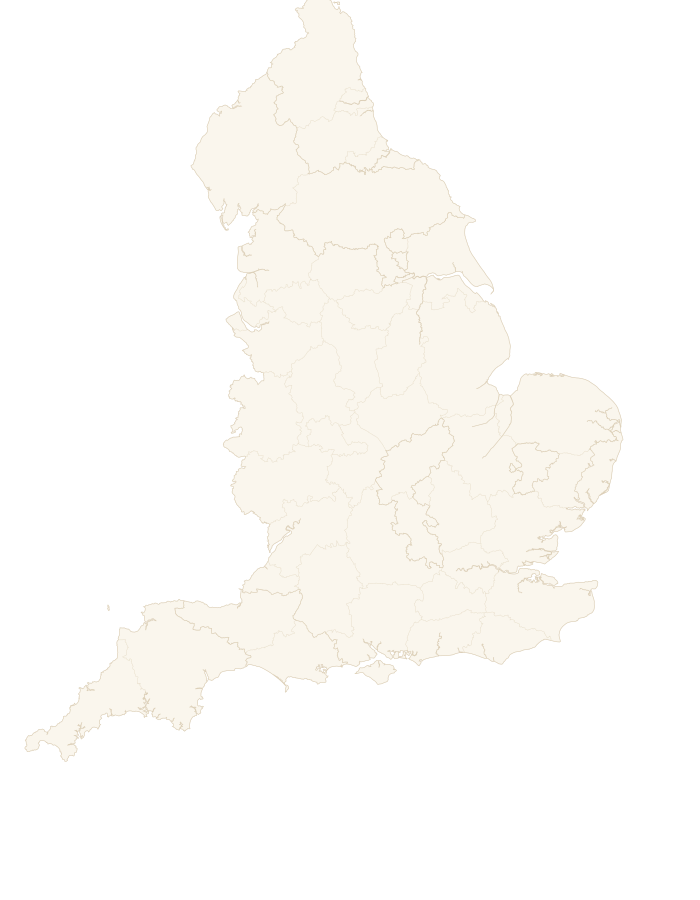
White is the seventeenth most common surname in England. Its heartland is the south and west (Cornwall, Devon, Somerset, Dorset and Wiltshire, Gloucestershire, Hampshire, Berkshire and Oxfordshire) running along the south-east through Kent, Surrey and both Sussexes, and historically thick as well in London, the Black Country, the west Midlands, Lancashire and East Anglia. That spread is the signature of a byname rather than a dynasty: it never radiated from one seat, because it began in hundreds of parishes at once.
The name reached America in the very first English generation. Resolved White sailed on the Mayflower, and Peregrine White, born in 1620 and living until 1704, was the first child born to the Pilgrims in New England. The surname was present at the beginning of English-speaking North America, not carried in on a later wave.
By the time of the 1990 United States census, White ranked fourteenth among all reported surnames, carried by 0.28 per cent of the population. It had slipped to twentieth by 2000 and twenty-second by 2014, not because there are fewer Whites, but because the American surname pool kept widening around them.
Gilbert White and the parish that became a book
The most consequential bearer of the name never left his village. Gilbert White (1720–1793) was curate at Selborne in Hampshire, and for forty years he corresponded with Thomas Pennant and Daines Barrington about what he saw in the fields, hedges and skies of one small parish. Those letters were gathered and published in 1789 as The Natural History and Antiquities of Selborne.
The book founded the English-language tradition of local-place natural history: the idea that a single patch of ground, watched closely for long enough, is a sufficient subject. It is reckoned the fourth most published book in the English language, behind only the Bible, the Book of Common Prayer and Shakespeare. Every nature diary, county flora and back-garden bird list in English descends in some measure from a Hampshire curate who thought his own parish worth the attention.
The name in the wider world
T. H. White (1906–1964) sat down at Doolistown in Ireland in 1939 and wrote The Once and Future King, the book his name is known for. Patrick White (1912–1990) carried the surname into Australian letters as one of that country's leading authors. Ethel Lina White (1876–1944) was a British crime writer and Charlotte Price White (1873–1932) a Welsh suffragist and politician. George White (1835–1912) rose to general in the British Army, and Florence Mildred White (1874–1957) made her career as an English policewoman.
In North America the name runs through public life. Andrew Dickson White (1832–1918) was a diplomat and a co-founder of Cornell University. Stanford White (1853–1906) was an architect and a partner in the New York firm of McKim, Mead and White. E. B. White (1899–1985) wrote children's books read aloud in American households ever since, and Byron White (1917–2002) sat as an Associate Justice of the Supreme Court of the United States.
None of them are relatives of one another in any traceable sense, and that is the point of a name like this. White is not a clan with a chief and a charter chest. It is thousands of separate families whose founding ancestors were each singled out, somewhere in England, Ireland or Gaelic Scotland, for the same plain and visible thing, and who carried that description across the world as a name that had long since stopped describing anything but them.
Champions of the White name
The bearers whose lives are inseparable from this surname. Each has their own page, biography, achievements, geography, connection to the family.
Historic Places, Rebuilt
Explore the streets and seats the White name knew, rebuilt with AI as they stood in history.
Castles the White held
Strongholds this name held for a decade or more, look one up, or rebuild it to explore.
- Luttrellstown Castle
Held by the bookseller Luke White and his descendants, the Barons Annaly.
Castles that share the White name
The same name on the map, look one up, see what it looked like in its prime, and recreate it to explore.

All castles in England → · Strongest castles in England → · Castles of Europe
Play As Your Clan
Hold a real castle against whatever you choose to send at it, take a ship out in her own service years, or stand at the shoulder of someone the record remembers. The chronicler sets the scene; the deeds are yours.
Notable bearers of the White name
- Gilbert White (1720–1793), naturalist, The Natural History of Selborne
- T. H. White (1906–1964), novelist
Stories of White
Gilbert White at Selborne
1789In the autumn of 1789 the London publisher Benjamin White & Son (the family firm of the author's youngest brother) issued The Natural History and Antiquities of Selborne, in the County of Southampton, a quarto of about 470 pages, by the Reverend Gilbert White, sixty-nine years old, curate of the small Hampshire village where he had been born and would die. The book was the edited collection of 110 letters, written over twenty-three years (1767–1788) to the antiquary Daines Barrington and the zoologist Thomas Pennant, on the wildlife, geology, climate and antiquities of a single parish. White had observed Selborne and its three miles of surrounding country every day of his adult life: the swifts under his eaves, the harvest-mice in the corn-stooks, the migration patterns of swallows (a question he settled empirically against the 18th-century belief that swallows hibernated in pond-mud). The book has been continuously in print since 1789, has gone through over three hundred editions, and is, by every careful judgment of natural-history writing, the foundational text of English-language nature writing and the model for every later naturalist's parish-record from Richard Jefferies to Robert Macfarlane.
Read the story →
T. H. White writes The Once and Future King at Doolistown
1939On 1 September 1939, the day Germany invaded Poland, the Anglo-Irish writer Terence Hanbury White, thirty-three years old, declared himself a conscientious objector to the imminent war and left Stowe Ridings in Buckinghamshire (where he had been schoolmastering at Stowe School and writing) for a rented farmhouse outside Doolistown, County Meath, fifteen miles north of Dublin. He stayed at Doolistown for the next seven years through to 1946, taught himself falconry, fishing and hare-coursing on the County Meath country, and wrote across the wartime years the four-volume Arthurian retelling that the post-war publisher Collins would assemble in 1958 as The Once and Future King. The four volumes (The Sword in the Stone 1938, The Witch in the Wood / The Queen of Air and Darkness 1939, The Ill-Made Knight 1940, The Candle in the Wind completed 1941 and held over) became the senior twentieth-century English-language Arthurian retelling, the source-text for Disney's 1963 Sword in the Stone, for the Lerner-and-Loewe 1960 Broadway musical Camelot, and (through the Kennedys' adoption of the closing-line as their post-assassination political icon) the source of the post-1963 American 'Camelot' political-mythology associated with the Kennedy White House.
Read the story →